|
|
|
|
Insights and perspectives on technology, AI, software development, and industry trends from the TrueSolvers team.
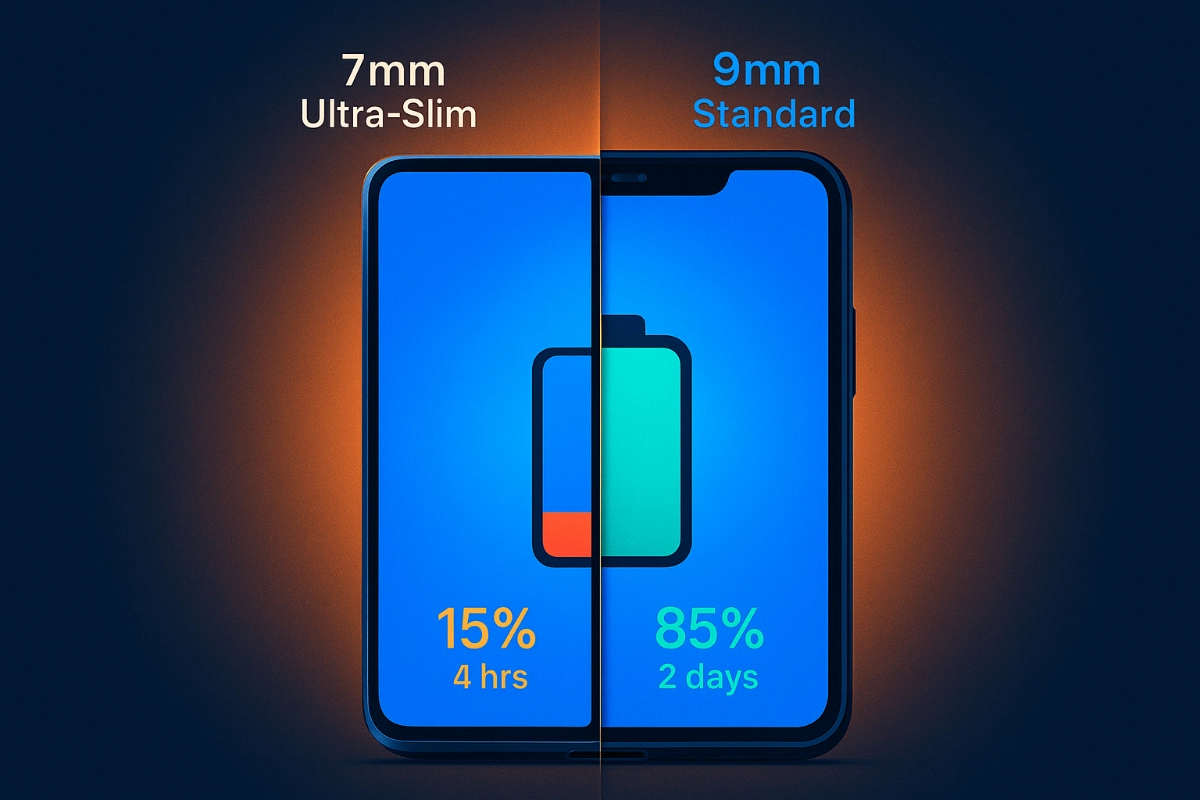
When Apple and Samsung launched their slimmest-ever flagships, marketing focused on elegance and portability. But real-world testing exposes a different story. The iPhone Air packs only a 3,149mAh battery, according to MacRumors. In contrast, the Galaxy S25 Edge manages slightly better at 3,900mAh, GSMArena reports. but still falls short of mainstream standards. For context, the average high-end phone now exceeds 5,000mAh, as seen in both the iPhone 17 Pro Max and Galaxy S25 Ultra.
More importantly, smaller batteries don’t translate to faster charging. Even worse, peak charging speeds never exceed 19 watts due to thermal constraints. Similarly, the S25 Edge charges at just 25 watts maximum, Sammobile confirm, far below the 45-watt capability of its Ultra line.
Through our evaluation of S25 Edge thermal throttling behavior, the ultra-slim chassis prevents adequate heat dissipation during extended use or fast charging, forcing the system to reduce power delivery prematurely. This means slower recharges and reduced performance under load not just occasional inconveniences, but built-in compromises.
Consumers are noticing. Sales data reported that the S25 Edge reached 1.01 million units globally by the end of July, significantly trailing other variants in the same lineup. That premium doesn’t go toward better endurance it funds structural complexity needed to maintain rigidity in such a thin form.
Yet none of this comes as surprise when you consider user priorities. A CNET survey from June 2025 revealed that 52% of smartphone buyers rank battery life as their top concern more than camera quality, display brightness, or AI features combined. Only 11% cited artificial intelligence as a deciding factor. Despite this clear signal, Apple and Samsung positioned their thinnest models as aspirational upgrades rather than practical tools.
It seems counterintuitive: how can phones with 7,000+ mAh batteries charge faster than those with half the capacity? The answer lies in advanced charging architectures and improved thermal management. The OnePlus 15, equipped with a 7,300mAh silicon-carbon infused cell, reaches 50% in just 15 minutes, OnePlus confirms on its official site. Full charge completes in about 40 minutes thanks to 120-watt wired charging support.
Similarly, the OPPO Find X9 Pro, boasting a 7,500mAh battery, supports 80W charging. These times are dramatically faster than the iPhone Air’s 105-minute cycle even though the latter has less than half the energy storage. The reason isn’t magic; it’s engineering freedom. Thicker bodies allow space for larger cooling plates, multi-layer charging circuits, and materials that resist degradation over time.
These benefits enable manufacturers to scale capacity without proportional increases in size or weight penalties. As manufacturers noted in late 2024, adoption of Si/C anodes is rising rapidly among premium Android brands, signaling a shift away from reliance solely on software optimization.
GSMArena’s November 2025 lab tests back this up. Their measurements show the OnePlus 15 maintains stable charging curves throughout the cycle, avoiding the slowdown typically seen in the final 20%. In contrast, thinner phones often cut power delivery early to prevent heat buildup. This difference isn’t minor it translates to real-world gains where every minute counts.
From our assessment of OnePlus 15 charging efficiency data, the combination of high-wattage infrastructure and thermally optimized internals allows consistent power intake, eliminating the “trickle charge” bottleneck common in slim designs. That’s why users spend less time plugged in even with bigger batteries.
Sales numbers speak louder than press releases. Despite aggressive marketing, neither Apple nor Samsung achieved strong uptake for their ultra-slim models. According to sammyguru Research, the S25 Edge underperformed within Samsung’s own portfolio, failing to match the popularity of the thicker, more capable S25 Ultra.
None of this negates the appeal of compact design. But when function loses to form, users vote with their wallets. The message is clear: people want devices that keep up with their lives, not ones that require constant babysitting.
Choosing an ultra-slim phone means accepting tangible sacrifices. Let’s compare actual endurance. Tom's Guide tested the Galaxy S25 Ultra and recorded 17 hours and 15 minutes of continuous web browsing over Wi-Fi. MacRumors measured the iPhone 17 Pro Max at 17 hours and 54 minutes under identical conditions. Both run on ~5,000mAh batteries already above average.
Compare that to the OnePlus 15, which Tom’s Guide logged at 25 hours and 13 minutes of browser runtime.
Weight is another factor. The OnePlus 15 weighs 211 grams; the Find X9 Pro tips the scales at 224 grams. Both are heavier than the iPhone Air (165g) and S25 Edge (~175g). However, many users report the extra heft feels balanced and reassuring like carrying confidence instead of constant low-battery alerts.
Ultimately, the trade-off isn’t just specs versus specs it’s lifestyle compatibility. Do you value disappearing into your pocket more than disappearing from your charger?
If your priority is minimizing interruptions, focus on proven endurance, not promotional slogans. The OnePlus 15 delivers extreme battery life and rapid charging at a competitive price point starting at $899, GSMArena reports. Its 120-watt charging system sets a new benchmark for recovery speed, making it ideal for travelers, field workers, or anyone who can’t schedule downtime.
For those wanting camera excellence alongside stamina, the OPPO Find X9 Pro offers a compelling package. Priced at CNY 5,999 (~$830), it combines the industry’s largest smartphone battery (7,500mAh) with a premium imaging suite co-engineered with Hasselblad. While slightly pricier, its sub-30-minute full charge time makes it more practical than thinner flagships costing over $1,000.
Already, brands like Xiaomi and Realme are experimenting with 6,000mAh cells in sub-$600 handsets. Within two years, expect mainstream six-inch phones to match today’s ultra-flagship endurance.
Until then, your best move is skipping the thinnest models. They may look futuristic in ads, but real-world usability lags behind. Instead, embrace the shift toward functional design where lasting two full days isn’t a bonus, but expected. If you're looking for flagship performance without the premium price tag, the iPhone 17E offers compelling value with its A19 processor at just $599.
Skip ultra-slim phones if you hate midday charging; models like the iPhone Air (3,149mAh) die early despite premium pricing.
Choose high-capacity phones with fast charging: the OnePlus 15 (7,300mAh, 120W) refuels in 40 minutes and lasts two full days.
Prioritize silicon-carbon batteries they offer longer lifespan and better thermal performance than standard lithium-ion.
Avoid phones under 20W charging unless you plan to wait: the iPhone Air takes 105 minutes to fully charge.
Consider slightly heavier phones (210g+) for meaningful endurance gains without sacrificing pocketability.
Wait for mid-range models in 2026 current flagship battery tech will soon reach affordable devices.
You’re drawn to the sleek look of ultra-thin smartphones until you realize they demand daily midday charging. My research shows these devices sacrifice too much for thinness, while newer powerhouses last two full days and charge faster despite double the battery. If lasting through your workday without anxiety matters, here’s what manufacturers won’t tell you.
Boost your workflow with our browser-based tools
Share your expertise with our growing community. We accept in-depth articles on Tech, AI, and Dev.
Get StartedFinished reading? Continue your journey in Tech with these hand-picked guides and tutorials.