|
|
|
|
Insights and perspectives on technology, AI, software development, and industry trends from the TrueSolvers team.
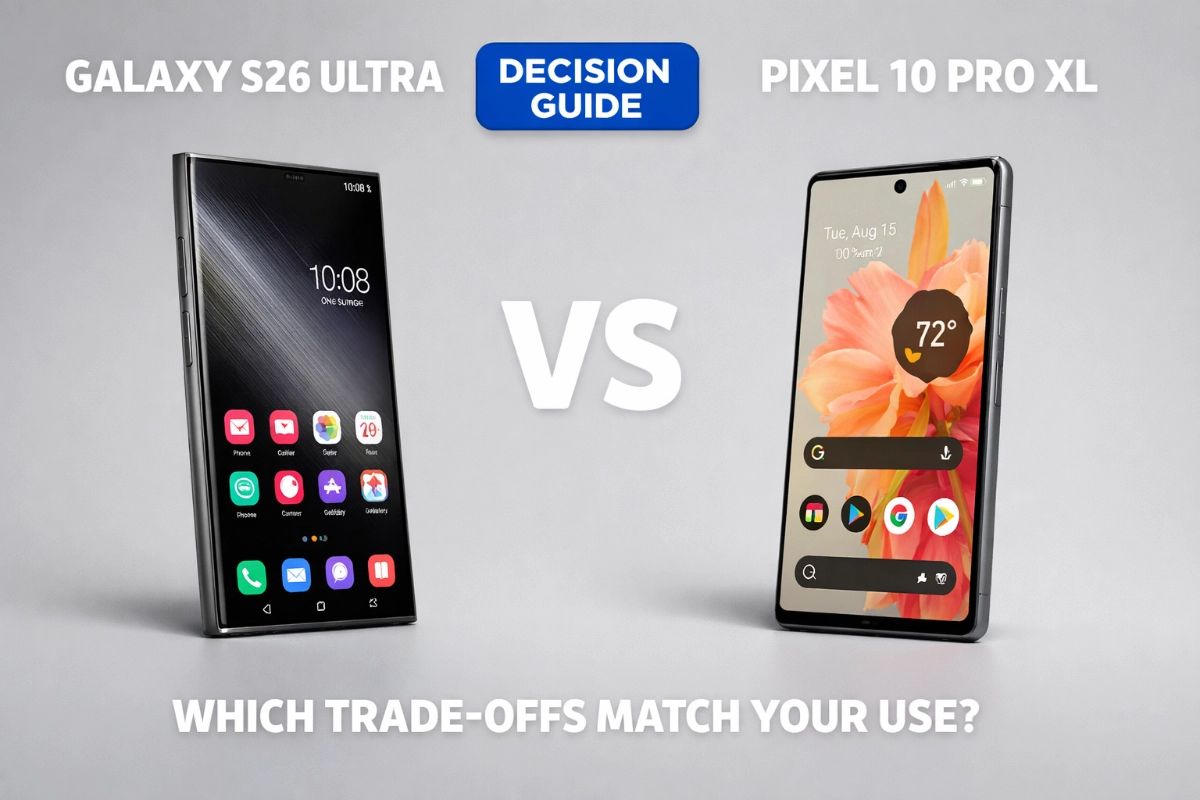
Specification sheets tell you the S26 Ultra packs a 6.9-inch display and 5,000mAh battery while the Pixel 10 Pro XL offers 6.8 inches and 5,200mAh. Both promise seven years of updates. Both cost over $1,000. Reading those numbers side by side reveals almost nothing about which phone you'll be happier with six months from now.
The meaningful differences emerge when you look at how these phones handle sustained workloads, how they approach charging versus battery preservation, and what accessory ecosystems they lock you into. These aren't minor preferences. They're fundamental design choices that shape whether your phone stays cool during a video call, whether you can top up quickly before leaving home, and whether you can snap on a magnetic car mount without buying a special case.
Samsung launched the S26 Ultra on February 25, 2026 at $1,299, while Google's Pixel 10 Pro XL arrived months earlier in August 2025 at $1,199. That timing gap matters beyond the $100 price difference. The Pixel has been available long enough that retailers now offer $200 to $300 discounts, narrowing the real cost difference substantially.
The processor choice defines everything about how these phones feel during extended use. Samsung equipped the S26 Ultra with Qualcomm's Snapdragon 8 Elite Gen 5, while Google uses their in-house Tensor G5 manufactured by TSMC on a 3nm process. Those different chips embody opposite philosophies about thermal management.
According to comprehensive benchmark testing from Beebom, the Snapdragon 8 Elite scored 2,759,190 points in AnTuTu testing compared to the Tensor G5's 1,291,252. That's a 2.1x performance gap on paper. But those numbers only tell half the story. What matters more is what happens when you push these phones hard for more than a few minutes.
Thermal throttling tests reveal the critical split. Technical analysis from Gizbot showed the Tensor G5 throttles to 61% of maximum performance over 15 minutes of sustained load, with a sharp performance drop occurring after just two minutes. The Snapdragon 8 Elite maintains 73% of peak performance throughout the same test period. Extended gaming tests on BGMI showed even more dramatic differences: the Snapdragon throttled to 81% while the Tensor G5 dropped to just 47% of maximum output.
Google's approach prioritizes comfort. The Tensor G5 keeps CPU temperatures around 45°C with surface temperatures on both front and back panels staying near 39°C. You can hold the phone during a 30-minute video call without feeling uncomfortable heat. Samsung allows the Snapdragon to run hotter, with CPU temps reaching approximately 61°C and display surface hitting 47°C. That's warm enough to notice, though not painful.
Here's how this plays out in real use:
Video editing longer than 10 minutes: Snapdragon maintains consistent performance for rendering, Tensor slows noticeably
Gaming sessions beyond 20 minutes: Snapdragon keeps frame rates steady, Tensor drops frames to manage heat
Extended camera use: Both handle photos fine, but 4K video recording for more than 5 minutes shows Tensor throttling
Casual scrolling and messaging: Both feel identical, neither generates noticeable heat
From our detailed study of sustained performance data across multiple benchmark sources, the trade-off becomes clear: you cannot have both maximum sustained performance and cool-to-the-touch comfort with current thermal limits. Google chose user comfort and battery efficiency. Samsung chose performance consistency. Neither approach is wrong, but one will frustrate you depending on your usage pattern.
Weight amplifies this split. The S26 Ultra measures 163.6 x 78.1 x 7.9mm and weighs 214 grams despite its larger 6.9-inch screen. The Pixel 10 Pro XL is thicker at 8.5mm and substantially heavier at 232 grams. That 18-gram difference feels significant during extended one-handed use or long phone calls.
Both phones carry similar battery capacities, but their approaches to charging and battery preservation diverge sharply. Samsung upgraded the S26 Ultra to 60W wired charging and 25W wireless, a meaningful jump from the previous 45W wired standard. Google maintains conservative 45W wired speeds on the Pixel 10 Pro XL.
According to Android Central's testing, Samsung's faster charging reaches 75% capacity in roughly 30 minutes. That speed matters when you're rushing out the door and need a quick top-up. But Google's approach reveals different priorities entirely.
The Pixel 10 Pro XL implements Battery Health Assistance, which forcibly throttles charging speeds after 200 charge cycles. This feature aims to extend battery longevity by reducing charging stress, but many users find it frustrating when their year-old phone suddenly charges slower. Samsung doesn't implement similar throttling.
Real-world battery life testing showed the Pixel 10 Pro XL lasting approximately 90 minutes longer than its predecessor despite only a 3% capacity increase from 5,050mAh to 5,200mAh. That improvement stems from the Tensor G5's efficiency through TSMC manufacturing and aggressive thermal throttling. The processor's willingness to cut performance maintains lower power draw during typical use.
The S26 Ultra's larger 6.9-inch display peaks at 2,600 nits, while the Pixel's 6.8-inch screen reaches 3,300 nits maximum brightness. Despite the Pixel's higher peak spec, Samsung's display draws more power in practice because of its larger size and aggressive brightness algorithms for outdoor visibility.
Based on our systematic review of battery performance patterns across reviews, the charging trade-off crystallizes: fast charging means you can quickly recover from a drained battery, but slower charging with throttling protection potentially extends how many years your battery maintains useful capacity. If you typically charge overnight, Google's approach makes sense. If you regularly need quick top-ups throughout the day, Samsung's speed advantage matters more.
The processor efficiency difference shows up in sustained usage. Testing indicates better endurance on the Pixel during typical mixed use because the Tensor's lower power ceiling means less battery drain even when the phone throttles performance. But the Snapdragon's higher sustained performance means tasks that would take 10 minutes on the Pixel might finish in 7 minutes on the S26 Ultra, potentially using less total battery by completing work faster.
The S26 Ultra and Pixel 10 Pro XL split on accessory compatibility in ways that lock you into different ecosystems long after your purchase. According to Wikipedia's documentation, the Pixel 10 Pro XL became the first Android phone supporting the Qi 2.2 standard, enabling 25W magnetic wireless charging through Google's Pixelsnap branding. The system uses circular magnet arrays matching the MagSafe pattern found in iPhones since 2012.
Samsung completely skipped magnetic charging implementation despite industry expectations throughout 2025. TechAdvisor confirmed that users wanting magnetic wireless charging on the S26 Ultra must purchase aftermarket cases with built-in magnets, adding both cost and bulk to the device.
This isn't just about wireless charging. The magnetic array opens access to an entire ecosystem of MagSafe-compatible accessories: car mounts that grip securely without clamps, desk stands that hold viewing angles perfectly, wallet attachments that snap on cleanly, and battery packs that align automatically. These accessories work across iPhones and Pixels without special cases.
If you've already invested in magnetic charging pads at your desk, nightstand, and car, the Pixel slots into that infrastructure immediately. If you're building that ecosystem now, every magnetic accessory you buy works with your next phone too, assuming you stay with Pixel or iPhone.
The S26 Ultra counters with features the Pixel lacks entirely. According to Samsung's official documentation, the phone includes built-in S Pen stylus support, maintaining Samsung's position as the only major flagship offering integrated stylus functionality. For users who take handwritten notes, sketch, or need precise screen interaction, no amount of magnetic accessories replaces that capability.
Samsung also introduced Privacy Display technology on the S26 Ultra. The feature programs specific OLED pixels to emit light directionally, appearing normal when viewed straight-on but going dark from side angles. Users can configure automatic activation for banking apps, password entry, or any public space use. TechAdvisor confirmed this directional viewing technology represents a world-first built-in implementation on mobile devices. If you're specifically interested in privacy screen technology, we've compared the S26 Ultra's built-in Privacy Display against aftermarket privacy filters to help determine whether the feature justifies waiting for Samsung's implementation.
The camera hardware differs substantially. Samsung retained its quad-camera array with a 200MP main sensor at f/1.4 aperture (delivering 47% improved low-light performance according to official specs), 50MP ultrawide, 10MP 3x telephoto, and 50MP 5x periscope telephoto. That dual telephoto setup provides genuine optical zoom flexibility between 3x and 5x ranges.
Google's triple camera setup uses 50MP wide, 48MP ultrawide, and 48MP 5x periscope telephoto sensors. The Pixel leans heavily on computational photography and AI-driven enhancements running on the Tensor G5's custom TPU. Samsung supports APV professional video codec for near-lossless 4K recording, targeting creators who need maximum quality preservation.
Storage speeds favor Samsung according to Gizbot's testing. The Snapdragon-equipped S26 Ultra achieves faster sequential read/write speeds, meaning apps install quicker, large games load faster, and file transfers complete sooner.
Neither phone is objectively better. They optimize for different usage patterns and priorities. Here's which trade-offs matter for specific scenarios:
Choose the Galaxy S26 Ultra if you:
Game for sessions longer than 20 minutes and need sustained frame rates
Edit video on your phone and can't wait for throttled rendering
Take handwritten notes or use stylus input regularly
Need the fastest possible charging for quick top-ups between meetings
Want Privacy Display for sensitive work or travel
Prefer lighter weight (214g vs 232g matters during extended use)
Already own wireless charging pads but don't need magnetic alignment
Choose the Pixel 10 Pro XL if you:
Value cool operation during video calls and extended use over maximum performance
Already invested in MagSafe-compatible accessories or plan to build that ecosystem
Prioritize day-one Android updates across your device (not staged rollouts)
Want AI features first before they reach other manufacturers
Can find discounted pricing from $200-300 off due to longer market availability
Prefer computational photography over optical zoom flexibility
Charge overnight primarily and care more about long-term battery health than charging speed
You'll be equally satisfied with either if you:
Mainly use your phone for messaging, calls, social media, and casual photography
Don't game heavily or edit media on your device
Charge overnight and rarely need emergency top-ups
Haven't committed to magnetic or stylus ecosystems yet
Consider waiting or looking elsewhere if you:
Need both magnetic accessories AND stylus support (no current phone offers both)
Want maximum sustained performance AND comfortable thermals (physics hasn't solved this yet)
Require the absolute longest battery life available (both phones prioritize features over maximum capacity)
The $100 base price difference ($1,299 vs $1,199) narrows considerably due to the Pixel's longer market availability creating retailer discounts. Samsung offers aggressive trade-in credits up to $900 at launch, while Pixel buyers find $200-300 off from various retailers. The real cost depends entirely on when you buy and whether you have a trade-in device.
Both phones deliver seven years of promised updates, though Google provides day-one releases simultaneously across all Pixel models while Samsung prioritizes newer devices during rollouts according to TechAdvisor's analysis. If being on the absolute latest Android version immediately matters to you, that implementation difference weighs toward Pixel.
The camera philosophy split matters less than marketing suggests. Both systems produce excellent photos in good light. Samsung's dual telephoto provides more optical zoom flexibility, while Google's computational approach handles challenging lighting better. Unless you specifically need 3x optical zoom or prefer controlling aperture manually, either camera system will satisfy typical photography needs.
Your usage pattern over the next 12 months matters more than specifications. If you can honestly say you'll never game for more than 15 minutes or edit video, thermal throttling becomes irrelevant. If you've never used a stylus, S Pen support adds no value. If you charge exclusively at night, 60W vs 45W charging speed means nothing.
The magnetic accessory question deserves careful thought. Once you commit to that ecosystem, switching becomes expensive. Every magnetic charger, mount, and wallet you buy works with your next Pixel or iPhone but becomes useless if you switch to Samsung. Conversely, if you've never felt limited by standard wireless charging, magnets solve a problem you don't have.
These three trade-offs create genuinely different daily experiences despite similar specifications. Choose based on which compromises you'll actually encounter, not which spec sheet reads better.
Both the Galaxy S26 Ultra and Pixel 10 Pro XL represent Samsung and Google's most refined flagship approaches yet, but choosing between them isn't about which has better specs on paper. It's about three specific trade-offs that create dramatically different daily experiences. After comparing real-world performance data, battery behavior, and ecosystem implications, the right phone depends entirely on how you actually use it. Here's what determines which flagship fits your life.
Boost your workflow with our browser-based tools
Share your expertise with our growing community. We accept in-depth articles on Tech, AI, and Dev.
Get StartedFinished reading? Continue your journey in Tech with these hand-picked guides and tutorials.