|
|
|
|
Insights and perspectives on technology, AI, software development, and industry trends from the TrueSolvers team.
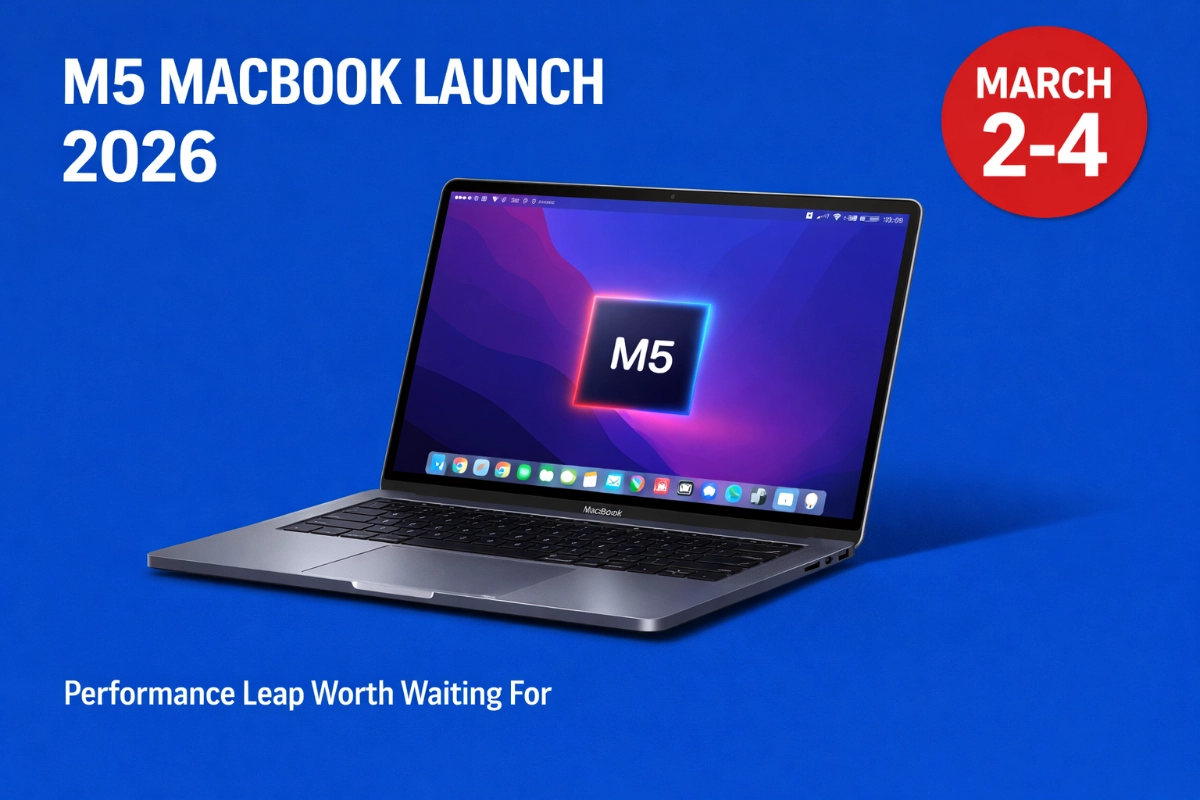
Apple built the M5 around a distributed AI processing architecture rather than incrementally improving existing designs. Each of the 10 GPU cores contains a dedicated Neural Accelerator, transforming the graphics subsystem into an AI compute fabric. According to Apple's official announcement in February 2026, this delivers over 4x peak GPU compute performance for AI compared to M4 and over 6x compared to the original M1 chip.
Memory bandwidth jumps to 153GB/s, representing a 30% increase over M4's 120GB/s. This matters because modern AI workloads spend more time moving data through unified memory than actually processing it. The bottleneck shifts from compute to memory access, and M5's wider data pipes let information flow faster across the entire system on a chip.
The CPU maintains M4's 10-core configuration with four performance cores and six efficiency cores, but Apple claims these are the world's fastest performance cores with up to 15% faster multithreaded performance. Storage performance sees dramatic gains too. Testing by Macworld in November 2025 measured M5 write speeds at 6440MB/s and read speeds at 6725MB/s, compared to M4's 3265MB/s write and 2904MB/s read speeds. That's 97% faster writes and 131% faster reads, cutting file transfer times substantially.
Raw specifications tell part of the story, but real-world application testing reveals where M5's architecture actually matters. For users running large language models locally, Cult of Mac reported in November 2025 that M5 delivers 3.6x faster time to first token compared to M4. That means responses start appearing 3.6 times quicker when you query a local AI model.
Video creators working with AI enhancement tools see similar gains:
Topaz Video AI enhancement: 1.8x faster processing
Adobe Premiere Pro speech enhancement: 2.9x speed improvement
Blender ray-traced rendering: 1.7x faster completion
Gaming performance jumps noticeably too. In 3DMark Solar Bay testing documented by Macworld, M5 achieved 101 frames per second while M4 managed 70 fps. That 50% frame rate increase makes the difference between smooth gameplay and occasional stuttering in demanding titles.
Apple's third-generation ray tracing engine delivers up to 45% higher graphics performance in 3D applications. Combined with second-generation dynamic caching that optimizes GPU resource allocation in real time, games feel noticeably smoother even when frame rates hover in similar ranges.
But here's what matters: these gains concentrate heavily in GPU-bound and AI-specific workloads. When Macworld tested standard productivity apps like Adobe Lightroom and GarageBand, performance differences between M5 and M4 essentially disappeared. Blender rendering showed minimal improvement at 9 minutes 45 seconds for M5 versus 9 minutes 55 seconds for M4. For document editing, web browsing, email, and media playback, M4 already exceeded requirements and M5 adds nothing perceptible to daily experience.
The MacBook Air's fanless design creates a fundamental tension with M5's increased power demands. Testing by Max Tech in October 2025 found the M5 draws approximately 30 watts during operation compared to M4's 25 watts, while generating more heat despite improvements in TSMC's third-generation 3nm manufacturing process.
Even the fan-cooled base MacBook Pro struggles with thermal management. According to Wccftech testing in October 2025, the single-fan cooling solution can't prevent M5 from reaching 99 degrees Celsius under sustained Cinebench loads. The chip throttles performance to manage temperature, and the fan runs significantly faster than it did with M4. Both the 14-inch M5 and M4 MacBook Pro models use identical cooling systems with a single fan and single heat pipe, yet M5's higher thermal output pushes this configuration to its limits.
The MacBook Air situation gets worse because it has no fan at all. Apple redesigned the Air in 2022 by replacing substantial metal heatsinks with thin graphite sheets, prioritizing thinness over sustained thermal capacity. The aluminum chassis acts as a passive heatsink, but without active cooling, heat buildup during intensive tasks has nowhere to go except through throttling.
Through our investigation of thermal management patterns across Apple's 2025-2026 product line, the MacBook Air faces greater thermal constraints than any other M5 device. The iPad Pro received sophisticated cooling enhancements including copper heat spreaders embedded in the Apple logo, yet the MacBook Air running full macOS with more demanding software hasn't received comparable improvements. Users planning sustained workloads like video rendering, software compilation, or extended gaming sessions should expect more frequent performance throttling with M5 than they experienced with M4 in the same chassis.
For casual users doing web browsing, document editing, and occasional photo work, the MacBook Air's thermal constraints won't matter. But anyone buying specifically for M5's AI performance gains or improved GPU capabilities needs to understand that the fanless design will prevent accessing those peak speeds for more than brief bursts.
Apple's high-end MacBook Pro models launching March 2026 separate themselves through both chip architecture and cooling design. According to MacRumors reporting in October 2025, the 14-inch and 16-inch MacBook Pro models with M5 Pro and M5 Max chips feature dual-fan cooling systems rather than the single fan in base configurations.
The M5 Pro steps up from the base M5's 10-core CPU to a 14-core configuration with 10 performance cores and four efficiency cores. Memory bandwidth scales higher than the base chip's 153GB/s, though exact figures await official announcement. Manufacturing uses TSMC's SoIC-MH process technology that enables vertical stacking of semiconductor components, improving thermal efficiency over standard 3nm fabrication.
Performance improvements range from 15% to 25% over previous M4 processors according to Macworld's analysis from October 2025. For buyers weighing whether to purchase M5 Pro models at launch or wait for the rumored OLED redesign later in 2026, the decision involves understanding both immediate performance gains and upcoming design changes. The modular architecture that separates CPU and GPU into distinct blocks allows flexible core configurations, explaining why these Pro and Max variants delayed until March 2026 rather than launching alongside the base M5 in October 2025.
If Apple maintains current pricing strategy, the 14-inch MacBook Pro with M5 Pro starts at $1,999 while the 16-inch model begins at $2,399. For M5 Max configurations, expect starting prices of $3,199 for 14-inch and $3,499 for 16-inch models. The base MacBook Air M5 holds at $999 for 13-inch and $1,199 for 15-inch configurations, both including 16GB base RAM according to MacRumors reporting from February 26, 2026.
These prices match M4 generation launch pricing, but current M4 inventory shows unusual discounts. Third-party retailers offer up to $200 off M4 models, creating immediate savings opportunities for buyers not requiring cutting-edge AI capabilities.
Value assessment depends entirely on matching hardware capabilities to actual workflow requirements. The performance delta between M4 and M5 matters dramatically for some users and barely registers for others.
M4 already delivers exceptional performance for typical computing tasks. As noted in the MacRumors buyer's guide from October 2025, the M4 chip routinely exceeds demands of normal Mac workflows, leaving little visible headroom for M5 to exploit in everyday usage. Web browsing loads instantly, documents respond immediately, media playback stays smooth, and basic photo editing feels snappy on both generations.
Where M5 justifies its premium centers on specific use cases. Users whose workflows include on-device AI inference, complex 3D rendering, or GPU-bound tasks will see material improvements. The combination of per-core Neural Accelerators, higher memory bandwidth, and redesigned GPU architecture produces multi-fold speed-ups in certain AI operations. For local large language model execution, real-time diffusion model generation, or computational photography with AI enhancement, M5 represents a meaningful step change rather than minor iteration.
Based on our observations of purchase timing patterns across Apple's silicon transitions, buying M5 in March 2026 locks you into current mini-LED display technology and existing industrial design for 12 to 18 months before M6 arrives. Historical patterns suggest M6 generation won't launch until late 2026 or 2027, potentially featuring OLED displays, touchscreen capability, redesigned chassis, and 2nm process technology. Those changes represent more substantial upgrades than the M4-to-M5 transition.
Current market dynamics favor patient buyers in some scenarios. M4 models launched March 2025, making them one year old at M5's release. Retailers clearing inventory offer genuine savings versus waiting for M5 at full retail price. But future considerations complicate simple cost analysis. Potential tariff impacts could raise prices on later production runs, and RAM cost increases might affect future configuration pricing according to industry speculation.
Your workflow requirements should drive purchase decisions, not marketing promises or fear of missing out.
1. Buy M4 Now If: Your work centers on productivity apps, web browsing, media consumption, and light creative tasks. Current $200 discounts on M4 models represent immediate savings, and performance already exceeds these workload requirements. You avoid paying premium prices for capabilities you won't use, and M4 remains a capable machine for years.
2. Wait for M5 If: You run AI models locally, work with real-time diffusion generation, or process computational photography with AI enhancement tools daily. The 3.6x faster LLM response times and 1.8-2.9x AI processing improvements directly reduce time spent waiting for results. SSD speed gains of 97-131% also benefit anyone moving large files regularly. For these users, M5's architecture delivers tangible workflow improvements worth the premium.
3. Consider MacBook Air M5 Only If: Your workload stays light and bursty. Short tasks benefit from M5 improvements without triggering thermal throttling. But skip the fanless Air if you plan sustained intensive work like video rendering, software compilation, or extended gaming. The thermal constraints will throttle performance exactly when you need peak speeds most. In those cases, spend extra for fan-cooled MacBook Pro models.
4. Invest in M5 Pro or M5 Max If: You're a professional whose time has monetary value and your work regularly maxes out current hardware. Video editors exporting multiple projects daily, 3D artists rendering complex scenes, or developers compiling large codebases will recoup the $2,000-$3,500 investment through time savings. The dual-fan cooling lets these chips sustain performance during the multi-hour work sessions where throttling would cost productivity.
5. Wait for M6 If: You want transformational design changes and can tolerate 12-18 months with current hardware. OLED displays, touchscreen capability, and redesigned chassis represent larger shifts than M4 to M5 chip improvements. M6 generation arriving late 2026 or 2027 offers a more compelling upgrade moment for users prioritizing user experience changes over incremental processor gains.
6. Budget-Conscious Users Should: Buy discounted M4 models now. The $200 savings represent 12-15% off retail pricing, and M4 handles mainstream computing effortlessly. Unless your specific workflow demonstrates measurable M5 advantages through the AI and GPU improvements detailed earlier, the previous generation delivers better value per dollar spent.
The March 2026 product announcements matter most for users whose work actually stresses the improvements M5 delivers. Everyone else benefits more from current discounts or waiting for more substantial platform changes coming in future generations.
Apple's March 2026 product announcements center on the M5 chip generation, and the performance improvements go beyond typical year-over-year updates. If you're debating whether to buy a discounted M4 MacBook now or wait for M5 models arriving March 2-4, the decision hinges on understanding where M5 actually delivers measurable advantages versus where marketing claims exceed real-world benefits. The M5 architecture fundamentally redesigns how Apple Silicon handles AI workloads, but thermal constraints in fanless models create performance ceilings that could frustrate buyers expecting sustained peak speeds.
Boost your workflow with our browser-based tools
Share your expertise with our growing community. We accept in-depth articles on Tech, AI, and Dev.
Get StartedFinished reading? Continue your journey in Tech with these hand-picked guides and tutorials.