|
|
|
|
Insights and perspectives on technology, AI, software development, and industry trends from the TrueSolvers team.
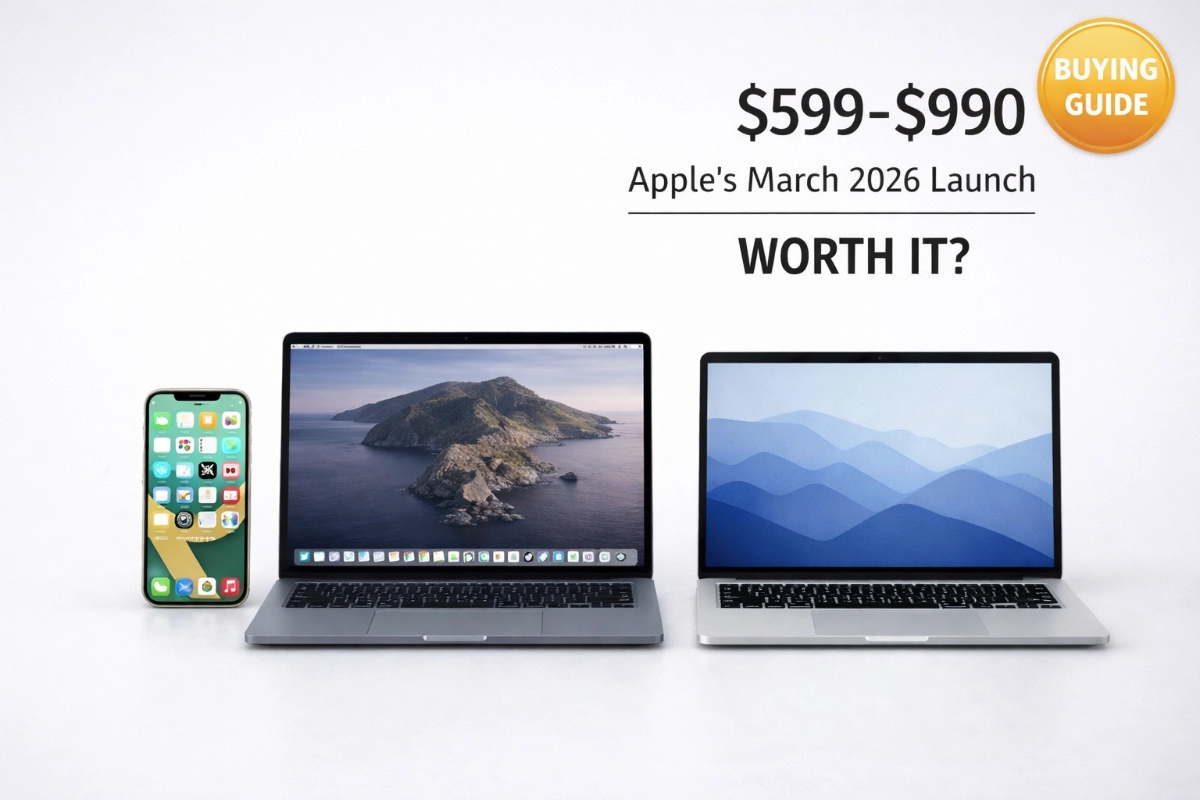
The launches span iPhone 17e, a budget MacBook using iPhone silicon, base iPad with AI features, iPad Air, and M5 MacBook Air models. MacRumors confirmed at least five products arrive through press releases rather than a traditional event, with hands-on sessions scheduled for March 4 in New York, London, and Shanghai. But price tags tell only half the story. The question worth $600 to $1,000 of your money is simple: which upgrades deliver capabilities you'll actually use, and which ones just fill spec sheets?
Apple's betting on $599 as its universal entry price, but that number masks dramatically different value propositions. The iPhone 17e holds this price point while adding substantial features over last year's model. According to 9to5Mac, the device maintains $599 while gaining the A19 chip shared with flagship iPhone 17 models, MagSafe charging, and Apple Intelligence support that the predecessor couldn't offer.
Here's what matters about that A19 chip. The iPhone 16e used an A18 processor. The 17e jumps two generations ahead by using the same silicon as devices costing $200 more. That's not just marketing. iDrop News reports the device also gets Apple's custom C1X cellular modem and N1 wireless chips, improving power efficiency compared to third-party components. You're getting flagship processor performance, MagSafe convenience, and enhanced connectivity at a price that historically bought you last year's technology with compromises.
But there's tension in Apple's lineup now. If the 17e offers 256GB at $599, it potentially delivers better value than the base iPhone 16 at $699 with just 128GB. Apple may avoid the storage bump precisely because it would cannibalize their own product line. The 17e targets two markets where price sensitivity determines purchase decisions: emerging economies and enterprise deployments. For individual buyers in developed markets, you're choosing between current flagship features at $599 or paying $100-200 more for design refinements that don't affect daily performance.
The budget MacBook represents Apple's most interesting pricing experiment because it breaks the traditional Mac silicon strategy. Instead of M-series processors, this laptop uses the A18 Pro chip from iPhone 16 Pro. Macworld analyzed benchmarks showing the A18 Pro's single-core performance matches M3 levels, while multi-core meets or exceeds the original M1 MacBook Air.
That performance claim needs context. The chip features 6-core CPU, 6-core GPU, and 16-core Neural Engine matching M1's AI capabilities. You're getting Apple Intelligence support identical to more expensive Macs. But the device ships with 8GB RAM versus 16GB now standard on MacBook Air and Pro models. For document editing, web browsing, and video streaming, macOS's memory efficiency means you won't notice. For running multiple pro apps simultaneously or working with large files, that 8GB ceiling becomes real fast.
Port selection reveals the bigger compromise. You get one or two standard USB-C ports without Thunderbolt support. Data transfers run slower. External display support is limited. If your workflow involves fast external drives or multiple monitors, that limitation isn't negotiable regardless of CPU benchmarks.
Pricing estimates have shifted upward. Mac Observer reports current expectations land between $699 and $749, potentially reaching $799, up from initial $599 targets. College students receive $100 education discounts, bringing effective prices back toward original projections for that demographic. The 12.9-inch display is smaller than the 13.6-inch MacBook Air, which helps differentiate the products visually.
Here's what this pricing means practically:
For students and casual users: You're getting legitimate Mac performance for Chromebook money if pricing stays near $699-749. The A18 Pro handles everyday tasks identically to M-series Macs.
For professionals: The port limitations and 8GB RAM ceiling mean this isn't a MacBook Air alternative. It's a secondary device or first Mac for someone entering the ecosystem.
For power users: Pass entirely. The savings aren't worth the workflow compromises.
Through our rigorous evaluation of Apple's chip strategy across this launch, a clear pattern emerges: the company's willing to use iPhone-derived silicon in Macs when market positioning demands it, breaking from the rigid separation that previously existed. This budget MacBook proves Apple can deliver acceptable Mac performance without M-series chips, which has implications for future product tiers. The question is whether buyers value macOS access enough to accept phone-grade silicon and compromised ports.
The base iPad's most important upgrade isn't visible on spec sheets. According to iDrop News, the 12th generation adds either A18 or A19 chips enabling Apple Intelligence support that was incomprehensibly absent from the 2025 model despite launching after AI features arrived.
That capability gap wasn't minor. The 11th generation used an A16 chip with 6GB RAM, below Apple Intelligence's 8GB minimum threshold. Users couldn't access AI-driven features available on every other new Apple device. The 12th generation fixes this with A18 or A19 chips and 8GB RAM, representing approximately 30% more memory than before. CPU performance jumps roughly 40% over A16 according to reports.
This matters because $349 becomes the cheapest way to access Apple's AI ecosystem. The iPhone 17e costs $250 more. The budget MacBook runs $350-450 more. For students, families buying tablets for kids, or enterprise customers deploying classroom devices, that price gap is decisive. Macworld notes pricing launched at $449 in 2022 before Apple cut it to $349 in 2024 while doubling storage from 64GB to 128GB. Tariffs and RAM cost increases create uncertainty, but no firm price hikes are currently indicated.
The iPad historically dominates educational deployments. Adding Apple Intelligence at the entry price point creates a complete low-cost ecosystem when combined with the budget MacBook. Schools can outfit students with AI-capable devices without jumping to $799 iPad Air or $999 MacBook Air pricing. That's not a small market. It's potentially the largest addressable customer base for Apple's AI features.
What you're not getting at $349: OLED display technology, advanced camera systems, or accessory compatibility beyond basic cases. The design remains unchanged from previous generations. This is purely a specification upgrade focused on bringing baseline capability to Apple's cheapest tablet. For anyone already owning an 11th generation iPad without AI support, the upgrade case is compelling. For everyone else, you're deciding whether tablet plus AI features at $349 serves your needs better than waiting for sales on higher-tier models.
Apple's mid-range tier shows where the company balances capability with accessible pricing. Two devices anchor this bracket with different upgrade philosophies.
The iPad Air receives M4 chips according to Macworld, maintaining Apple's pattern of giving this model silicon one generation behind the Pro line that moved to M5 last October. You're getting the 9-core CPU version rather than 10-core, paired with 10-core GPU. That configuration matches the lower-tier setup used in 2024's iPad Pro.
The M4 brings substantially faster performance than the outgoing M3 version. Multitasking runs smoother. App launches happen quicker. Gaming and creative applications benefit from improved graphics rendering. The 16-core Neural Engine enhances machine learning tasks including photo editing and AI features integrated into iPadOS. What hasn't changed: the LED-backlit Liquid Retina display. OLED technology remains exclusive to iPad Pro.
The 11-inch model is expected to hold its $599 starting price despite supply constraints that put Apple in "supply chase mode" according to CEO Tim Cook during Q1 2026 earnings. The 13-inch continues at $799. You're paying $450 more than the base iPad to get M4 performance, better display quality, and compatibility with premium accessories like Magic Keyboard. That gap is either justified or excessive depending entirely on whether you need the processing headroom for demanding apps or if basic iPad capabilities already exceed your requirements.
The M5 MacBook Air launches in the March 2-4 window with 16GB unified memory as base configuration. Macworld reports expected pricing around $999-$1,199, similar to current M4 models. The M5 chip delivers approximately 15-25% faster CPU speeds and up to 45% better graphics performance versus M4, with memory bandwidth reaching 153GB/s compared to M4's 120GB/s.
Here's the honest assessment: those percentage improvements sound substantial on paper but translate to seconds saved during exports or marginally smoother gameplay. Unless you're currently using an M1 or earlier Mac, the performance delta won't transform your daily experience. MacRumors notes leaked benchmarks show single-core scores around 4,133 and multi-core around 15,437, representing roughly 12-15% improvements over M4 in both categories.
The real upgrade is that 16GB RAM finally becoming standard. Apple's 8GB base configurations aged poorly as software bloat increased and AI features demanded more memory. You're now getting adequate RAM for multitasking without paying upgrade fees. The current design from 2022 continues unchanged. No OLED, which Apple appears to be reserving for MacBook Pro introduction possibly later in 2026 or 2027.
At $999, the MacBook Air competes against its own history. Retailers frequently discount M3 models to $849-899. The budget MacBook at $699-749 offers "good enough" performance for many users. For those considering the professional tier, our analysis of M5 Pro MacBook Pro timing and OLED expectations examines whether waiting makes sense. You're paying the premium for proven thermal design, Thunderbolt ports, double the RAM, and guaranteed longevity. That's worth it if you keep devices for 4-5 years. It's questionable if you upgrade every 2-3 years when M3 discounts exist.
Apple's official announcement from October 2025 detailed the base M5 MacBook Pro at $1,599. The M5 Pro and M5 Max variants launching by March 4 complete the lineup. According to Macworld, pricing is expected to match current M4 models: 14-inch with M5 Pro starting at $1,999, 16-inch at $2,399, with M5 Max configurations reaching $3,199 for 14-inch and $3,499 for 16-inch.
The M5 GPU provides up to 3.5x faster AI performance versus M4 and 6x versus M1. The 10-core CPU delivers up to 20% faster multithreaded performance than M4, with over 150GB/s unified memory bandwidth enabling work with large AI models on-device or manipulation of massive 3D scenes. Battery life reaches 24 hours. The new architecture separates CPU and GPU into distinct modular blocks, potentially enabling more flexible configurations in the future.
From our detailed study of performance improvements across this launch, a consistent pattern emerges: Apple's settled into predictable 10-20% CPU gains generation over generation, with GPU improvements reaching 30-45%. This mirrors previous M3-to-M4 transitions. Single-core performance often exceeds multi-core gains, benefiting everyday responsiveness more than sustained workloads. Thermal constraints significantly impact real-world performance, which is why the actively cooled MacBook Pro maximizes chip capabilities while fanless designs in Air and budget MacBook throttle under load despite impressive benchmarks.
Here's when that $1,999+ investment makes sense: you're running video editing software daily, you're compiling code regularly, you're training machine learning models, or you're doing 3D rendering work. The Pro delivers performance that fundamentally changes workflow speed for these tasks. If you're writing documents, managing spreadsheets, and browsing web, the $1,400 premium over MacBook Air buys you capabilities you'll never use. This isn't subtle. It's binary.
The M5 Pro and M5 Max models will include N1 chip integration bringing Wi-Fi 7 and Bluetooth 6 capabilities. Supply constraints on current M4 Max models, with delivery estimates stretching from February to mid-March for built-to-order configurations, signal imminent replacement timing. If you need this level of performance, waiting until March 4 ensures you're not buying outdated hardware weeks before its successor arrives.
Apple's March launches reveal more about the company's pricing strategy than product innovation. Here's where your money actually goes:
$349 iPad: Strongest value proposition. You're getting Apple Intelligence support at the entry price, fixing the inexcusable gap from 2025's model. If you need a tablet and want AI features, this is $250 less than the next option while delivering the core functionality most users actually require.
$599 iPhone 17e: Conditional value. You're receiving flagship silicon and MagSafe at iPhone SE pricing, but only if you're coming from iPhone 14 or earlier. If you already own a 15 or 16, the upgrades don't justify replacement.
$699-$799 Budget MacBook: Market-dependent value. Students with education discounts getting it for $599-649 win substantially. Everyone else is paying within $200 of M3 MacBook Air sale prices for phone silicon and port compromises. The math only works if you absolutely need macOS at minimum cost.
$799 iPad Air: Weak value relative to alternatives. You're paying $450 more than base iPad for M4 over A18/A19 performance. Unless you're running pro apps that genuinely stress the processor, that premium buys capability you won't access. Wait for sales on M3 models instead.
$999 MacBook Air: Reluctant recommendation. The 16GB RAM upgrade finally makes this configuration viable long-term, but only because Apple inexcusably shipped 8GB for too long. M5's performance gains over M4 are marginal for most users. Buy this if you keep devices 5+ years. Otherwise, hunt for M3 discounts.
$1,999+ MacBook Pro: Niche but justified. If your work involves video editing, code compilation, 3D rendering, or ML training, the performance difference is measurable in hours saved weekly. For everyone else, you're paying $1,000+ for unused capability.
The pattern across all these devices: Apple's holding price points steady while delivering incremental improvements that matter most to specific user categories. The base iPad's AI support addresses a genuine capability gap. The budget MacBook opens macOS to new buyers. The iPhone 17e maintains value at its price tier. But the mid-range products, especially iPad Air, feel like they're priced to protect more expensive models rather than maximize their own value proposition. And the MacBook Air's biggest "upgrade" is finally including enough RAM that it should have shipped with years ago.
Your decision shouldn't be "what's new in March 2026?" It should be "what capabilities justify the price for my actual usage?" More often than not, the answer is either the entry-level device or waiting for discounts on previous generations.
Apple's announcing five new products across three days starting March 2, but the real story isn't what's launching. It's what you're actually getting for your money. The company's holding these $599 to $990 price points steady despite component cost increases, which sounds consumer-friendly until you examine what's changing under the hood and what isn't.
Boost your workflow with our browser-based tools
Share your expertise with our growing community. We accept in-depth articles on Tech, AI, and Dev.
Get StartedFinished reading? Continue your journey in Tech with these hand-picked guides and tutorials.