|
|
|
|
Insights and perspectives on technology, AI, software development, and industry trends from the TrueSolvers team.
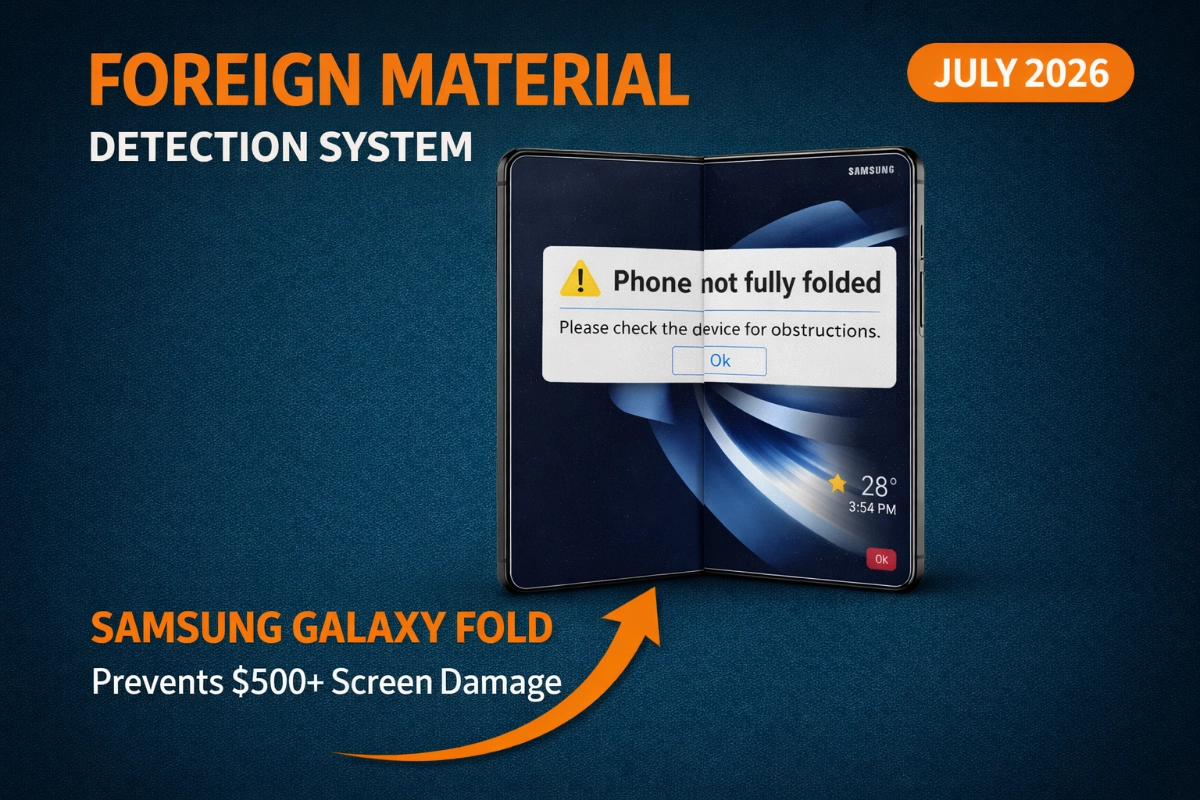
Foldable smartphones carry a fundamental vulnerability that traditional phones don't face. The hinge mechanism requires microscopic gaps between the device body and folding components to enable motion. These gaps create entry points for particles like sand, dust, and lint. When debris lodges between the screen halves during closure, forced folding compresses the flexible display against hard particles, creating pressure points that damage the screen's delicate layers.
The material science explains why this matters so much. Foldable displays use polyimide-based plastic film or Ultra Thin Glass coatings instead of the tempered glass found in conventional smartphones. These flexible materials begin showing scratches at Mohs hardness level 6, equivalent to steel. Traditional Gorilla Glass resists scratching up to level 7. This single-level difference means everyday metal objects like keys or belt buckles can mark foldable screens, and a single grain of sand trapped during closure can cause permanent damage requiring complete screen replacement.
Engineering targets provide context for the challenge. Manufacturers design foldable displays to withstand 200,000 folds, roughly equivalent to five years of average use. But particle intrusion creates a failure mode that bypasses this durability testing. A device that passes 200,000 fold cycles in a controlled lab environment can fail catastrophically from one forced closure with trapped debris in real-world conditions.
Leaked One UI 9 code builds revealed Foreign Material Detection's operational approach. The system monitors whether the device folds completely closed. When the phone fails to achieve full closure, it triggers an on-screen notification with the title "Phone not fully folded." The message instructs users to open the device and check for foreign substances on the screen before attempting to close it again, explicitly stating the goal is to avoid screen damage.
Users maintain control over the feature. The notification includes information about disabling alerts through Settings if desired. This flexibility addresses power users who might find constant warnings disruptive while providing protection for typical users who benefit from the safeguard.
The implementation details remain partially unclear. Whether the detection capability functions through software monitoring of hinge position sensors or requires new hardware components hasn't been confirmed. Graphics discovered within One UI 9 show the system designed for all three 2026 models:
Galaxy Z Fold 8
Galaxy Z Flip 8
Wide Fold variant
The timing suggests Samsung views this as a category-wide solution rather than a flagship-exclusive feature. Questions remain about backward compatibility. Whether older foldables like the Galaxy Z Fold 7 and Z Flip 7 can receive Foreign Material Detection through software updates would significantly expand the feature's protective reach across Samsung's existing foldable user base.
Repair economics reveal why prevention matters more than reactive fixes. According to SamMobile, fixing the cover display on a Samsung Fold7 costs approximately $610, while the main inner display repair exceeds that amount. These prices approach or surpass the cost of buying a new mid-range smartphone outright.
Samsung offers one-time discounted repairs to soften the blow. First-incident screen repairs cost around $150 for Fold models and $120 for Flip variants. But subsequent repairs face full pricing, and users who've already used their discounted repair face the complete $500 to $800 cost for additional damage.
Insurance provides an alternative cost structure. Samsung Care+ costs approximately $256 annually for a Fold7, providing coverage for accidental screen and back glass damage. Over a typical two-year ownership period, that represents $512 in insurance premiums. Users must calculate whether paying for insurance makes financial sense compared to the risk of needing a repair.
From what we observed of repair cost patterns across foldable manufacturers, Samsung's pricing sits in the middle of the market. OnePlus charges $329 for a two-year Protection Plan in the US. The broader pattern shows foldable repairs universally cost more than traditional smartphone fixes, creating a significant economic barrier to mainstream adoption. Foreign Material Detection functions as preventive economics. By alerting users before damage occurs, it eliminates the repair need entirely, potentially saving the full $500 to $800 replacement cost.
The TriFold model amplifies these stakes. Hinge failures on Samsung's triple-screen device cost $800 to $1,200 to repair, reflecting the increased mechanical complexity. As manufacturers introduce more complex folding mechanisms, the economic value of damage prevention systems increases proportionally.
Samsung's approach to particle protection has evolved through distinct phases since 2020. The Galaxy Z Fold2 introduced Sweeper Technology, a mechanical solution inspired by vacuum cleaner brushes. Delicately cut nylon fibers sit within the gap between the device front and hinge housing. As the hinge folds and unfolds, these fibers physically sweep through the gap to prevent small particles from entering and damaging the display.
Developing effective sweeper bristles required solving three simultaneous challenges. The fibers needed elasticity to accommodate shifts in gap size as the device folded. They required flexibility to withstand 200,000 fold cycles without degrading. And they had to maintain slim profiles to preserve the device's form factor. Engineers iterated through dozens of failed prototypes before achieving a working design that met all three conditions.
As devices became thinner across subsequent generations, Samsung shortened the sweeper bristles to improve aesthetics while maintaining protective function. The passive mechanical approach proved effective but incomplete. Sweeper Technology reduces particle entry, but it can't prevent all intrusion or alert users when particles do enter.
The Galaxy Z Fold3 in 2021 added another protective layer with IPX8 water resistance, the first foldable to achieve this rating. Samsung applied rubber band seals to the outer display and used corrosion-resistant materials with long-lasting lubricant in the hinge mechanism. Silicone-based gaskets protected electrical terminals from water exposure. But water resistance differs from dust resistance. The gaps necessary for folding motion still permitted particle entry, just not liquid intrusion.
This progression reveals Samsung's systematic approach to durability. Sweeper Technology provided passive mechanical protection. IPX8 certification addressed liquid damage. Foreign Material Detection completes the protective system by adding active user notification before particle damage occurs. Each innovation addresses a different aspect of foldable vulnerability rather than replacing previous solutions.
Production numbers signal Samsung's strategic bet on foldable market expansion in 2026. Industry sources report Samsung targeting approximately 3.5 million Galaxy Z Fold 8 units for the second half of 2026, significantly surpassing the 2.5 to 3 million units planned for Z Flip 8. This reverses recent years where the Flip consistently outsold the Fold, suggesting Samsung's confidence that larger-screen foldables will drive category growth as mainstream hesitation about durability subsides.
The Wide Fold variant reinforces this mainstream push. With production targets around 1 million units and a 16:10 aspect ratio outer display creating a more natural passport-like shape when closed, the device aims to attract users who find current Fold models too tall and narrow. A potentially lower price point compared to the standard Z Fold 8 could position it as an entry point for buyers curious about foldables but unwilling to pay flagship prices.
Competitive timing adds urgency to Samsung's durability narrative. Apple's rumored foldable iPhone is expected later in 2026 with a similar wider form factor. Samsung's July launch provides a several-month head start, and Foreign Material Detection establishes a tangible durability advantage Samsung can emphasize in marketing before Apple enters the category.
After looking into of how manufacturers communicate foldable durability, prevention-focused features like Foreign Material Detection offer clearer consumer benefits than passive technologies. IPX8 water resistance and Sweeper Technology work invisibly. Users can't directly observe their protective effects. But Foreign Material Detection provides visible, active intervention. The notification itself becomes proof that the device protects itself, creating a psychological reassurance that passive systems can't match.
Software integration through One UI 9 and Android 17 completes the readiness story. Android 17's lock-free MessageQueue implementation should improve UI responsiveness during intensive multitasking scenarios common on foldable devices. One UI 9 brings enhanced multitasking capabilities, cross-device features like Do Not Disturb sync and Universal Clipboard, and AI-powered browser tools. These software improvements work alongside hardware durability advances to address the complete user experience question mainstream buyers ask.
Samsung will unveil three foldable devices at its July 2026 Galaxy Unpacked event: the Galaxy Z Fold 8, Z Flip 8, and entirely new Wide Fold variant with internal codename "H8." All three will debut with One UI 9 based on Android 17 and include Foreign Material Detection among their protective features.
The Z Fold 8 brings hardware refinements beyond software protection. Laser-drilling metal plate hinge technology demonstrated at CES 2026 dramatically reduces the visible fold line, creating what Samsung describes as a nearly crease-free inner display. Expected specifications include:
Qualcomm Snapdragon 8 Elite Gen 2 processor
Up to 16GB RAM
Storage starting at 256GB
Camera upgrade from 12MP to 50MP ultrawide sensor
Display improvements focus on reducing the crease visibility that has bothered users since the first Galaxy Fold. Slightly rounded corners across all 2026 models contribute to more ergonomic designs, though whether this represents actual hardware changes or simplified graphical representation in early software builds remains uncertain.
Pricing remains speculative but could stay in the $1,799 to $1,999 range for the Z Fold 8, though component costs and upgrades might push prices higher. Samsung's 2026 pricing strategy across the Galaxy lineup suggests the company is carefully balancing premium features against mainstream accessibility. The Wide Fold could carry a slight premium over base Flip models while staying well below standard Fold pricing to serve its market expansion role.
A beta phase for One UI 9 is rumored to begin in May 2026, with the S26 Ultra and S25 series likely receiving testing access first. This would give flagship owners hands-on experience with the new software before the July foldable launch. Samsung officially moved the Galaxy S22 series and Z Fold 4 to quarterly security schedules in early February 2026, meaning those devices will stop at One UI 8.5 and won't receive One UI 9 or Foreign Material Detection if it requires Android 17 features.
The fundamental question facing potential foldable buyers has shifted over the category's evolution. Early models asked "Will this survive?" Modern devices tested at 200,000-plus folds ask "Can I trust this daily?" Foreign Material Detection moves the conversation forward to "Will this prevent problems before they happen?" That transition from reactive repair to proactive prevention marks foldables' maturation from enthusiast devices to technology mainstream users can confidently adopt. Samsung's July 2026 lineup positions itself to answer that shifted question affirmatively through combined mechanical protection, water resistance, and now active damage prevention working together as a complete protective system.
Samsung's July 2026 foldable lineup introduces Foreign Material Detection, a software system that warns users when debris prevents complete closure. The feature addresses particle intrusion, which causes a significant portion of foldable screen failures costing $500 to $800 to repair. By alerting users before forced closure damages the flexible display, the technology shifts foldable protection from passive mechanical solutions to active prevention.
Boost your workflow with our browser-based tools
Share your expertise with our growing community. We accept in-depth articles on Tech, AI, and Dev.
Get StartedFinished reading? Continue your journey in Tech with these hand-picked guides and tutorials.