|
|
|
|
Insights and perspectives on technology, AI, software development, and industry trends from the TrueSolvers team.
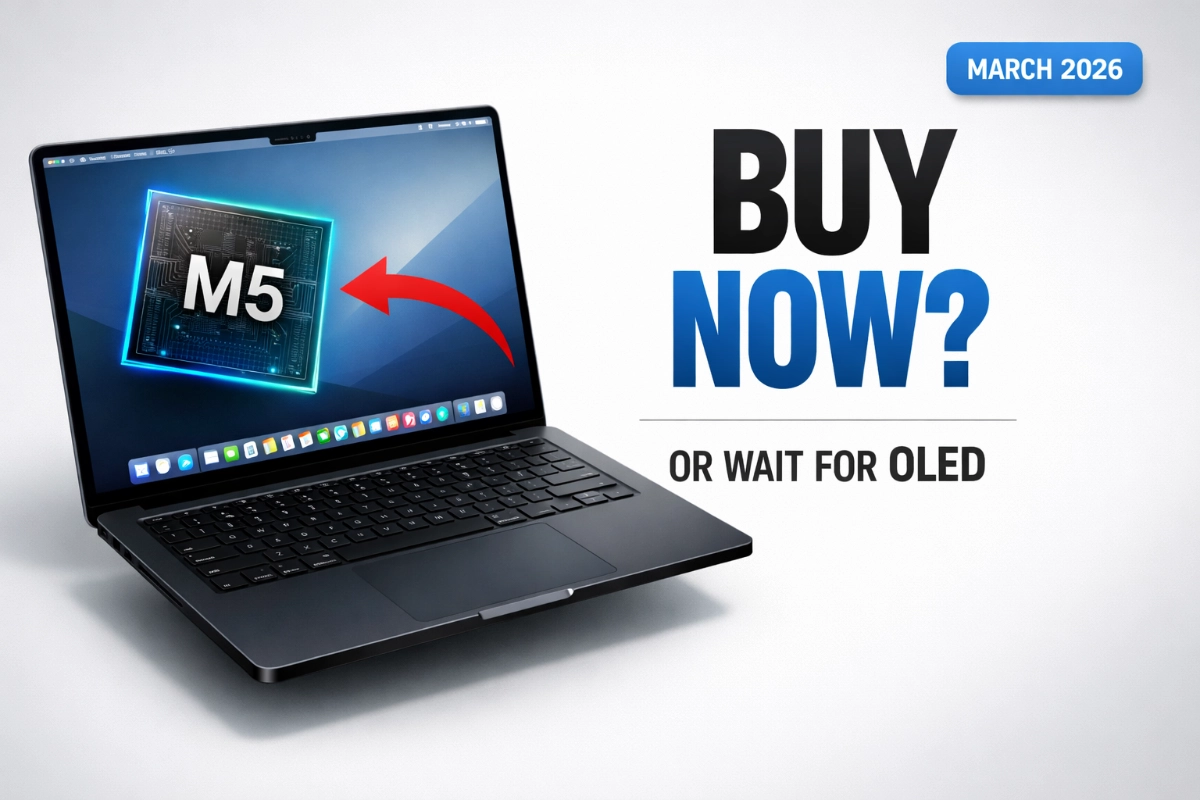
Apple officially announced a "special Apple Experience" event for March 4, 2026, in New York, London, and Shanghai. The multi-city format and the absence of a live stream signal a hands-on product reveal rather than a broadcast announcement. Based on Bloomberg's Mark Gurman, who reported the launch window tied to the macOS 26.3 software cycle, M5 Pro and M5 Max MacBook Pros are the centerpiece.
The inventory signal is already flashing. M4 Pro and M4 Max MacBook Pro stock dried up at Apple resellers in early February, which is the pattern Apple consistently runs before pulling the trigger on new hardware. The new machines carry internal Apple codes J714 and J716.
What won't change: the chassis. The MacBook Pro design has been identical since October 2021. Buyers picking up an M5 Pro in March will receive the same physical laptop Apple has been selling for more than four years, with mini-LED display, notch, and identical port layout.
The M5 chip uses TSMC's third-generation 3nm process, called N3P, which is a step above the N3E node that powered M4. That process difference matters because it improves power efficiency even when CPU and GPU clock speeds stay similar.
Macworld's benchmarks on the base M5 MacBook Pro reveal where the gains are dramatic and where they're modest. SSD performance is the standout: write speeds came in at 6,440 megabytes per second compared to 3,265 on M4, a 97% improvement. Read speeds were 131% faster. These aren't synthetic edge cases; faster storage translates directly to quicker project loads, faster cache flushing in video applications, and snappier virtual machine performance.
CPU rendering improvements are more restrained. A 3D model computation that took 9 minutes and 55 seconds on M4 completed in 9 minutes and 45 seconds on M5, roughly a 2% gain on that specific task. For most creative workflows like Lightroom cataloging and audio production, Macworld's reviewers noted the subjective difference is not dramatic.
The genuine leap is in AI workloads. Apple's M5 chip embeds Neural Accelerators directly into GPU cores, an architectural change the M4 Pro did not have. Apple claims the M5 is up to 3.5 times faster than M4 on neural engine tasks, and Macworld's testing corroborated substantial gains in that range. For developers running local models, researchers doing on-device inference, or anyone using AI-powered features in professional software, this matters more than the CPU number.
For M5 Pro and M5 Max specifically, Gadget Hacks projected GPU gains of approximately 34% over M4 Max based on benchmark scaling from the base chip. At that rate, the M5 Max would surpass even the M3 Ultra's 80-core GPU score. M5 Pro multi-core CPU performance is projected at roughly 22% ahead of M4 Pro.
There's also a hardware configuration note worth knowing. A modular chip architecture is rumored for M5 Pro and Max, with CPU and GPU on separate silicon blocks rather than a single die. If accurate, this could enable more granular configuration options than previous generations allowed, according to Macworld.
The macbook pro m5 rumors have circulated for months, but understanding them requires separating two distinct product generations that will both land in 2026.
The M6 MacBook Pro redesign is, by most accounts, the most significant update to the laptop since the M1 generation launched in 2020. MacRumors described it that way, and the list of changes supports that framing. The M6 Pro and M6 Max models (Apple internal code K116) are expected to feature Tandem OLED displays, which stack two emissive layers for higher sustained brightness without the power penalty of single-layer panels. This is the same technology used in the iPad Pro M4.
Beyond the display, the redesign includes: a thinner chassis enabled by removing the mini-LED backlight assembly, a punch-hole camera replacing the notch, touchscreen support with a reinforced hinge Apple engineered specifically to resist wobble when pressing a clamshell screen, and M6 chips on TSMC's 2nm process. The 2nm node, also expected in the iPhone 18 Pro's A20 chip, is projected to deliver 15-20% performance gains over the 3nm M5 with substantially better power efficiency.
Samsung reportedly began 8.6-generation OLED panel production specifically for the MacBook Pro display line in early 2026. Research firm Omdia has rated an OLED MacBook Pro launch in 2026 as "highly likely."
Here's the detail most coverage glosses over: the redesign applies only to M6 Pro and M6 Max configurations. The base M6 MacBook Pro, identified internally as K116... wait, the base model carries the code J804 and will retain the current mini-LED design. According to Wccftech, only the K116 M6 Pro and Max variants receive the OLED panels, thinner body, and touchscreen.
If you're considering a base MacBook Pro under $2,000, the OLED redesign isn't coming to your price bracket at launch. Macworld noted the base M6 OLED redesign won't reach the lower tier until approximately 2028.
After reviewing how Apple segments hardware upgrades across price tiers, the K116 vs J804 split is the single most important piece of information for 2026 MacBook Pro buyers. Almost all coverage focuses on whether the OLED is coming this year; the more useful question is whether it's coming at your price point.
Every discussion of whether to buy M5 Pro now or wait eventually runs into the same dividing line: your intended spend.
Under $2,000 means the base M5 MacBook Pro tier, starting at $1,599. The OLED redesign isn't arriving at that price bracket in 2026, and possibly not until 2028. Buyers in this range have one real question: do you need a machine now, or can you wait for the base M6 in late 2026 or 2027? Current Amazon pricing has the M5 base model at $1,449 to $1,849 depending on configuration, so discounts are already available.
At $2,000 and above, you're in M5 Pro or M5 Max territory, and this is where the decision carries genuine weight. The M6 Pro OLED with touchscreen, thinner design, and 2nm chips is scheduled for the same machines at the same price tier. MacRumors explicitly moved its buying advice to "wait" for high-end MacBook Pro buyers in February 2026, calling it an unusual departure from its typical new-Mac stance.
The expected price increase for M6 Pro OLED models is at least $200 over current M5 Pro pricing, according to Macworld. If the current M5 Pro starts at $1,999, the M6 Pro redesign may open above $2,200 for the 14-inch base configuration.
Waiting for the M6 OLED is not a free action. There are three concrete costs: time, money risk, and the risk that the timeline slips.
On timeline: MacRumors explicitly noted that 2027 is the "safer bet" for the M6 redesign, with late 2026 as the optimistic scenario. Tom's Guide raised the possibility of a staggered release, where the base M6 MacBook Pro arrives in fall 2026 but M6 Pro and Max with OLED don't follow until early 2027. Samsung's OLED production beginning in spring 2026 makes a late 2026 debut plausible, but first-generation OLED manufacturing at scale for a laptop has more variables than a chip upgrade.
The practical scenarios for an M5 Pro buyer look like this:
If M6 OLED Pro arrives October-November 2026: You'd be 7-8 months into an M5 Pro purchase when the redesign launches. That's similar to the gap M2 Pro buyers experienced before M3 Pro arrived in October 2023.
If M6 OLED Pro slips to Q1 2027: Waiting means sitting out nearly 12 months. For professionals on M1 or M2 machines who need better performance now, that's a substantial productivity cost.
If you're on M3 or M4 Pro already: MacRumors explicitly recommended against upgrading from M3 or M4 to M5 without a specific workflow need. The jump from M5 Pro to M6 Pro might be worth waiting for in that case.
From our exploration of how production timelines for new display technologies typically play out, first-generation OLED on a new form factor almost always runs later than initial projections. Tandem OLED at laptop scale involves tighter yield requirements than phone or tablet panels. The late-2026 target is possible; treating it as certain would be optimistic.
On money: if you're coming from an M1 Pro machine, Apple trade-in value for that hardware was approximately $500 as of early 2026. Every month of additional use extracts diminishing resale value. Buyers waiting 12 months may find their current machine worth $100 to $200 less than it is today.
The right answer genuinely depends on your situation. Here's how the scenarios break down.
If you're on an Intel Mac or M1: Buy the M5 Pro in March. The performance gap between your current machine and M5 Pro is already enormous. The M5 SSD alone is roughly 10 times faster than Intel-era MacBook Pro drives. Waiting 9-12 months to close a gap that's already large doesn't make practical sense for most professionals.
If you're on M2 Pro and need more power: This is the hardest call. You'd get real gains from M5 Pro (22% more multi-core CPU, 34% more GPU, 97% faster SSD), but the M6 OLED redesign would be a more significant generational leap. If you can absorb current performance for another 9-12 months, waiting is defensible. If workflow bottlenecks are hurting you daily, the M5 Pro upgrade is productive and reasonable.
If you're still weighing whether the M4 Pro makes sense as a stopgap before M5, we covered that decision in detail.
If you're on M3 or M4 Pro: Don't buy M5 Pro. MacRumors' data is clear that the gains from M3 or M4 to M5 don't justify the cost. Wait for M6.
If your budget is under $2,000: The OLED redesign isn't for you at launch regardless. The base M5 MacBook Pro at current Amazon pricing makes sense if you need a machine. The base M6 non-OLED may arrive in fall 2026, so waiting a few months for a design that still won't have OLED is a personal call.
If you specifically want touchscreen or OLED display: Wait. Full stop. Neither feature is coming to any MacBook Pro before the M6 redesign, and there's no workaround for that.
Possibly, but don't count on it as part of your planning. Apple's historical pattern is to retain the previous-generation model at its original price for a period, then eventually discontinue it. What sometimes happens is that third-party retailers discount M5 Pro stock when M6 arrives, similar to how M5 base MacBook Pro units were available at $150-200 discounts on Amazon in January 2026. If you can wait for the M6 launch window specifically to buy an M5 Pro at a discount, that's one approach, but it depends on stock availability.
Current Macworld specifications for the M5 Pro lineup indicate the same RAM tier structure as M4 Pro. The M5 Max continues to support up to 128GB of unified memory. Buyers who need maximum memory capacity still need to step up to M5 Max configuration, which starts above $3,000. One benefit of the modular chip architecture rumored for M5 Pro and Max is potentially more configuration flexibility, but confirmed RAM ceilings won't be known until March 4.
For most professional workflows, the mini-LED performs well. Tom's Guide noted the current MacBook Pro display falls behind OLED Windows competitors on color gamut coverage, with some Dell and Lenovo OLED laptops exceeding 200% sRGB coverage. However, the MacBook Pro mini-LED display remains calibrated accurately for professional color work and delivers high sustained brightness. The gap is real, but it's most relevant for buyers who specifically need OLED-grade contrast and black levels for display-critical creative work.
MacBook Pro machines running M1 chips from late 2020 remain capable professional tools as of early 2026, more than five years later. Apple Silicon's efficiency and software optimization longevity suggest M5 Pro will handle professional workloads well past 2030. The M6 OLED will be faster and thinner, but the M5 Pro won't become inadequate when it launches. For buyers on Intel Macs upgrading now, they're likely looking at another 5-6 years of capable service from M5 Pro hardware.
Apple's March 4 event makes the M5 Pro MacBook Pro decision urgent, but the answer depends entirely on how much you're planning to spend. Here's what the real performance data, the M6 OLED timeline, and buyer segmentation signals from major reviewers tell you before you open your wallet.
Boost your workflow with our browser-based tools
Share your expertise with our growing community. We accept in-depth articles on Tech, AI, and Dev.
Get StartedFinished reading? Continue your journey in Tech with these hand-picked guides and tutorials.