|
|
|
|
Insights and perspectives on technology, AI, software development, and industry trends from the TrueSolvers team.
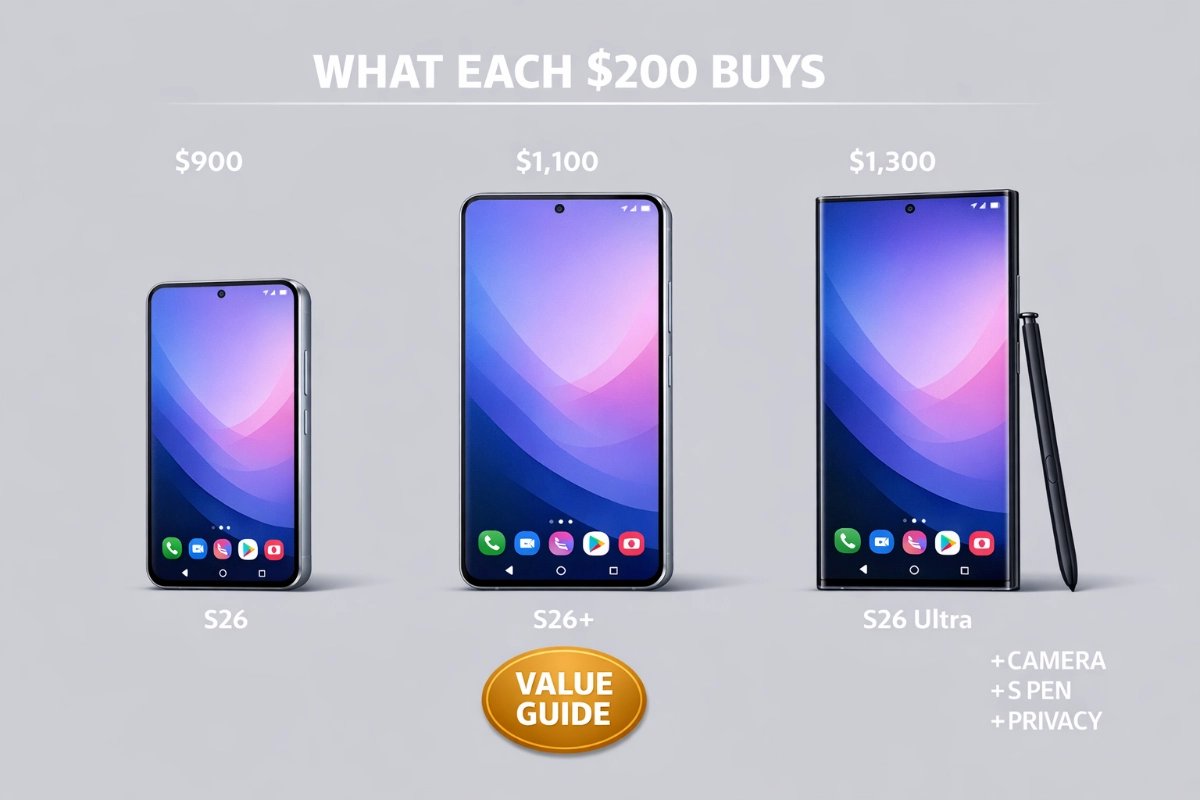
The S26, S26+, and S26 Ultra share core DNA but diverge sharply in specific areas. All three run the Snapdragon 8 Elite Gen 5 processor in North America, feature similar aluminum frames with Gorilla Armor glass, and carry IP68 water resistance. The software experience stays identical across models with Android 16, seven years of updates, and the same AI features from Galaxy AI to Circle to Search.
Here's where your money actually splits:
Base S26 ($900): 6.3-inch display at 2,340 x 1,080 pixels, triple camera array unchanged from last year, 4,300mAh battery, 15W wireless charging, sub-6GHz 5G only
S26+ ($1,100): 6.7-inch display at 3,120 x 1,440 pixels, same triple camera as base model, 4,900mAh battery, 20W wireless charging, mmWave + sub-6GHz 5G support
S26 Ultra ($1,300): 6.9-inch display at 3,120 x 1,440 pixels, quad camera with 200MP main sensor, 5,000mAh battery, 25W wireless charging, Privacy Display, S Pen, mmWave + sub-6GHz 5G support
The Plus model offers nothing photographically over the base S26 despite costing $200 more. You're paying for screen size, resolution, faster wireless charging, and mmWave connectivity. The Ultra justifies its premium through camera hardware, Privacy Display, and the embedded stylus. Whether those matter depends entirely on your usage patterns.
Storage configurations complicate the value equation further. All models start at 256GB with 12GB RAM, with 512GB available across the lineup. The Ultra adds a 1TB option with 16GB RAM at $1,800. That's a $500 premium over the base 256GB Ultra, or $900 more than a base S26. For most users, 256GB suffices. That 1TB tier exists for professionals shooting extensive 8K video or maintaining massive photo libraries.
Camera hardware separates the Ultra from its siblings more than any other specification. The S26 and S26+ carry identical triple-camera setups completely unchanged from previous generations: a 50MP main at f/1.8, 12MP ultrawide at f/2.2, and 10MP 3x telephoto at f/2.4. Samsung made zero upgrades here. If you owned an S25 or S25+, you're shooting with the same glass.
The S26 Ultra takes a different approach. Its 200MP main camera now uses an f/1.4 aperture instead of f/1.7, capturing 47% more light according to Samsung. The 50MP periscope telephoto for 5x optical zoom moved from f/3.4 to f/2.9, grabbing 37% more light. These aren't sensor size increases. They're aperture improvements targeting low-light performance, historically a weakness in Samsung phones.
Wider apertures deliver measurable benefits in specific conditions. Shooting indoors without flash, capturing evening cityscapes, or photographing subjects in shade all benefit from increased light capture. The difference shows in reduced noise, better detail retention, and faster shutter speeds that minimize motion blur. Android Authority noted the aperture improvements address real-world scenarios where previous Samsung flagships struggled.
What you won't gain: better daytime photos. In bright outdoor conditions with ample light, the base S26's camera performs nearly identically to the Ultra's. Computational photography and AI processing apply equally across models. The Ultra's advantage materializes specifically when light becomes scarce. If you rarely shoot in challenging lighting or don't pixel-peep your photos, spending $400 for superior low-light capability makes little sense.
The Ultra's dual telephoto setup (10MP 3x plus 50MP 5x) enables up to 100x digital zoom compared to 30x on the base and Plus models. Beyond 10x, you're into digital zoom territory where quality degrades rapidly. The practical telephoto advantage sits between 3x and 10x, useful for concerts, sporting events, or wildlife if you frequent those scenarios. For everyday photography of people, food, and travel snapshots, the base S26's 3x lens handles it fine.
Every Galaxy S26 uses the same Snapdragon 8 Elite Gen 5 chip if you live in North America, China, or Japan. Samsung claims 19% faster CPU performance, 24% faster GPU performance, and 39% better AI processing compared to last year's chip. Those numbers matter less than where you buy the phone.
European and most global buyers receive the Samsung Exynos 2600 processor in the base S26 and S26+ models. Only the Ultra ships with Snapdragon worldwide. This isn't disclosed prominently. The model names stay identical, the prices stay identical, but the silicon differs fundamentally.
The Snapdragon chip uses two Prime cores running at 4.6GHz and six Performance cores at 3.65GHz. The Exynos version runs one C1-Ultra core at 3.8GHz, three C1-Pro cores at 3.25GHz, and six efficiency cores at 2.75GHz. That's nearly a 1GHz clock speed gap on the fastest cores. Early Geekbench 6 testing shows the Snapdragon delivering 15% to 20% better single-core CPU performance, though multi-core scores land within margin of error thanks to the Exynos having more cores total.
GPU performance surprisingly favors the Exynos in some benchmarks due to AMD's RDNA architecture collaboration. Both chips handle everyday tasks smoothly. The gap emerges in sustained workloads: extended gaming sessions, 8K video recording, or processor-intensive apps running for minutes rather than seconds. Thermal management historically favored Qualcomm chips, though Samsung's new copper heatsink technology in the Exynos 2600 aims to close that gap.
After looking into of the regional processor split, buyers face a performance lottery based solely on geography. Spending $900 on a base S26 in New York gets you meaningfully different hardware than spending £879 on the same model in London, despite identical pricing relative to market. The Exynos 2600 isn't a bad chip. It's Samsung's own silicon using advanced 2nm manufacturing versus the Snapdragon's 3nm process. But the clock speed disadvantage and historical thermal patterns create an uncomfortable reality: identical model names mask hardware disparities, and customers pay the same price for objectively different performance ceilings.
Battery capacity numbers mislead. The S26 packs 4,300mAh, the S26+ carries 4,900mAh, and the Ultra holds 5,000mAh. Those are the marketing numbers. What matters more: how long they last under actual use.
EU energy labels provide standardized testing data. The base S26 achieves 51 hours of runtime per charge. The S25 managed 37 hours with its 4,000mAh battery. That's a 38% endurance improvement from just a 7.5% capacity increase. The S26+ and Ultra both reach 55 hours, up from approximately 44 hours on their predecessors. Those gains stem from silicon efficiency, modem optimization, and display improvements rather than physically larger cells.
The Plus and Ultra batteries didn't grow at all compared to last year. Capacity stayed flat. Yet runtime jumped 22% to 26% through efficiency alone. Samsung prioritized making each milliamp-hour work harder instead of cramming in bigger batteries that add weight and thickness.
This creates a surprising scenario: the base S26 nearly matches its larger siblings in practical endurance despite having 600mAh to 700mAh less capacity. For users who charge nightly, all three models clear a full day comfortably. The Plus and Ultra provide more cushion for heavy users or those who forget to charge, but the gap isn't as dramatic as raw capacity suggests.
There's a trade-off. Samsung reduced battery longevity ratings from 2,000 charging cycles to 1,200 cycles before hitting 80% capacity. At roughly 250 cycles per year for typical users, that's 4 to 5 years instead of 8 years. Samsung chose immediate user experience over long-term device lifespan.
When we analyzed battery strategy, Samsung made a calculated bet that users upgrade phones every 3 to 4 years regardless of battery health. The efficiency gains deliver better daily experience now at the cost of accelerated degradation later. For buyers planning to keep their phone 5+ years, this matters. For those on upgrade cycles, it's invisible.
Charging speeds differentiate models. The Ultra finally supports 60W wired charging, reaching 75% in 30 minutes. The Plus handles 45W wired, while the base S26 stays at 15W wireless charging only for fast charging purposes. None include magnetic Qi2 functionality built in. You'll need specific cases to add magnetic mounting.
The S26 Ultra's defining feature isn't about megapixels or processing power. Privacy Display fundamentally changes how screens work in public spaces.
Samsung's Flex Magic Pixel technology modifies how the display emits light, making it nearly unreadable from side angles. Independent testing by UL Solutions measured 3.5% brightness at 45-degree viewing angles and 0.9% at 60 degrees. Those numbers mean someone sitting next to you on transit sees less than 1% of what you see straight-on. The screen effectively goes black from their perspective.
Unlike adhesive privacy protectors, this works from all angles including top and bottom. It toggles on and off instantly. You can apply it to the entire screen or just specific portions. Demonstrating with Google Messages, the feature activates automatically when opening sensitive apps if configured that way. Notification masking particularly impressed early reviewers. Privacy Display can hide just the notification pop-up area while leaving the rest of the screen visible, with precise edge detection around the alert.
This represents the first hardware-integrated privacy display in smartphones, comparable to MagSafe's introduction on iPhone in 2020 according to 9to5Google's hands-on assessment. Samsung Display filed over 150 patents related to this technology since 2020. The S26 Ultra uses second-generation LEAD 2.0 panels.
The Ultra maintains its embedded S Pen, though Samsung removed Bluetooth functionality. Air Actions gestures that let you control the phone remotely don't work anymore. What remains: precise stylus input for note-taking, photo editing, and document markup. The stylus sits inside the phone's body without requiring separate storage or charging.
Samsung dropped titanium frames from the Ultra, reverting to aluminum across all three models. This cuts manufacturing costs while maintaining durability through Gorilla Armor 2 glass. The Ultra measures 7.9mm thick and weighs 214g, actually 4g lighter than last year despite the same battery size.
These exclusive features justify the Ultra's premium only for specific users. If you work in finance, healthcare, or handle sensitive information in public frequently, Privacy Display provides genuine security value. If you take extensive handwritten notes or mark up documents regularly, the S Pen enables workflows touchscreens can't match. If neither applies, you're paying $400 for features you'll rarely activate.
The right S26 depends on how you'll actually use it, not which spec sheet looks most impressive. Here's how to decide based on real-world priorities:
Choose the base S26 if: You rarely shoot photos in low light, primarily use your phone for messaging and media consumption, want something pocketable, and don't need mmWave 5G. At $900, it delivers 90% of the experience for 69% of the Ultra's cost. The battery efficiency improvements fixed the previous generation's main weakness.
Skip the S26+ unless: You specifically want a large 6.7-inch screen at QHD+ resolution but don't care about camera upgrades or the S Pen. It offers nothing photographically over the base model. You're paying $200 for display size, mmWave support, and slightly faster wireless charging. That's a narrow use case.
Buy the Ultra only if: You shoot extensively in challenging lighting, need Privacy Display for work, use a stylus regularly, or want the most capable camera Samsung offers. At $1,300, it's Samsung's complete package. But "complete" matters only if you'll use those exclusive capabilities. Buying the Ultra for bragging rights while never touching the S Pen or Privacy Display wastes $400.
Consider the processor carefully: If you're in Europe or most global markets, the base S26 and S26+ ship with Exynos chips that perform 15% to 20% slower in CPU tasks than the Snapdragon version North American buyers receive at identical prices. The Ultra uses Snapdragon worldwide. This geographic lottery affects which model provides the best value based solely on where you live.
The S26 series represents incremental evolution, not revolution. Samsung increased prices while making selective improvements rather than overhauling the lineup. The base model's battery efficiency gains matter more than the Ultra's extra megapixels for most buyers. The Plus model occupies an awkward middle ground with few compelling reasons to exist. The Ultra justifies its premium only when you'll actively use its exclusive features.
Your $900 to $1,300 decision should reflect which features you'll actually notice during two years of daily use, not which spec list looks longer.
Samsung's Galaxy S26 lineup arrives with three models spanning $400 in price, but the spec sheet won't tell you which differences you'll actually notice daily. The base S26 costs $900, the Plus rings up at $1,100, and the Ultra commands $1,300. That's straightforward enough until you realize Samsung removed the 128GB option entirely, forcing every buyer into 256GB minimum storage at prices $40 to $100 higher than last year's equivalent models. Meanwhile, Apple's iPhone 17 with 256GB sells for $830. The pricing pressure creates an uncomfortable question: what are you getting for each $200 jump, and does it matter for how you'll use the phone? Marketing materials highlight megapixel counts and display sizes, but real-world performance gaps tell a different story. Some differences justify the cost. Others don't.
Boost your workflow with our browser-based tools
Share your expertise with our growing community. We accept in-depth articles on Tech, AI, and Dev.
Get StartedFinished reading? Continue your journey in Tech with these hand-picked guides and tutorials.