|
|
|
|
Insights and perspectives on technology, AI, software development, and industry trends from the TrueSolvers team.
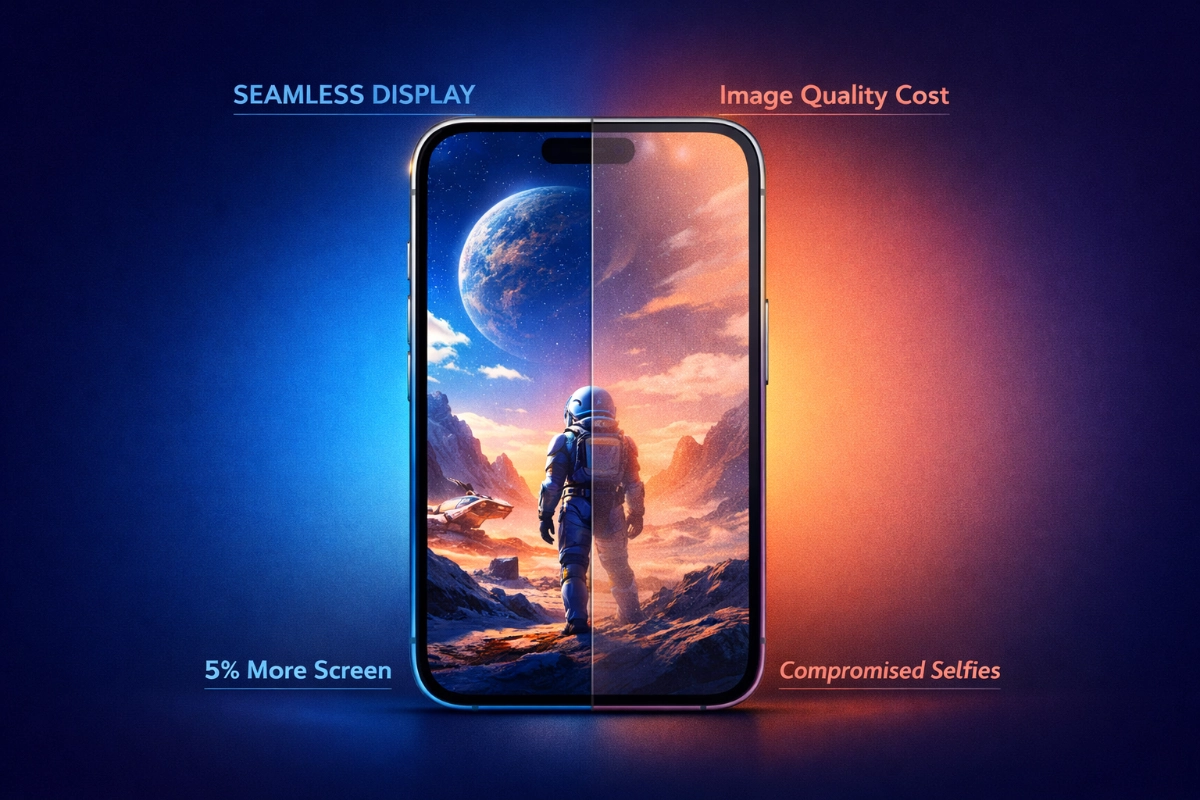
Smartphone displays have chased the bezel-free ideal for nearly a decade. Apple introduced the notch in 2017, evolved it into Dynamic Island in 2022, but consumers never stopped asking for a truly uninterrupted screen. The technical challenge isn't about hiding components. It's about maintaining image quality when a camera peers through active display pixels.
ZTE shipped the first under-display camera phone in 2020 with the Axon 20 5G. The technology hasn't gone mainstream because the fundamental physics creates stubborn problems. When light travels through display layers to reach a camera sensor, three things happen. First, the pixel grid blocks substantial amounts of light from entering the lens. Second, gaps between pixels cause diffraction artifacts that blur images and reduce sharpness. Third, thin-film layers in OLED displays alter the light's path and spectral characteristics, degrading color accuracy.
These aren't software problems that updates can fix. They're optical limitations imposed by physical materials. The camera technically worked, but image quality fell below acceptable standards for premium devices. That gap between working and working well has kept under-display cameras confined to niche products.
Apple partnered with Samsung Display to develop specialized OLED panels where the screen area above the camera achieves sufficient transparency without creating visible artifacts during normal use. This balancing act represents the core technical achievement. Make the display too transparent and users see a hazy patch when viewing light backgrounds. Keep pixel density too high and the camera can't gather enough light for acceptable photos.
Samsung's teams identified low light transmittance and diffraction as the primary obstacles. According to Samsung engineers working on Galaxy Z Fold4, image quality depends on both camera specifications and display panel properties, creating a unique challenge compared to conventional punch-hole cameras. The company developed AI-based three-dimensional image signal processing algorithms with built-in flexibility to tune output based on different panel characteristics.
Apple's implementation will use enhanced OLED displays from Samsung while maintaining the 120Hz ProMotion refresh rate. The display area above the camera uses a different pixel arrangement than the rest of the screen. This specialized region must remain imperceptible during everyday use while allowing adequate light transmission for photography. Getting this balance right took years of development because there's no margin for error. Users notice display irregularities immediately.
The camera area often appears as a blurrier patch even when inactive, particularly noticeable during full-screen content viewing or gaming. Current under-display implementations haven't eliminated this visual indicator completely. Apple's tolerance for imperfection is famously low, suggesting their solution minimizes but may not entirely remove the visible camera region. The extent to which this partial visibility proves distracting will determine how users perceive the feature in daily use.
Removing Dynamic Island increases viewing area by approximately five percent compared to iPhone 15 Pro models. That translates to more immersive experiences for video streaming, gaming, and photo viewing. The gain matters more than the percentage suggests because the notch interrupts content at eye level where attention focuses naturally.
Full-screen video no longer gets cropped around a black cutout. Games designed for edge-to-edge displays can finally use the entire panel without avoiding the Dynamic Island zone. Photography apps show more of your composition during capture. These improvements accumulate throughout daily use, making the screen feel genuinely larger despite identical 6.3-inch and 6.9-inch diagonal measurements for iPhone 18 Pro and Pro Max.
The aesthetic benefit shouldn't be dismissed either. Phones with uninterrupted displays simply look more premium. They signal technical sophistication in a way that specs can't convey. For users who prioritize design as much as function, eliminating the notch represents meaningful progress even if practical gains measure in single-digit percentages.
Under-display cameras struggle significantly with image quality, especially in low-light conditions. Light passing through display layers creates suboptimal flow to the sensor, requiring extensive computational correction.
From our assessment of current under-display implementations, a clear pattern emerges: all require aggressive AI processing to produce acceptable images, and none match conventional camera quality in challenging conditions. Video calls show reduced clarity. Selfies in dim restaurants come out noisier. The iPhone 18 Pro's selfie camera will technically work, but it won't perform at the level of the iPhone 15 Pro's conventional camera.
What specifically degrades:
Resolution and fine detail capture drops noticeably
Contrast suffers from light scattering through display layers
Color accuracy shifts due to thin-film interference
Low-light performance decreases from reduced light intake
Flare and haze appear in backlit situations
Apple will apply sophisticated processing to restore images. The A20 Pro chip's computational photography capabilities will work overtime correcting optical deficiencies. But there's only so much software can accomplish when the hardware foundation involves light passing through obstacles. If selfie quality ranks high in your priorities, this represents a genuine step backward from current Pro models.
Samsung's approach for Galaxy Z Fold4 required AI-based restoration algorithms for video recording and video calling scenarios for the first time, addressing strict requirements for real-time processing within power consumption constraints. Apple faces identical challenges. Processing every video call frame through restoration algorithms while maintaining acceptable power draw and thermal performance pushes the limits of current mobile processors.
The Face ID sensor array won't be completely invisible in iPhone 18 Pro. While the selfie camera hides beneath the display, the additional sensors required for facial recognition will remain somewhat visible. This partial implementation postpones the arrival of a completely borderless screen for future generations.
Apple prioritizes reliability over aesthetics for security features. Face ID needs to work instantly and accurately across varying lighting conditions, face angles, and environmental factors. Hiding those sensors beneath display layers would introduce failure points Apple won't accept. Better to maintain proven functionality than chase aesthetic perfection at the cost of dependability.
This pragmatic decision reveals Apple's actual priorities. The company will push display technology to eliminate visible interruptions, but not at the expense of core features users depend on daily. Face ID unlocks your phone dozens of times per day. Occasional front camera use doesn't demand the same reliability threshold. Treating these features differently makes engineering sense even if it complicates the marketing narrative around seamless displays.
The iPhone 18 Pro introduces variable aperture technology to the main camera, allowing manual adjustment between f/1.4 and f/2.0. This addresses a specific problem created by large smartphone sensors paired with wide apertures: excessively shallow depth of field that makes practical photography difficult.
Large sensors with wide apertures create focus zones where only small areas remain sharp. Peripheral subjects in group shots appeared out of focus. Food photography showed blurred edges on items at the frame borders. Document photography became problematic because flat surfaces couldn't stay uniformly sharp.
Aperture size controls two critical factors: light intake and depth of field. A wider aperture like f/1.4 gathers more light, improving low-light performance but creating extremely narrow focus zones. A narrower aperture like f/2.0 reduces light intake but extends the area that remains in focus. Variable aperture lets photographers choose the right balance for each situation.
This matters more as sensors grow larger. One-inch image sensors benefit from at least four distinct aperture settings to maintain both image quality and creative flexibility. The larger the sensor, the more critical aperture control becomes for keeping images properly focused across different shooting scenarios.
From our detailed study of variable aperture implementations, We've found that automatic aperture adjustment proves most valuable for users who don't want manual control. Many phones with this capability switch between aperture levels automatically in standard photo mode. The Xiaomi 13 Ultra implements dual aperture switching between f/1.9 and f/4.0. While less flexible than continuous adjustment, this still provides distinctly different aperture options that help keep pictures properly focused.
Apple's implementation will likely favor automatic operation by default, adjusting aperture based on scene analysis. Users who want manual control can access it through pro camera modes. This approach makes the technology accessible to casual photographers while giving enthusiasts the control they want.
The A20 Pro chip manufactured using TSMC's two-nanometer process enables the under-display camera and variable aperture features through raw processing power. According to AppleInsider, this represents Apple's first chip at the two-nanometer node, delivering expected performance improvements between ten and fifteen percent compared to the iPhone 17 generation.
Smaller transistors switch faster while consuming less energy. The higher transistor density allows the chip to handle artificial intelligence and machine learning tasks more efficiently. This proves crucial for under-display camera image restoration, which requires processing every photo through complex algorithms that correct optical deficiencies.
The chip also enables variable aperture processing. When the aperture changes, the camera system must adjust exposure, focus calculations, and image processing parameters in real time. The A20 Pro handles these adjustments seamlessly while managing thermal output and battery consumption. TSMC plans to implement WMCM packaging for the A20 Pro, replacing the current InFo packaging method, potentially increasing memory bandwidth for faster data transfer between processor and memory.
Battery life improves through a stainless steel casing that replaces aluminum in previous models, a crucial improvement since ultra-slim phone designs often sacrifice battery capacity for aesthetics. The device maintains peak performance longer during intensive tasks like extended photography sessions or video recording.
The iPhone 18 Pro delivers the seamless display Apple's pursued for years, but the achievement requires compromises around selfie quality that won't suit everyone. If front camera performance matters less to you than screen aesthetics and immersive content viewing, the under-display implementation represents genuine progress. If video calls and selfies rank among your primary phone uses, the image quality degradation compared to iPhone 15 Pro poses a real concern.
Variable aperture proves more universally beneficial. It solves actual problems that large-sensor cameras create without introducing new drawbacks. Combined with the A20 Pro's processing capabilities and improved battery technology, the iPhone 18 Pro advances in meaningful ways beyond just hiding the notch. Whether those advances justify upgrading depends on which features matter most for your specific usage patterns.
Apple's iPhone 18 Pro eliminates the Dynamic Island by hiding the selfie camera beneath the display, delivering the seamless screen users have wanted since 2017. This creates five percent more viewing area but requires image quality compromises. The variable aperture main camera and A20 Pro chip offer more practical improvements. Understanding these trade-offs helps determine if upgrading makes sense for your usage.
Boost your workflow with our browser-based tools
Share your expertise with our growing community. We accept in-depth articles on Tech, AI, and Dev.
Get StartedFinished reading? Continue your journey in Tech with these hand-picked guides and tutorials.