|
|
|
|
Insights and perspectives on technology, AI, software development, and industry trends from the TrueSolvers team.
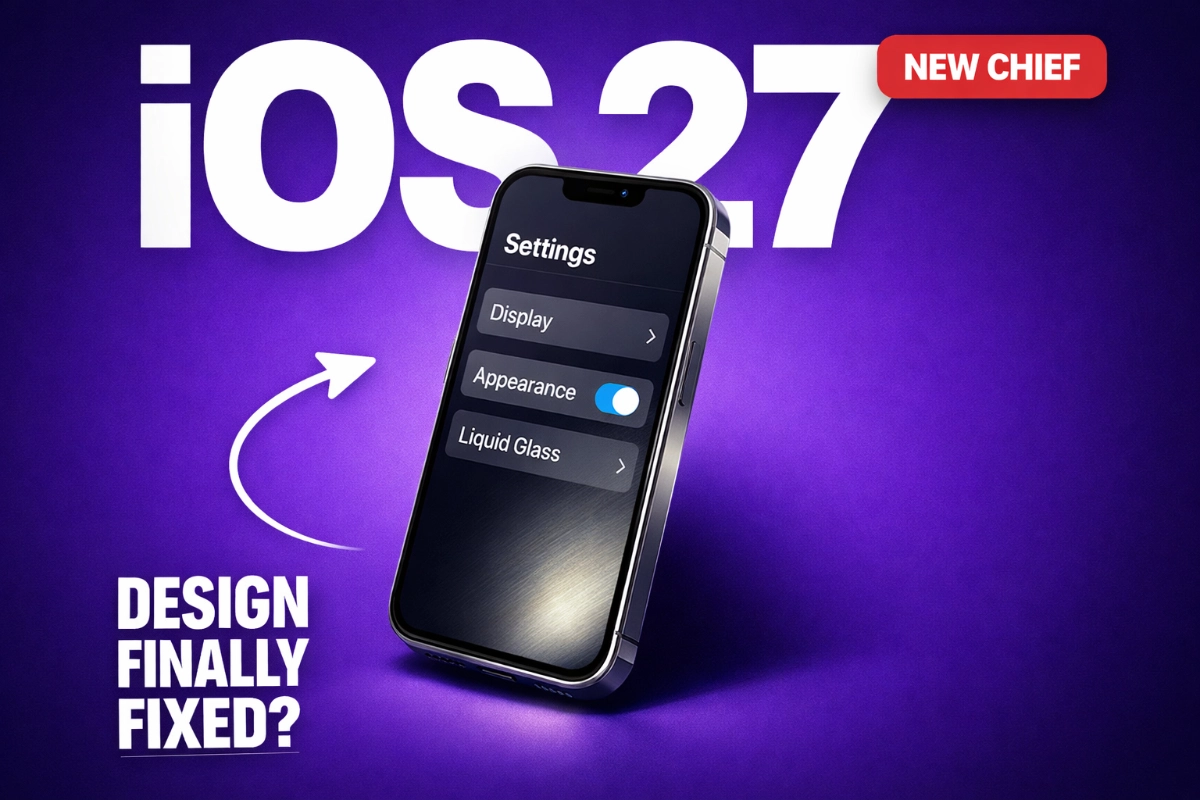
When iOS 26 launched with Liquid Glass, the visual ambition was obvious. Translucent, refracting elements across navigation bars, tab bars, and app controls created an aesthetic that felt genuinely new. Apple borrowed from the spatial computing work behind Vision Pro and applied it to the flat phone screen. The result looked alive.
Actually using it revealed a different set of problems.
Nielsen Norman Group, the most authoritative UX research organization in the field, documented specific failures after analyzing iOS 26. Tab bars collapse when users activate search, which strips away navigation at the exact moment someone needs to move between sections. Safari's forward button appears and disappears based on context, which sounds logical until you realize that predictable button placement is how people build reliable muscle memory. You can't trust a target that moves.
The Music app's song title animates like a ticker during playback and physically repositions itself when the tab bar shifts on scroll. Touch targets in Photos shrank compared to iOS 18, which conflicts with Apple's own Human Interface Guidelines specifying minimum tap area sizes. In Mail, translucent layers stack on each other and create legibility problems where text competes with text.
None of these are aesthetic complaints. They're functional regressions. An interface that hides controls at wrong moments, shrinks tap targets, and creates visual competition between layers isn't a style preference issue. It's a design that makes routine tasks harder than they were before.
The performance cost of Liquid Glass compounds the usability concerns.
Rendering real-time light refraction and physics-based animations isn't free. Every scroll, unlock, and notification in iOS 26 requires the GPU to compute what static elements in iOS 18 handled without that overhead. Older iPhones feel this most directly: users on iPhone 12 and 13 hardware reported batteries depleting before end of workday.
Structured testing showed the scale of the problem. A controlled test comparing iPhone 16 Pro Max units running iOS 26 versus iOS 18 put both devices through 150 repetitions of four standard daily actions: pulling notification center, opening and closing Safari, scrolling Photos, and unlocking. Both devices started at 80% battery with brightness at 50% and WiFi connected. According to BGR's reporting on the test by In Depth Tech Reviews, the iOS 26 device lost 13% battery completing those actions. The iOS 18 device lost 1%.
Apple acknowledged a "temporary impact on battery life and thermal performance" following the update. Whether Liquid Glass's animation overhead is truly temporary or structural is something iOS 27's expected codebase cleanup will directly address. Bloomberg reports iOS 27 is focused on removing legacy code, rewriting older features in more efficient forms, and producing a faster, more responsive OS as a byproduct. Better battery performance may follow from that work regardless of any explicit design changes.
Early reports suggested iOS 26 adoption was catastrophically low. One StatCounter figure placed adoption near 15%. That number was wrong.
The confusion came from an Apple privacy decision. iOS 26 deliberately misidentifies itself as iOS 16 in browser user-agent strings, which defeats advertiser fingerprinting techniques. Third-party analytics services that rely on user-agent strings counted iOS 26 devices as iOS 16 devices, producing badly distorted figures.
Apple's own App Store data tells a different story. According to MacRumors, as of February 12, 2026, 74% of iPhones from the last four years were running iOS 26. iOS 18 had reached 76% at a comparable stage, but that iOS 18 measurement was taken 23 fewer days after launch. Accounting for that gap, adoption curves are nearly identical.
iOS 26 adoption is slightly behind iOS 18. Not dramatically. Users are updating at roughly normal rates, which means most iPhone owners are living with Liquid Glass whether they love it, tolerate it, or actively dislike it. That population is large enough that iOS 27's interface tweaks will matter at scale.
Alan Dye became Apple's VP of Human Interface Design in 2015. His pre-Apple career included work at Kate Spade and Ogilvy & Mather, both brand and marketing communications roles. He joined Apple in 2006 through the marketing communications team, not the interface team. That career trajectory matters.
Brand and print design and software interaction design require fundamentally different thinking. Brand design asks: does this look right and communicate the right identity? Interaction design asks: does this feel right across ten thousand repeated uses by people with different habits, expectations, and physical precision? A button that photographs beautifully in a press release can be maddening to tap reliably in practice.
John Gruber at Daring Fireball reported that Dye's inner circle treated interaction design terminology as "programmer talk," a characterization that reveals a profound misalignment for people leading Apple's largest design organization. When the people defining an interface don't speak the language of interaction design, the interface optimizes for static presentation over dynamic use.
The results are visible in iOS 26's specific failures: controls that disappear on scroll, tap targets that shrink, animations that run continuously without purpose. These aren't bugs in implementation. They're decisions that prioritized how things looked over how they behaved.
When we studied the pattern across iOS 26 criticisms, the through line isn't "this looks bad." It's "this works worse than what it replaced." That's the signature of a design process that valued screenshots more than sessions.
Lemay's background is the inverse of Dye's. He joined Apple in 1999, was part of the original iPhone interface team alongside Imran Chaudhri, Bas Ording, Mike Matas, and Marcel Van Os, and spent 26 years building the interaction primitives that define how touch interfaces work.
His patent portfolio covers the fundamentals: virtual keyboards, gesture-based text selection, handwriting input. Justia lists 53 pages of his patents, including the master iPhone patent, US 8,570,278 B2. These aren't decorative contributions. They're the mechanics under the glass.
A project that captures his philosophy: the Apple Pencil Pro's shadow effect. When asked about it by French publication Numerama, Lemay explained the shadow's purpose was to help users cognitively feel like they're holding a real pencil. The shadow isn't decorative. It's functional. It creates cognitive alignment between the tool's behavior and the user's physical intuition.
That distinction, function and feeling as inseparable, is the core difference between his approach and what characterized the Dye era. Former colleague Ben Hylak described Lemay publicly as "by far the best designer I have ever met or worked with in my entire life." John Gruber reported Apple employees were "if not downright giddy" at news of the transition.
What Lemay brings to iOS 27, specifically, is a career-long focus on the gap between how interfaces look and how they perform under real, habitual use. The problems iOS 26 created are exactly the class of problems an interaction designer trained on touch primitives and physical cognition would prioritize fixing:
Tab bars that disappear unpredictably
Floating controls that compete visually with content
Tap targets too small for reliable activation
Animations that run continuously without communicating state
These aren't aesthetic problems requiring an art director. They're interaction problems requiring someone who thinks about gesture, spatial memory, and the cost of learned habits disrupted.
Bloomberg's Mark Gurman describes iOS 27's interface work as "tweaks," specifically noting they won't match the scale of iOS 26's Liquid Glass introduction. Liquid Glass itself isn't going anywhere. Gurman reports Apple's internal position is that the design was a collective institutional decision, not a personal Dye project.
So the conversation isn't "does Liquid Glass survive Lemay's arrival?" It already has. The conversation is what Lemay does with it now that he has expanded authority.
After looking into of what the documented iOS 26 failures have in common, every major usability problem is correctable within the Liquid Glass visual framework. Tabs can be persistent without abandoning translucency. Tap targets can meet HIG minimums while still using glass rendering. Animations can run purposefully, tied to state change rather than running continuously. These are refinements, not reversals.
That's precisely what "tweaks" creates room for. iOS 26 established the aesthetic language. iOS 27 is where that language gets corrected for actual legibility.
The Snow Leopard parallel that Gurman invokes is instructive. Apple's 2009 Mac OS update is famous for prioritizing reliability, speed, and cleanup over new capabilities. It's remembered as one of the best things Apple ever did for the Mac. That wasn't because Snow Leopard reversed what came before. It was because it fixed what Leopard got wrong while keeping what Leopard got right.
iOS 27 has the same structural opportunity.
The honest answer is that iOS 27's interface tweaks are unannounced in any specific detail. What Gurman confirmed is that tweaks are planned, not what they target.
But Lemay's background and the pattern of documented iOS 26 failures create a reasonable frame for expectations. He came up through interaction design. The iPhone's core gesture vocabulary carries his fingerprints. He thinks about the cost of disrupting learned physical habits. The iOS 26 problems that most directly violate those principles are the ones most likely to see attention.
Persistent tab bars that don't collapse on search activation. Navigation controls with stable enough placement to rebuild spatial memory. Tap targets that meet the size standards Apple set for itself. These are structural fixes, not aesthetic ones.
iOS 27 is also internally code-named "Rave" and carries significant cleanup work aimed at removing legacy code and rewriting older features more efficiently. Bloomberg reports new hardware arriving later in 2026 including a foldable iPhone and a touchscreen MacBook Pro. iOS 27 needs to be stable and fast as a platform for those devices. The incentive structure around this release pushes toward reliability over spectacle.
That combination, a design leader with interaction fundamentals at his core, a codebase cleanup aimed at efficiency, and new hardware driving platform stability requirements, sets up iOS 27 as genuinely consequential even if nothing it does looks dramatic from the outside.
The fixes that matter most rarely do.
Apple is planning interface tweaks for iOS 27, and they'll be more meaningful than the description "tweaks" implies. Not because the changes will be dramatic. But because whoever shapes them now operates with a fundamentally different design philosophy than the person who shaped Liquid Glass. That shift in thinking matters more than any single UI adjustment Apple might make.
Boost your workflow with our browser-based tools
Share your expertise with our growing community. We accept in-depth articles on Tech, AI, and Dev.
Get StartedFinished reading? Continue your journey in Tech with these hand-picked guides and tutorials.