|
|
|
|
Insights and perspectives on technology, AI, software development, and industry trends from the TrueSolvers team.
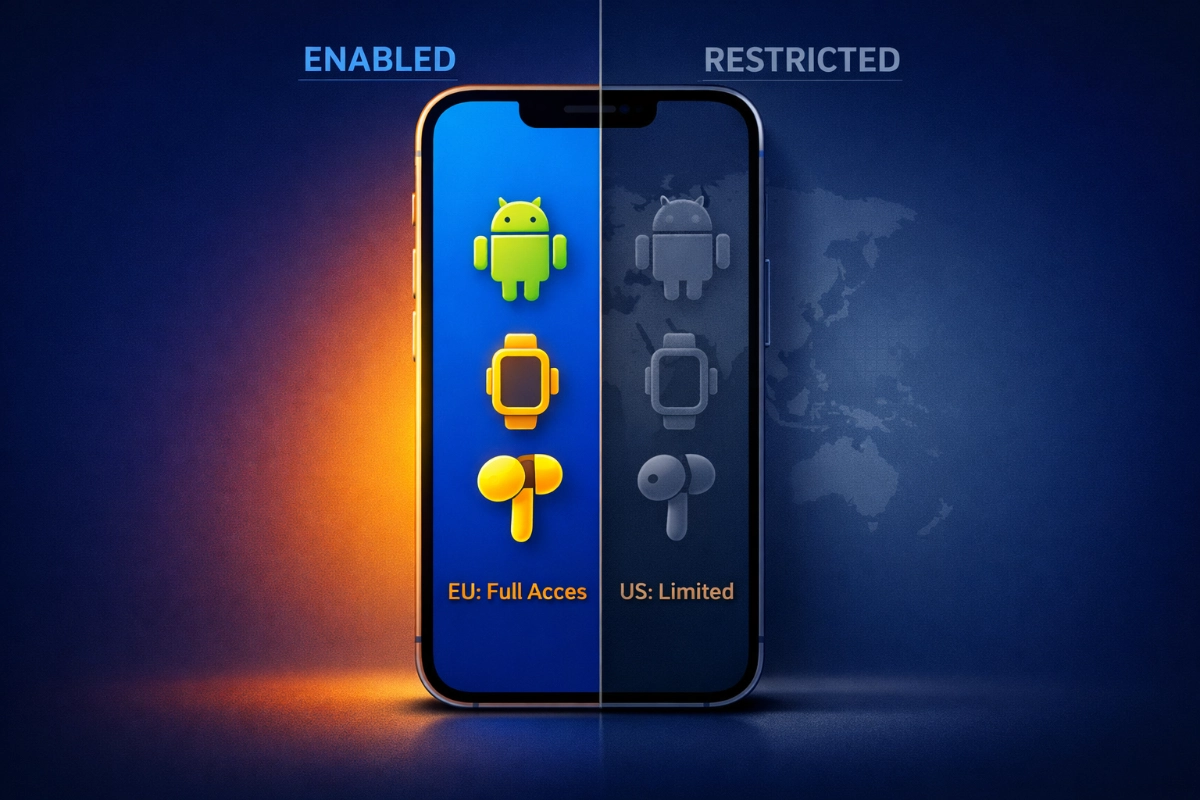
iOS 26.3's cross-platform features exist because European regulators demanded them, not because Apple voluntarily decided to open its ecosystem. The European Commission classified Apple as a "gatekeeper" under the Digital Markets Act and mandated equal access to iOS capabilities for competing products. According to official EU regulatory documentation, Apple must implement nine connectivity features for third-party devices with strict deadlines: beta versions by the end of 2025 and full implementation by June 1, 2026.
The DMA specifically targets practices that lock users into proprietary ecosystems. European regulators argued that Apple's integration advantages create unfair barriers for competing smartwatches, headphones, and smartphones. By restricting how third-party accessories interact with iPhones, Apple made its own products functionally superior regardless of their standalone quality. The regulation forces technical parity, requiring Apple to provide the same notification depth, pairing simplicity, and data access to any manufacturer that requests it.
Brazil's competition authority took separate action through its Administrative Council for Economic Defense. According to MacRumors, CADE launched an investigation in 2022 over concerns that Apple imposed unfair restrictions on app distribution and in-app purchases. Apple settled by agreeing to implement alternative app stores, third-party payment systems, and external offer links within 105 days, creating an April 2026 deadline. This follows similar forced openings in Japan and South Korea, establishing a global pattern where competition regulators compel ecosystem changes that Apple resists implementing voluntarily.
The timing matters. Apple released the first iOS 26.3 beta on December 15, 2025, just weeks before the EU's beta deadline. This wasn't a gradual strategic shift toward openness. Apple engineered these features under legal obligation with compliance timelines driving the release schedule.
Switching from iPhone to Android previously required downloading Google's "Switch to Android" app or manually exporting data through cloud services. iOS 26.3 eliminates that friction by building Android data transfer directly into iPhone settings. Navigate to General, then Transfer or Reset iPhone, and you'll find a new "Transfer to Android" option. Place your Android device next to your iPhone, and the system handles everything wirelessly.
The transfer uses a combination of WiFi and Bluetooth for local, encrypted data movement. According to AppleInsider, both devices need the latest software, WiFi connection, and active Bluetooth. You don't upload anything to cloud servers or download additional apps. The phones communicate directly, moving photos, messages, notes, apps, and your phone number to the new Android device.
This represents genuine collaboration between platform rivals. According to 9to5Mac, Apple and Google jointly developed the transfer system, with Android's latest beta adding reciprocal iPhone-to-Android switching capabilities. Google's SIM Manager app includes language specifically designed to help users transfer eSIM from iPhone to Android, showing coordination at the technical implementation level. The companies aligned their data migration frameworks so Android devices can natively interpret and import iPhone data formats.
The system works globally in all regions where iOS 26.3 ships, unlike other features in this update that remain Europe-only. Apple built universal compatibility for platform switching, likely because blocking it would face antitrust scrutiny worldwide, not just in the EU.
Transfer requirements:
iPhone running iOS 26.3 or later
Android device running latest system software
Both devices connected to WiFi
Bluetooth active on both devices
Devices placed in close physical proximity
iOS 26.3 introduces notification forwarding that lets third-party smartwatches display iPhone notifications with the same depth as Apple Watch. Previously, non-Apple wearables received only basic notifications through standard Bluetooth profiles, showing truncated message previews without actionable buttons or app-specific content. Now, according to 9to5Mac, users can view and react to incoming notifications with functionality that was exclusively limited to Apple Watch.
The system addresses a longstanding competitive complaint. According to MacRumors, third-party wearable makers argued that Apple Watch's exclusive access to rich notifications created an unfair advantage unrelated to hardware quality. A Garmin or Samsung watch might have superior battery life, fitness tracking, or display technology, but it couldn't match Apple Watch's notification depth simply because Apple restricted the APIs. The DMA specifically targeted this practice, requiring Apple to provide equal notification capabilities to any smartwatch manufacturer.
Setting up notification forwarding happens through the Notifications menu in iPhone Settings. You enable the feature and pair your third-party watch, which then receives the same notification detail that Apple Watch gets. Complications, quick replies, and notification actions all work as expected.
However, Apple engineered a significant technical constraint. According to AppleInsider, notifications forward to one accessory at a time, and enabling notification forwarding completely disables Apple Watch notifications. You can't run both simultaneously. If you own both an Apple Watch and a Garmin watch, you choose which one receives notifications. Switching requires toggling the setting each time.
Upon review of this binary limitation, the restriction serves Apple's competitive interests while technically complying with regulatory requirements. Nothing in the DMA mandates single-device-only forwarding. Apple could have implemented simultaneous notification forwarding to multiple devices, similar to how iMessage delivers to all your Apple devices. The artificial limitation ensures that using a third-party watch means sacrificing Apple Watch functionality entirely, creating friction that discourages cross-platform accessory use. Users who invested in Apple Watch face a choice: abandon their existing wearable completely or stick with the ecosystem. This design choice undermines the regulation's goal of enabling genuine competition.
Proximity pairing for third-party accessories works similarly to AirPods. According to MacRumors, bringing compatible earbuds or headphones close to an iPhone triggers a one-tap pairing interface, eliminating the traditional Bluetooth settings menu navigation. The feature makes non-Apple audio accessories as simple to connect as Apple's own products.
iOS 26.3's most significant limitation isn't technical but geographic. Android data transfer works globally, but notification forwarding and proximity pairing remain strictly EU-exclusive in the final release. According to MacRumors, Apple built these features into the worldwide iOS 26.3 codebase for testing purposes, so they currently appear on devices everywhere during the beta period. However, when the update reaches public release, geographic detection will activate these features only for users in European Union countries.
This creates a fragmented iPhone experience unprecedented in iOS history. An iPhone user in Germany can pair third-party earbuds with one tap and forward notifications to any smartwatch. An iPhone user in the United States with identical hardware running identical software cannot access these capabilities. The features exist in the code but remain locked behind region checks.
Apple's implementation approach reveals its resistance to voluntary ecosystem opening. Rather than embracing cross-platform compatibility as a competitive advantage or user benefit, Apple implements the absolute minimum required by each jurisdiction's regulations. The EU mandated these features, so EU users get them. Other markets lack equivalent mandates, so Apple maintains ecosystem restrictions there.
The European Commission confirmed this geographic limitation in an official statement. According to 9to5Mac, the Commission noted that developers can test interoperability with smartwatches, headphones, and TVs, with functionality "expected to be fully available in Europe" in 2026. The careful phrasing acknowledges these features won't extend beyond EU borders without additional regulatory pressure.
After studying of this fragmentation pattern, Apple's strategy of implementing region-specific features creates technical debt that will become increasingly difficult to maintain. The company now manages a globally unified iOS codebase with sophisticated geographic detection and feature flagging at a scale that previously didn't exist. Each new regulation in each new jurisdiction requires another layer of conditional feature activation. Japan mandates certain changes, South Korea others, Brazil adds more, and the EU continues opening specification proceedings for additional interoperability measures. This multiplying complexity suggests iOS will increasingly diverge by region rather than offering a consistent global product experience.
Third-party app store expansion to Brazil follows the same pattern. According to MacRumors, Brazilian users will gain access to alternative app marketplaces like AltStore alongside Apple's App Store, but this availability extends only to Brazil due to CADE's settlement requirements. European users already have third-party app stores through earlier DMA compliance, but users in most of the world remain locked to Apple's App Store exclusively.
The Android transfer tool includes deliberate exclusions that limit its usefulness for certain users. According to MacRumors, Health data, Bluetooth-paired devices, and password-protected notes cannot transfer to Android devices, even when running iOS 26.3. Apple cites platform incompatibilities and privacy architecture differences, though these limitations conveniently protect Apple's ecosystem advantages in health tracking and secure note-taking.
The Health exclusion matters most for fitness-focused users. Years of workout data, medical records, menstrual cycle tracking, and health metrics remain trapped on iPhone. Android has health tracking capabilities through Google Fit and Samsung Health, but Apple won't export the data in a format these systems can import. Users switching platforms lose their complete health history and must start fresh.
Bluetooth-paired devices include accessories like fitness trackers, hearing aids, and medical devices that connect directly to iPhone. These pairings don't transfer, requiring manual re-pairing with the new Android device. For medical devices or complex accessories, this can involve troubleshooting and reconfiguration.
Password-protected notes with additional security layers beyond basic note encryption don't move to Android. Standard notes transfer, but users who locked specific notes with passwords or biometric authentication must manually migrate that content.
Excluded from Android transfer:
Complete Health app data and medical records
Bluetooth device pairings and configurations
Password-protected or biometrically secured notes
Apple Pay card information
HomeKit smart home configurations
Apple Watch pairing and fitness data
According to 9to5Mac, Apple and Google stated that new data types will be added as they continue the beta testing process across both platforms. This suggests current exclusions might narrow over time, but there's no timeline or commitment for specific additions.
The exclusions preserve Apple's competitive moat in health and home automation. Even when regulations force Apple to enable platform switching, the company maintains strategic data restrictions that make switching painful for users deeply invested in its ecosystem services.
Apple typically delivers three beta versions followed by a Release Candidate before rolling out the final stable version, with each beta taking approximately one week. The 28-day timeline from initial beta suggests a late January 2026 launch. Historical data supports this estimate. iOS 18.3 released on January 27, iOS 17.3 on January 22, and iOS 16.3 on January 23, establishing a consistent pattern of third-point updates launching in the final week of January on Mondays. The expected release is Monday, January 26, 2026, though Apple may delay if critical bugs emerge.
The update measures approximately 8GB download size with build number 23d5089E, according to Geeky Gadgets. iOS 26.3 also brings improvements to the Preview app for document editing capabilities. Early beta testers report stable performance comparable to iOS 26.2, with no significant battery degradation attributable to the new features themselves. However, typical beta issues persist: keyboard lag, occasional camera freezing, intermittent WiFi disconnections, and CarPlay connectivity problems. These bugs should resolve in subsequent betas before public release.
Battery performance remains consistent with previous versions. According to Apple Headlines, iPhones run background indexing tasks for three to five days after major updates, temporarily affecting battery life during that period. Users should expect normal battery behavior once indexing completes.
iOS 26.3 represents Apple's initial compliance step rather than complete ecosystem opening. The EU continues opening additional specification proceedings for more interoperability measures. The UK and Australia are developing similar regulatory frameworks. This suggests iOS will continue fragmenting by region, with users in regulated markets gaining cross-platform capabilities that users elsewhere lack. The walled garden isn't gone. It's just developing holes where regulators force them open, creating a multi-tiered iPhone experience based on geography rather than hardware capability.
Apple's iOS 26.3 beta enables direct iPhone-to-Android data transfer, forwards notifications to any smartwatch, and pairs third-party earbuds like AirPods. These cross-platform features break down ecosystem barriers, but geographic restrictions and technical limitations mean not all iPhone users worldwide can access them.
Boost your workflow with our browser-based tools
Share your expertise with our growing community. We accept in-depth articles on Tech, AI, and Dev.
Get StartedFinished reading? Continue your journey in Tech with these hand-picked guides and tutorials.