|
|
|
|
Insights and perspectives on technology, AI, software development, and industry trends from the TrueSolvers team.
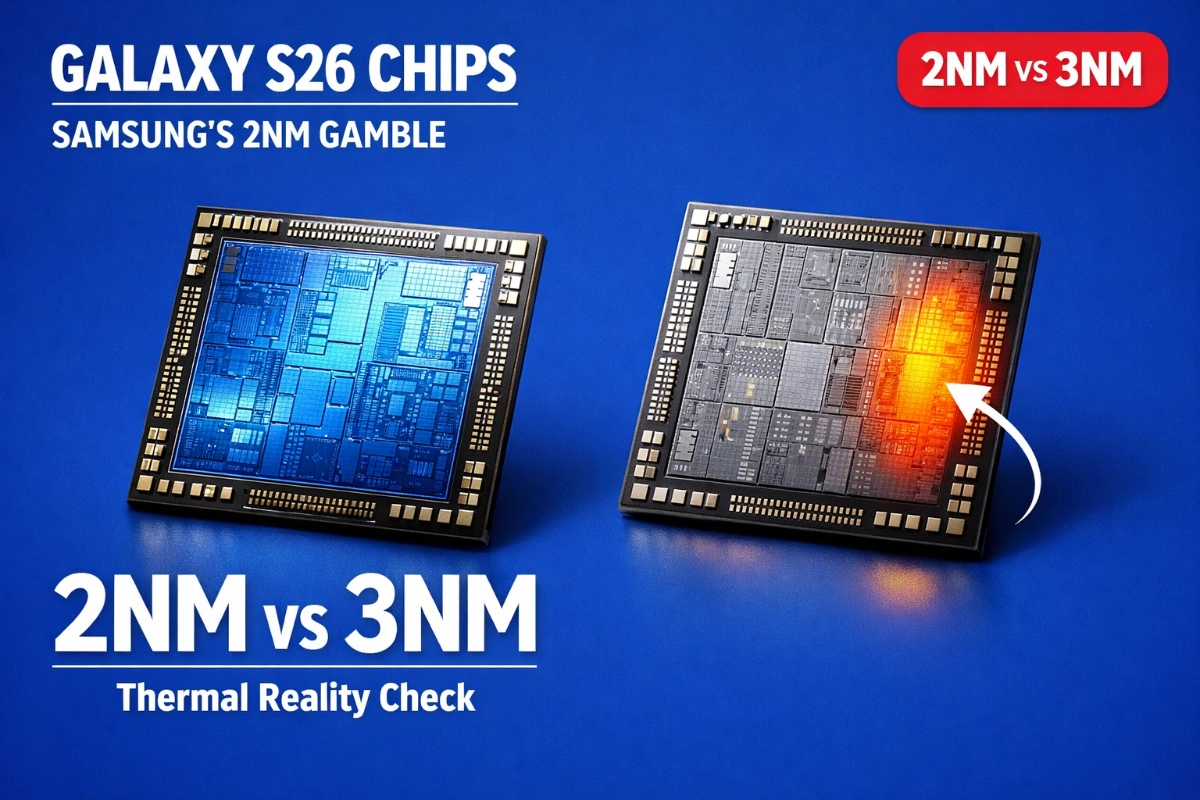
The Galaxy S26 lineup launches February 25, 2026, with Samsung's familiar dual-chip strategy but an unfamiliar twist. Global markets including Europe, India, and the Middle East get the Exynos 2600 built on Samsung's 2nm GAA process. The US, China, and anyone buying the S26 Ultra worldwide receives Qualcomm's Snapdragon 8 Elite Gen 5 on TSMC's 3nm N3P node.
This marks the first time an Exynos chip uses more advanced manufacturing than its Snapdragon counterpart. Samsung's 2nm GAA process represents the industry's first smartphone processor at this node size. Smaller transistors packed more densely should deliver better performance per watt, which matters for battery life and heat generation.
But specs on paper don't guarantee better phones. The Exynos 2500 from last year also promised improvements yet still lagged behind Snapdragon 8 Elite in real-world testing. What's different this time comes down to how Samsung addressed the fundamental weakness that plagued every Exynos generation: thermal management.
Manufacturing process nodes determine what's physically possible inside a processor. At 2nm, transistors measure smaller than at 3nm, allowing more computing power in the same die area. Samsung's GAA (Gate-All-Around) architecture wraps the gate around all four sides of each transistor channel, providing tighter control over electrical current compared to FinFET designs that contact only three sides.
According to Samsung's official announcement in November 2025, the 2nm GAA process delivers specific measurable gains over their own 3nm GAA technology:
5% higher performance at equivalent power draw
8% better power efficiency at the same performance level
5% improved transistor density for mixed logic and memory designs
TSMC's N3P node, which powers the Snapdragon 8 Elite Gen 5, offers its own advantages. The N3P process provides 5% higher performance at the same leakage or 5-10% lower power at identical frequencies compared to TSMC's N3E node, plus 4% better transistor density. However, N3P remains a FinFET architecture, which means it can't match GAA's control over leakage current at the transistor level.
Leakage current matters because it represents wasted power that generates heat without doing useful work. Lower leakage means the processor can run cooler at the same performance level or push higher performance within the same thermal envelope. That's where manufacturing differences translate to user experience.
Samsung introduced Heat Path Block technology on the Exynos 2600, marking the first implementation of this thermal solution in a mobile processor. HPB uses a copper-based heatsink integrated directly onto the chip die, with DRAM repositioned to the side rather than stacked on top. This creates direct thermal contact between the processor and the phone's cooling system.
The official Exynos 2600 documentation claims HPB reduces thermal resistance by up to 16% and lowers operating temperatures by 30% compared to the Exynos 2400. Combined with High-k EMC epoxy molding compound, the system disperses heat more efficiently so the processor maintains stable internal temperatures even under sustained loads like gaming or AI processing.
Ironically, thermal issues shifted to Qualcomm's side this generation. Testing on the Snapdragon 8 Elite Gen 5 reveals severe throttling under sustained workloads. The realme GT8 Pro, representing a mainstream flagship implementation, demonstrates the thermal reality facing phones without extreme cooling solutions.
In 3DMark stress testing designed to measure sustained rather than burst performance, the realme GT8 Pro throttles dramatically to maintain safe touch temperatures. According to Android Authority's testing in November 2025, the device drops to just 28.6% of peak performance in the demanding Solar Bay test and 38.9% in the Wildlife benchmark. Surface temperature caps at 44.1°C, which is already hotter than the typical 40°C target for comfortable handheld use.
Only gaming phones with active cooling fans can sustain the Snapdragon 8 Elite Gen 5's peak capabilities. The RedMagic 11 Pro maintains performance within a few percentage points of Qualcomm's reference model but hits internal temperatures of 56°C during stress tests. That's far too hot for phones people actually hold and use.
Based on our thorough investigation of thermal behavior across multiple Snapdragon 8 Elite Gen 5 devices, the pattern is clear: mainstream phones sacrifice massive performance to stay thermally comfortable, while gaming phones with elaborate cooling achieve the promised performance at the cost of uncomfortable heat levels. The 2nm process combined with HPB technology allows Exynos 2600 to sustain performance longer before thermal limits force throttling.
Early benchmark data from multiple sources shows Snapdragon maintains advantages in specific areas while Exynos closes gaps that were wide in previous generations. The architectural differences remain significant but tell a more nuanced story than past years.
Snapdragon uses two Prime Oryon V3 cores clocked at 4.74GHz (in the "for Galaxy" variant) plus six Performance cores at 3.62GHz, creating an eight-core design. Exynos 2600 deploys ten cores with one ARM C1-Ultra at 3.80GHz, three C1-Pro cores at 3.25GHz, and six C1-Pro cores at 2.75GHz. That nearly 1GHz clock speed difference on the prime core drives clear single-core advantages for Snapdragon.
According to benchmark leaks from Greek outlet TechManiacs reported by NotebookCheck, the Snapdragon-powered Galaxy S26 Ultra achieved 3,724 points in single-core and 11,237 points in multi-core Geekbench testing. The Exynos-equipped regular S26 scored 3,197 in single-core and 11,012 in multi-core.
The performance breakdown reveals two distinct patterns:
Single-core performance: Snapdragon leads by approximately 16%, directly correlating to the clock speed advantage
Multi-core performance: Snapdragon leads by only 2%, which falls within margin of error for early pre-release testing
Exynos's ten-core layout compensates for lower individual core speeds when running parallel workloads. The 2nm process efficiency helps those extra cores run without proportionally increasing power consumption or heat generation.
GPU testing shows a different story. According to PhoneArena's reporting on Basemark results, the Exynos 2600's Xclipse 960 GPU scored 8,262 points in the In Vitro ray-tracing benchmark. That came in approximately 10% higher than the Snapdragon 8 Elite Gen 5's Adreno 840, which scored around 7,500 points in the same test using the Nubia RedMagic 11 Pro.
Samsung claims the Xclipse 960 delivers twice the graphics performance of the previous generation and 50% faster ray-tracing. The company also introduced Exynos Neural Super Sampling, an AI-based upscaling technology similar to Qualcomm's Game Super Resolution feature.
Power efficiency becomes the Exynos 2600's standout advantage when examining real-world power consumption data. Testing on prototype devices shows the chip consuming 7.6W during multi-core workloads and 3.6W during single-core tasks, with claims of 59% better efficiency than competing processors on similar workloads.
Lower power consumption translates directly to battery life. More efficient chips waste less energy as heat and extend runtime between charges. The combination of 2nm manufacturing efficiency and improved thermal management should favor Exynos in real-world battery longevity, reversing years of Snapdragon dominance in this metric.
The CPU architecture represents another strategic advantage. Samsung eliminated the traditional tri-cluster design with big, middle, and little cores. Instead of low-power cores that handle background tasks, the Exynos 2600 uses only high-performance and mid-tier cores. This broadens the performance envelope while maintaining efficiency without compromising peak capabilities. According to Samsung's official documentation, the redesigned architecture contributes to the claimed 39% improvement in overall CPU computing performance.
AI processing capabilities differ in meaningful ways beyond raw performance numbers. Exynos 2600 supports ARM's Scalable Matrix Extension 2 (SME2) instruction set for on-CPU machine learning, while Snapdragon supports only the first-generation SME. SME2 enables multi-vector instructions and weight compression, allowing lighter AI tasks like text-to-speech or summarization to run on CPU cores without activating the power-hungry NPU. This reduces both latency and power consumption for conversational AI and text processing tasks.
From our investigation of manufacturing yields and production reality, Samsung's 2nm GAA process reportedly reached 55-60% yield rates by late 2025, which is respectable for a new node but still trails TSMC's mature N3P yields. This affects Samsung's economics and production costs rather than end-user experience, but it's worth noting for context about supply availability.
Samsung's distribution strategy follows the established pattern with modest refinements. The Galaxy S26 launches February 25 with regional chip variations: the S26 and S26 Plus receive Exynos 2600 in Europe, South Korea, India, Middle East, and most global markets. US, China, and Japan get Snapdragon 8 Elite Gen 5 in those same models. The Galaxy S26 Ultra uses Snapdragon globally regardless of region.
All three models start with 12GB RAM as the base configuration. The Ultra offers a 16GB option exclusively on the 1TB storage variant. Samsung reportedly dropped the 128GB entry tier entirely, making 256GB the minimum storage across the lineup.
Charging speeds remain unchanged for the baseline and Plus models at 25W and 45W respectively. Only the Ultra receives improved charging capabilities.
This regional split matters because you can't simply choose your preferred chip version. Your location determines which processor you receive unless you're willing to import an international model and deal with warranty complications, potential network compatibility issues, and higher costs.
The decision framework depends on your specific usage patterns and priorities rather than blanket recommendations. The manufacturing and thermal changes this generation complicate the traditional "always choose Snapdragon" advice.
Choose Exynos 2600 if:
Battery life matters most. Lower power consumption at 7.6W multi-core and 3.6W single-core should extend runtime meaningfully compared to previous generations. The efficiency advantage becomes more pronounced during mixed daily use rather than benchmark sprints.
You do sustained workloads. Extended gaming sessions, 4K video recording, or intensive AI processing benefit from better thermal management. The combination of 2nm efficiency and HPB cooling allows sustained performance without aggressive throttling that mainstream Snapdragon phones experience.
You prioritize thermal comfort. Phones that run cooler feel better in your hand during extended use. The 30% temperature reduction claim suggests noticeably more comfortable operation under load.
Choose Snapdragon 8 Elite Gen 5 if:
You need absolute peak performance in bursts. The 16% single-core advantage matters for tasks like app launches, photo processing, and short-duration workloads where thermal limits don't kick in yet. That 4.74GHz clock speed delivers faster response in scenarios under 30 seconds of sustained load.
You're buying the Ultra. No choice here since it's Snapdragon globally. The Ultra typically pairs better cooling solutions with higher performance demands, though it still faces thermal constraints under sustained loads.
You live in the US, China, or Japan. Geography makes the decision for you unless you want the complexity of importing.
The conventional wisdom that Exynos equals compromise no longer holds categorically. This generation presents genuine trade-offs where each chip excels in different scenarios rather than one clearly dominating across all use cases. The 2nm manufacturing advantage combined with Heat Path Block technology addresses the core weaknesses that made previous Exynos chips legitimately inferior choices.
For most users doing typical smartphone tasks like social media, web browsing, photography, and occasional gaming, both chips will feel fast and responsive. The differences emerge under sustained loads where thermal behavior determines whether the phone maintains performance or throttles to stay cool enough to hold.
For years, tech-savvy buyers knew the drill: avoid the Exynos version, wait for Snapdragon. The Galaxy S26 series breaks that pattern with Samsung's first 2nm smartphone processor facing Qualcomm's 3nm chip, but the manufacturing advantage tells only part of the story. The real question isn't which chip is more advanced on paper. It's whether Samsung finally solved the thermal problems that made Exynos phones run hot and throttle performance when you needed it most.
Boost your workflow with our browser-based tools
Share your expertise with our growing community. We accept in-depth articles on Tech, AI, and Dev.
Get StartedFinished reading? Continue your journey in Tech with these hand-picked guides and tutorials.