|
|
|
|
Insights and perspectives on technology, AI, software development, and industry trends from the TrueSolvers team.
According to Tom's Guide, Samsung scheduled Galaxy Unpacked for February 25, 2026 at 10am Pacific Time in San Francisco. The company's promotional materials emphasize Galaxy AI capabilities, suggesting artificial intelligence features will headline the announcement alongside the S26, S26 Plus, and S26 Ultra models.
Engadget reports Samsung sent official invites on February 10, 2026, following AI photography teasers on February 17 that highlighted instant day-to-night photo conversion, object restoration in images, and low-light capture improvements. These capabilities exist in competing photo applications already, but Samsung positions them as differentiated implementations.
The timing follows Samsung's established annual flagship cycle. The S25 series launched January 2025, the S24 arrived January 2024, and the pattern suggests the S26 maintains this late-January through February window. What changed isn't the release schedule but what the release means for existing device values.
Early pricing leaks suggest Samsung will hold the line. According to TechRadar, South Korean press reports and industry source UniverseIce indicate the S26 lineup will launch at $799 for the base model, $999 for the Plus, and $1,299 for the Ultra. Those prices match the S25 launch exactly, which matched the S24 before it.
But launch pricing tells only half the story. The S24 currently sells for $759.99 new from Samsung in the US, per Tom's Guide, representing a $40 reduction from its original $799. That gap widens in retail channels where clearance inventory pushes prices lower. The S26 will command full MSRP on launch day while the S24 sits discounted as prior-generation stock.
January 2024 marks the critical threshold in Samsung's update strategy. The Galaxy S24 series became the first smartphones to receive Samsung's 7-year commitment covering both major Android OS upgrades and monthly security patches.
Devices launched before that date operate under the previous policy. According to Android Authority, the S23, S22, and S21 series receive four years of major Android updates. The S23 launched February 2023 with One UI 5.1 and Android 13. Four years from that date puts final major updates around early 2027, capping the device at Android 17.
The S24 launched January 2024 with One UI 6.0 and Android 14. Seven years extends support through early 2031, reaching Android 21. An 11-month launch gap created a three-year support differential.
This isn't retroactive generosity. SamMobile confirms Samsung has not extended the 7-year policy backward to pre-S24 models. The S23 remains on the 4-year track despite launching just months before the policy changed. Here's what the timeline looks like for major flagship generations:
S21 series (January 2021): Four major updates through Android 15, security patches through 2026
S22 series (February 2022): Four major updates through Android 16, security patches through 2027
S23 series (February 2023): Four major updates through Android 17, security patches through 2028
S24 series (January 2024): Seven major updates through Android 21, security patches through 2031
S25 series (January 2025): Seven major updates through Android 22, security patches through 2032
S26 series (February 2026, expected): Seven major updates through Android 23, security patches through 2033
The pattern shows two distinct eras. Pre-2024 flagships cap at four years regardless of when they launched. Post-2024 flagships enjoy the full seven-year window. The dividing line is absolute.
Google's Pixel phones match the seven-year timeline starting with the Pixel 8, according to SamMobile, but Samsung's considerably larger global market share means the policy benefits substantially more customers worldwide. Apple historically provided roughly five to six years of iOS support, making Samsung's commitment industry-leading for Android manufacturers.
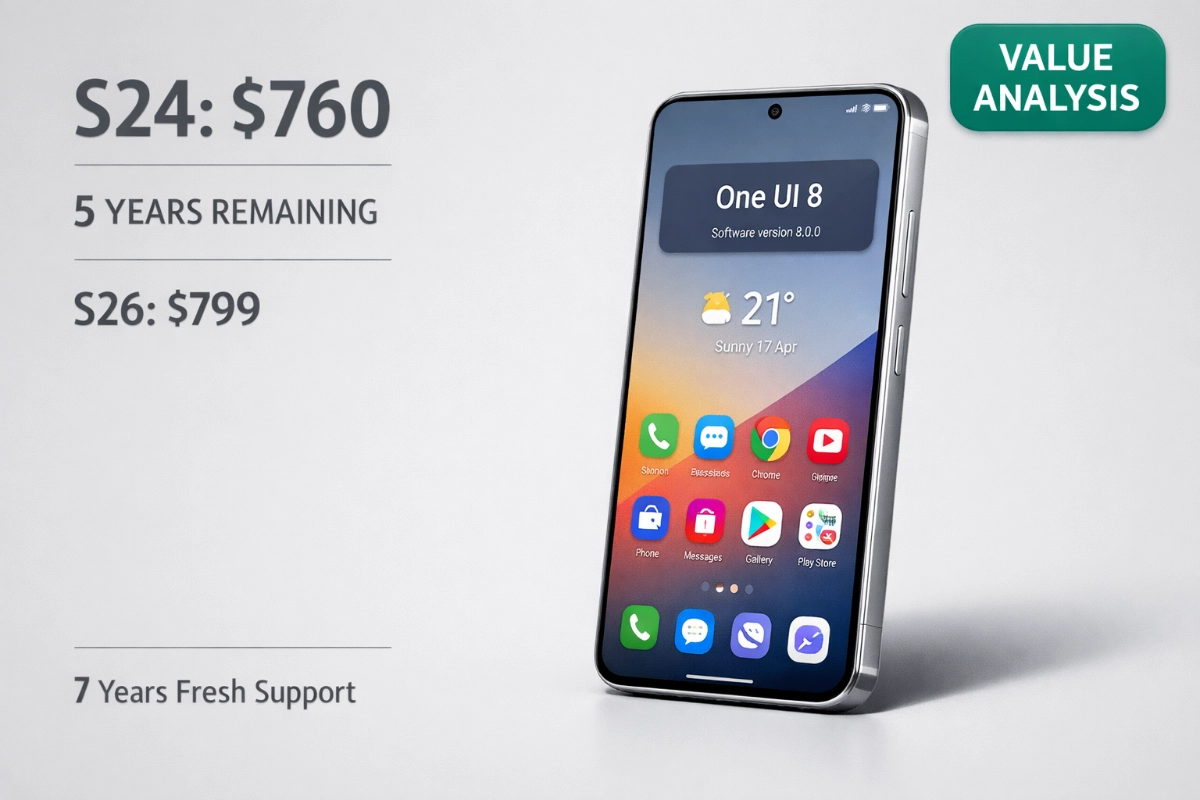
A buyer purchasing an S24 in February 2026 receives updates through early 2031. That's approximately five years of remaining support. The S26 buyer gets seven years through 2033. The two-year difference sounds significant until you examine actual usage patterns.
Most consumers don't hold smartphones for seven years. Industry research consistently shows replacement cycles between two and three years in developed markets. The device breaks, battery degradation becomes noticeable, or users want newer camera technology.
A five-year remaining window exceeds typical ownership duration by a comfortable margin. The buyer upgrading in 2029 after three years will replace the device while it still receives active support. The extra two years the S26 offers become theoretical value rather than practical benefit for most users.
The S24 launched with One UI 6.0 and Android 14. According to SamMobile, it has already received One UI 7 (Android 15) and One UI 8 (Android 16). That's two of its seven promised major updates consumed.
The S26 will launch with One UI 8.5 and Android 16, meaning both devices currently run the same base Android version. The S24 sits on One UI 8, the S26 debuts with the refined 8.5 variant. Feature parity is nearly complete at launch.
Five remaining updates on the S24 versus seven fresh updates on the S26 creates the real comparison. For someone holding a device three years, both phones deliver the same number of updates during actual ownership.
When we analyzed of depreciation patterns across Samsung's flagship generations, the improved value retention correlates directly with extended update commitments. Android Authority's research tracking Samsung device values shows the S22 depreciated 60% in year one, the S23 improved to 59%, and the S24 further improved to 58%. The trend line suggests buyers increasingly factor long-term software support into resale value calculations. An S24 purchased in February 2026 for $760 retains higher resale value in 2028 than an S23 purchased in February 2023 for similar pricing, specifically because the S24's update window extends years beyond the S23's cutoff. The depreciation curve flattens when buyers know the device remains supported.
One UI 8.5 debuts February 25, 2026 alongside the Galaxy S26 series, according to Sammy Fans. But the stable release timeline for existing devices follows Samsung's established tier system.
Android Central reports One UI 8.5 Beta 5 rolled out to Galaxy S25 users in the US, South Korea, and India in late February 2026. The beta program remains exclusive to the S25 series. Samsung initiated testing for Beta 6, suggesting refinement continues through the S26 launch date.
The phased rollout targets older eligible devices starting late March 2026. Premium models receive priority. The S25 gets updates in late March, with other devices following progressively through April, May, and June 2026. Mid-range and budget models trail further behind.
This tiered approach isn't new, but it reinforces which devices Samsung treats as priority hardware. Flagship buyers receive faster access to new features and security improvements. Budget tier customers wait months longer despite paying for devices eligible for updates.
The One UI 8.5 update itself focuses on refinement rather than revolution. Samsung's official newsroom announcement on February 20, 2026 detailed a redesigned Bixby operating as a conversational device agent. Won-Joon Choi, Chief Operating Officer of Samsung's Mobile eXperience Business, explained the company integrated a device agent directly into the experience to reduce user effort.
The upgraded Bixby enables device control through natural language without requiring precise setting names or commands. It now accesses current information from the open web, positioning it as a more capable alternative to traditional voice assistants limited to device-local functions.
Additional features include smarter lock screen customizations, floating tabs for multitasking, performance optimizations, Galaxy AI integrations, enhanced app security, and smoother animations. The February 2026 security patch ships with current betas.
One UI 9, based on Android 17, has entered early internal testing on select recent flagships like Galaxy Z Fold series devices. Sammy Fans expects public beta around May 2026, with stable rollout later in 2026 coinciding with new flagship launches.
The S25 launched at $799 for the 128GB base model according to Tom's Guide, matching the S24's original launch price exactly. Storage tiers aligned identically: 256GB models at $859, with 512GB variants reaching upper pricing brackets in UK and Australia markets.
But the S24 benefits from post-launch price reductions as Samsung repositions it as prior-generation inventory. The company officially reduced the S24's new starting price to $759.99 in the US, £699 in the UK, and AU$949 in Australia. That represents meaningful savings versus the S25 while maintaining identical 7-year software support.
Hardware specifications between the S24 and S25 show minimal differentiation. Both share identical dimensions, camera sensor configurations (50MP main, 12MP ultrawide, 10MP 3x telephoto), battery capacity, and charging speeds. The primary distinction lies in the S25's Snapdragon 8 Elite processor versus the S24's Snapdragon 8 Gen 3 or Exynos 2400 depending on region.
The S26 will likely follow this pattern. Launch pricing holds at $799, $999, and $1,299 based on TechRadar's reporting of South Korean press leaks. But the S25 will receive price cuts as Samsung clears inventory for the new generation. By March or April 2026, the S25 could sell for $760 to match current S24 pricing.
That creates a cascading value ladder. The S26 commands full MSRP at launch. The S25 drops to $760 within weeks. The S24 falls further to perhaps $700 or lower as retailers clear remaining stock. All three devices receive the same 7-year update commitment.
After exploring of update value per dollar, the math shifts dramatically based on purchase timing. An S24 buyer in February 2026 pays $760 for five remaining update years, or roughly $152 per year of support. An S26 buyer pays $799 for seven years, or approximately $114 per year. The S26 delivers better cost efficiency, but only if you value the theoretical maximum support window over immediate price savings. For buyers replacing devices every three years, the S24's $760 price for five available years ($253 per year during actual ownership) competes effectively against the S26's $799 for the same three-year ownership period ($266 per year). The extra $40 saved upfront matters more than unused update years.
The processor difference between generations produces measurable but modest performance gaps. Benchmark improvements typically range 15-20% generation over generation. Real-world usage for standard tasks like web browsing, social media, and video streaming shows negligible differences. Gaming and AI processing tasks benefit most from newer silicon.
Storage and RAM configurations factor into long-term value. The S25 standardized on 12GB RAM across all storage tiers, while the S24 varied. Both support 128GB, 256GB, and 512GB storage options with UFS 4.0 in higher tiers.
Samsung's 7-year commitment remains exclusive to premium flagships. Mid-tier A-series devices received improved support timelines but fall short of flagship treatment.
According to Tech and Trend 4U, newer A-series models like the A56 5G and A36 5G receive six years of both OS upgrades and security updates. That's a substantial improvement from earlier 3-4 year commitments, but still trails flagship timelines by one year.
Budget M-series and F-series devices show further stratification. Newer models receive four to six years depending on specific model and launch timing. Older A-series devices typically received three major OS updates.
SamMobile confirms the Galaxy Tab S10 and S11 tablet series receive the full 7-year commitment matching flagship phones. Galaxy Watch devices (Watch 4, 5, 6, 7, and Ultra models) operate on a different cadence with at least four years of Wear OS and One UI Watch support.
This tier differentiation sharpens the value proposition calculations. Buyers paying flagship prices receive substantially extended software support justifying the initial investment. Budget-conscious buyers sacrifice update longevity for lower upfront costs.
The pattern mirrors Apple's historical approach of providing longer iOS support for flagship iPhones compared to budget-tier devices. The difference is Samsung now makes the support timeline explicit and commits to specific year counts publicly.
For someone considering an A56 versus an S24, the calculation involves more than just update years. The A56 launches around $450 with six years of support. The S24 costs $760 with seven years remaining. The $310 price gap buys one additional update year, better camera hardware, faster processor, and premium build quality.
The update timeline becomes one factor among many rather than the sole determinant. Different users weight those factors differently based on budget constraints and feature priorities.
The S26 launch on February 25, 2026 doesn't automatically make it the best value proposition. Your optimal choice depends on how long you actually hold devices and what you prioritize in daily use.
Buy the S24 now if:
You replace phones every 2-3 years and won't use the full 7-year window anyway. The $760 price buys five remaining update years, exceeding typical ownership duration. If privacy features matter during this ownership window, consider whether Samsung's privacy display technology justifies waiting for the S26 Ultra or purchasing a screen filter for current devices.
You want flagship hardware at a discount. Camera sensors, build quality, and performance match the S25 while costing $40 less.
Processor improvements don't matter for your usage. Web browsing, social media, and video consumption show negligible real-world differences between Snapdragon 8 Gen 3 and 8 Elite.
You value immediate savings over theoretical maximum support. The $40 saved buys accessories or reduces monthly payment costs.
Wait for S26 pricing to settle if:
You hold devices 4+ years and will actually use extended support. Seven fresh years versus five remaining creates genuine value for long-term owners.
You want the latest processor for gaming or AI tasks. The performance gap matters most in demanding workloads.
You prefer buying at launch for maximum update runway. Starting with One UI 8.5 means every subsequent update arrives as new rather than catch-up.
March-April S25 discounts could offer better value. Waiting 4-6 weeks might provide S25 at S24 pricing with one extra update year.
Consider the A56 instead if:
Budget constraints make $760 stretch too far. Six years of support at $450 delivers strong value for mid-range needs.
Camera and performance requirements are modest. Daily tasks don't stress flagship-tier hardware.
You replace devices more frequently than 4 years. The shorter support window won't affect actual ownership.
The $310 price gap funds other priorities. Saving money matters more than premium features.
Skip the S26 at launch unless:
You absolutely need the latest processor immediately. Most users won't notice the difference.
You plan to hold the device 5+ years. Only then does the full 7-year window justify launch pricing.
Early adopter satisfaction matters to you. Paying full MSRP for newest hardware brings its own value some users prioritize.
The 7-year update policy changed Samsung's value equation permanently, but it didn't eliminate the importance of purchase timing and price gaps between generations. The S24 at $760 with five remaining years competes directly with the S26 at $799 for buyers who replace devices every 2-4 years. The extra two years of support don't compensate for the upfront savings unless you genuinely plan to hold the phone into 2030 or beyond.
Samsung confirmed February 25, 2026 as the Galaxy S26 launch date, and buyers face a calculation that didn't exist two years ago. The S26 debuts with One UI 8.5 and seven years of guaranteed updates. But so does the S24 from January 2024, which now sells for $760 instead of its original $799 launch price. That $40 gap matters less than the update timeline both devices share. The decision isn't about which phone gets the longest support anymore. It's about which purchase timing delivers the most update years per dollar spent. Samsung's 7-year commitment reshuffled the value hierarchy, and understanding where each device generation sits on that spectrum determines whether waiting for the S26 makes financial sense or wastes money on features you'll replace before the update window closes.
Boost your workflow with our browser-based tools
Share your expertise with our growing community. We accept in-depth articles on Tech, AI, and Dev.
Get StartedFinished reading? Continue your journey in Tech with these hand-picked guides and tutorials.