Finished reading? Continue your journey in Tech with these hand-picked guides and tutorials.
Boost your workflow with our browser-based tools
Share your expertise with our readers. TrueSolvers accepts in-depth, independently researched articles on technology, AI, and software development from qualified contributors.
TrueSolvers is an independent technology publisher with a professional editorial team. Every article is independently researched, sourced from primary documentation, and cross-checked before publication.
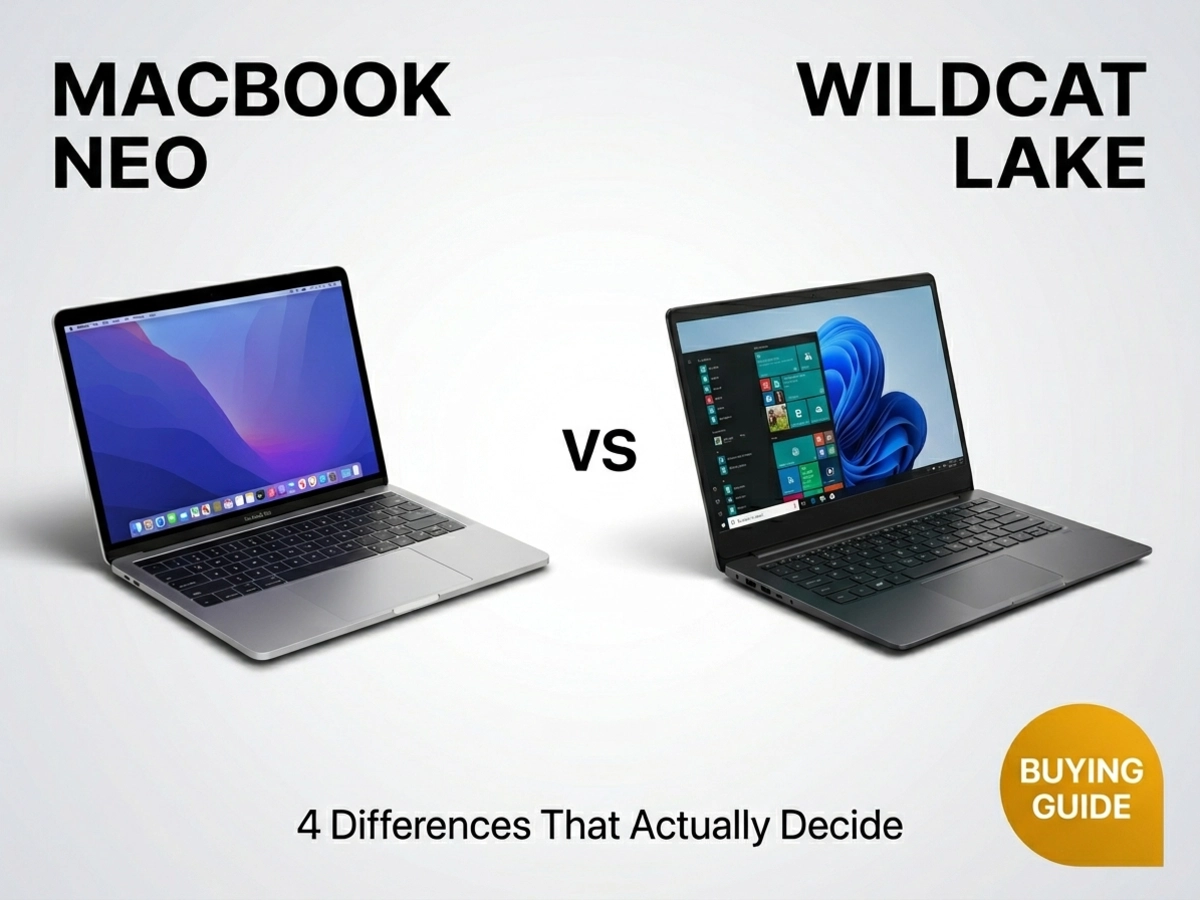
Apple's MacBook Neo sold out through April. Intel's answer launched on April 16. But the benchmarks are contradicting each other, the pricing headlines are misleading, and the RAM debate is missing the actual question. This comparison cuts through the noise on four dimensions — performance, pricing, memory, and connectivity — to help you figure out which platform fits your situation.
When Apple launched the MacBook Neo on March 11, 2026, at $599, the company didn't just release a budget laptop. It sold out through April and doubled its production target to 10 million units, creating a supply shortage in a market segment Apple had never seriously contested before. On Apple's Q2 2026 earnings call, Tim Cook described demand as "off the charts", confirmed the company was supply-constrained, and revealed it had driven the best launch week for first-time Mac buyers in the company's history. Mac revenue hit $8.4 billion that quarter.
Intel's response — Wildcat Lake, officially the Core Series 3 — launched five weeks later. By then, buyers who wanted a cheap, well-built laptop had already been redirected toward Apple. Asus's co-CEO called the MacBook Neo "a shock to the entire PC market." MSI had already named two models, the Modern 14S and 16S, as direct MacBook Neo challengers.
This competitive context matters because it shapes what Intel needed Wildcat Lake to accomplish. A chip that simply outperforms the MacBook Neo on paper isn't sufficient. The question is whether the laptops that carry it can compete on the dimensions that made the Neo a cultural moment: price, build quality, battery life, and the overall sense that you're not getting a compromise product. Intel's silicon is ready; whether OEM partners build around it accordingly is still an open question.
Early benchmark data for Wildcat Lake comes entirely from pre-production hardware and engineering samples. Until retail laptops undergo independent testing, every performance figure should be read as directional rather than definitive.
The Core 5 320 scores 15,222 points in PassMark multi-core — a 21% lead over the A18 Pro — while Geekbench places the same chip 11% behind the MacBook Neo in single-thread, at 2,564 versus 3,461. These aren't errors from different labs. They reflect what each tool is actually measuring.
PassMark's workload mix rewards total thread count, which gives Wildcat Lake an advantage: six x86 threads tackling a diverse task set pull ahead of the A18 Pro's six ARM threads in aggregate. Tweaktown documented the Core 5 320's PassMark multi-thread score at 15,222 and single-thread at 4,047 — with the A18 Pro matching it closely at 4,066 in single-thread. Geekbench, by contrast, weights per-core instruction throughput more heavily, which is where Apple's architecture holds a structural advantage. The A18 Pro's cores execute more instructions per clock cycle at lower frequencies — the exact characteristic Geekbench surfaces. Both benchmarks are accurate. They measure different things, and buyers relying on headlines that cherry-pick one tool get a misleading picture.
The same interpretive caution applies to other ARM-based Windows alternatives currently on the market — our analysis of what the Snapdragon X2 Elite's benchmarks hide from buyers shows how reference-platform testing conditions can produce scores that retail hardware won't replicate.
For the workloads most buyers at this price tier actually run — web browsing, streaming, document editing, video calls — single-core responsiveness matters more than multi-thread throughput. That's the performance dimension Geekbench captures better, and it's where the MacBook Neo currently leads. The MacBook Neo scored 3,461 single-core, 8,668 multi-core, and 31,286 in Metal GPU on Geekbench 6, with GPU numbers that reflect Apple's deep hardware-software integration.
That GPU advantage is the second piece of this story. Wildcat Lake ships with two Xe3 GPU cores. The A18 Pro carries five GPU cores with hardware-accelerated ray tracing and a dedicated ProRes media engine. For photo editing, smooth video playback at higher resolutions, and even the Apple Arcade titles the Neo handles comfortably, the MacBook Neo's GPU architecture provides a meaningful real-world edge that CPU benchmark leads do not offset.
The $340 tray price Intel published for the Core 5 320 generated headlines about a budget chip that costs more than half a MacBook Neo before you add RAM, storage, or a screen — but that figure applies to purchases of exactly 1,000 units, and no major laptop maker buys in thousands.
Digital Trends reported the official ARK pricing as $340 for the Core 5 320 and $426 for the Core 7 360 at 1,000-unit tray quantities before Intel removed those listings. That pricing structure is the reference commercial price (RCP) — a ceiling figure governing what small system integrators pay. Tweaktown documented the full Wildcat Lake RCP range at $304 to $470, while also noting that manufacturers like Dell, HP, and Lenovo operate under multi-year contracts covering hundreds of thousands to millions of units, with rebate structures that substantially reduce the effective per-chip cost. What Intel publicly lists and what a major OEM actually pays are different numbers, and that gap is not publicly disclosed.
This matters because Intel announced more than 70 laptop designs from partners ranging from Samsung and HP to Colorful and Hasee. Those designs will not be priced uniformly. A Samsung or HP device built on high-volume procurement and paired with quality components will compete differently with the MacBook Neo than a regional integrator building closer to the RCP floor. The MacBook Neo's value proposition rests on Apple controlling every layer of the product — chip, enclosure, display, software, retail experience — and pricing it as a unified system. Wildcat Lake's value will vary by who builds around it.
The 2026 DRAM shortage adds a complication for both platforms. Memory prices rose 57% in April 2026 alone, with the shortage projected to persist into late 2027, driven by DRAM manufacturers shifting capacity toward High Bandwidth Memory for AI accelerators. Windows OEM laptops need to source DDR5 or LPDDR5X from that constrained market and pass costs downstream to buyers. Apple faces a parallel supply problem — TSMC's 3nm capacity is heavily committed to AI orders, forcing Apple to pay above-standard chip prices for fresh A18 Pro production runs — but that cost enters Apple's margin rather than the consumer's purchase price. The $599 MacBook Neo price may not hold indefinitely; Wildcat Lake laptop pricing has no confirmed retail anchor at any level.
Apple's MacBook Neo ships with 8GB of unified memory across both configurations, with no upgrade path. That ceiling isn't a cost-cutting decision Apple can reverse on current hardware. The A18 Pro uses InFO-PoP packaging that bonds memory directly to the chip — a physical engineering constraint, not a product-line choice. Wildcat Lake supports up to 64GB DDR5 or 48GB LPDDR5X, giving buyers genuine configuration flexibility.
In 2026, for the tasks this price range targets — email, streaming, web browsing, documents, video calls — 8GB is genuinely adequate on the MacBook Neo. Apple's macOS manages memory pressure well through compression and intelligent background app management, and the unified memory architecture provides bandwidth advantages that traditional discrete RAM configurations at this capacity don't match. Real-world testing has shown the Neo handling sustained multitasking without the stuttering that 8GB Windows machines often display.
The question is what year four or five looks like. Applications grow more memory-intensive over time. Adobe Lightroom Classic already recommends a minimum of 12GB; Photoshop recommends 16GB. Browser tabs, collaboration tools, and AI-powered features in productivity software are all trending toward higher baseline memory requirements. A buyer who upgrades every two years doesn't face a RAM problem with the MacBook Neo. A buyer expecting five or more years of service from a single machine is making a bet on 8GB remaining sufficient — a bet that becomes harder to defend as software evolves and the ceiling cannot be raised.
Wildcat Lake users who choose configurations with 16GB or 32GB avoid this entirely. For students, light office workers, and anyone who expects to swap devices within three years, the MacBook Neo's RAM ceiling is a practical non-issue. For longer-term ownership, it is the most concrete structural limitation separating these platforms.
On battery life, both platforms target all-day use and both measure under optimistic controlled conditions. Intel's official Core Series 3 launch materials specify up to 18.5 hours of Netflix streaming and 12.5 hours in Office productivity on a pre-production Core 7 350 system — figures generated under Intel-controlled test conditions. The MacBook Neo is rated for up to 16 hours of video streaming and 11 hours of wireless web browsing from a 36.5 watt-hour battery. Independent retail testing of Wildcat Lake laptops will determine how those competing claims hold in practice.
On connectivity, the platforms diverge significantly. Notebookcheck's hands-on with Intel's reference design confirmed Wildcat Lake supports three power modes: 17W standard, 22W high-performance, and 11W fanless, with an Intel representative confirming the chip operates without active cooling at 11W. That fanless mode is new for x86 performance at this tier and directly matches what makes the MacBook Neo's passive design appealing. Whether production laptops fully exploit it depends on OEM thermal engineering choices.
Wildcat Lake's platform includes two Thunderbolt 4 ports running at full 40Gbps bandwidth — a meaningful advantage for users with external monitors, high-speed storage, or docking stations. The MacBook Neo offers only two USB-C ports: one at USB 3 speed (10 Gbps) and one at USB 2 speed (480 Mbps), with no Thunderbolt at all. That port gap reflects the A18 Pro's single high-speed I/O controller and creates a real daily-use constraint for anyone relying on external peripherals.
The MacBook Neo's build quality, display, and trackpad deliver a premium feel that Tom's Hardware described as "shockingly good for $599" — an unusual achievement at this price point that Intel's reference design attempts to match with its aluminum chassis and colorful themes. If OEM partners follow that template in production, the visual and tactile gap between platforms could narrow. The critical unknown is whether the 70+ announced Wildcat Lake designs prioritize build quality or cut corners to capture lower price points — a variable the MacBook Neo, as a single unified product, doesn't face.
Choose the MacBook Neo if you need a laptop today, value a proven product with known battery life and build quality, upgrade every two to three years, and primarily use your laptop for browsing, streaming, documents, and communication. The MacBook Neo delivers those tasks with strong single-core responsiveness, 16 hours of battery, a premium feel, and a coherent ecosystem — right now, in a product you can order and receive.
Wait for Wildcat Lake if you need Windows compatibility for work software, plan to own your next laptop for four or more years and want RAM flexibility above 8GB, require Thunderbolt 4 for a monitor or dock, or need more than 8GB for applications like Lightroom or Photoshop. The platform has genuine architectural advantages; the question is which OEM partner builds the right laptop around it.
Consider Panther Lake (Core Ultra Series 3) if your budget allows more than the $599 tier. Panther Lake starts around $999 for current HP and MSI designs and delivers substantially more — more GPU cores, a higher NPU rating, and broader configuration options — for buyers who want a premium Windows experience rather than an entry-level one.
The most direct framing: the MacBook Neo is the better finished product available right now. Wildcat Lake is the better architectural bet for longer ownership and Windows-specific use cases, provided the right OEM builds around it. The choice comes down to whether you value what Apple delivered today, or what Intel's ecosystem may deliver over the coming months.
For buyers with more budget headroom, Intel's Panther Lake — sold as Core Ultra Series 3 — represents a substantially more capable platform than Wildcat Lake. Where Wildcat Lake tops out at two Xe3 GPU cores and 17 TOPS on the NPU, Panther Lake scales to 12 Xe GPU cores and 50 TOPS on the NPU alone — a figure that meets Microsoft's Copilot+ NPU-only threshold without aggregating CPU and GPU contributions. The CPU configuration is also more generous, with Panther Lake reaching up to 4 performance cores and 8 efficiency cores versus Wildcat Lake's maximum of 2 performance cores.
The tradeoff is cost. HP and MSI Panther Lake designs are currently listed starting around $999, compared to the $599 MacBook Neo. At that price gap, the comparison shifts from Wildcat Lake territory to MacBook Air territory. Panther Lake makes the most sense for buyers who need a premium Windows machine with strong AI performance, Thunderbolt 4, and configuration flexibility beyond 8GB — and who are evaluating it against Apple's higher-tier lineup rather than the MacBook Neo.
Intel launched the Core Series 3 platform on April 16, 2026, with OEM partners beginning rollouts that same day. More than 70 designs from Acer, ASUS, HP, Lenovo, MSI, Samsung, and others are scheduled through the rest of 2026, with the primary consumer wave expected around the back-to-school season — typically July through September. MSI's Modern 14S and 16S, both explicitly positioned as MacBook Neo challengers, are among the announced designs.
The practical caveat is that Intel announcing a platform and OEM partners shipping retail hardware with confirmed pricing are events on different timelines. No manufacturer had confirmed retail pricing for any Wildcat Lake laptop at launch, and the 2026 DRAM shortage means memory configuration decisions are being made in a cost environment that pushes against entry-level positioning. If you are waiting specifically for Wildcat Lake, the realistic window for a meaningful selection of available products is summer to fall 2026.