Finished reading? Continue your journey in Tech with these hand-picked guides and tutorials.
Boost your workflow with our browser-based tools
Share your expertise with our readers. TrueSolvers accepts in-depth, independently researched articles on technology, AI, and software development from qualified contributors.
TrueSolvers is an independent technology publisher with a professional editorial team. Every article is independently researched, sourced from primary documentation, and cross-checked before publication.
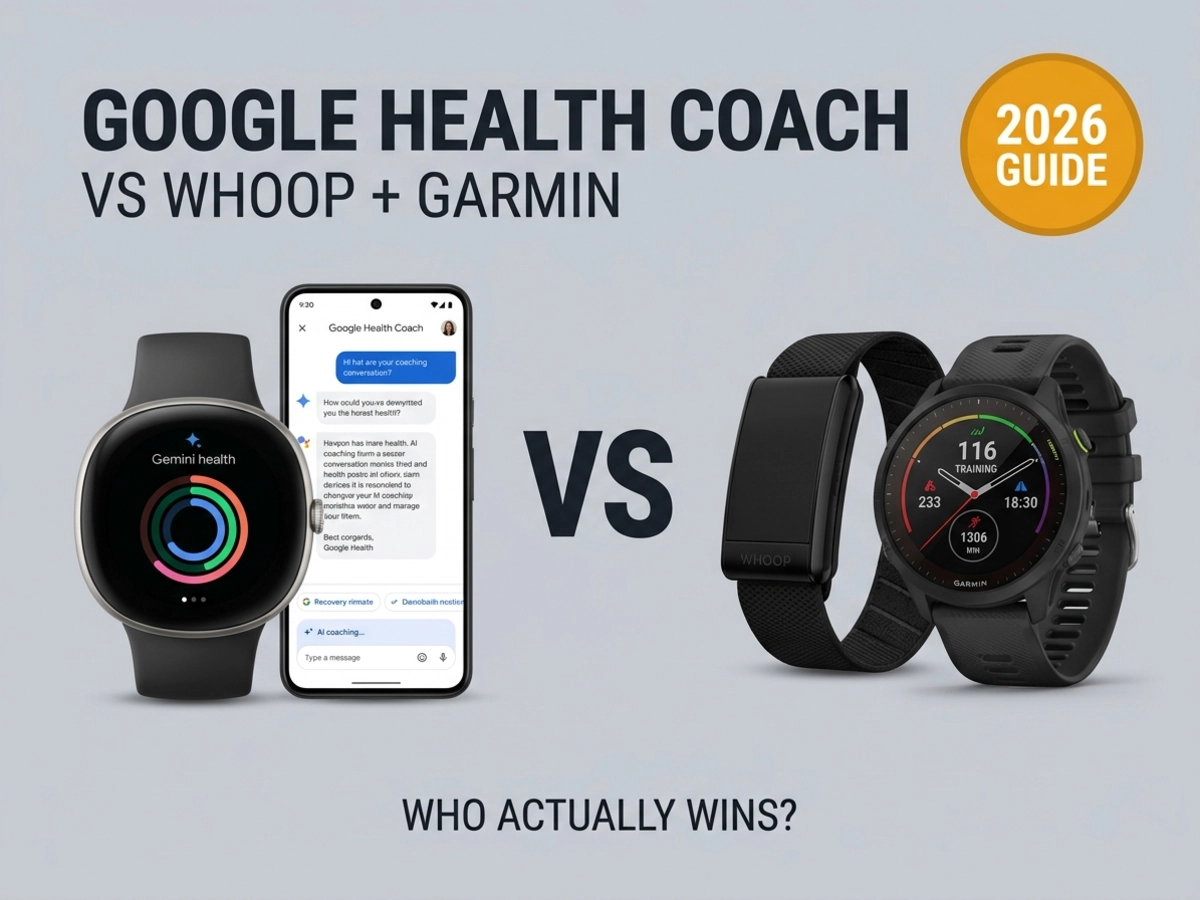
Google just rebranded the Fitbit app into a Gemini-powered health platform — but the AI coach that makes it compelling only works with two devices at launch. Before deciding whether to switch ecosystems, buy a Fitbit Air, or stay put, four concrete differences separate Google Health from Whoop, Garmin Connect, and Apple: AI coaching access, five-year cost reality, sensor density, and what Google is actually trying to build. Here is how they stack up.
The Google Health Coach is a conversational AI assistant built on Gemini that operates across four sections of the redesigned app: Today, Fitness, Sleep, and Health. It begins with an onboarding session where users describe their health goals, preferred activities, daily routine, available equipment, and any injuries or limitations. That initial context shapes the advice the coach delivers going forward — weekly fitness plans adapt to your schedule, sleep analysis reflects your specific recovery patterns, and nutrition guidance adjusts to what you have actually been eating rather than a generic template.
What distinguishes this from a standard fitness app is the coach's ability to update in real time. Tell it about a sore knee, a work trip that disrupted sleep, or a week of poor nutrition, and it recalibrates its plans accordingly. Users can log meals by photographing their plate and letting the AI estimate macros, or dictate a workout they completed that a wearable missed. The coach integrates data across fitness tracking, sleep, nutrition, cycle tracking, and US medical records where the user grants access — pulling from more personal health context than most consumer apps have attempted.
The subscription structure builds on the former Fitbit Premium model. TechCrunch reported the service costs $9.99 per month or $99 per year under the Google Health Premium label. Anyone subscribed to Google AI Pro or Ultra plans receives Health Premium at no extra charge, which meaningfully changes the calculation for users already paying into Google's broader AI subscription stack — for them, the coaching layer arrives at no marginal cost. The Fitbit Air, Google's new screenless tracker, starts at $99.99 and includes a three-month trial of Health Premium, providing a practical runway to evaluate the full coaching platform before any subscription commitment. A Special Edition version with a Stephen Curry colorway runs $129.99 with identical hardware.
The quality claim behind the coach is substantive. Google's official Health Coach post documents that the SHARP evaluation framework — Safety, Helpfulness, Accuracy, Relevance, and Personalization — involved more than one million human annotations and over 100,000 hours of expert evaluation across cardiology, sleep medicine, exercise science, and behavioral health. The same post confirms that the new machine learning model powering sleep tracking is 15% more accurate than the previous generation, based on clinical validation against gold-standard measurements. Neither figure comes from an independent auditor — these are Google's own internal benchmarks — but the granularity is unusual for a consumer health app and signals the company treated this as a clinical-adjacent product rather than a marketing exercise.
The coach moved from public preview in October 2025 to general availability in May 2026. Apple Watch AI coaching support and a migration pathway for existing Google Fit users are both scheduled for later in 2026, though no specific dates have been attached to either commitment.
The Google Health app now ingests data from Apple Health, hundreds of third-party apps, and US medical records — but on launch day, the AI that makes sense of all that data is only available if you wear a Fitbit or Pixel Watch.
That gap is the most consequential fact in this comparison for anyone arriving from a competing platform. The Fitbit Help Center support page specifies that users without a Fitbit or Pixel Watch "will see a focused experience with the Today and Health tabs" — which means the Fitness tab with its weekly planning, the Sleep tab with coaching, and the conversational Health Coach interface are absent entirely. TechCrunch confirmed the coach is restricted to Fitbit and Pixel Watch users at launch, with broader device support listed as "coming soon" without a timeline.
The Fitbit Help Center documents the platform's third-party ingestion capabilities through Health Connect and Apple Health — steps, sleep metrics, and other standard data types — but the depth of that integration is still developing. An independent assessment by The5krunner, whose reviewer has spent a year using Google's health tools, found that the current beta pulls only basic steps and sleep data from Garmin via Health Connect — full workout activity ingest is planned for later in 2026. Garmin users considering Google Health as a data hub should treat that capability as a roadmap commitment, not a current feature.
The openness of the data layer and the restriction of the AI layer are not contradictory by accident. Google has explicitly stated its ambition is to support whatever hardware the user chooses, and Apple Watch compatibility is on the roadmap. But between the announcement and the execution sits a meaningful window where the platform's most compelling feature is hardware-gated. Potential converts from Apple Watch or Garmin who pay for Google Health Premium today will be funding a product that is not yet complete for their situation.
Google itself acknowledges that AI answers may be inaccurate or incomplete and that the platform is not intended for medical diagnosis — which is standard disclosure for AI health tools, but worth keeping in mind before placing significant weight on the coach's guidance. The social features that gave Fitbit its early stickiness — badges, community feed, direct messaging, and group challenges — are being phased out starting May 12, 2026. The trade-off is deliberate: Google is replacing community-based engagement with AI coaching as the platform's primary retention mechanism.
Independent accuracy testing of the Fitbit Air sensor itself is not yet available — the device ships May 26, 2026, and side-by-side data against Whoop, Oura, and other reference devices will emerge over subsequent weeks from reviewers.
Fitbit Air saves at minimum $426 over five years compared to Whoop's cheapest tier — and brings FDA-cleared AFib detection at a price point where Whoop charges $359 per year for the same capability.
Those two numbers reshape the comparison considerably. Google's official Fitbit Air spec sheet confirms the 0.5Hz heart rate sampling rate, a detail that DC Rainmaker's technical breakdown confirms alongside Whoop's 26Hz figure — the kind of hardware specificity that rarely surfaces in launch-day coverage. An analysis by Heal Nourish Grow, built by a reviewer simultaneously wearing Whoop, Oura Ring, and a pre-ordered Fitbit Air, documents the five-year math in full: compared to Whoop's three membership tiers — One at $199/year, Peak at $239/year, and Life at $359/year — Fitbit Air with Health Premium at $99/year saves $426, $626, or $1,226 respectively over five years.
The medical feature comparison cuts even more sharply than the subscription math. Gadgets and Wearables documented that FDA-cleared passive AFib detection is included with the Fitbit Air at the base $99.99 hardware price. On Whoop, that same cardiac monitoring capability belongs exclusively to the Whoop MG sensor — accessible only through the Life tier at $359 per year. That is a 3.6x price gap for the same background atrial fibrillation surveillance.
The same Heal Nourish Grow analysis quantifies the sensor gap with equal precision: Whoop 5.0 samples heart rate 26 times per second, while Fitbit Air records at 0.5Hz — once every two seconds, a 52x raw data density difference. Where that gap matters depends entirely on the user's workout type. For passive around-the-clock monitoring — tracking resting heart rate overnight, watching HRV trends across a week, measuring sleep quality — the two-second interval captures the relevant data reliably. Heart rate variability during rest changes slowly enough that 0.5Hz is sufficient to distinguish meaningful recovery patterns. The gap becomes real during high-intensity interval work, where heart rate can swing 30 to 40 beats per minute within a few seconds. Whoop's denser capture is built for that environment; Fitbit Air's cadence can miss rapid transitions during hard efforts. Even Whoop's 26Hz advantage has limits in practice — at that sampling rate, wrist movement during heavy barbell work still introduces enough noise to distort strain readings, making the sensor advantage most reliable in cardio-dominant training rather than mixed strength work.
The Fitbit Air is rated at seven days on a full charge, with a five-minute fast charge delivering a full day of use and a complete charge in 90 minutes. Whoop 5.0 is rated at 14 days, though its on-wrist wireless PowerPack allows top-ups without removing the device — narrowing the practical battery gap. For Oura Ring 4 users, the calculation shifts further: the ring carries a subscription of $69.99 per year on top of the hardware purchase, and as Google Health's ability to ingest Oura data matures, that ongoing subscription becomes harder to justify on cost grounds alone.
Garmin operates on a fundamentally different pricing model. The core Garmin Connect platform is free, with hardware purchased outright — entry-level options around $250, flagship models over $1,000. For users who prioritize sport performance tracking and are already in the Garmin ecosystem, that free software layer is a genuine competitive advantage. The cost math for switching to Google Health is real only if the coaching capability adds meaningful value — which brings the analysis back to what each platform's coaching layer actually delivers.
For the majority of users — those primarily monitoring sleep quality, daily readiness, and resting cardiac trends rather than tracking zone-based interval intensity — Fitbit Air's pricing structure is decisively better than Whoop's. The sensor trade-off becomes relevant only for athletes doing structured interval training three or more times per week who rely on real-time heart rate zone accuracy.
Garmin's competitive standing here turns on what a user actually needs from a health platform. Its algorithm set — Body Battery, Training Readiness, and HRV Status — is among the most analytically developed in consumer wearables, built on years of athlete data across endurance, strength, and recovery contexts. An independent year-long assessment of Garmin Connect+ concluded the subscription tier is not worth paying for most users, with the strongest use case limited to athletes doing structured gym sessions who want real-time phone mirroring during strength training. The fundamental gap is conversational intelligence: Garmin delivers charts, static readiness numbers, and structured training plans — but users cannot pose a goal-adaptive question and receive an adjusted response. Google Health Coach does exactly that, and for users who find themselves wanting to ask "why am I still tired?" or "should I skip today's run?" and get a contextually informed answer, Garmin cannot deliver.
Apple Health operates as a system-level data repository rather than a coaching platform. Apple Fitness+ provides guided workouts but is tied to Apple hardware and does not offer the kind of conversational, goal-adaptive intelligence that Google Health Coach provides. For Apple Watch users who want to optimize what they already have while evaluating Google's roadmap, building a unified Apple Health dashboard is the most practical near-term step — Apple Health can consolidate data from Apple Watch, smart scales, medical portals, and fitness rings into one automated view, which reveals patterns that fragmented tracking never surfaces.
IDC places Google behind Apple, Samsung, Xiaomi, and Huawei in global wearable shipments — and CNN's coverage of the launch quoted Google's own health lead saying the target isn't Whoop but OpenAI and Microsoft. OpenAI reported that 230 million people turn to ChatGPT for health-related questions every week. That is the market Google is positioning against, not the wearable shipment rankings.
The evidence suggests Google views this less as a wearable product launch than as a positioning move for health AI infrastructure, though whether that bet pays off depends on execution speed and regulatory dynamics that remain uncertain. A company trailing four rivals in hardware market share has a limited path to winning on devices alone. The more rational play is to become the AI intelligence layer running across everyone's hardware — which explains the open data architecture, the Apple Watch compatibility roadmap, and a Gemini-powered coach designed to work independently of the Gemini app. The Fitbit Air is the most affordable entry point into that system, but the system itself is the product Google is building.
Which platform wins for you, by situation:
If you primarily monitor sleep quality, daily readiness, and resting cardiac trends without doing structured high-intensity interval training, Fitbit Air at $99.99 with no mandatory subscription is the strongest value in the screenless tracker category today. The cost advantage over Whoop is substantial, and the free tier covers the metrics most users actually act on.
If you do structured interval training three or more days per week and rely on zone-based heart rate accuracy during effort, Whoop's sensor density and recovery analytics depth are not yet matched by Fitbit Air. The premium is real, but so is the capability gap for this specific training pattern.
If you are an existing Garmin user who needs GPS, on-device coaching, and endurance sport performance depth, there is no compelling reason to switch ecosystems based on this launch. Google Health does not yet ingest full Garmin workout data, and Garmin's algorithms for sport tracking remain the most developed available.
If you use an Apple Watch and have been waiting for a coaching layer that goes beyond Apple Fitness+, Google Health is the platform to watch — but evaluate it based on what it delivers today, not what the roadmap promises. In the meantime, building a complete Apple Health hub is the most practical way to extract full value from the data Apple Watch already collects.
Yes. As of May 19, 2026, Fitbit Premium is renamed Google Health Premium, and existing subscribers transition automatically. The pricing structure stays the same — $9.99 per month or $99 per year — and Premium subscribers gain access to the Google Health Coach as part of the rebrand. The Fitbit Help Center documents that no action is required; the app updates automatically during the May 19–26 rollout window. Users who subscribe to Google AI Pro or Ultra plans also receive Health Premium at no additional charge, folding the coaching access into a subscription many users are already paying for other reasons.
The Fitbit Air ships May 26, 2026, meaning independent side-by-side testing against Whoop, Oura, and Garmin devices was not yet available at the time of publication. DC Rainmaker, whose technical breakdowns are the most detailed in the wearables space, identified three specific variables for his full review: whether the seven-day battery claim holds under real-world mixed usage, whether heart rate, sleep, and activity data is accurate compared to reference devices, and how well the Google Health platform performs as a multi-device aggregator. For buyers who rely on independent accuracy data before committing, waiting three to four weeks for hands-on reviews is the lower-risk path. For buyers primarily drawn to the cost model and the three-month Premium trial that ships with the device, the pre-order is straightforward — the hardware can be evaluated during the trial window before any subscription commitment is required.
Not fully, as of the May 2026 launch. The Google Health app is available on iOS 16.4 and later and can pull basic data from Apple Health — steps, general sleep metrics, and other standard data types — but the conversational Google Health Coach requires a Fitbit or Pixel Watch at this stage. Without one of those devices, the platform delivers a data dashboard without the AI coaching interface. Google has stated that Apple Watch support for the coach is planned for later in 2026, without a specific date. The practical step for Apple Watch users right now: download Google Health and connect it to Apple Health to evaluate the data aggregation layer, while building a complete Apple Health dashboard that consolidates your wearable, scale, and medical record data into one place — so when Google's coaching layer does arrive for Apple Watch users, it has a richer data foundation to work from.
Disclaimer: This article is for informational purposes only and does not constitute medical advice. The health metrics, AI coaching insights, and recovery scores discussed are generated by consumer-grade wearable devices and software platforms, not certified medical instruments. Pricing, feature availability, device compatibility, and subscription terms are accurate as of May 2026 and are subject to change without notice — verify current details directly with each manufacturer before making a purchase decision. Google Health Coach, Whoop, Garmin Connect, and Apple Health are not substitutes for professional medical evaluation, diagnosis, or treatment. If you have concerns about your heart health, sleep disorders, or any medical condition, consult a qualified healthcare provider.