Finished reading? Continue your journey in Tech with these hand-picked guides and tutorials.
Share your expertise with our readers. TrueSolvers accepts in-depth, independently researched articles on technology, AI, and software development from qualified contributors.
TrueSolvers is an independent technology publisher with a professional editorial team. Every article is independently researched, sourced from primary documentation, and cross-checked before publication.
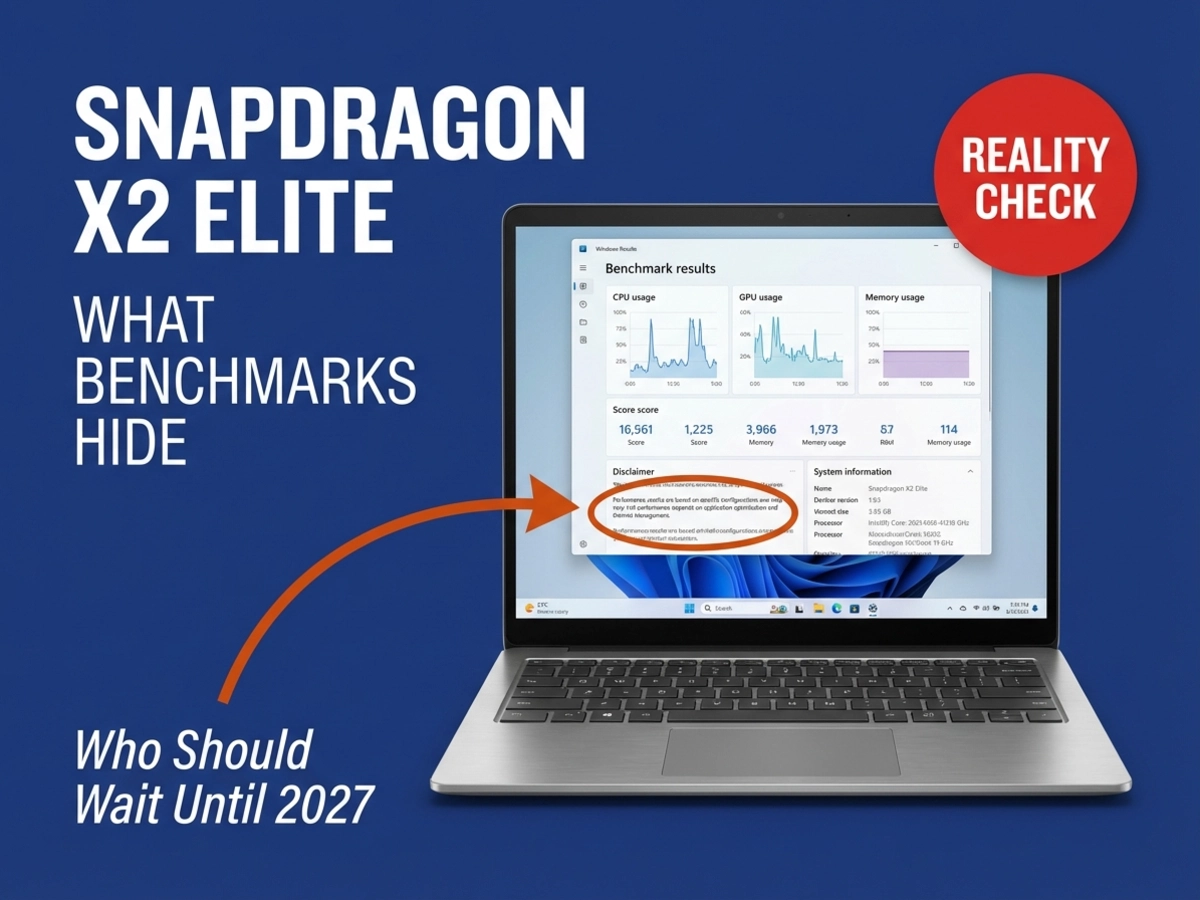
The Snapdragon X2 Elite's benchmark scores are genuinely impressive. But those scores came from a 120W reference platform that no retail laptop will match, the GPU trails Intel's Panther Lake in creative workloads, and buyers land on a Windows update branch that won't rejoin the mainstream until 2027. Here's who should buy one now, and who should wait.
The Snapdragon X2 Elite is Qualcomm's second-generation ARM processor for Windows laptops, built on TSMC's 3nm process and introduced at the Snapdragon Summit in September 2025. The headline numbers are striking. In Geekbench 6, the top-tier X2 Elite Extreme recorded a single-core score of 4,033 and a multi-core score of 23,198, compared to AMD's Ryzen AI Max+ 395 at 3,048 and Intel's Panther Lake Core Ultra at 3,066 single-core. That's a 31% single-core lead over the fastest x86 competition.
The chip family covers nine variants. The X2 Elite Extreme sits at the top of the stack with 18 cores, 12 of which are high-performance Prime cores capable of boosting to 5.0 GHz in single- or dual-core work. According to the Snapdragon X2 Elite product brief, the Extreme carries 53 MB of cache and memory bandwidth of 228 GB/s on a 192-bit LPDDR5x interface. The standard X2 Elite line drops to either 18 or 12 cores depending on SKU, with a narrower memory bus and smaller cache. The X2 Plus, aimed at thinner or more affordable machines, adds optional 5G connectivity. Every X2 variant clears the 80 AI TOPS threshold Microsoft requires for Copilot+ PC certification.
The performance gap over Intel is less dramatic once Apple enters the picture. Tom's Guide's multi-chip comparison places the X2 Elite Extreme's multi-core at 23,407 points, Apple's M5 Max at nearly 30,000, and Intel's Panther Lake at 17,283. The X2 leads every x86 chip by a meaningful margin while trailing Apple's higher-end silicon. Tom's Guide's hands-on testing of reference hardware found the third-generation Oryon CPU delivers 39% faster single-core and 50% faster multi-core peak performance versus the first-generation X Elite, with memory bandwidth up 69% due to the on-package memory design.
We haven't seen a single independent retailer review of a final shipping Snapdragon X2 device; every benchmark figure in circulation today comes from either Qualcomm's reference hardware or pre-production OEM samples with early drivers and unoptimized firmware. That context matters, and the next section explains exactly why.
Benchmark scores are not produced in a vacuum. The reference laptop Qualcomm used at the Snapdragon Summit to generate the X2 Elite Extreme's headline figures ran at a total device power of approximately 120W, confirmed by Microcenter's Matthew Smith, who attended the event and ran benchmarks on that hardware. Consumer laptops built around the X2 Elite Extreme will typically operate within a 45–65W package power budget. The gap between those two figures is not minor.
Qualcomm's reference laptop for the Summit benchmarks ran at 120W TDP, nearly triple the 45W package power of most slim laptop designs where the X2 Elite Extreme will actually ship. Microcenter's reviewer also noted that the chip produced significant fan noise under maximum Cinebench load at that power level. When the same chip is placed inside a thin, fanless, or thermally constrained chassis, the sustained power ceiling drops, and benchmark scores drop with it. This suggests retail performance will likely trail the headline figures, though by how much depends on each OEM's thermal design choices.
The pattern has historical precedent. During the first-generation Snapdragon X Elite launch, real-world Geekbench results from production hardware came in substantially below Qualcomm's demo figures, largely because OEMs applied their own power caps to manage heat in thin devices. That generation's gap was large enough to register clearly in independent benchmarks. Gen 2 has better thermal efficiency per watt, and Qualcomm confirmed the standard 12-core X2 Elite should consume power comparable to the first-generation X Elite in standard configurations. The Extreme tier, however, carries a significantly higher core count and a faster GPU, and the thermal ceiling in slim consumer hardware will constrain it the same way it constrained every previous ARM chip at retail.
Whether the GPU gap versus Intel Panther Lake closes or widens in final retail hardware remains unknown until independent labs can test shipping units. The 12-core reference design ran at just 22W in hands-on event testing, producing very different numbers than the Extreme at full reference power. Buyers should treat all current X2 Elite benchmarks as a ceiling, not a floor.
The CPU and NPU story clearly favors Snapdragon. The GPU story does not.
In 3DMark Solar Bay, a demanding GPU workload, the X2 Elite Extreme registered 88 frames per second, while Intel Panther Lake ranged from 77 to 99 fps across tested configurations, according to Tom's Guide's three-way comparison. The Extreme and Panther Lake are near-competitive at that GPU tier. Drop to the standard X2 Elite (the 12-core non-Extreme), and the same test falls to 49.6 fps. In OpenCL testing, the X2 Elite Extreme scores 44,786 against Panther Lake's 55,000-plus. Apple's M5 Max sits far above both at 268 fps in Solar Bay. AMD's Strix Halo outpaces all three in GPU-heavy workloads.
The Adreno X2-90 GPU architecture has meaningfully improved over its predecessor, and we note that the Extreme tier closes much of the gap with Panther Lake's Xe3 in lighter workloads, which will cover the majority of everyday tasks. For productivity tasks, web browsing, video calls, and light photo editing, the gap between 88 fps and 99 fps in a synthetic workload is invisible in practice.
The divide matters for three specific user types. GPU-accelerated video export is the first: professional video editors using GPU-compute export paths in applications like DaVinci Resolve or Adobe Premiere will encounter a real throughput difference versus Panther Lake on the non-Extreme X2 Elite SKUs. Hobbyist 3D work is the second: rendering in Blender or running real-time 3D previews will be noticeably slower on the standard X2 Elite compared to either Panther Lake or the Extreme tier. Casual gaming is the third, with the important caveat that casual gaming on the Extreme tier is competitive, while gaming on standard X2 Elite configurations is limited.
Against Apple's higher-end silicon, the gap is more significant across all GPU workloads. Buyers choosing between an X2 Elite laptop and a MacBook Pro with M5 Pro or M5 Max specifically because of GPU-intensive creative work are unlikely to find the Snapdragon a comparable option. For the CPU-dominant workflows where the X2 genuinely excels, such as compilation, web workloads, AI inference, and document-heavy productivity, the GPU deficit is irrelevant.
The software compatibility picture for Windows on ARM has changed substantially over the past two years. A compatibility guide updated for 2026 puts the share of everyday apps running natively on ARM at over 93%. Adobe's suite, Microsoft 365, browsers, developer tools, and most productivity software run without emulation. For the remaining apps, Microsoft's PRISM emulation layer translates x86 code to ARM in real time, adding roughly 10 to 15% performance overhead and 15 to 20% more battery drain compared to native execution. Old hardware drivers remain a genuine limitation: unlike apps, drivers cannot be emulated, so specialized legacy peripherals may not function.
The gaming landscape has crossed a meaningful threshold. Qualcomm partnered with Epic Games to bring Fortnite to Windows on ARM with full kernel-level anti-cheat support, resolving a long-standing categorical block. AVX2 instruction emulation, which unlocks a broad range of previously incompatible games, arrived on the X2 Elite at launch. Qualcomm also released a Snapdragon Control Panel with per-game optimization settings, upscaling, and GPU drivers that install independently of Windows updates. BattlEye and Denuvo compatibility has expanded. The gap between "barely playable" and "genuinely usable" is now closed for mainstream gaming.
The remaining hard block is Riot Games' Vanguard anti-cheat system. Vanguard operates at the kernel level and checks for x86 hardware signatures, making its block of ARM categorical rather than a performance issue. Until Riot builds ARM drivers, titles including Valorant, League of Legends, and Teamfight Tactics will not run on Snapdragon X2 hardware at all. From the data available at launch, our read of the gaming picture is that casual players are now well-served, while competitive esports players on Riot titles face a categorical block that is unlikely to change on a short timeline.
Strong CPU multi-core, an NPU that dominates every rival, adequate but trailing GPU performance, genuine 12 to 15 hours of daily-use battery, and a gaming catalog with specific hard gaps: these five data points, taken together, describe a chip optimized for a specific kind of buyer. That buyer works primarily in CPU-bound productivity and developer workflows, spends most of their day in native ARM apps, needs all-day battery without a charger, and either doesn't game competitively or plays titles unaffected by Vanguard. For that buyer, the X2 Elite is the strongest Windows laptop chip available today. For buyers outside those parameters, the trade-offs are real.
Pricing and available devices are only partially clear at launch. ASUS Japan confirmed the Zenbook SORA 16 at approximately $2,180 equivalent, with a late March 2026 release window. US and EU pricing has not been officially announced. Earlier European listings suggested a range of roughly €1,715 to €1,906 depending on configuration. Lenovo's Yoga Slim 7x starts at a more accessible entry price for the non-Extreme X2 Elite tier.
The Windows update situation is more consequential than pricing for some buyers, and almost no benchmark coverage has touched it. Microsoft launched Windows 11 version 26H1 specifically for Snapdragon X2 devices in February 2026, built on a distinct codebase called Bromine. The Windows IT Pro blog post we examined confirms directly that 26H1 devices will not be able to update to the next annual feature update in the second half of 2026. The path back to the unified Windows codebase is expected through a future release in 2027. The support lifecycle runs to March 14, 2028 for Home and Pro editions, and March 13, 2029 for Enterprise and Education.
The Windows 11 26H1 situation puts early Snapdragon X2 buyers in a position no benchmark headline captures: on a platform branch that cannot upgrade to 26H2, maintained as a separate codebase until 2027. For most consumers this is unlikely to matter in practice, as Microsoft confirms security updates and feature-level maintenance continue on 26H1. For enterprise buyers and IT-managed fleets, however, the 2027 convergence timeline may reasonably be treated as a reason to evaluate the second wave of X2 devices later this year rather than committing to large deployments now.
Our read of the available launch device lineup is that these are positioned as battery-first, productivity-forward devices rather than general-purpose flagships. The ASUS Zenbook A16 pairs the X2 Elite Extreme with a 16-inch 3K OLED panel at 120Hz, up to 48GB of LPDDR5x RAM on a 192-bit memory interface, and a 70 Wh battery. ASUS's internal testing measured 21-plus hours under a web-browsing scenario at 150 cd/m² brightness with Wi-Fi connected, though brightness-controlled lab conditions mean real-world results will vary. XDA confirmed at CES that ASUS has exclusive access to the X2 Elite Extreme for the initial launch window, HP receives an exclusive 85-TOPS NPU variant, and Dell, Acer, Samsung, and Microsoft are expected to follow with X2 devices in Q2 2026.
Work primarily in productivity and developer workflows where CPU performance is the constraint. Travel frequently and need 10-plus hours of reliable battery from a thin laptop. Spend the majority of your time in native ARM apps, which now covers most of the mainstream software ecosystem. Have no hard requirement for Riot Games titles. Are comfortable as an early adopter knowing that independent retail reviews are not yet available.
Need the strongest GPU performance available at any price point for creative work. Rely on competitive multiplayer games using Vanguard anti-cheat. Are buying for enterprise deployment and want clarity on the Windows 27H2 convergence timeline before committing. Prefer to buy after independent reviewers have tested final retail units with production firmware, not reference hardware.
The second wave of X2 devices expected in Q2 and Q3 2026 will likely include more diverse form factors, more competitive pricing as availability broadens, and the benefit of post-launch driver maturation. The chip architecture is strong. The software ecosystem is in the best shape ARM on Windows has ever seen. Whether the first wave of retail hardware delivers on the reference benchmark promise depends on decisions each OEM has not yet been fully tested on. That is not a reason to avoid the platform. It is a reason to buy with appropriate expectations.
ASUS Japan announced the Zenbook SORA 16 at approximately $2,180 equivalent for the Elite Extreme configuration, with a late March 2026 release. No US or EU retail pricing has been officially confirmed. Earlier European listings placed the A16 in the €1,715 to €1,906 range depending on tier, but those listings have not been formally validated by ASUS's European regional pages. Lenovo's Yoga Slim 7x offers an entry point at $949.99 for a standard X2 Elite configuration, which is significantly below the Extreme-tier ASUS pricing.
US and EU launch pricing typically follows Japan's initial market release by two to six weeks for major OEM brands. Based on the Japanese pricing and the Lenovo entry tier, the X2 Elite device range will likely span from roughly $999 at the low end to $2,200 or above for the Elite Extreme configuration. These are projections based on launch patterns; confirmed pricing should be treated as the final reference once available.
The X2 Plus covers two SKUs: a 10-core variant and a 6-core variant, both reaching 80 AI TOPS, which still qualifies them for Copilot+ PC status. The X2 Plus also adds optional built-in 5G connectivity, making it a meaningful option for buyers who work frequently from locations without reliable Wi-Fi. The trade-offs versus the full X2 Elite are real: fewer CPU cores, a slower GPU (the Adreno X2-45 versus X2-85 or X2-90), and less memory bandwidth.
For buyers whose primary workloads are document editing, web browsing, email, and video calls, the X2 Plus will be adequate and may deliver better battery life than the Extreme tier due to lower power draw. For anyone running heavier CPU workloads, compiling code, or doing light creative work, the X2 Elite's multi-core advantage becomes meaningful. No X2 Plus device was announced at CES, so availability at launch is limited. This tier is more likely to arrive in Q2 2026 alongside the broader OEM rollout.
There is no confirmed roadmap from Riot Games for ARM driver support as of this article's publication. The block is not a performance limitation but an architectural one: Vanguard checks for x86-specific hardware signatures at the kernel level, and ARM processors are categorically excluded. Resolving it would require Riot to develop and certify new ARM64 drivers for Vanguard, a process that involves both engineering work and third-party security certification.
Riot has been expanding ARM support for its games in other contexts, and the broader gaming ecosystem's ARM progress is accelerating. Given that kernel-level security software carries strict certification requirements, a timeline of less than 12 to 18 months would be optimistic. Buyers who rely on Valorant, League of Legends, or other Riot titles as a primary gaming use case should treat this as a current hard block, not an imminent fix.