Finished reading? Continue your journey in Tech with these hand-picked guides and tutorials.
Boost your workflow with our browser-based tools
Share your expertise with our readers. TrueSolvers accepts in-depth, independently researched articles on technology, AI, and software development from qualified contributors.
TrueSolvers is an independent technology publisher with a professional editorial team. Every article is independently researched, sourced from primary documentation, and cross-checked before publication.
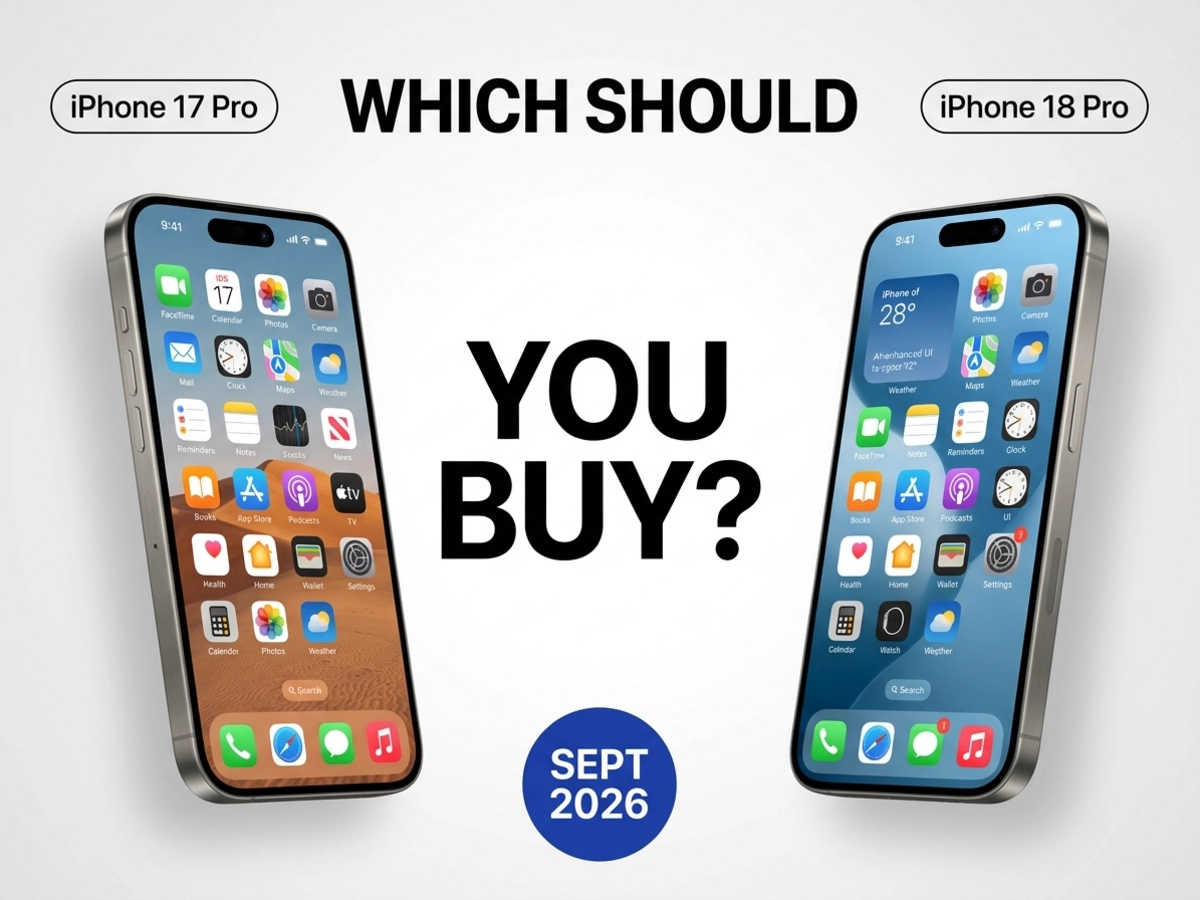
The iPhone 17 Pro is the best iPhone available right now. The iPhone 18 Pro arrives in September with a chip node jump, Apple's first in-house Pro modem, and a variable aperture camera. Whether waiting four months is worth it depends entirely on which generation you're upgrading from and how you actually use your phone.
Start with the honest baseline. The iPhone 17 Pro is a genuinely strong device — not just by Apple marketing metrics, but by independent testing. Apple's own Newsroom confirmed the A19 Pro chip delivers up to 40% better sustained performance compared to the A18 Pro when paired with the vapor chamber cooling system — a number that reflects real thermal headroom, not just peak burst figures. The vapor chamber matters here: the aluminum unibody conducts heat efficiently enough that the chip can run at higher levels for longer before throttling, which is what makes sustained performance different from peak performance. Benchmark testing by Tom's Guide found the iPhone 17 Pro hitting 46.4 fps on the 3DMark Solar Bay Unlimited graphics test, compared to the iPhone 16 Pro Max's 28.4 fps on the same benchmark — a 63% GPU improvement in one generation.
Battery life adds another layer to the baseline argument. CNN Underscored's extended testing found the iPhone 17 Pro Max lasted 21 hours and 44 minutes on a 4K looping video test — beating the iPhone 16 Pro Max by one hour and four minutes in controlled conditions, and sustaining 15 hours and 30 minutes of continuous mixed real-world use including heavy camera and cellular activity.
Here is why that matters for the buy/wait decision: the A19 Pro's multi-core CPU improvement over the A18 Pro was roughly 11–12%, meaningfully smaller than the approximately 18% gain the A18 Pro achieved over the A17 Pro. Each generation raises the floor. The stronger the prior year's device, the less dramatic the following year's gains feel in daily use. That compressing gain pattern means the iPhone 18 Pro's improvements will register differently depending on your starting point.
Someone upgrading from an iPhone 15 Pro to the iPhone 18 Pro crosses two chip generations and lands on a platform with Apple's first fully in-house Pro modem stack. Someone upgrading from an iPhone 17 Pro to the iPhone 18 Pro is moving from one excellent device to another — the differences exist, but they are extensions of a strong foundation, not corrections of meaningful shortcomings.
The move from TSMC's 3nm process to 2nm is the most technically significant chip transition in the iPhone Pro line in several years. TSMC's 2nm technology page confirms N2 mass production began Q4 2025, with a design goal of 10–15% performance improvement at the same power level or 25–30% power reduction at equivalent performance.
The architectural shift underlying those numbers matters. The 2nm node switches from FinFET transistors to Gate-All-Around nanosheet technology, which allows more precise control of electrical current and reduces leakage at the transistor level. That translates directly to either more headroom for performance or more efficiency at typical workloads — Apple's choice of how to balance those levers will determine the real-world outcome. The same N2 node powers Apple's upcoming M6 chips for Mac, so there is precedent for expecting Apple to push efficiency alongside performance rather than raw speed alone.
MacRumors reports that the A20 Pro is expected to deliver roughly 15% faster processing and approximately 30% better efficiency than the A19 series — consistent with what TSMC's process-level specifications project for N2. The A20 Pro also uses WMCM packaging that places RAM on the same wafer as the CPU, GPU, and Neural Engine, reducing memory latency rather than just increasing raw speed. That packaging change is not captured in traditional CPU benchmark comparisons but shows up in tasks where memory bandwidth limits throughput — advanced AI workloads and computational photography among them.
For users whose A19 Pro already handles everything without hesitation, the A20 Pro's real-world difference will be modest in daily tasks. The efficiency gains, however, show up somewhere else entirely.
The iPhone 17 Pro Max runs on a 5,088 mAh cell and delivers up to 39 hours of video playback. The iPhone 18 Pro Max is expected to arrive with a 5,100–5,200 mAh cell — a number that looks almost identical on paper.
But the raw cell size is only one of four contributions to what the iPhone 18 Pro Max will actually deliver on a charge. The A20 Pro's 2nm efficiency improvements mean the processor draws substantially less power at equivalent performance levels. The C2 modem, which integrates with the A20 Pro chip package rather than sitting as a discrete Qualcomm component, eliminates the energy overhead of routing data between separate silicon. And the display is receiving a technology upgrade: LTPO+ panels, now confirmed with Samsung and LG as exclusive suppliers after BOE was unable to meet quality and yield requirements, extend oxide materials to the driving transistors that control OLED light emission — enabling finer per-pixel power management that the current LTPO architecture cannot achieve.
These four sources of efficiency — chip, modem, display, and cell — compound simultaneously on the same device. Battery life is a product of how much power the hardware demands at each moment, not just how much the cell stores. The actual battery life improvement for the iPhone 18 Pro Max will be driven far more by that compound efficiency story than by the modest cell capacity increase. For anyone who regularly ends a heavy day with the phone at 15% or charges mid-afternoon while traveling, this is the most practically meaningful upgrade in the lineup.
The iPhone 17 Pro uses a Qualcomm Snapdragon X80. The iPhone Air uses Apple's C1X. The iPhone 18 Pro gets the C2.
That three-device sequence tells a deliberate platform story. Wikipedia's iPhone 17 Pro article documents Apple's explicit acknowledgment that in-house modem adoption "was not the focus for this year" when the flagship skipped the C1X in favor of the Qualcomm chip. The iPhone 18 Pro changes that equation. Apple will, for the first time, have its own silicon handling the processor, the modem, and the wireless networking chip simultaneously on a Pro model — completing a hardware stack integration no prior Pro generation achieved.
The practical modem gap is real and has been measured. An Ookla study from September 2025, cited by onoff.gr, found Apple's C1 modem on T-Mobile averaged 252 Mbps median download speeds compared to 317 Mbps for Qualcomm-equipped iPhones on the same network — a 21% gap attributable to the C1's narrower carrier aggregation support and the absence of mmWave 5G. The C2 adds mmWave and closes that performance gap. But the speed numbers alone understate the significance of the shift.
9to5Mac reports that Apple told Reuters the C-series modem architecture allows the processor to signal the modem about which data traffic is most time-sensitive — prioritizing it during network congestion in ways a third-party modem cannot do with the same level of integration. When the CPU and modem are designed together, iOS can coordinate them at a level that separate silicon from separate vendors simply cannot match. That tight integration also means satellite connectivity via NR-NTN becomes possible — the C2 is expected to support direct-to-satellite data access for areas beyond cellular coverage, though the full rollout depends on Globalstar infrastructure upgrades and carrier agreements still being finalized.
For users who stay in urban areas with strong 5G coverage, the day-to-day modem difference will be subtle. For anyone who travels to areas with spotty coverage, or who has noticed their iPhone 17 Pro working harder than expected to maintain signal, the efficiency and intelligence of the C2 represent a genuine quality-of-life improvement.
Every iPhone Pro from the 14 through the 17 uses the same fixed f/1.78 aperture on its main camera. The lens opens to its maximum and stays there for every shot. The iPhone 18 Pro changes that: Gadget Hacks reported that Apple has moved variable aperture into active supplier production, with Sunny Optical and Luxshare ICT handling actuator mechanisms and LG Innotek — the same manufacturer that built Apple's first periscope telephoto for the iPhone 15 Pro Max — assembling the finished modules.
Variable aperture lets the camera physically narrow the lens opening in bright conditions, reducing overexposure without relying on electronic shutter tricks. It widens in low light to collect more raw data before any processing begins. For portrait photography, the benefit is real but requires context: current iPhone computational portrait mode estimates depth and applies blur convincingly in most conditions. What variable aperture changes for portrait work is the quality of edge transitions. Algorithmic bokeh must make decisions about where a subject ends; optical blur follows physics and makes no such decisions. The falloff happens because of the optics, not because software estimated it should.
The clearest case for variable aperture is in video. A filming convention called the 180-degree shutter rule requires shutter speed to be double the frame rate, which creates an exposure problem in bright outdoor conditions when the aperture is fixed at f/1.78. The only current solution is a neutral density filter carried as external hardware. Variable aperture eliminates that friction natively, without accessories.
The exact aperture range Apple will ship has not been confirmed, and Gadget Hacks reported that dedicated cameras typically offer f/2.8 to f/22, while whatever Apple ships will be considerably narrower than that range. The precise depth-of-field benefit for still photographers remains unverifiable until hands-on reviews. Separately, a larger-aperture telephoto lens — a second camera upgrade also confirmed for iPhone 18 Pro production — should improve low-light zoom performance regardless of how the aperture range debate resolves.
For still photographers primarily shooting people, food, or products and already satisfied with iPhone's portrait output, variable aperture may not shift the experience significantly. For video creators, it addresses a genuine constraint that has no software workaround.
The starting device matters more than any single iPhone 18 Pro feature.
On an iPhone 15 Pro or older, the case for waiting is strong. The iPhone 18 Pro brings two chip generations of performance improvement, a modem that completes Apple's silicon stack, four compounded sources of battery efficiency, and a camera hardware upgrade that represents the first structural change to iPhone aperture since the fixed f/1.78 arrived with the iPhone 14 Pro. Four months is a reasonable wait for that combination.
On an iPhone 16 Pro, the calculation is closer. The A19 Pro already addressed the GPU gap that made the 16 Pro feel dated in graphics-intensive tasks. The C2 modem and battery efficiency stack are genuinely new territory with the 18 Pro. If battery life or coverage quality is a daily friction point, waiting makes sense. If neither is, the 16 Pro remains a capable device for another two to three years.
On an iPhone 17 Pro, the honest answer for most users is: wait if cameras or battery life are primary concerns; buy now if your need is immediate. The A19 Pro already handles everything in the current software ecosystem without hesitation, and its battery life is already exceptional by any prior iPhone standard. The iPhone 18 Pro's improvements are real, but they extend a strong foundation rather than correct meaningful shortcomings.
One open question worth monitoring: Gadget Hacks, citing The Information's reporting, reported that the Camera Control button will be simplified on the standard iPhone 18 — removing touch sensitivity and haptic feedback, retaining only pressure sensing — but this change has not been confirmed for the iPhone 18 Pro. Whether the Pro model keeps the full dual-sensor button or adopts the same simplified version will matter to anyone who has built a workflow around swipe-based Camera Control gestures. Apple's September announcement will settle that question.
The iPhone 18 Pro launches in September alongside the Pro Max and the foldable iPhone Ultra. Apple is also making distinct choices about how it positions the 18 Pro as a product — including the introduction of a deep red Dark Cherry finish that reflects broader shifts in how Apple competes in premium markets. For more on what those choices signal, iPhone 18 Pro Red: Apple's Color Gamble Reveals Product Strategy Shift examines what the color direction tells us about Apple's 2026 priorities. With pricing expected to hold near current Pro levels and a defined September window, anyone on the fence today has a clear wait threshold: roughly four months, short enough that for most people on a 15 Pro or older, holding off is a straightforward call.
Apple is expected to announce the iPhone 18 Pro and iPhone 18 Pro Max in September 2026, following the company's standard fall launch schedule. MacRumors reports that Apple has shifted to a two-phase release structure for 2026: the iPhone 18 Pro, iPhone 18 Pro Max, and foldable iPhone Ultra ship in September, while the standard iPhone 18 and iPhone 18e are now expected in early 2027.
On pricing, Apple held the same starting price for the iPhone 17 Pro that the 16 Pro launched at, and there is no confirmed indication of a change for the 18 Pro. The iPhone 18 Pro Max will reportedly be slightly thicker and heavier than the 17 Pro Max to accommodate its larger battery — consistent with the design direction Apple used for the 17 series — with display sizes unchanged at 6.3 inches and 6.9 inches.
The confirmed change applies to the standard iPhone 18. Gadget Hacks, citing The Information's reporting, reported that Apple plans to remove the capacitive touch layer and haptic feedback from the Camera Control on the standard model, leaving only pressure sensing. The report explicitly did not confirm whether this change extends to the iPhone 18 Pro.
The gap matters for prospective Pro buyers. If the Pro line retains the dual-sensor Camera Control, it becomes a differentiating hardware feature with genuine utility for users who rely on swipe gestures to adjust zoom or exposure. If both models receive the same simplified version, it signals Apple decided the design complexity of the original button wasn't worth the manufacturing cost and repair overhead it generated. Apple previously added a "Require Screen On" software setting specifically to reduce accidental Camera Control activations — a workaround that hardware simplification would address more cleanly. The September announcement will confirm which direction the Pro line takes.