Finished reading? Continue your journey in Tech with these hand-picked guides and tutorials.
Share your expertise with our readers. TrueSolvers accepts in-depth, independently researched articles on technology, AI, and software development from qualified contributors.
TrueSolvers is an independent technology publisher with a professional editorial team. Every article is independently researched, sourced from primary documentation, and cross-checked before publication.
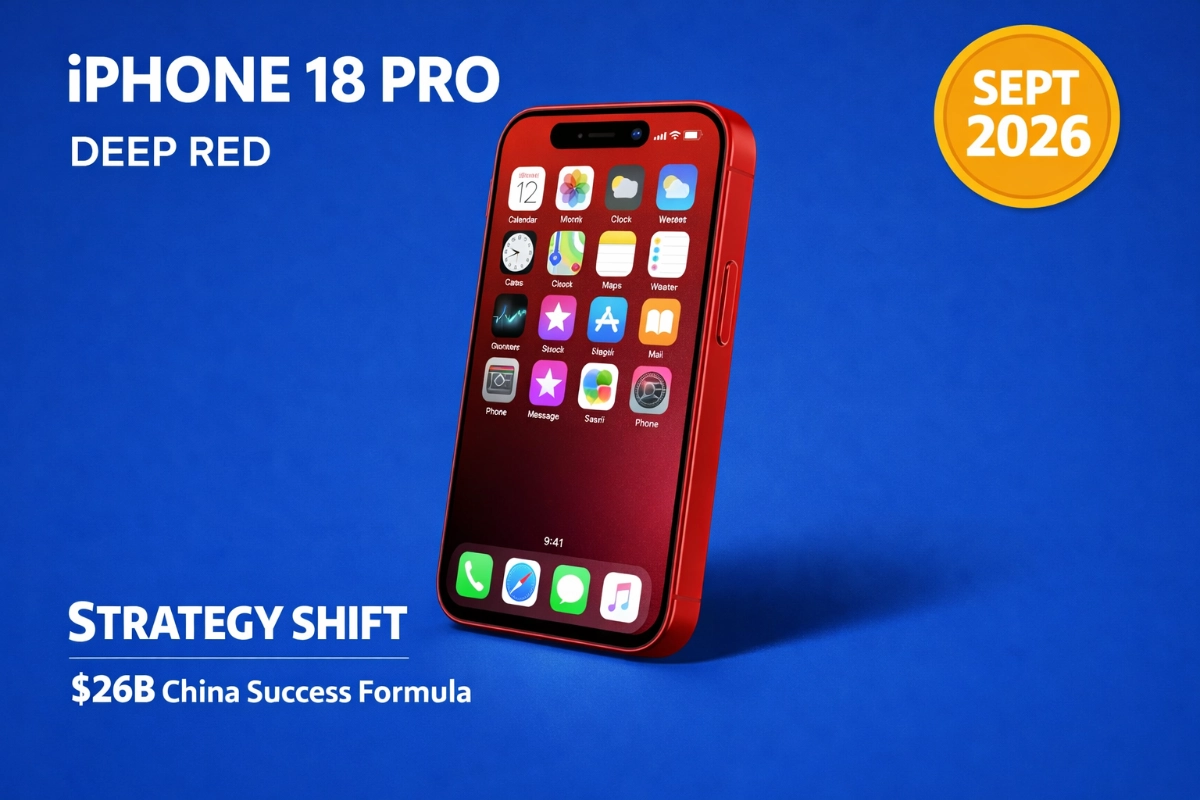
Apple is testing a deep red finish for the iPhone 18 Pro series launching September 2026, but this isn't just another color option. The move signals fundamental changes in how Apple positions premium phones, structures product launches, and competes in markets where technical specifications no longer guarantee wins. What looks like a simple design choice actually reveals Apple doubling down on a strategy that just generated $26 billion in China revenue growth.
On February 22, 2026, Bloomberg's Mark Gurman reported that Apple is testing a deep red finish for the iPhone 18 Pro and Pro Max. The shade he described sits closer to a rich burgundy than the bright scarlet most people associate with Apple's past red devices. Earlier rumors that mentioned purple and brown variants turned out to be different descriptions of the same deep red concept, not separate color options.
If the finish makes it to production, it would mark the first time Apple has ever offered a Pro or Pro Max iPhone in any shade of red. That fact alone warrants a second look, because red is not a new color for Apple. The PRODUCT(RED) program ran for nearly two decades, raising approximately $270 million for the Global Fund to fight AIDS. It appeared on iPhone after iPhone. But every single one of those devices belonged to the standard or budget tier. The Pro line was always excluded.
That exclusion is now permanent in the most literal sense. Apple no longer offers any device in PRODUCT(RED), a transition that was completed quietly when the iPhone 16e launched in early 2026 without the program's branding. The charitable partnership faded without fanfare.
What we find notable is the timing of this shift. Apple retired a philanthropic red from its budget tier and is now, in the same period, introducing a luxury-grade burgundy to its most expensive phones. These are not unrelated events. The same color is being repositioned from charity signal to prestige marker, from the product line sold on affordability to the line sold on aspiration. No Apple announcement has connected these dots directly, but the sequence is difficult to read as coincidental.
To understand why Apple is reaching for a bold color on the iPhone 18 Pro, start with what happened when Cosmic Orange launched on the iPhone 17 Pro in September 2025.
The color went viral on Douyin, Xiaohongshu, and Weibo within days of the announcement. Chinese consumers immediately noticed a visual resemblance to the signature orange associated with Hermès, the French luxury house. Influencer content amplified the comparison. The connection was not orchestrated by Apple's marketing team; it emerged organically and spread faster than any paid campaign could have. The Mandarin word for orange carries the same sound as the word for success, giving the color an unplanned linguistic dimension that resonated particularly well in a market where symbolic meaning in consumer goods carries genuine weight.
The financial results were measurable and significant. Apple's Greater China revenue reached $26 billion in Q4 2025, a 38% increase year-over-year, reversing nearly three years of decline in the market. IDC Senior Research Director Nabila Popal pointed specifically to the external design changes, naming the orange color as a driver that pulled out early upgraders. That framing matters: it was not a chip announcement, a camera specification, or a software feature that moved buyers. It was how the device looked.
The sales composition reflected the same dynamic. iPhone 17 models accounted for 80% of all global iPhone sales in December 2025, per CIRP data, with the Pro Max alone capturing 27% of total iPhone sales and the Pro taking 25%. Greg Joswiak, Apple's head of product marketing, acknowledged that Pro customers had been requesting vibrant colors for years, noting that the standard line had historically received all the expressive options while Pro buyers were offered only restrained neutrals.
Color was not the only lever Apple pulled in China. The base iPhone 17 launched at 5,999 RMB in China, exactly one yuan below the 6,000 RMB threshold for the government's electronics subsidy program, which offered buyers up to 15% back on qualifying purchases. China's subsidy program directed roughly $43 billion in electronics spending in 2025. Chinese consumers chose iPhones despite Apple Intelligence remaining unavailable in mainland China, meaning the purchase decision turned entirely on physical and cultural factors, not software.
Apple priced the base iPhone 17 at 5,999 RMB — one yuan below the government subsidy threshold — while simultaneously launching a color that accrued organic Hermès associations across Douyin and Xiaohongshu. Every competitor knew the subsidy program existed. None of them owned the cultural association that belonged to Apple's specific shade. Neither element alone would have produced the same result. Together, they created a convergence that competitors could observe but not easily replicate.
Color no longer functions as cosmetic differentiation applied after the hardware decisions are made. It now functions as positioning architecture, chosen because it signals something specific about identity, aspiration, and cultural fit. The standard iPhone line gets playful pastels aimed at approachable personality. Pro models get luxury statement colors aimed at status signaling. Each tier communicates a distinct identity through color before a single specification enters the conversation.
Orange's success in China was real, but it was also structurally dependent. The Hermès association required a specific visual coincidence between Apple's chosen shade and a French luxury brand's signature color. The linguistic luck required Mandarin phonetics. Both factors were genuine and powerful, but neither was portable: you cannot engineer the Hermès connection in a different market, and the Mandarin sound association does not translate to Hindi, Tamil, or Gujarati.
Red carries a different kind of weight. In Chinese culture, red has been the dominant color of celebration, prosperity, and good fortune for centuries. Its significance in Chinese New Year, weddings, and major milestones is not a brand association; it is a cultural constant. No luxury house needs to be involved. Red's meaning in China is self-sufficient.
In India, where Apple is investing aggressively in manufacturing and market share, red holds comparably strong symbolic associations: vitality, celebration, and auspiciousness. The color appears throughout religious practice, wedding ceremony, and national identity. Unlike orange's China-specific linguistic hook, red's resonance across both China and India gives Apple something orange never offered: a single premium color that carries meaningful weight in two of its highest-priority growth markets simultaneously.
Orange's resonance required a specific visual coincidence with Hermès and a Mandarin phonetic accident — neither of which travels to Hindi, Tamil, or Gujarati. Red's symbolic weight in both China and India is self-sufficient, requiring no brand association and no linguistic coincidence to function. Orange proved the model. Red extends it to a wider stage.
The color-wheel proximity Gurman himself flagged is the remaining complication. Orange and red sit close enough together that offering both in the same Pro lineup risks making the palette feel internally redundant rather than expansively expressive. Luxury brands typically anchor each tier to a single hero color; offering two closely related shades can dilute the exclusivity that made either meaningful. The evidence suggests that keeping both would undermine the scarcity that gave orange its status-symbol quality in the first place. Whether Apple retires Cosmic Orange or finds a way to position both will be a visible signal of how deliberately the company manages color as brand architecture going forward.
Understanding why a color matters requires understanding the hardware year it arrives in.
Bloomberg's Mark Gurman described the iPhone 18 Pro as a device that "won't be a big update," framing the expected improvements as the kind of incremental refinements Apple used to mark with an "S" suffix. The A20 chip, variable aperture camera, and C2 modem represent real progress, but not the category-shifting leap that characterized the iPhone 17 Pro's material and camera overhaul. Gurman's read was direct: the foldable iPhone, arriving in the same fall 2026 launch window, will be the story. The Pro will be the familiar, reliable option beside a genuinely novel one.
That framing has a direct consequence for how Apple sells the Pro. When the hardware narrative is incremental, something else has to create the emotional permission to upgrade. Joswiak's acknowledgment that Pro customers had been asking for expressive colors for years points toward exactly this: Apple has been building toward using color as a purchase catalyst for a demographic that had been underserved by neutral titanium palettes.
The 2026 launch structure reinforces the point. Standard iPhone 18 and the budget iPhone 18e are not arriving in fall; they are delayed to spring 2027. Buyers who want a new iPhone in September 2026 will choose between the Pro, the Pro Max, and the foldable. The entry-level option is not available. That is not an accident of supply chains; it is a product hierarchy decision that ensures fall 2026 buyers are spending at the highest price points available.
The "won't be a big update" framing does not weaken the device's appeal. It clarifies what the appeal has to be. In a breakout hardware year, the product story carries itself. In a refinement year, the device's identity becomes the story. A deep burgundy Pro iPhone that signals luxury and carries the kind of cultural weight Cosmic Orange demonstrated provides Apple with exactly the kind of identity statement that converts a hesitant "I'll wait another year" attitude into an actual purchase. The color is not compensating for weak specs. It is doing the work that breakthrough specs do in other years.
The iPhone 17 Pro's shift from titanium to aluminum was primarily an engineering decision about thermal performance. Aluminum conducts heat roughly twenty times more effectively than titanium, which matters considerably when a device contains a chip as powerful as the A19 Pro. The redesigned enclosure, which Apple officially describes as a "heat-forged aluminum unibody," also integrated a laser-welded vapor chamber that pulls heat away from the processor more aggressively than the previous titanium-framed design allowed.
The color benefit was a secondary consequence of a structural decision. Anodizing, the electrochemical process that colors aluminum by growing an oxide layer on the surface, produces saturated, rich finishes that titanium's PVD coating process cannot match at production scale. The color lives inside the oxide layer itself rather than sitting on top as an applied coating, which is why anodized aluminum holds its hue with a consistency that Apple's titanium phones struggled to achieve in deeper shades. Deep burgundy on a heat-forged aluminum enclosure is achievable in a way that deep burgundy on the iPhone 16 Pro's titanium frame would not have been.
iFixit, working with a materials scientist, documented a phenomenon on the iPhone 17 Pro where the anodized oxide layer separated at sharp edges, particularly around the raised camera bump plateau. On flat surfaces, the anodizing holds well. At geometrically sharp edges, the oxide layer cannot adhere as uniformly, and small fragments can detach under normal contact. This is not a failure specific to aluminum versus titanium; titanium oxide is only marginally harder. The issue is edge geometry, and it affects any anodized finish in high-contact zones. A deep burgundy iPhone 18 Pro will make such wear more visible than a silver or black model would, simply because the contrast between the rich color and the bare metal beneath is higher. This is not a reason to avoid the device, but it is context worth carrying into a purchase decision.
On the specification side, the iPhone 18 Pro runs on an A20 Pro chip built on TSMC's 2-nanometer manufacturing process, delivering roughly 15% better performance and 30% improved efficiency compared to the current 3-nanometer generation. Apple's own C2 modem replaces the Qualcomm-sourced chip, bringing mmWave 5G support and a meaningful improvement in battery efficiency during cellular use. The variable aperture main camera lets the lens physically adjust its opening, offering greater control over light intake and depth-of-field rendering. Per MacRumors' comprehensive iPhone 18 roundup, the feature may initially be limited to the Pro Max, with the standard Pro potentially following in a subsequent cycle. For a deeper look at what variable aperture changes about the practical photographic experience day to day, our full breakdown of the iPhone 18 Pro camera system covers what this means for everyday shooting. The Dynamic Island is expected to shrink noticeably; whether under-display Face ID arrives fully in 2026 remains contested across available leak sources, with some reports suggesting only partial implementation by fall.
The iPhone 18 Pro and the iPhone Fold will arrive in the same September 2026 launch window. Their color choices could not be more different.
Per Gurman's reporting, the Fold will launch in conservative finishes: dark gray or black and silver or white. No Cosmic Orange equivalent. No deep burgundy. The palette is specifically designed to avoid what Apple's Pro models now embrace.
The device itself represents a significant physical departure: a book-style design that opens to a 7.6-inch display and closes to a 5.3-inch exterior screen. Early testing feedback has characterized the fold line as something that recedes from awareness at normal viewing distances, a significant improvement on first-generation competitors. Apple has given it the same A20 Pro chip that powers the iPhone 18 Pro, establishing immediate performance credibility. The expected starting price falls between $2,000 and $2,500. Touch ID via a side button is the anticipated authentication method, bypassing Face ID entirely.
The conservative palette is not a missed opportunity; it is a deliberate argument. A device asking buyers to accept a new form factor, a new price tier, and new ergonomics all at once has no room for aesthetic controversy alongside those asks. Bold color on a $2,000 first-generation foldable would pull reviews, social media reactions, and purchasing conversations toward the finish and away from the fundamental question: does folding work? Apple needs the answer to that question to be experienced and evaluated on its merits, not filtered through a polarizing color choice. The restraint is strategic communication.
The contrast between the two devices also reveals how Apple is managing the premium tier's internal hierarchy. The Fold is the experimental flagship for early adopters willing to pay for novelty. The Pro is the proven flagship for buyers who want the best established iPhone. Color reinforces the distinction: expressive and culturally coded for the familiar choice, quiet and professional for the experimental one.
The momentum Apple built in China through the iPhone 17 cycle did not stop at the December 2025 quarter.
Counterpoint Research found that Apple recorded 8% year-on-year sales growth in China for January 2026, making it the only major smartphone brand to grow during a period in which the broader Chinese smartphone market contracted by 23%. Every major Chinese competitor, including Huawei, Xiaomi, Vivo, and Oppo, posted double-digit declines in the same window.
Apple is not entering the iPhone 18 Pro launch trying to recover lost ground. It is entering with an advantage and attempting to extend it. That distinction changes the meaning of the deep red color choice. This is not a corrective move. It is a bet that the cultural-color strategy Apple proved with orange can be iterated successfully, and that red's broader symbolic resonance across China and India offers a larger total opportunity than orange ever could.
The largest open question is whether Cosmic Orange survives the transition. Gurman himself acknowledged the tension, noting that the two colors are close enough on the spectrum that the final lineup decision remains unsettled. If both shades appear together, the Pro lineup carries two warm, premium-positioned colors within the same tier, a configuration that risks making each feel less exclusive. If orange is retired in favor of red, Apple signals that its color strategy is genuinely sequential rather than cumulative, managing scarcity by rotating flagship shades rather than expanding them indefinitely.
The September 2026 launch will answer questions that go beyond this single device. It will test whether Apple's cultural-color strategy is a repeatable system or a one-time coincidence. It will reveal whether the company treats color as rotating art direction or as a structured element of product architecture with its own lifecycle discipline. And it will show whether a deep burgundy can carry the same aspirational weight in Chinese and Indian markets that a Hermès-coded orange carried in the twelve months prior.
For buyers deciding whether to upgrade, the relevant calculation extends beyond the finish itself. The iPhone 18 Pro arrives in an incremental hardware year, priced against a foldable that commands a completely different budget. The color provides a reason to buy that the specs alone may not. Whether that reason is sufficient depends less on the burgundy than on whether a buyer wants to own a device whose identity Apple has invested considerable strategic thought in making feel like something genuinely worth owning.
Will Cosmic Orange be kept alongside the new deep red for iPhone 18 Pro?
No final decision has been confirmed. Gurman acknowledged that orange and red sit close on the color wheel and stated the lineup remains unsettled as of his February 2026 reporting. Apple's internal color testing typically continues through late spring before final production commitments are made. The proximity of the two shades makes a dual offering risky from a brand architecture standpoint; offering both would likely dilute the exclusivity that drove orange's commercial success. The more probable outcome, based on how luxury brands handle signature color rotation, is a transition rather than an expansion, but Apple has not confirmed either direction.
Does the iPhone 18 Pro deep red have any connection to Apple's PRODUCT(RED) charity program?
No. Apple retired the PRODUCT(RED) program from its device lineup entirely, with the iPhone 16e in early 2026 marking the end of the program on any Apple device. The iPhone 18 Pro deep red is a luxury finish with no charitable branding, no RED organization partnership, and no donation component attached. The two uses of red represent completely different positioning: one built around philanthropy on budget-tier devices, the other built around prestige on Apple's highest-priced phones.
Is the variable aperture camera confirmed for both iPhone 18 Pro models?
Not definitively. MacRumors' roundup of available leak sources indicates the feature may arrive first on the Pro Max, with the standard Pro potentially following later. Apple has not confirmed specifications. The picture should clarify as production ramps through summer 2026. For the full breakdown of what variable aperture means in practice, our detailed camera analysis covers the feature in depth.
How does the iPhone 18 Pro's deep red finish compare to the durability of previous iPhone finishes?
The anodized aluminum process that enables saturated colors on the iPhone 17 Pro and 18 Pro carries a documented limitation at sharp edges. iFixit and materials researchers found that the oxide layer on the iPhone 17 Pro's camera bump edge can separate under normal contact. On flat surfaces, the finish is durable. The practical implication for a deep burgundy finish is that edge wear will be more visually apparent than on a lighter or neutral color, because the contrast between the rich hue and the bare metal beneath is more noticeable. A case covering the camera bump area reduces this exposure significantly.