Finished reading? Continue your journey in Tech with these hand-picked guides and tutorials.
Share your expertise with our readers. TrueSolvers accepts in-depth, independently researched articles on technology, AI, and software development from qualified contributors.
TrueSolvers is an independent technology publisher with a professional editorial team. Every article is independently researched, sourced from primary documentation, and cross-checked before publication.
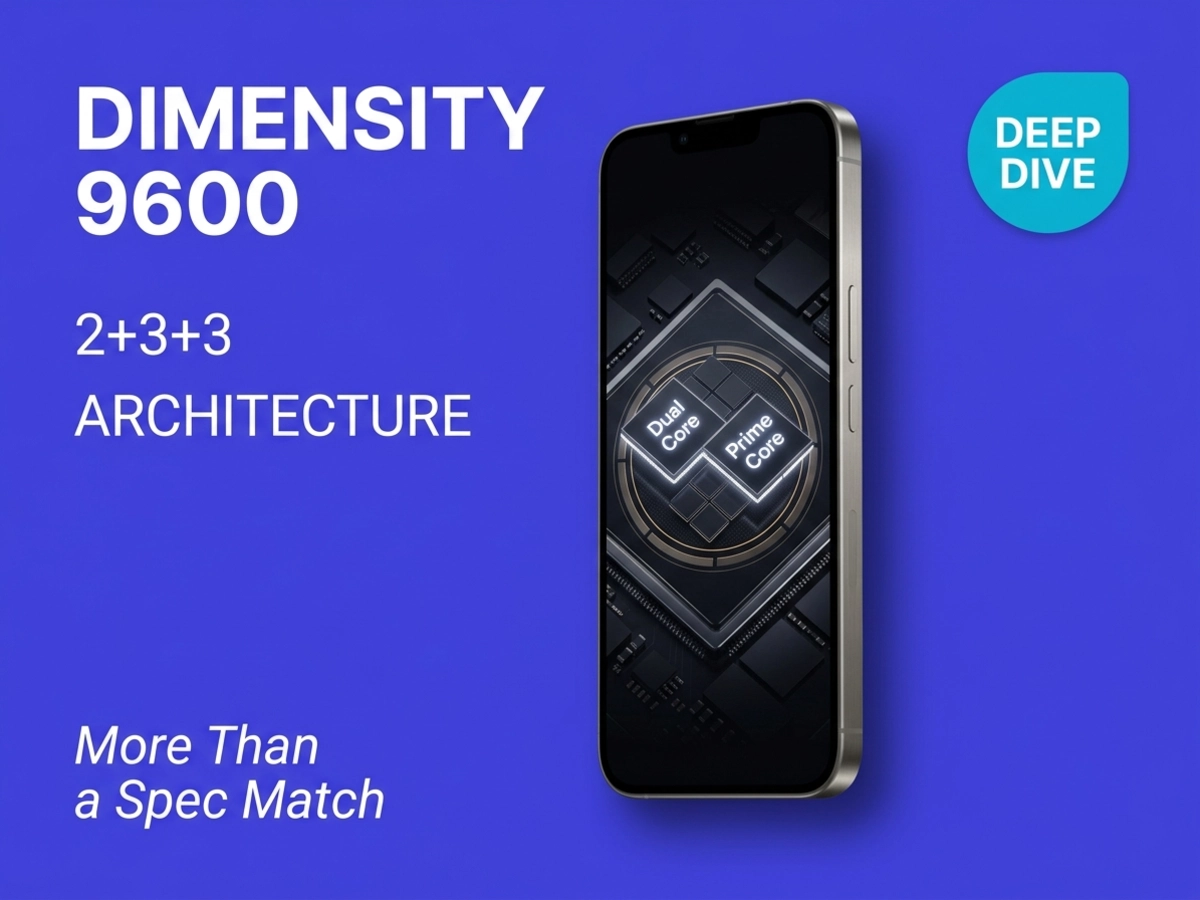
The MediaTek Dimensity 9600's 2+3+3 CPU layout looks identical to Qualcomm's Snapdragon 8 Elite Gen 6 on paper. But the similarities end at the cluster count. This analysis explains what the ARM C2 cores, TSMC N2P process, and current-gen benchmark data reveal about whether MediaTek has finally built a chip that earns parity rather than approximates it.
The Dimensity 9600 represents a departure from every prior generation in the Dimensity 9 series. Previous chips operated with a single flagship core at the top of the cluster, supported by rings of progressively lower-performance units. The upcoming design, internally codenamed "Canyon," reorganizes that structure into a 2+3+3 arrangement built entirely from ARM's next-generation C2 family, with no efficiency cores in the mix.
The manufacturing foundation matters as much as the core count. The chip is expected to run on TSMC's N2P process, an enhanced derivative of the base 2nm node. TSMC's mobile platform documentation specifies that N2P delivers a 5% performance improvement over the standard N2 node while using identical design rules, and roughly 18% better performance alongside 36% lower power consumption compared to the N3E process that underpins current flagship chips. Volume production is scheduled for the second half of 2026. For context, the Dimensity 9500 runs on N3P; the jump to N2P is a full-node leap, not an incremental refresh.
The 2nm era is intensifying across the entire industry. Google's Pixel 11 Pro XL is also making the move to 2nm with its Tensor G6 processor, with TSMC's node providing comparable efficiency gains over the 3nm competition. The key difference is that the Dimensity 9600 targets the N2P variant specifically to extract the additional 5% performance headroom that the base N2 node does not offer.
The core hierarchy itself deserves unpacking. ARM's C-series, introduced in 2025, structures cores into four tiers with distinct design priorities:
C2-Ultra: The performance peak, handling the heaviest workloads at the highest clock speeds
C2-Premium: Near-flagship output in a smaller silicon footprint, suited for sustained performance tasks
C2-Pro: Mid-tier sustained performance, optimized for extended gaming and multitasking
C2-Nano: Efficiency-focused, designed for background and always-on tasks (not present in the 9600's all-big-core configuration)
The Dimensity 9600 pairs two C2-Ultra cores with three C2-Premium and three C2-Pro units, filling all eight slots with high-performance silicon. MediaTek has not officially confirmed any of these specifications, and the ARM C2 core family itself has not yet been publicly announced as of April 2026; what we know comes from pre-announcement industry leaks. The ARM C2 announcement is expected in September 2026, coinciding with the Dimensity 9600's own launch window, which means the chip and its core generation will debut together. MediaTek has not previously launched a flagship chip and its underlying core architecture in the same product cycle.
The current generation reveals exactly where a second Ultra core would close the gap. To see why, the Dimensity 9500's benchmark profile tells the story.
At MediaTek's own launch event for the Dimensity 9500, the chip posted Geekbench 6 scores of 4,007 in single-core and 11,217 in multi-core. Those are strong numbers that reflect how far MediaTek has closed the gap with Qualcomm's competing Snapdragon 8 Elite Gen 5. But the performance picture is not uniform across workload types.
In AnTuTu testing with comparable devices, the Snapdragon 8 Elite Gen 5 led the Dimensity 9500 by roughly 16% in the CPU subscore, while the Dimensity 9500 held a narrow 3% advantage in GPU performance. The Snapdragon's CPU lead traces directly to its prime cores running at 4.61 GHz against the Dimensity's single C1-Ultra at 4.21 GHz. That 400 MHz gap translates into a measurable sustained-throughput difference when workloads keep both prime clusters at high utilization simultaneously.
GPU performance has consistently favored the Dimensity lineup. CPU sustained scores are where Qualcomm has maintained its edge.
The C1-Ultra clocked at 4.21 GHz already delivered single-core scores within 5% of Qualcomm's Oryon-powered Gen 5 running at 4.61 GHz, a gap of 400 MHz producing only marginal differentiation, which means the Dimensity 9600's move to two C2-Ultra cores on N2P is closing the sustained-workload ceiling that synthetic benchmarks routinely flatten into invisibility. A single Ultra core can be saturated by AI inference tasks, extended ray-traced gaming sessions, or simultaneous camera processing and video encoding. Two Ultra cores on a faster process node allow both to run at peak capacity concurrently rather than forcing the scheduler to queue work behind a single high-performance gate.
This is precisely the failure mode that the Dimensity 9300 and 9400 exhibited under extended load. The all-big-core design that MediaTek pioneered in 2023 with the Dimensity 9300 eliminated efficiency cores in favor of wringing maximum throughput from every clock cycle, and the Dimensity 9500 made substantial progress on the thermal management story. The 9600 extends that logic by doubling the performance ceiling rather than raising it incrementally.
Qualcomm's Snapdragon 8 Elite Gen 6 is expected to use the same 2+3+3 cluster layout as the Dimensity 9600. Both chips will run on TSMC's N2P process. Both should support LPDDR6 memory and UFS 5.0 storage. On a spec sheet, they will look nearly identical. The underlying engineering is not.
Qualcomm's cores are built from scratch. Tom's Hardware reported, citing testimony by Oryon lead architect Gerard Williams in the Qualcomm-ARM trial, that Oryon cores contain "one percent or less" of ARM's proprietary technology; Qualcomm acquired the startup Nuvia, where Oryon was designed, for $1.4 billion in 2021. Oryon implements ARM's instruction set as the software compatibility layer, but the pipelines, execution units, cache hierarchies, and branch prediction hardware are Qualcomm's own design decisions. The company can iterate on any of those elements without waiting for ARM's next reference release.
MediaTek's approach is the inverse. The C2-series cores inside the Dimensity 9600 will be ARM's design, optimized by MediaTek for clock tuning and integration within TSMC's N2P process. That is not a weakness: ARM's C1 generation already produced cores capable of competitive single-core performance at a clock disadvantage relative to Oryon, which is a genuine architectural credibility signal. But it means MediaTek's roadmap is tied to ARM's release schedule rather than its own silicon team.
We should note that Qualcomm's Gen 6 Pro is also rumored to push performance cores to 5.0 GHz or higher, a clock speed the current Dimensity architecture has not approached and whose feasibility on N2P remains unconfirmed by either company.
MediaTek and Qualcomm are converging on identical cluster blueprints: 2+3+3, N2P, LPDDR6. But they are simultaneously diverging at the most fundamental level of chip design, one licensing its cores from ARM and the other building them from the ground up with over 99% original IP. The divergence matters most not for the current generation but for the one after it. Qualcomm can adjust its execution width, cache sizes, or branch predictor in the Snapdragon 8 Elite Gen 7 without any external dependency. MediaTek's equivalent improvements will arrive when ARM announces C3. That difference in iteration velocity is the deeper story inside the spec-sheet symmetry.
Architectural competitiveness and market competitiveness are separate problems. MediaTek has historically solved the second one by solving the first at a lower price. That equation is under pressure for 2026.
The Dimensity 9500 cost OEMs approximately 50% less than the Snapdragon 8 Elite Gen 5 on the same N3P process; TSMC's N2P wafers carry an estimated price of $30,000 each, and Apple has secured the majority of base N2 capacity, pushing both Qualcomm and MediaTek toward the pricier N2P variant — which means the economic gap that made MediaTek attractive to Oppo and Vivo is under more pressure than at any recent point, and the data points toward this coinciding with the Dimensity 9600's strongest architectural moment.
The wafer cost dynamic is structural, not cyclical. Apple moving aggressively on N2 capacity pushed both Qualcomm and MediaTek toward N2P, the enhanced variant. Both companies now pay the same premium for access to the same fabrication node. The Wccftech Dimensity 9600 roundup documented that the Dimensity 9500 cost OEMs between $180 and $200 per unit; the 9600's pricing is expected to rise given the jump from N3P to N2P. Separately, Wccftech's reporting on LPDDR6 exclusivity documented the $30,000-per-wafer estimate and confirmed that LPDDR6 memory is expected to remain exclusive to flagship-tier chips in 2026 because of elevated DRAM prices.
MediaTek is also weighing whether to split the Dimensity 9600 into two configurations, as Qualcomm has done with its Gen 6 and Gen 6 Pro. A lower-cost variant would likely retain the 2+3+3 CPU architecture on N2P but pair it with a less powerful GPU and LPDDR5X rather than LPDDR6. The final pricing picture for Dimensity 9600-powered devices is not yet clear; we do not know whether MediaTek will split the lineup into tiers or maintain a single flagship configuration.
If the price gap between Dimensity and Snapdragon narrows significantly, Oppo and Vivo face a harder choice than they have in recent cycles. In 2025, those OEMs chose Dimensity partly because it allowed them to maintain margins while delivering competitive performance. If the cost differential compresses toward parity, the decision becomes purely technical, and Qualcomm's mature software ecosystem and broader 5G connectivity specs become more relevant to the OEM calculus.
MediaTek's launch timing is itself a competitive statement. The Dimensity 9500 arrived in late September 2025, which meant Oppo and Vivo's flagship phones landed in October, a month after Xiaomi's Snapdragon-powered devices hit shelves. BigGo Finance reported that Xiaomi's 17 series, launched in September with Qualcomm's chip, crossed one million units sold in China before the Dimensity-powered alternatives were available. MediaTek is targeting September 2026 for the Dimensity 9600 announcement, which would put Oppo and Vivo's next flagships, including the expected Find X10 Pro and Vivo X400 series, in the same launch window as Apple's iPhone 18 and Xiaomi's next generation.
That timing shift matters beyond competitive symbolism. The September window captures peak consumer attention heading into the holiday buying cycle, and Chinese OEMs that launch in October are effectively selling against established review narratives built around the September releases. A simultaneous window eliminates that disadvantage.
The Snapdragon 8 Elite Gen 6 occupies a more complex market position than prior Qualcomm flagships because it splits into two tiers. The base Gen 6 is expected at lower pricing with a less capable GPU; the Gen 6 Pro targets premium pricing with Adreno 850 graphics, LPDDR6, and the reported high-clock performance cores. The Dimensity 9600, if it launches as a single configuration, will likely sit between the two Snapdragon tiers on performance, offering something closer to the Gen 6 Pro's CPU architecture and connectivity profile while potentially underpricing the Pro tier on chip cost.
What we can say with confidence is that the September 2026 flagship window will be the most technically competitive in recent memory, regardless of which chip ultimately leads benchmarks. Three companies will field their most capable silicon simultaneously on the same manufacturing node, each making different engineering bets on what the next phase of mobile performance requires.
For buyers, the practical takeaway is this: chip-level differentiation between the top Android flagships will be narrower in 2026 than it has been in any recent cycle, and the decision between a Dimensity-powered device and a Snapdragon-powered one will increasingly come down to OEM software, camera implementation, connectivity features, and price rather than a straightforward performance hierarchy.
Eliminating efficiency cores removes the idle-power safety net that traditional big.LITTLE designs rely on, trading the power floor those cores provide against the efficiency gains from always running workloads on silicon genuinely capable of handling them. MediaTek pioneered this approach with the Dimensity 9300 in 2023, and successive generations have improved thermal management progressively. The Dimensity 9500 showed substantially better sustained performance than the 9400, which suffered visible throttling under extended load on some devices.
The N2P process contributes meaningfully to this equation. TSMC's documentation confirms that N2P delivers roughly 36% lower power consumption at equivalent speeds compared to N3E, which provides meaningful headroom for the all-big-core cluster to operate without the power spikes that caused earlier generations to throttle. Whether that headroom is fully realized depends heavily on how each OEM designs its cooling solution, a variable outside MediaTek's control.
The Oppo Find X10 Pro and the Vivo X400 series have been named in leaks as the expected launch devices for the Dimensity 9600. Both brands have historically been among the first to adopt new Dimensity flagships; the Vivo X300 series and the Oppo Find X9 series launched with the Dimensity 9500 in late 2025. Xiaomi is expected to retain its pattern of September launches with Qualcomm's chip before potentially offering a Dimensity variant later.
The broader OEM picture reflects economics as much as preference. Qualcomm's Snapdragon 8 Elite Gen 6 Pro is expected to carry a substantial premium, and OEMs that use it in their top-tier Ultra models will need to price those devices accordingly. The Dimensity 9600 gives Oppo and Vivo a path to flagship-grade specifications without absorbing the highest-tier Qualcomm pricing, assuming MediaTek's cost advantage survives the N2P transition.
The Mali-G2 Ultra is expected to follow the scalable architecture pattern ARM established with the Mali-G1 family, optimized for 2nm process characteristics. For context, the Mali-G1 Ultra already delivered a 20% general graphics performance improvement over its predecessor and doubled ray-tracing throughput, establishing ARM's GPU lineup as genuinely competitive with Qualcomm's Adreno in rasterization and ray-traced workloads.
The more architecturally interesting addition is the Neural Shader Scheduler. The Wccftech Dimensity 9600 roundup documented ARM's design intent: the NSS coordinates inference tasks including motion estimation, upscaling, and frame reconstruction between the GPU and NPU, reducing total power draw and preventing GPU stalls when machine-learning compute loads arrive unpredictably. In practice, this means the GPU spends less time waiting and the NPU handles tasks it executes more efficiently, a tighter division of labor that should produce higher sustained frame rates in complex titles without proportionally higher power consumption. Whether that translates into measurable real-device improvements over the Mali-G1 Ultra's already strong performance is a question that only device testing will answer.