Finished reading? Continue your journey in Tech with these hand-picked guides and tutorials.
Boost your workflow with our browser-based tools
Share your expertise with our readers. TrueSolvers accepts in-depth, independently researched articles on technology, AI, and software development from qualified contributors.
TrueSolvers is an independent technology publisher with a professional editorial team. Every article is independently researched, sourced from primary documentation, and cross-checked before publication.
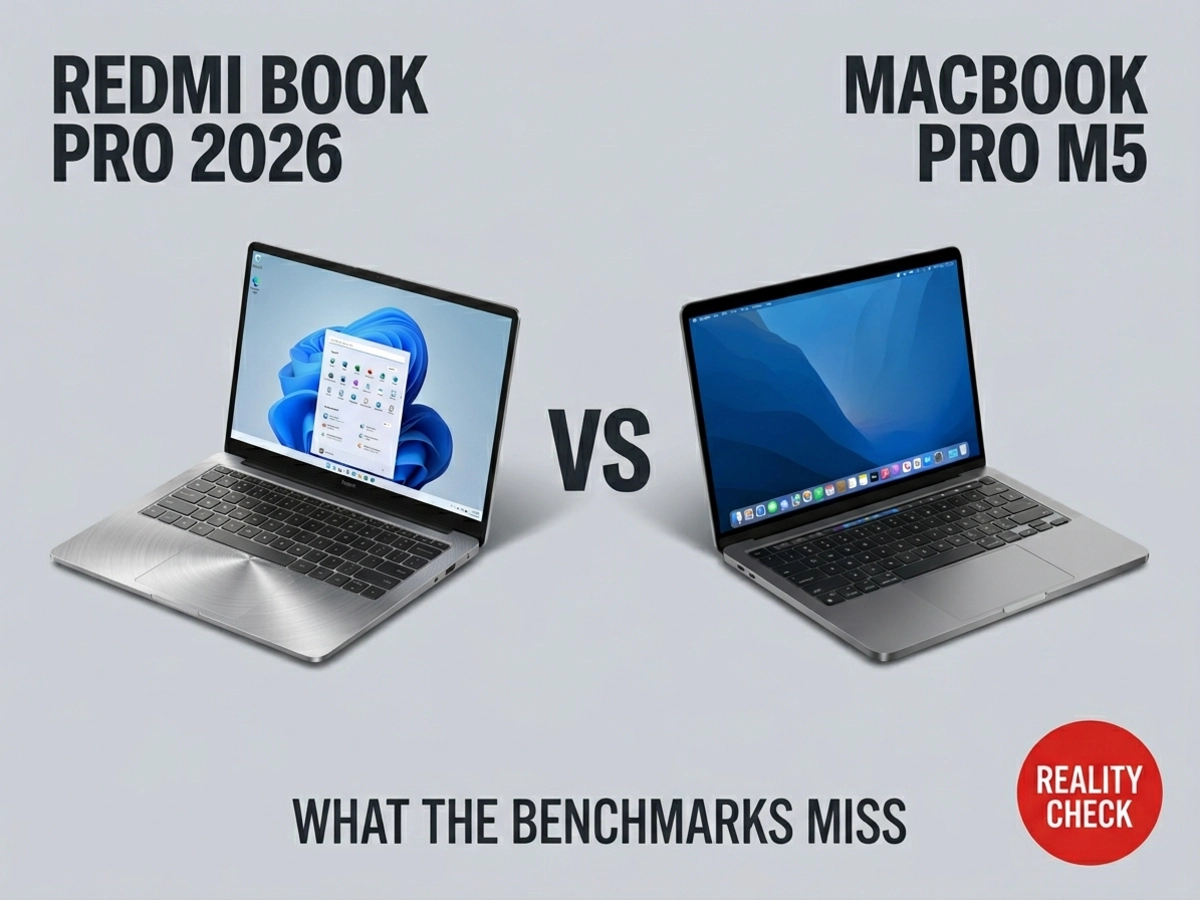
For the first time in years, a Windows laptop can genuinely challenge the MacBook Pro M5 on hardware terms. The Redmi Book Pro 2026 arrives with Intel's brand-new Panther Lake chip, a battery larger than most competitors, and a price that should land meaningfully below Apple's entry point. But the benchmark headlines that have dominated coverage since CES — the ones declaring Intel has finally beaten Apple Silicon — describe a different chip than the one inside the Redmi. That gap changes the calculation, and it's not the only thing the spec sheets leave out.
Panther Lake is Intel's Core Ultra Series 3 platform, and it represents the first time Intel's mobile chip story has been genuinely interesting in five years. The Core Ultra X7 358H at the heart of the Redmi Book Pro 2026 is a 16-core design: four high-performance cores, eight efficiency cores, and four low-power efficiency cores, tuned to balance demanding workloads with background tasks and idle power draw. The base power envelope sits at 25 watts, with a turbo ceiling of 80 watts and a maximum boost frequency of 4.8 GHz.
The compute tile runs on Intel's own 18A process — the first time Intel has owned production at this node — while the GPU tile comes from TSMC's N3E, a dual-foundry architecture that marks a structural departure from Intel's recent strategy of outsourcing production entirely. The integrated Arc B390 graphics, with 12 Xe3 cores, represents a meaningful leap over previous generations of Intel integrated graphics.
The TDP gap relative to Apple M-series chips matters in practice. Apple's M5 draws roughly 15 watts in comparable scenarios. The 25-watt base for Panther Lake creates more thermal work for a thin chassis to manage, which affects how laptops like the Redmi Book Pro 2026 perform under sustained load — a point that becomes relevant later in this comparison.
The benchmark numbers circulating since January 2026 are striking. Panther Lake's flagship chip posted 1,285 against the Apple M5's 922 in Cinebench 24 multi-core testing; Intel wins that category clearly. Apple reversed the result in single-core performance, where the M5 scored 199 against Intel's 130 — and single-core speed is what governs the responsiveness of most everyday tasks. In a 4K Adobe Premiere Pro export, Intel edged Apple by eleven seconds. In Geekbench 6 single-core, Apple led 4,208 to 3,009.
The picture is genuinely split, and that complexity is worth sitting with rather than flattening into a headline.
The Core Ultra X9 388H that appeared in all those headline benchmarks is a tier above the X7 358H inside the Redmi Book Pro 2026 — and the difference matters when translating lab results to a real purchase. The X9 is the flagship Panther Lake chip, used in premium devices like the Asus Zenbook Duo. The X7 in the Redmi runs at a lower maximum clock and will produce multi-core scores below those headline figures — narrowing the gap against the M5 considerably. Even the X9 388H, Intel's best, still trails the older M4 Pro across all benchmark categories. The X7 358H in the Redmi is competing more directly with the base M5, not the M5 Pro.
Our read of the available benchmark data is that the Redmi's X7 358H will land meaningfully below the X9 figures that dominated CES coverage — which is worth understanding before treating those headline numbers as directly applicable. The premium Xiaomi Book Pro 14, which uses the same X7 chip and launched in China at approximately $1,237 at the base configuration, provides a useful reference point: it is a genuinely competitive machine at that price, but it does not reproduce the multi-core dominance that made headlines.
The Redmi Book Pro 14 2026 carries a 92-watt-hour battery — notably larger than the 72 Wh in the MacBook Pro 14 M5 — and the 16-inch model reaches 99 Wh, approaching the regulatory maximum for airline carry-on. Xiaomi claims 37 hours of local video playback for the 14-inch model with 90-watt fast charging. That figure, if accurate under real conditions, would set an endurance mark no Windows ultrabook has previously reached.
Apple's tested battery life for the MacBook Pro 14 M5 reaches up to 24 hours of video streaming and up to 16 hours of web browsing under its internal testing conditions. Those numbers come from Apple's published specifications, which were based on preproduction units tested in September 2025. Tom's Guide's independent testing of the 16-inch M5 Pro returned 21 hours and 10 minutes of web browsing — consistent with Apple's claim and a strong result.
The Xiaomi Book Pro 14, which uses the same Core Ultra X7 358H chip as the Redmi and ships with a 72 Wh battery, achieved roughly 12.4 hours of continuous video streaming in independent review testing. That number rises toward 16 hours in lighter meeting scenarios. The Redmi's larger 92 Wh battery — a 28% capacity increase over the 72 Wh in the premium Book Pro — directly explains why Xiaomi can claim substantially longer figures for the Redmi model.
Battery life test methodology is part of what drives the gap between manufacturer figures and real-world results. Xiaomi's 37-hour number reflects local video playback at minimum screen brightness — a controlled test scenario that differs significantly from a full work session with web browsing, applications, and varying screen brightness.
We have not been able to verify independent battery life results for the Redmi Book Pro 2026 at the time of writing — the device has not yet been tested by major publications.
PCWorld's testing of the Samsung Galaxy Book6 Ultra — also a Panther Lake machine — produced 25.7 hours against Samsung's advertised 30; the same ~15% discount applied to Xiaomi's 37-hour claim yields roughly 31 hours under equivalent conditions. That is still an exceptional figure for a Windows laptop — substantially beyond what Apple's MacBook Pro achieves under the same test. But it is also not 37 hours, and buyers expecting field-tested endurance rather than minimum-brightness video playback should plan for real-world results closer to 20–25 hours of mixed use, depending on workload.
The Redmi Book Pro 2026's spec sheet is genuinely competitive — and at this moment, you cannot buy it outside China without importing it yourself, forgoing warranty support, and calculating your own import duties.
The April 21, 2026 launch in China is confirmed. A Redmi K90 Max phone, the K Pad 2, and the Redmi Pad 2 SE are launching at the same event — the product lineup underscores that this is a Xiaomi ecosystem launch targeting Chinese consumers, not a global product introduction. Xiaomi has not announced global availability for either the premium Xiaomi Book Pro 14 (which launched in March 2026) or the Redmi Book Pro 2026. Historically, Xiaomi laptops have not been sold through official channels in the United States.
For buyers in most markets outside China, the retail path remains unclear at the time of writing — global availability may be announced after the April 21 launch, but no timeline has been confirmed. A buyer in the US, UK, Germany, or Australia who wants the Redmi Book Pro 2026 today would need to source it through a grey-market importer, pay duties on import, and accept that any hardware issue falls outside the standard warranty support infrastructure.
The MacBook Pro M5, by contrast, is sold globally through Apple's retail and online channels with full consumer protection in most markets. That asymmetry is not a minor footnote — for most readers outside China, the availability gap is the single most decisive factor in this comparison, regardless of what the spec sheets show.
Both Apple and Intel throttle under sustained load, but they do it differently and under different circumstances.
Apple Silicon largely decouples performance from power source. The MacBook Pro M5 delivers close to identical throughput whether it is plugged into a wall or running on battery. This is a genuine engineering achievement that took Apple several years to perfect, and its practical value is underappreciated: a render, export, or compile that takes ten minutes at a desk takes approximately ten minutes in a meeting room without a charger nearby.
Panther Lake laptops scale back CPU performance when unplugged, as all x86 Windows laptops do. A Redmi Book Pro 2026 on battery doing a sustained workload — video export, large codebase compilation, extended AI processing — will be measurably slower than the same task performed while plugged in. The performance gap varies by workload and implementation, but it is a structural characteristic of the platform, not a deficiency specific to Xiaomi's implementation.
We have not independently tested Panther Lake's battery-state performance scaling on the Redmi specifically — the X7 358H's implementation may differ from the Samsung and Asus machines where this behavior has been measured.
There is a counterpoint worth stating honestly on the Apple side. NotebookCheck's review of the MacBook Pro 14 with the M5 Max chip documented Cinebench 2024 Multi scores ranging between roughly 1,400 and 2,073 points across identical test conditions — a spread that reveals the 14-inch chassis cannot sustain the M5 Max's peak power draw under maximum CPU stress. This problem is specific to the M5 Max in the 14-inch form factor. The base M5 and M5 Pro configurations in the same chassis are substantially less affected, and the 16-inch MacBook Pro with M5 Pro shows no equivalent throttling behavior.
In practice, this means the throttling asymmetry favors different buyers. A professional who works primarily at a desk and needs maximum sustained throughput will encounter the Panther Lake battery-state limitation rarely. A professional who frequently works away from power — in transit, on-site, between meetings — will find that performance gap is felt on every mobile session, while the MacBook Pro M5 (base or Pro configuration) maintains consistent output throughout.
Where Panther Lake wins clearly and cleanly is integrated GPU performance. The Arc B390 graphics architecture significantly outperforms the M5's GPU in gaming benchmarks, delivering playable frame rates in titles that would struggle on Apple's base M5.
The MacBook Pro 14 M5 carries a 14.2-inch Liquid Retina XDR panel with ProMotion adaptive refresh up to 120Hz, sustained brightness of 1,000 nits, and a peak of 1,600 nits for HDR content. It is one of the best laptop displays available at any price, and it is a meaningful advantage over what the Redmi Book Pro 2026 will offer.
Our review of Xiaomi's official product positioning confirms the LCD choice is intentional — the Redmi line uses high-refresh LCD while the flagship Xiaomi Book Pro uses OLED, placing the two products at distinct price tiers within the same brand. The Redmi is a battery-and-value proposition, not a display-premium proposition, and buyers who need exceptional screen fidelity for color-graded video, photography, or print work should factor this difference heavily.
On portability, the numbers favor Xiaomi significantly. The premium Xiaomi Book Pro 14, which shares the Redmi's chip, weighs 1.08 kilograms — lighter than the MacBook Air M4 at 1.24 kg. The MacBook Pro 14 M5 weighs 1.55 kilograms. For travelers and commuters, that weight difference is felt across a full day.
Ecosystem is often the argument that ends the spec comparison before it begins. macOS integrates deeply with iPhone through AirDrop, Handoff, iPhone Mirroring, and seamless iCloud continuity — features that work only within Apple's device family. For a buyer who already uses an iPhone and iPad, the MacBook Pro's software integration provides genuine daily productivity value that no hardware specification can replicate. For a buyer on Android who uses Windows-native professional software — AutoCAD, enterprise ERP platforms, specific government tools — the Redmi Book Pro 2026 on Windows removes compatibility friction that macOS would introduce.
Four questions determine this purchase, and they can be answered in under a minute.
First: Are you in a market where you can buy the Redmi Book Pro 2026 at retail? If the answer is no — and for most readers outside China, the honest answer today is no — the decision is resolved. A MacBook Pro M5 is available globally, backed by Apple support, and purchasable without import complexity.
Second: Does your workflow require consistent performance away from power outlets? If you regularly work in transit, at client sites, or in locations without reliable charging, the MacBook Pro M5 (base or Pro configuration) delivers that consistency at the platform level. The Redmi Book Pro 2026 will scale back under battery in a way the MacBook does not.
Third: Do you primarily work in macOS-native software, or are you Windows-dependent? Final Cut Pro, Logic Pro, and deep iPhone ecosystem integration pull strongly toward Apple. Windows-only enterprise software, specific CAD applications, and Android-adjacent workflows pull toward the Redmi. Neither platform can fully replicate the other's strengths through compatibility layers.
Fourth: What is the price? Pricing for the Redmi Book Pro 2026 has not been confirmed at the time of writing — the April 21 launch will set the final number, and the decision shifts meaningfully if it comes in below $1,100. The MacBook Pro 14 M5 starts at $1,599, with the M5 Pro beginning at $2,199. For buyers whose budget falls closer to the entry tier, it is worth knowing that Apple's 2026 Mac pricing structure has shifted — Mac prices moved on March 3, and Apple simultaneously launched the $599 MacBook Neo, which changes how the full Apple lineup maps against a sub-$1,200 Redmi alternative.
The Redmi Book Pro 2026 is a genuinely impressive machine that Xiaomi has positioned correctly: strong multi-threaded performance, extraordinary battery capacity, aggressive pricing, and a legitimate first entry in the post-MacBook-dominance era of Windows ultrabooks. The MacBook Pro M5 is still the more coherent purchase for most buyers in 2026 — not because it wins every benchmark, but because it is available, consistent, and integrated in ways that hardware specifications alone cannot capture.
Xiaomi has not announced final pricing for the Redmi Book Pro 2026. The company has positioned it as more affordable than the Xiaomi Book Pro 14 lineup, which starts at approximately $1,171 (CNY 7,999) for the base configuration and reaches approximately $1,528 (CNY 10,499) for the flagship Core Ultra X7 358H model. The Redmi line is expected to land below those figures.
For context, the MacBook Pro 14 M5 starts at $1,599, while the M5 Pro configuration begins at $2,199. The Redmi's value proposition depends heavily on where its final price lands — and on whether global availability is announced, which would eliminate the import premium currently attached to buying one outside China.
Panther Lake's Arc B390 integrated GPU — with 12 Xe3 cores — represents a genuine step change for integrated laptop graphics. The chip outperforms the base M5's GPU in gaming benchmarks and delivers playable frame rates in modern titles at 1080p on medium settings. For a machine with no dedicated graphics card, that is a meaningful capability.
The base Apple M5 is not designed around gaming and shows lower integrated graphics scores in standard benchmarks. Panther Lake is a clear winner for buyers who want occasional gaming capability without carrying a gaming laptop. Neither platform approaches what a discrete RTX or Radeon GPU provides for serious gaming, but Panther Lake narrows the gap between ultrabook and gaming machine more than any prior Intel integrated graphics generation.
No global launch has been announced. The April 21, 2026 event is a China-market product launch, and Xiaomi has not provided a timeline for international availability. Xiaomi's laptop lineup has historically remained China-focused — the company has not established an official laptop retail presence in the United States through its own channels.
Whether a global launch follows remains unconfirmed at the time of writing. Buyers outside China who need the device now will need to use a grey-market import service and accept the warranty limitations that come with it.