Finished reading? Continue your journey in Tech with these hand-picked guides and tutorials.
Boost your workflow with our browser-based tools
Share your expertise with our readers. TrueSolvers accepts in-depth, independently researched articles on technology, AI, and software development from qualified contributors.
TrueSolvers is an independent technology publisher with a professional editorial team. Every article is independently researched, sourced from primary documentation, and cross-checked before publication.
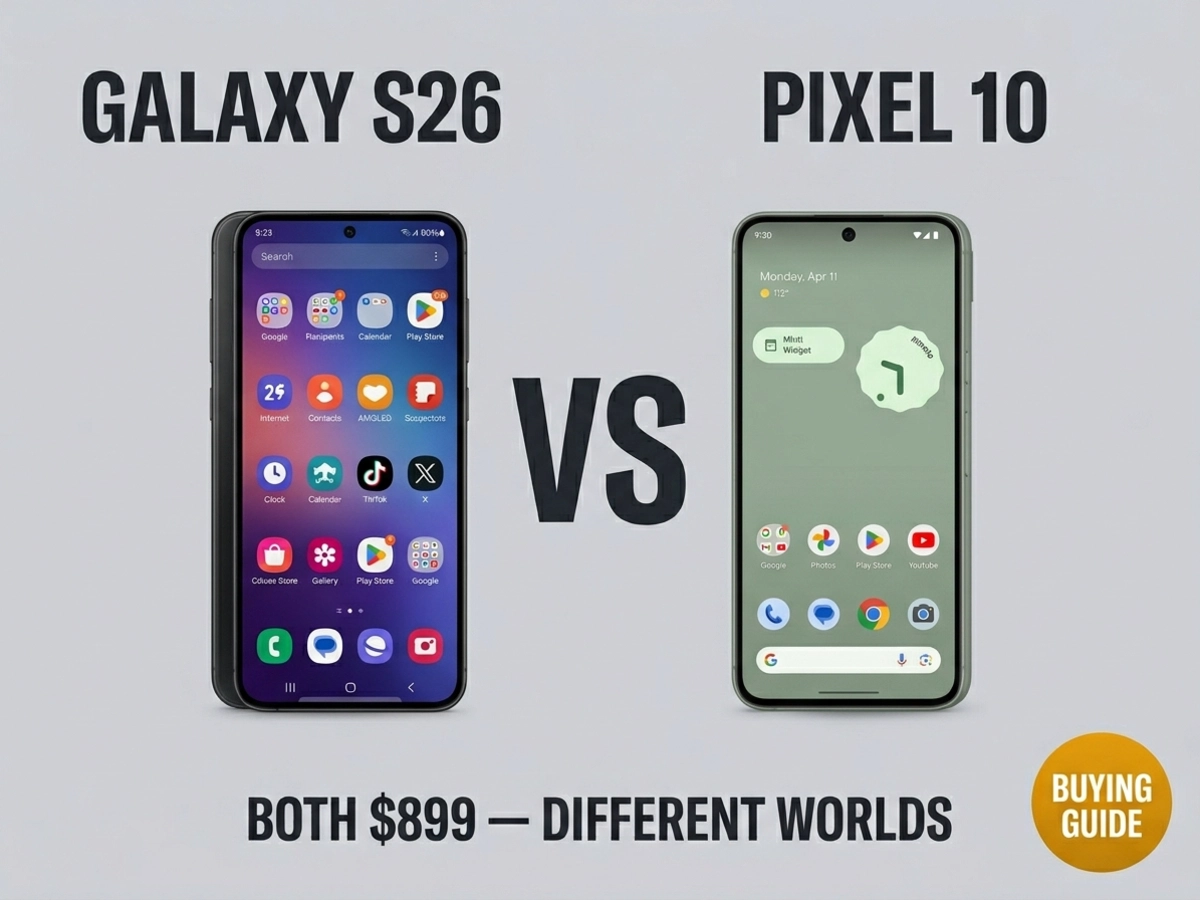
Both phones cost $899 for 256GB of storage in 2026 — yet they were built for different users. The Galaxy S26 wins on raw power and display color; the Pixel 10 wins on battery life, built-in Qi2 magnets, and clean software. Here's how to know which philosophy matches the way you actually use a phone.
On paper, the Galaxy S26 vs. Pixel 10 comparison looks close to a draw. Both pack 6.3-inch screens, three rear cameras, 12GB of RAM, Android 16, and a commitment to seven years of software updates. At 256GB of storage, both retail for exactly $899.
That price equivalence is not accidental. Samsung dropped the 128GB storage tier entirely with the S26 launch in March 2026, matching the approach Apple has used for years. The Pixel 10 technically starts at $799 — but that entry configuration ships with 128GB, a capacity that fills up fast when modern cameras capture higher-resolution files. Upgrading the Pixel 10 to 256GB costs $899. We have not verified regional pricing differences, but in the US market both configurations land at identical $899 retail.
What the shared price tag conceals is a genuine philosophical divide. Samsung built the Galaxy S26 around maximum hardware performance and ecosystem breadth — the Snapdragon 8 Elite Gen 5, the thinnest and lightest chassis in the compact flagship category, and the most feature-complete AI suite on Android. Google built the Pixel 10 around a different bet: that on-device AI efficiency, computational photography, native Qi2 magnetic charging, and a clean software experience would matter more to most buyers than raw benchmark numbers. Both bets are defensible. Neither phone is the objectively correct answer. The question is which bet matches your life.
The Snapdragon 8 Elite Gen 5 powering the Galaxy S26 is a legitimately powerful chip. Sportskeeda Tech's benchmark comparison found the Snapdragon outpaces the Tensor G5 in the Pixel 10 by 61% in single-core Geekbench 6 scores and 89% in multi-core — a gap that is not subtle.
The Tensor G5 powering the Pixel 10 is a fundamentally different kind of chip. Android Central's deep-dive on the Tensor G5 confirms it runs on TSMC's 3nm fabrication process — the same manufacturing node used by Qualcomm's Snapdragon 8 Elite and Apple's A18 Pro. Google claims the Tensor G5's CPU runs 34% faster than its predecessor, with the tensor processing unit (TPU, the AI-specific core) up to 60% more powerful than the Tensor G4. But the design philosophy is explicit: Tensor G5 deliberately prioritizes machine learning efficiency and on-device AI execution over raw compute headroom.
Our review of Samsung's official specifications page confirms the Snapdragon 8 Elite Gen 5 for Galaxy was co-optimized with Qualcomm specifically for Galaxy AI workloads. The Galaxy S26 also ships with a new vapor chamber that Samsung claims improves thermal management by 29% over the S25 generation — a relevant advantage for users who push the phone hard under sustained load.
The Snapdragon 8 Elite Gen 5 is 61–89% faster than Tensor G5 in benchmark tests — and in most everyday use, that gap is completely invisible. Loading Instagram, sending email, browsing the web, streaming video, or running navigation puts no meaningful pressure on either chip. Both phones handle these tasks without hesitation. The performance gap becomes tangible only in sustained 3D gaming, video editing, and intensive multitasking across many open applications. If those describe how you use a phone, the Galaxy S26 is the correct choice. If they don't, the chipset difference is not a factor in your decision.
Both phones arrived at the same hardware configuration in 2026: three rear cameras, combining a wide shooter, an ultrawide, and a telephoto. The Pixel 10 is notable for reaching this tier because it marks the first time a non-Pro Pixel included a telephoto lens at all, closing a hardware gap that previously set it apart from the Galaxy line.
The Pixel 10's camera system consists of a 48MP wide with Macro Focus, a 13MP ultrawide, and a 10.8MP telephoto with 5x optical zoom — reaching up to 20x via Super Res Zoom with optical quality maintained at 1x, 5x, and 10x. The Galaxy S26 counters with a 50MP wide, 12MP ultrawide, and 10MP telephoto with 3x optical zoom. The camera hardware on the S26 and S26+ is unchanged from the Galaxy S25 generation; all improvements on the S26's camera front are software and AI-processing driven.
The telephoto reach difference matters in practice. At 5x optical zoom, the Pixel 10 produces sharper, more detailed frames in wildlife, sports, and architectural photography than the S26 can manage at 3x. At higher digital zoom distances — 20x on the Pixel, 30x on the S26 — the Samsung holds detail more consistently according to Tom's Guide's extended zoom testing.
Under ideal daylight conditions, both cameras produce results that are nearly indistinguishable at a glance. The dividing line is color philosophy. The Galaxy S26 processes images to be brighter, more saturated, and visually punchy — the shots that perform well on social media without editing. The Pixel 10 leans toward accuracy, rendering colors closer to what the eye actually sees. Neither approach is wrong. We have not run a structured blind-comparison test between these two cameras — the color preference findings cited here come from hands-on reviewers at Android Police and Tom's Guide.
The practical implication: if you shoot and share directly, the Galaxy S26's output tends to require less post-processing to look compelling online. If you prefer accuracy — or if you edit — the Pixel 10's more neutral starting point gives you cleaner material to work from.
Tom's Guide's battery test recorded an average of 11 hours 28 minutes on the Galaxy S26 — nearly two hours less than the Pixel 10, despite the S26 carrying a more powerful processor. This is the most counterintuitive finding in this entire comparison, and it matters more than any benchmark score.
The explanation lies in raw capacity. The Galaxy S26 carries a 4,300mAh cell. The Pixel 10 carries 4,970mAh — a 670mAh advantage. Google's official specs confirm the Pixel 10 reaches 55% charge in approximately 30 minutes via 30W wired charging, with Qi2-certified Pixelsnap wireless charging at 15W. The Snapdragon's efficiency edge is real, but it is not large enough to overcome a capacity gap of that size across the varied demands of a full day's use.
The charging picture complicates the Galaxy S26's case further. BGR's review of the Galaxy S26 documented that the base model tops out at 25W wired charging and 15W wireless — and without built-in Qi2 magnets, magnetic wireless accessories require a compatible case. Our reading of the Galaxy S26 spec page confirms the base model tops out at 25W wired — the same ceiling as the Galaxy S25 before it. The S26 Ultra leapt to 60W. The base S26 did not move.
The Qi2 situation deserves specific attention. The Pixel 10 carries the magnets natively — no case required — making it the first mainstream Android phone to fully support the Qi2 accessory ecosystem out of the box. This enables a growing range of chargers, car mounts, and wallet accessories to snap into place and charge at rated speeds without additional hardware. Samsung uses a "Qi2.2 Ready" designation that offloads the magnet requirement to cases, meaning achieving full Qi2 speeds depends on finding a certified case with the correct magnet placement. As Qi2 becomes the default charging standard across cars, desks, and nightstands, the Pixel 10's native compatibility looks set to become a compounding advantage.
The Galaxy S26 does support 4.5W reverse wireless charging — the ability to place compatible accessories or earbuds on the phone's back to top them up. The Pixel 10 does not offer this in either direction wirelessly.
Samsung's Galaxy AI suite arrived at the S26 with One UI 8.5 adding significant new capabilities: Now Nudge for context-aware screen suggestions, Now Brief for personalized daily digests, text-prompt-based Photo Assist editing, Audio Eraser extended to work inside third-party apps including Instagram and YouTube, and Call Screening with live transcription and text replies. It is worth noting that not every One UI 8.5 feature reaches all Galaxy devices equally — our breakdown of One UI 8.5 AI feature eligibility details exactly which hardware generations receive the full AI suite versus a partial rollout.
Google's Pixel 10 AI suite takes a quieter approach with equal functional depth: Magic Cue surfaces relevant information from your calendar and emails during calls, Voice Translate converts conversations in real time using your own voice rather than a robotic synthesized one, Scam Detection via Gemini Nano screens calls before they reach you, Call Notes handles automatic transcription with post-call task suggestions, and Pixel Screenshots creates a searchable NotebookLM-connected library of your screen captures.
The AI feature gap between Galaxy and Pixel is real in 2026 — Samsung's suite is broader by feature count. But buyers who choose the S26 specifically for Galaxy AI are making a bet on a difference that is actively narrowing. Samsung and Google operate a close partnership: new Google AI features routinely debut on Galaxy flagships before arriving on Pixel, and Samsung's features eventually migrate to Pixel through Pixel Drops. Buying based on today's Galaxy AI lead means buying for a gap that a few quarterly updates will largely close.
We have not independently verified the full timeline of Pixel 10 software issues, but 9to5Google's March 2026 update changelog documents the specific regressions and their fixes.
The March 2026 Pixel update fixed a GPU driver regression, a background AI processing freeze bug, and a battery status reporting error — all of which had been introduced by preceding update cycles. This appears to suggest a pattern: the Pixel 10's quarterly Pixel Drop cycle, which brings new capabilities, also carries a documented history of occasionally introducing regressions that require follow-up patches. The Pixel 10's first months included Wi-Fi and Bluetooth failures, app crash cascades, and performance degradation severe enough that some users described it as reducing a flagship to budget-tier responsiveness. The March 2026 update has addressed the most serious of these. Buyers purchasing the Pixel 10 today are unlikely to encounter the same severity that early adopters experienced — but the update-instability pattern is a legitimate long-term reliability variable that no benchmark test captures.
One UI 8.5 on the Galaxy S26 carries its own friction points: Samsung pre-installs duplicate apps, Microsoft integrations, and a Samsung Keyboard that reviewers have called unreliable. All of these can be uninstalled, and the core One UI experience is smooth and responsive. Both phones run Android 16 with identical seven-year OS and security update commitments.
The display specs are close but not identical. The Galaxy S26 runs a 6.3-inch Dynamic AMOLED 2X panel with true LTPO adaptive refresh — scaling from 1Hz during static content to 120Hz during active use. The Pixel 10 runs a 6.3-inch OLED with a floor of 60Hz. The LTPO advantage on the S26 contributes directly to battery efficiency; the panel draws less power when nothing is moving on screen.
Our reading of Tom's Guide's display measurements notes that real-world peak brightness on both phones fell below manufacturer-rated peaks — 1,950 nits measured vs. 2,600 nits claimed for the S26; 2,333 nits measured vs. 3,000 nits claimed for the Pixel 10. Manufacturer ratings reflect peak burst brightness under specific conditions; the tested figures reflect sustained brightness under realistic use. Both are accurate — just different measurements. The practical outcome: the Pixel 10 is more legible outdoors in direct sunlight. The Galaxy S26 produces more vivid and color-accurate images, with DCI-P3 and Delta-E scores that outpace the Pixel 10.
The weight and thickness difference is the most physically noticeable factor in daily use. The Galaxy S26 weighs 167 grams and measures 7.2mm thick — a phone that disappears in a pocket and feels light in hand. The Pixel 10 comes in at 204 grams and 8.6mm. The 37-gram gap is perceptible within seconds of holding both. Samsung used Gorilla Glass Victus 3 on both the front and back of the S26. The Pixel 10 uses Gorilla Glass Victus 2. Both carry IP68 ratings for dust and water resistance.
The display and build differences map cleanly onto the philosophical split: Samsung optimized for color fidelity, battery efficiency, and in-hand lightness. Google optimized for outdoor brightness, accessory ecosystem compatibility, and maximum battery capacity. Neither trade-off is irrational — they simply serve different users.
You game on your phone regularly or run video editing and multitasking-heavy workflows. The Snapdragon 8 Elite Gen 5's benchmark lead is invisible in casual use but becomes real and consistent under sustained load. The S26 is also the right call if you prioritize the thinnest, lightest compact flagship available — 167 grams is genuinely light, and the 7.2mm profile is noticeable compared to every competing Android phone in this size class.
Choose the S26 if you're already inside Samsung's ecosystem — Galaxy Watch, Galaxy Buds, Galaxy Tab — and want multi-device continuity features that work natively without configuration. Samsung's DeX desktop mode, which projects a full windowed interface when connected to a monitor, has no equivalent on the Pixel.
The camera color science also matters: if you want shots that look ready to post without editing, the Galaxy S26's processing produces vivid, punchy results by default.
Your priority is battery endurance over everything else. Tom's Guide's real-world test found the Pixel 10 outlasting the Galaxy S26 by nearly two full hours. If you routinely need your phone to make it through a long travel day or a late night without reaching for a charger, the Pixel 10 is the practical choice regardless of what its chip scores in synthetic benchmarks.
Choose the Pixel 10 if you're switching from iPhone and want the least steep on-ramp to Android. Multiple hands-on reviewers described Material 3 Expressive as more intuitive and less cluttered for first-time Android users than One UI 8.5. Google's AI features also work without deliberate setup — Magic Cue, Scam Detection, and Voice Translate activate in the background without configuration.
We'd add one more consideration: if you already own Qi2 accessories or plan to buy them, the Pixel 10's built-in magnets are a concrete advantage the S26 cannot match without a case. As Qi2 chargers and car mounts become standard, native magnetic support will matter more each year.
The Pixel 10 also offers a starting price of $799 for the 128GB configuration — a real option if you are primarily a streaming and browsing user with minimal local storage needs. The 256GB version matches the Galaxy S26 at $899.
It depends on the model. The Galaxy S26 and Galaxy S26+ use the Snapdragon 8 Elite Gen 5 in North America, China, and Japan. In all other markets, including Europe and most of Asia, the S26 and S26+ ship with Samsung's in-house Exynos 2600 chipset. The Galaxy S26 Ultra uses Snapdragon globally without exception.
The regional split matters for buyers purchasing in markets outside the Snapdragon zone, or for those buying internationally. The benchmark comparisons in this article are based on the Snapdragon version. Exynos 2600 performance has not been independently verified against the Tensor G5 in the same head-to-head format — buyers outside North America, China, and Japan should seek region-specific review data.
For light users — primarily streaming, messaging, and browsing with minimal local media — 128GB can work. For anyone who shoots video, stores offline music libraries, or uses the phone as a primary camera, 128GB fills up faster than expected. Modern camera systems produce larger files at higher quality settings, and the gap between a full and empty drive compounds over time.
Samsung's decision to eliminate the 128GB tier on the Galaxy S26 reflects where the industry is heading: 256GB is increasingly the baseline expectation for a flagship phone in 2026. If 128GB is your only budget for the Pixel 10, factor in the cost of cloud storage or periodic manual cleanup. Upgrading to the 256GB Pixel 10 at $899 removes the constraint entirely and brings the Pixel to price parity with the Galaxy S26.
The direction is broadly yes. Samsung and Google operate a close partnership that has historically moved AI features in both directions. New Google capabilities — including Circle to Search — have debuted on Galaxy flagships before arriving on Pixel. Samsung's features have a track record of finding equivalents on Pixel over time. Tom's Guide noted that if one phone offers a feature, an equivalent typically arrives on the other within a few update cycles.
The specific timing of any individual feature is not guaranteed, and some features may remain platform-exclusive indefinitely. But buyers who are choosing the Galaxy S26 specifically because of a Galaxy AI feature that doesn't yet exist on the Pixel 10 should weigh whether that feature will still be exclusive by the time it matters to their daily use.