Finished reading? Continue your journey in Tech with these hand-picked guides and tutorials.
Boost your workflow with our browser-based tools
Share your expertise with our readers. TrueSolvers accepts in-depth, independently researched articles on technology, AI, and software development from qualified contributors.
TrueSolvers is an independent technology publisher with a professional editorial team. Every article is independently researched, sourced from primary documentation, and cross-checked before publication.
Apple's iPhone 18 Pro dramatically shrinks the Dynamic Island by moving Face ID sensors beneath the display, delivering the cleanest front panel the iPhone has ever shipped. The selfie camera remains a conventional hole-punch but is rumored to upgrade to 24MP, likely avoiding any image quality penalty. The variable aperture main camera and A20 Pro chip represent the more universally practical upgrades. Understanding what actually changes and what doesn't helps determine whether upgrading makes sense for your usage.
The headline tells you the Dynamic Island is gone. What the under-display camera story on the iPhone 18 Pro actually involves requires a closer read.
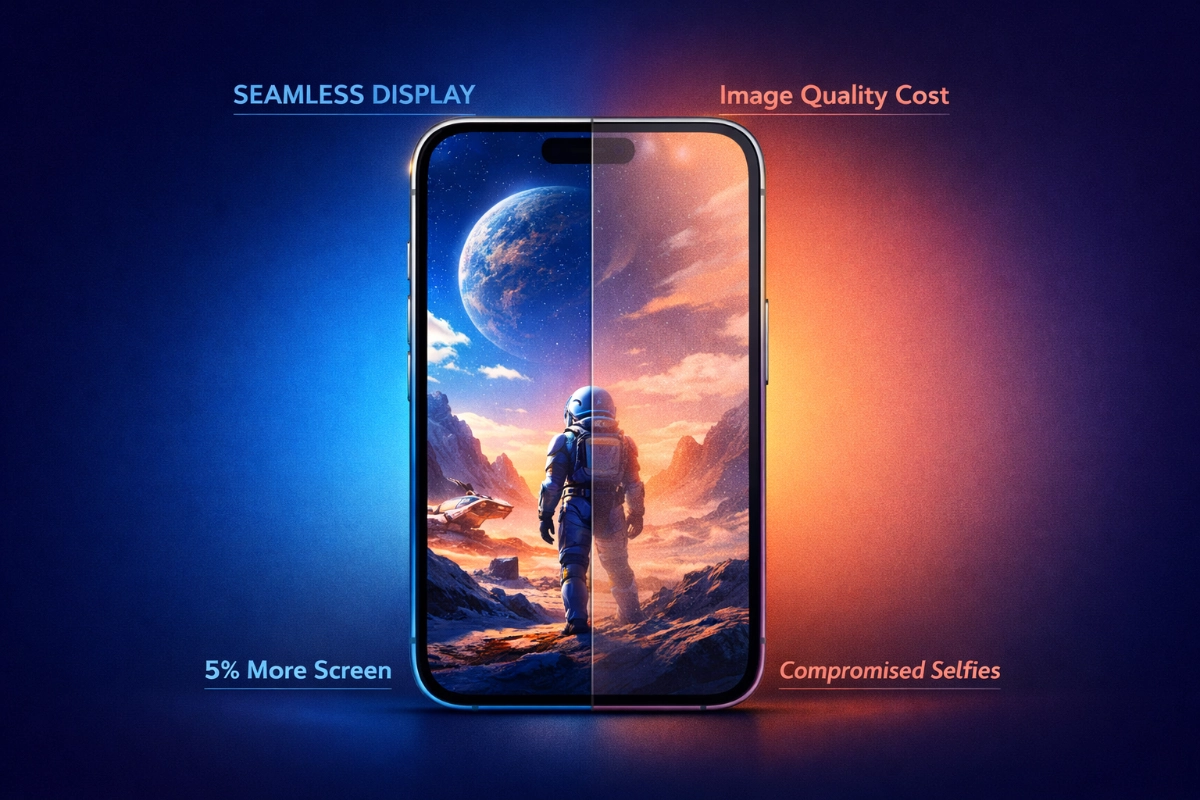
What Apple is moving beneath the display is the Face ID sensor array: the infrared dot projector, flood illuminator, and proximity sensor that enable facial recognition. These components have occupied the oval pill cutout since Apple introduced Dynamic Island in 2022. Routing them under the panel eliminates the visible hardware interrupt that Dynamic Island software has been masking, and screen real estate increases to nearly 98% of the front panel, per AppleInsider's analysis of the change.
The selfie camera is a separate question, and the picture here is less settled. The most recent reporting as of early 2026 points to a smaller, centered hole-punch cutout for the camera rather than a full disappearing act. Earlier leaks described the camera moving to the top-left corner; more recent signals suggest that interpretation may have resulted from misreading supply chain reports. What is consistent across credible sources is the Dynamic Island shrinking substantially, approximately 35% by linear measurement from its current size.
The most defensible description of the iPhone 18 Pro's front panel is a dramatically smaller pill, enabled by Face ID going under the display, with the selfie camera as a smaller standalone cutout. Whether that cutout sits centered or offset is still contested. The full seamless front, with no visible interruption at all, remains a future target.
The technology enabling the Face ID portion is confirmed from a supply chain level. OTI Lumionics, a materials supplier working on transparent display regions for under-panel sensors, had its CEO publicly confirm at the SID Business Conference that phones using their under-display technology are expected to reach consumers in 2026. Display analyst Ross Young linked that confirmation directly to the iPhone 18 Pro. It is one of the few named-executive disclosures tying the technology to a specific launch window, lending it more weight than anonymous supply chain leaks.
Apple's decision to hide Face ID sensors, but not the selfie camera, reflects a specific technology assessment. The best way to understand that assessment is to examine what every company that tried under-display selfie cameras learned.
ZTE launched the first commercial under-display camera phone in 2020 with the Axon 20 5G. The result was instructive: DXOMARK's testing assigned it a Selfie score of 26, the second-lowest in their entire database at the time. White balance, dynamic range, color accuracy, and skin tone rendering all suffered because the display layers filtering light above the sensor create fundamental optical obstacles. Making the transparent region more see-through improves camera performance but introduces a visible hazy patch. Keeping it visually clean starves the sensor of light.
ZTE improved across subsequent generations. The problem never went away. By the third generation, the Axon 40 Ultra, the under-display camera still produced softer, noisier images than budget Android phones using conventional hole-punch cameras. The gap between working and working well remained.
Samsung's trajectory tells the same story with higher stakes. The Galaxy Z Fold 3 introduced an under-display camera in 2021. Samsung stayed with the technology through the Z Fold 4, Z Fold 5, and Z Fold 6, four consecutive flagship generations. The sensor stayed at 4MP across all four generations, because pushing resolution higher through the display layers only amplified the quality problems. Then, in 2025, Samsung discontinued the under-display camera with the Galaxy Z Fold 7, replacing it with a conventional 10MP punch-hole. Direct comparisons showed the conventional camera's image quality clearing a substantially higher bar in direct side-by-side testing.
Samsung and ZTE are the two companies on earth with the deepest display engineering expertise, and both tried under-display visible-light cameras across multiple consecutive flagship generations and retreated. That is not a failure of ambition. It is evidence that hiding a visible-light camera under an active OLED panel creates optical constraints that current materials and processing cannot overcome. Infrared sensors for Face ID operate on entirely different wavelengths and can use specially engineered transparent windows without the same light-scattering problems. Apple is doing the one thing that is ready in 2026 and reserving the harder problem for when the technology catches up.
This distinction has a direct consequence for anyone who makes selfie quality a primary purchase criterion.
The framing of the iPhone 18 Pro's selfie situation as a quality compromise misreads what Apple is actually doing. The compromise framing applies specifically to a fully under-display visible-light camera, the scenario that Samsung and ZTE tested and retreated from. If the selfie camera stays as a conventional hole-punch, the picture current reporting supports, there is no optical penalty from display layers, and the story flips from compromise to potential upgrade. These are two completely different engineering scenarios with opposite quality implications, and much of the iPhone 18 Pro selfie coverage has conflated them.
If the selfie camera remains a hole-punch, the image quality degradation that would come with a fully under-display selfie camera is not on the table for this generation.
The front camera story has a separate and more straightforwardly positive dimension: a sensor upgrade. The iPhone 17 Pro uses an 18MP front camera, per Digital Trends' coverage of the upgrade trajectory. The upgrade path from 12MP through 18MP points toward a continued increase, and supply chain reporting covered by Digital Trends suggests 24MP as the likely next step. The sourcing on the specific figure is partly built on extrapolating a consistent upgrade trajectory rather than direct supply chain confirmation, so the number should be treated as indicative rather than settled. But the direction, toward higher resolution housed in a smaller, less visually dominant cutout, is consistent across sources and would represent a genuine improvement for selfie and video call quality.
The camera most iPhone users will notice more in daily shooting is the main rear camera, specifically because of what a variable iris mechanism changes about practical focusing behavior.
Every iPhone from the iPhone 14 Pro through the iPhone 17 Pro uses a fixed aperture of f/1.78 on the main camera. That aperture never changes regardless of the scene. In low light, this works well: the wide opening gathers ample photons and the sensor performs accordingly. The problem appears in brighter conditions and in any scene with objects at different distances from the camera.
Large sensors with wide fixed apertures produce shallow depth of field. That means the zone of sharp focus is narrow, and objects slightly in front of or behind the focal plane blur. This is celebrated in portrait photography. It creates real problems everywhere else. Group shots where one person stands slightly further back come out with soft faces on the edges. Food photography with overlapping dishes shows blurred items at frame borders. Document scanning produces subtly uneven sharpness across a flat page. Portrait Mode's software solution estimates which parts of the scene should blur, and it misidentifies edges often enough that the effect reads as artificial on close inspection.
Variable aperture, expected to range from f/1.4 to f/2.0 on the iPhone 18 Pro, addresses this optically rather than computationally. A narrower aperture extends the focus zone so more of the scene stays sharp, without software intervention. Wider apertures remain available for low light and deliberate background separation.
The most practically valuable variable aperture mode, across Android flagships that already implement it, is automatic. Phones that switch apertures intelligently based on scene analysis deliver the benefit to the largest share of users without requiring any manual input. Apple will almost certainly implement automatic aperture adjustment as the default behavior, with manual access available for users who want it. The one caveat worth noting: variable aperture requires mechanical iris blades, adding moving parts to a component that currently has none. Long-term durability implications will not be clear until the phones have been in use for a year or more.
Apple's A20 Pro chip, built on TSMC's 2nm fabrication process, will accompany the iPhone 18 Pro's camera and display changes. It is projected to deliver up to 15% faster performance and up to 30% greater power efficiency compared to the A19 generation.
Those are the headline numbers. The more relevant contribution for iPhone 18 Pro users is what the efficiency gain enables during extended use.
The A20 Pro's benchmark story is the least important part of its contribution to the iPhone 18 Pro. What matters more is that under-display Face ID authentication, real-time variable aperture adjustment, and computational photography correction all draw on the same processor simultaneously. The 2nm architecture provides enough thermal headroom to run all three without any one task degrading the others, which is the condition that makes the hardware combination coherent rather than theoretical.
Based on the projected efficiency gains from the 2nm process, the A20 Pro should extend sustained photography performance meaningfully: longer continuous recording sessions, faster processing of computational images, and Apple Intelligence operations running in parallel with camera work without competing for the same thermal budget. The architectural shift to Gate-All-Around nanosheet transistors changes how heat distributes through the chip, which directly affects how long the processor can hold peak throughput before throttling begins. For a phone asking its chip to manage multiple simultaneous high-demand tasks, that sustained ceiling matters more than peak single-task speed.
TSMC's WMCM packaging also brings RAM onto the same die as the CPU, GPU, and Neural Engine, reducing latency for data transfers between the processor and memory. For image processing tasks that require rapid passes through large raw files, reduced memory latency translates directly to faster computational photography results.
The iPhone 18 Pro arrives in September 2026 as a collection of carefully staged advances. Understanding who benefits from which advances produces a clear upgrade map.
iPhone 14 Pro and earlier: Variable aperture, the A20 Pro chip, the smaller Dynamic Island footprint, and a likely front camera sensor upgrade all represent meaningful steps forward from a three-year-old device. The display improvement alone, even if it stops short of a fully seamless front panel, removes the single most visually prominent feature that ages current iPhones quickly. Battery capacity is part of that generational gain as well. The iPhone 18 Pro Max is expected to carry a battery in the 5,100–5,200 mAh range, meaningfully larger than earlier Pro Max models, and an area where design choices can significantly affect all-day reliability. For users whose primary complaint with their current iPhone is running low before the end of the day, that improvement carries real weight.
iPhone 15 Pro and 16 Pro: The calculation is narrower. Variable aperture is the most tangible camera upgrade in recent memory, because it addresses a depth-of-field problem that the fixed-aperture rear camera creates in practical everyday shooting. If photography is a primary use case and group shots, food photography, or close-range scenes are regular subjects, the aperture change represents a genuine capability gain rather than an incremental one.
The under-display Face ID is a real advance, but it affects the appearance of the pill cutout more than it changes how Face ID functions day to day. The A19 chip and camera system in the 17 Pro are less than a year old by the time the 18 Pro ships. For iPhone 17 Pro users, the delta does not clear the bar for an upgrade cycle.
For buyers primarily motivated by selfie and video call quality: the current trajectory suggests the iPhone 18 Pro front camera will be a conventional hole-punch with a higher-resolution sensor. If that holds, the image quality concern diminishes substantially, and the upgrade decision reduces to whether the rear camera's variable aperture and the A20 Pro's performance advantages justify the cost relative to your current model.
All performance figures and features described reflect pre-launch supply chain reporting. Specifications will be confirmed at Apple's expected September 2026 announcement.