Finished reading? Continue your journey in Tech with these hand-picked guides and tutorials.
Share your expertise with our readers. TrueSolvers accepts in-depth, independently researched articles on technology, AI, and software development from qualified contributors.
TrueSolvers is an independent technology publisher with a professional editorial team. Every article is independently researched, sourced from primary documentation, and cross-checked before publication.
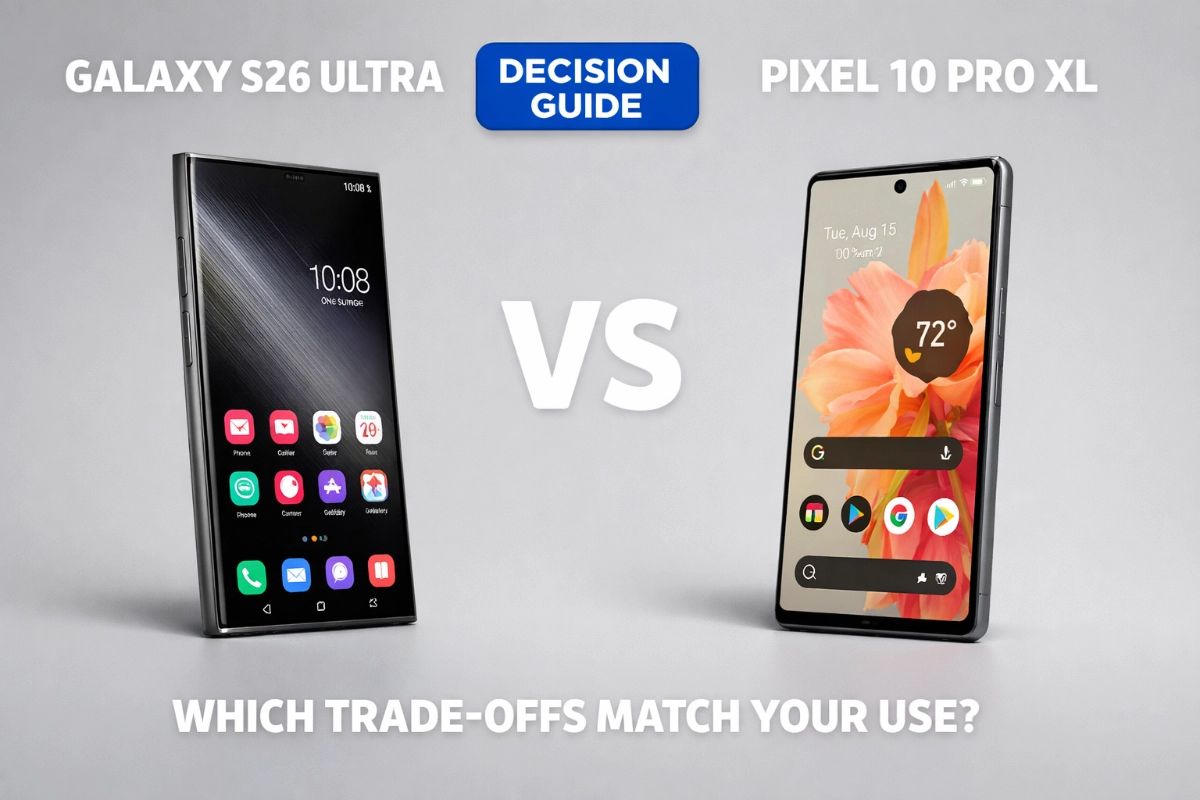
Both the Galaxy S26 Ultra and Pixel 10 Pro XL represent Samsung and Google's most refined flagship approaches yet, but choosing between them isn't about which has better specs on paper. It's about three specific trade-offs that create dramatically different daily experiences. After comparing real-world performance data, battery behavior, and ecosystem implications, the right phone depends entirely on how you actually use it. Here's what determines which flagship fits your life.
The Galaxy S26 Ultra arrived on February 25, 2026 at $1,299, giving it a $100 base price premium over the Pixel 10 Pro XL's $1,199 starting price. Both phones run on the same Android foundation, carry IP68 water resistance, and promise seven years of operating system updates. Both display screens measure between 6.8 and 6.9 inches. A side-by-side spec comparison returns almost nothing actionable.
The gap that matters isn't between columns on a comparison table. It's between three specific engineering decisions that Samsung and Google made differently, and that each company made deliberately. Those decisions shape whether your phone stays cool when you need it, whether your battery behaves the same way in month eight as it did in month one, and whether a $40 magnetic car mount you bought last year will work without a case upgrade.
For users who don't game intensively, don't use a stylus, and have no investment in magnetic accessories, neither phone's headline advantages translate into felt daily experience. The trade-offs covered below only matter if your usage pattern actually puts you inside them. Start there, not with processor clock speeds.
The conventional wisdom heading into the S26 Ultra launch was that Samsung phones run warm under gaming load while Google's Tensor chip keeps surface temperatures comfortable. That framing applied accurately to the S25 Ultra and the Pixel 9 Pro XL. It no longer applies.
Samsung equipped the S26 Ultra with the Snapdragon 8 Elite Gen 5 for Galaxy, a custom-tuned variant featuring prime cores running at 4.74GHz and improvements of approximately 24% in GPU throughput and 39% in NPU performance compared to its predecessor. On paper, this chip is in a different performance class than Google's Tensor G5. In synthetic testing, the S26 Ultra scores approximately 3.72 million on AnTuTu, a benchmark figure that reflects raw ceiling performance.
The meaningful change sits in the thermals. Pre-launch benchmark testing on production units recorded the S25 Ultra peaking at approximately 63°C under a sustained GPU stress test. The S26 Ultra, under the identical test, peaked at approximately 44°C a 19-degree reduction under the same workload, and it happens because Samsung made a specific engineering trade that becomes important in Trade-off #3: the physical space that would have housed a magnetic ring was instead used to enlarge the phone's vapor chamber cooling system.
The result is a phone that delivers sustained high performance without warming noticeably in hand during gaming sessions or extended video calls. Reviewers who tested 30-minute gaming sessions on demanding titles described comfortable device temperatures throughout.
The previous framing of "Samsung runs hot, Pixel stays cool" described a genuine experience difference in 2024. In 2026, it no longer applies: the S26 Ultra runs cooler under load than the Pixel 10 Pro XL in many benchmark conditions. The engineering decision that made this possible is the same one that created the magnetic charging complication covered in Trade-off #3. Long-term real-world thermal data for the S26 Ultra is still accumulating as the phone reaches broader consumer hands — the benchmark picture is consistent across early reviews, but sustained daily-use conclusions will sharpen over the next several months.
Google's Tensor G5, manufactured by TSMC on a 3nm process, was designed to optimize AI task processing and everyday efficiency rather than raw benchmark peaks. In synthetic testing it trails the Snapdragon by a substantial margin. In practice, the relevant improvement over its predecessor is that the Tensor G5 now handles major mobile games at a consistent 60 frames per second; the prior Tensor G4 couldn't reliably sustain that frame rate.
For casual daily use, neither phone feels faster than the other. Scrolling, app loading, camera switching, and message threading are indistinguishable between them. The Snapdragon's advantage becomes real and noticeable only in tasks that require sustained peak output: rendering video clips, running complex AI processing jobs on-device, or gaming sessions longer than about 20 minutes. If those tasks describe your phone use, the S26 Ultra's performance advantage is genuine. If they don't, the Tensor G5 handles everything you do without friction.
The S26 Ultra charges at 60W over a wired connection, up from 45W on its predecessor. The Pixel 10 Pro XL charges at 45W. In practice, the S26 Ultra's 60W charging delivers a meaningful rescue charge faster when you're heading out the door with 15% battery remaining. The Pixel's 45W wired charging reaches approximately 70% in 30 minutes, which is competitive but not class-leading.
The real difference isn't the speed figure on the box. It's what happens to charging speed after roughly 200 discharge cycles.
Android Central's testing of the Pixel 10 Pro XL confirmed that Google's Battery Health Assistance feature is no longer optional with the Pixel 10 series. On the Pixel 9 Pro XL, users could disable it. On the Pixel 10 series, the feature is mandatory and has no override. Starting around the 200th charge cycle, it begins reducing charging speed and voltage to limit long-term battery stress. Google's stated goal is preserving battery capacity, with the system calibrated to hold degradation to a maximum of 80% capacity loss at approximately 1,000 cycles.
This change deserves significantly more attention than most comparisons give it. At once-daily charging, 200 cycles arrives in approximately six to seven months. A buyer evaluating the Pixel 10 Pro XL's charging specifications at purchase is evaluating a phone that will charge at a different, slower rate by the time it's a year old, with no way to override that behavior. Samsung does not implement equivalent forced throttling on the S26 Ultra. That said, Google's design goal has genuine merit: the system is calibrated to hold battery capacity degradation to a maximum of 80% at approximately 1,000 charge cycles, which represents solid long-term health for a phone kept beyond two years.
The trade-off cuts the other direction on daily endurance. The Pixel 10 Pro XL lasts approximately 90 minutes longer per charge than the Pixel 9 Pro XL, a significant real-world improvement for a single phone generation. That improvement comes from two sources: the Tensor G5's lower power ceiling under load and the larger 5,200mAh battery. On a day that involves heavy camera use, navigation, and several hours of screen time, the Pixel tends to end the day with more battery remaining than the S26 Ultra under comparable conditions.
The charging philosophy split comes down to a single question about how you use your phone. If you charge overnight and rarely need an emergency top-up during the day, Google's approach serves you well: slower charging speed in exchange for longer daily endurance and a system that tries to preserve battery health over years. If you regularly charge in short windows during busy days and want the battery that charged quickly today to still charge quickly in month eighteen, Samsung's approach fits better.
The Pixel 10 Pro XL is the first major Android phone to include genuine built-in magnetic alignment rings, marketed under Google's PixelSnap branding. The magnets are built directly into the phone body, meaning the Pixel slots onto any MagSafe-compatible car mount, desk stand, wallet attachment, or charging pad without a case, an adapter, or any additional hardware. Google's magnets use the same circular array pattern as iPhone's MagSafe, confirmed as compatible with the existing MagSafe accessory ecosystem.
The Galaxy S26 Ultra does not include built-in magnets. This makes Samsung the only major flagship maker that hasn't added them, following Apple's introduction with the iPhone 12 in 2020 and Google's addition with the Pixel 10 in 2025. To use magnetic accessories with the S26 Ultra, a case containing an embedded magnetic ring is required.
The Qi2 wireless charging specification contains two distinct power profiles. The Extended Power Profile caps at 15W and requires no magnetic alignment. The Magnetic Power Profile supports the advertised 25W speed but requires magnetic alignment between charger and device. Without a magnetic case, the S26 Ultra's wireless charging is capped at the 15W EPP limit regardless of the charger's rated capability. The 25W wireless speed Samsung advertises requires hardware the phone doesn't include by default.
Samsung's official explanation, delivered by Samsung MX COO Won-Joon Choi and reported by SamMobile, is that the internal space for a magnetic ring was redirected to enlarging the vapor chamber cooling system, which produced the thermal improvement discussed in Trade-off #1. Samsung also cited internal research showing 83% of Galaxy users apply a protective case, framing a magnetic ring in a case as functionally equivalent to one built into the body. Notably, the S26 Ultra is only 0.3mm thinner than the S25 Ultra a marginal difference that reviewers noted undercuts any reasoning about thinness preventing magnets.
The S26 Ultra includes Samsung's built-in S Pen stylus, stored in an integrated slot at the base of the phone. For users who annotate documents, sketch ideas, or need a precision interface for editing, it remains the only major flagship that offers this capability. No MagSafe-compatible phone does.
The complication emerges when you want both. Third-party magnetic cases can interfere with the S Pen's electromagnetic signal, and the S26 Ultra will display a system notification warning users of this when such a case is attached. Samsung's first-party magnetic cases are engineered to reduce this interference, but they come at additional cost and limit case choice. For users who intended to buy the S26 Ultra precisely for the S Pen and wanted to simultaneously adopt magnetic accessories, Samsung's own software will flag the combination as potentially problematic.
The S26 Ultra also introduces a Privacy Display feature exclusive to the Ultra model within the S26 lineup. The system uses directional pixels that emit light in a narrow forward-facing cone, making the screen appear dark from the side angles typically used by shoulder-surfers. Users can configure it to activate automatically on specific apps such as banking and passwords, by time, by location, or selectively for notification pop-ups only.
In hands-on testing, the feature works as described: screen contents become genuinely difficult to read from angles sharper than roughly 30 degrees. Activating Privacy Display does reduce display brightness noticeably, and the maximum-restriction setting dims the screen further. For frequent travelers, open-plan office workers, or anyone who regularly uses banking apps in public spaces, this is a functionally useful capability with no equivalent on the Pixel. If Privacy Display is a significant factor in your decision, we've compared the S26 Ultra's built-in implementation against aftermarket privacy filters to help determine whether the feature justifies waiting for Samsung's version.
Samsung's camera system on the S26 Ultra includes four lenses: a 200MP main sensor at f/1.4, a 50MP ultrawide, a 10MP 3x telephoto, and a 50MP 5x periscope telephoto. The dual telephoto setup provides genuine optical zoom flexibility between 3x and 5x. The 200MP main sensor's f/1.4 aperture is the headline upgrade for low-light performance. The 3x telephoto remains the comparative weak point in the system, carrying a smaller sensor than the other three cameras with output that is more software-dependent.
The Pixel 10 Pro XL uses a triple camera system: 50MP main, 48MP ultrawide, and 48MP 5x periscope telephoto. Google's camera processing pipeline, running on the Tensor G5's dedicated image processing hardware, drives the Pixel's reputation for photography. The Pixel's strength is accuracy and consistency: natural color rendering, reliable subject separation, and strong computational HDR.
The choice between these two systems is a shooting-preference question more than a quality hierarchy. Samsung wins when optical zoom range matters: the 3x-to-5x optical coverage is genuine flexibility that the Pixel can't match. Google wins when processing consistency and natural color science matter more than reach. In video, Samsung's APV professional codec support and 4K@120fps capability serve creators who need maximum recording quality; Google's Video Boost feature handles challenging low-light video scenarios more consistently. For everyday photography in reasonable lighting, both produce excellent results that most people won't distinguish.
After comparing the S26 Ultra and Pixel 10 Pro XL across the three trade-offs, the right phone follows directly from which trade-offs appear in your daily life.
You regularly game for sessions longer than 20 minutes and need sustained frame rates without thermal throttling. You edit video on your phone and need consistent rendering performance over 10-minute export windows. You take handwritten notes or sketch regularly and value having the S Pen always available in its built-in slot. You frequently charge in short windows during the day and want the fastest possible wired top-up for the life of the phone. You work in environments where screen privacy matters and would use the Privacy Display regularly. You prefer a lighter phone: at 214g, the S26 Ultra is meaningfully lighter than the Pixel's 232g during extended one-handed use.
One specification worth checking before purchase: the S26 Ultra's base configuration ships with 12GB of RAM. Moving to 16GB requires selecting the 1TB storage tier. The Pixel 10 Pro XL includes 16GB of RAM across its storage tiers.
You've already invested in MagSafe-compatible accessories car mounts, desk stands, charging pads or plan to build that ecosystem. You want magnetic wireless charging capability from the phone body itself, with no case required. You prioritize receiving Android updates on their release day across all features and security patches simultaneously. Google delivers major Android releases to all Pixel models on the same day, while Samsung uses a tiered rollout that prioritizes newer flagship models. You charge overnight primarily and care more about daily endurance than peak charging speed. You want the AI photography features and on-device processing capabilities that come from Google's own hardware-software integration.
The Pixel 10 Pro XL's longer market availability on sale since August 2025 vs. the S26 Ultra's March 2026 retail launch means retailer discounts of $200 to $300 are now common. Combined with the $100 base price difference, the real-world cost gap between these phones can be substantially larger than the list price comparison suggests.
You primarily use your phone for messaging, browsing, social media, and casual photography. You charge overnight and never need an emergency midday top-up. You have no investment in magnetic accessories and no particular interest in building that ecosystem. You've never felt limited by not having a stylus. Both phones deliver a smooth, excellent daily experience for these use cases, and neither's headline advantage would surface as a felt difference in your hand.
The three trade-offs in this comparison only matter when you actually fall into one of the use cases they serve. Spec comparisons can't tell you which side of each trade-off your daily routine sits on. Your daily routine can.
Does the S Pen work normally when using Samsung's official magnetic case on the S26 Ultra?
Samsung's first-party magnetic cases for the S26 Ultra are designed to minimize S Pen signal interference. The system interference warning that can appear with third-party magnetic cases is less likely to trigger with Samsung's own cases, though sensitivity can vary depending on stylus use angle and case design. For users who rely heavily on the S Pen, Samsung's official case is the recommended choice if adding magnetic accessories to the setup.
Can you disable Battery Health Assistance on the Pixel 10 Pro XL if it becomes a problem?
No. Google made Battery Health Assistance non-disableable starting with the Pixel 9a and carried that forward through the Pixel 10 series, including the Pixel 10 Pro XL. The feature activates automatically around 200 charge cycles and cannot be turned off via settings. Users who want full control over charging speed and behavior throughout the phone's life should factor this in before purchasing.