Finished reading? Continue your journey in Tech with these hand-picked guides and tutorials.
Boost your workflow with our browser-based tools
Share your expertise with our readers. TrueSolvers accepts in-depth, independently researched articles on technology, AI, and software development from qualified contributors.
TrueSolvers is an independent technology publisher with a professional editorial team. Every article is independently researched, sourced from primary documentation, and cross-checked before publication.
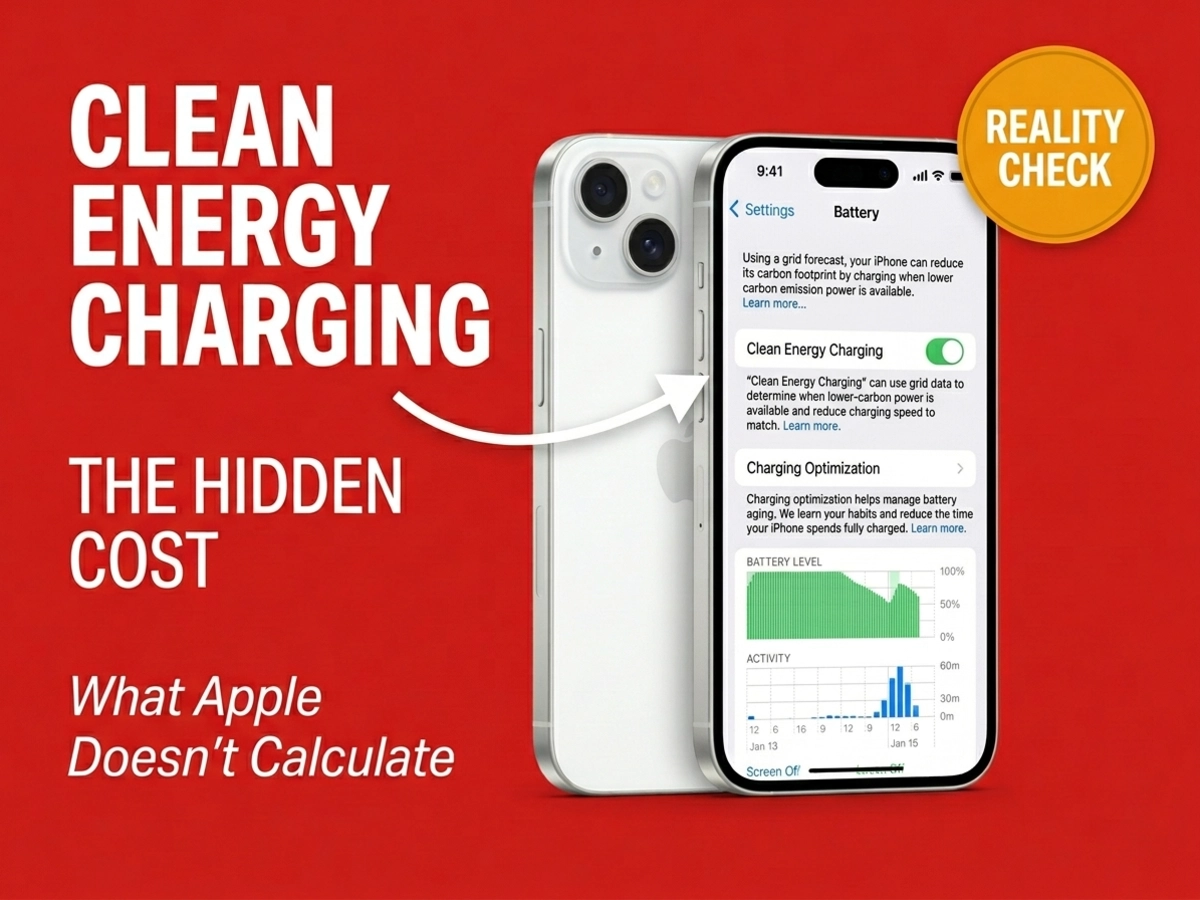
Apple introduced Clean Energy Charging in October 2022 with iOS 16.1, promising to reduce your iPhone's carbon footprint by timing charges around cleaner grid power. The system delays charging when fossil fuel plants dominate the grid, waiting for renewable sources to take over. But here's the catch: the feature's extended charging sessions may degrade your battery faster, waste more energy through charging inefficiency, and ultimately consume more lifetime power than it saves. Understanding when this environmental feature actually increases energy consumption helps you make an informed choice about keeping it enabled.
Clean Energy Charging launched alongside iOS 16.1 as a default-on feature for US iPhone users. The system analyzes a carbon emission forecast for your local power grid and schedules charging during windows when cleaner energy sources are producing more of the electricity on the wire. When the grid is running heavy on fossil fuels, the phone may pause charging entirely or delay starting until conditions improve. A Lock Screen notification tells you charging is suspended and shows an estimated completion time; pressing "Charge Now" overrides the delay without permanently disabling the feature.
The system requires three permissions to function: Location Services, System Customization, and Significant Locations and Routes. That last setting is the mechanism through which the phone learns where you regularly spend extended time. Clean Energy Charging only activates at recognized locations like home or work, where the algorithm predicts you'll leave the phone connected for long enough to allow a delay. While traveling or plugging in at unfamiliar spots, the feature simply doesn't engage.
Clean Energy Charging does not operate alone. Optimized Battery Charging runs alongside it, and the distinction between these two features matters significantly for understanding what the feature actually does to your battery. OBC delays charging past 80% until the algorithm determines you'll soon need the phone, then completes the final top-up shortly before that predicted time. Apple explicitly warns that disabling charging optimizations can increase wear on your battery and reduce its lifespan, which means the system was designed around managing both timing and voltage exposure together.
Critics of Clean Energy Charging typically treat it as a single battery-stressing feature, but Apple's documentation describes two distinct mechanisms with different jobs. Clean Energy Charging governs when charging begins; Optimized Battery Charging governs when it ends and how long the battery sits at maximum voltage. That division of labor changes the battery degradation analysis in important ways.
Lithium-ion batteries degrade through two primary mechanisms: the number of full charge cycles they complete, and the cumulative time they spend in a high-stress state. High stress means elevated temperature combined with a high state of charge. Above approximately 4.10 volts per cell, chemical changes inside the battery accelerate; when heat compounds that voltage exposure, the degradation rate increases substantially. Battery chemistry research consistently places this combination, not cycling frequency, as the dominant driver of long-term capacity loss.
Apple's own guidance acknowledges this directly. The company recommends charging in ambient temperatures between 62 and 72 degrees Fahrenheit and notes that sustained exposure above 95 degrees Fahrenheit can permanently reduce capacity. That temperature sensitivity is why charging in a hot car is harmful even at slow charge rates: the voltage stress and the thermal stress combine.
Where Optimized Battery Charging matters for the Clean Energy Charging debate is precisely here. OBC limits the time the battery spends at maximum charge state by holding at 80% and completing the final top-up just before the user's predicted wake time. The stressor that battery chemistry research identifies as most damaging, extended time at full voltage, is the exact stressor OBC is designed to compress. Modern iPhones are engineered to complete at least 800 charge cycles before reaching 80% of original capacity, and that target assumes the full charging system, including OBC, is operating together.
The battery degradation concern raised about Clean Energy Charging is directionally valid, but it treats the feature as if OBC weren't running alongside it. Clean Energy Charging's primary effect is delaying when the phone starts charging, not necessarily extending the window during which the battery sits at 100%. OBC continues to govern that endpoint — and it is active, by default, for the same users running Clean Energy Charging. The concern overstates the risk when both features are operating together.
The scenario where both risks genuinely compound is when a user disables OBC while keeping Clean Energy Charging on, or when a wireless charger keeps the phone in an elevated-temperature state throughout a multi-hour delay window. That second scenario brings us to a more straightforward cost.
It's also worth understanding where battery chemistry is heading. Emerging silicon-carbon battery designs show promise for managing the thermal stress that makes extended charging sessions risky their higher energy density means less time is needed to reach a full charge, which reduces the dwell time that OBC and Clean Energy Charging are designed to minimize. For now, though, most iPhones still run conventional lithium-ion chemistry, and the voltage and temperature rules above apply fully.
Wired and wireless charging are not equally efficient, and the gap matters considerably when Clean Energy Charging extends how long a phone stays connected to power.
iFixit's 2025 measurement of an iPhone 15 Pro using a watt meter at the mains found that wired charging consumed 18.25 watt-hours to fully charge the phone's 12.7 watt-hour battery. MagSafe wireless charging required 23.33 watt-hours for the identical task a 24.4% increase over wired, representing roughly 59% of the battery's actual capacity consumed in overhead losses. MagSafe's magnetic alignment keeps the coils positioned correctly, which is why its efficiency loss is lower than older Qi chargers, but the physics of electromagnetic energy transfer across an air gap still generates meaningful heat and waste regardless.
Older wireless chargers perform worse. Testing published by Eric Ravenscraft in Wired found that wireless charging averaged 47% more power consumption than cable charging overall, with wired drawing 14.26 watt-hours on average versus 21.01 watt-hours wirelessly. The gap between the two test results reflects MagSafe's alignment advantage: the 2025 iFixit numbers represent best-case wireless; the 2020 Wired numbers represent the broader category of Qi-compatible chargers where coil alignment varies.
When Clean Energy Charging delays charging by several hours, a wireless charger continues drawing standby power throughout that window. That entire delay period passes at the charger's baseline efficiency floor, consuming power without delivering it to the battery. The energy "saved" by timing a cleaner grid window can be offset by the overhead of an extended wireless connection before charging even begins. The math consistently works against users who charge wirelessly and have Clean Energy Charging enabled. The efficiency penalty is directionally certain; the exact magnitude of the standby draw depends on individual charger design.
Wired charging removes this dynamic almost entirely. A wired charger consumes negligible standby power during a delay period, and when charging resumes, the efficiency loss is limited to the roughly 43% overhead that iFixit measured for wired connections. For wired users, Clean Energy Charging's costs shift back to the battery chemistry question. For wireless users, the energy arithmetic often fails before battery chemistry even enters the equation.
The premise behind Clean Energy Charging is that the US electrical grid is dirtier at some hours than others, and that shifting a phone charge to cleaner windows reduces carbon emissions. That premise is true, but the degree to which it's true varies enormously by location and is shrinking as the grid decarbonizes.
The peaker plant argument is the most common framing. The US operates 999 peaker plants, facilities that handle peak demand by running gas turbines that can ramp output quickly. These plants account for only 3.1% of annual net electricity generation but represent 19% of total designed output capacity. The median peaker emits 1.6 times more sulfur dioxide per unit of electricity than the median non-peaker, primarily because peakers tend to lack comprehensive emissions control systems. Shifting iPhone charging away from the hours when peakers operate represents a genuine, if modest, emissions benefit in coal- and gas-heavy grid regions.
The challenge is that grid composition is neither uniform nor static. In 2024, carbon-free electricity sources, including nuclear, supplied approximately 44% of all US electricity, and wind and solar combined overtook coal in annual generation for the first time. In regions with substantial nuclear or hydroelectric baseload, the carbon content of the grid is relatively consistent around the clock; there is no "dirty peak" to avoid in the same way that exists in gas-heavy markets. In solar-heavy states, the cleanest hours may actually be midday rather than overnight, which is roughly the opposite of when Clean Energy Charging appears to prefer charging.
Clean Energy Charging ships enabled for all US users, but the conditions under which it delivers meaningful benefit are narrower than that default implies. Users in the Pacific Northwest on hydro-dominant grids, users in nuclear-heavy regions of the Northeast and South, and users in states where solar has expanded rapidly are all running the feature in contexts where the carbon delta between peak and off-peak charging is approaching negligible.
There is an additional layer of uncertainty beyond regional variation: the quality of Apple's carbon emission forecast itself. Apple has not publicly confirmed which data provider powers Clean Energy Charging's grid forecasts. Apple's 2024 Product Use Electricity Strategy cites WattTime for operating margin grid emissions modeling in other contexts, making it the likely candidate, but Apple hasn't confirmed this for Clean Energy Charging specifically.
An independent analysis by gridstatus.io examined Apple's grid forecast labels against actual measured emissions data from the PJM interconnect, one of the largest grid regions in the eastern US, and found weak correlation between Apple's "More Clean" label and statistically distinct reductions in measured carbon intensity during those periods. The authors acknowledge that Apple's forecast may use more granular local data than the PJM-wide averages they compared against, which could explain the discrepancy. Even so, the analysis raises a genuine question: if the forecast doesn't reliably identify lower-emission periods, some of Clean Energy Charging's delayed sessions may be incurring costs, extended connection time and wireless standby draw, without delivering the corresponding carbon benefit.
Step back from the feature's per-session math and the environmental picture changes scale entirely.
Manufacturing an iPhone 17 produces approximately 55 kilograms of CO2 equivalent, a figure Apple publishes in its environmental documentation. Manufacturing accounts for the overwhelming majority of an iPhone's total lifetime carbon footprint; use-phase emissions from charging represent a relatively small portion of the total. The carbon saved by time-shifting a single phone's charging to cleaner grid windows, across an entire year, is a fraction of the footprint embedded in producing the device itself.
Device longevity is the dominant environmental lever, not charging behavior. Keeping a phone in service for an additional year avoids the manufacturing footprint of a replacement device. Optimizing when an existing phone charges delivers marginal improvements by comparison.
This proportionality matters for the central question this article raises. If Clean Energy Charging contributes to materially earlier battery replacement, whether by accelerating degradation through extended wireless connection or by giving users the impression that the feature's presence means battery care is handled, the embodied carbon in that replacement battery can exceed any emissions the feature saved through cleaner-grid timing. The scale difference is large enough that even a modest acceleration of a replacement cycle creates a net carbon-negative outcome.
Apple's stated goal is to match every watt of customer charging electricity with clean energy by 2030 through a combination of efficiency improvements, grid investment, and features like Clean Energy Charging. The feature is one component of a larger system-level strategy, not the primary mechanism of change. Understanding that context helps calibrate how much individual charging optimization actually moves the needle.
The right answer depends on three variables: what kind of charger you use, where you live, and how you weigh the trade-offs the previous sections identified.
Wireless users bear the most direct and quantifiable cost. MagSafe charging already uses 24% more energy than wired even under optimal conditions; older Qi chargers can use 47% more. When Clean Energy Charging extends the window during which a wireless charger stays connected, the standby draw and inefficiency losses compound. In most wireless charging scenarios, the energy overhead of the extended session exceeds the emissions savings from timing a cleaner grid window.
The fix here is layered. Switching to wired charging removes the efficiency penalty entirely and improves the feature's cost-benefit calculation at the same time.
Users in nuclear-heavy regions, hydro-dominant areas like the Pacific Northwest, or states with significant solar penetration face a genuinely narrow emissions difference between peak and off-peak hours. The carbon cost of the feature's extension of charging time is not offset by meaningful carbon savings when the grid is clean around the clock. These users get most of Clean Energy Charging's costs with little of its environmental payoff.
The original design premise holds most clearly for users in regions where the gap between peak fossil-fuel generation and cleaner off-peak periods is still wide, who charge exclusively via cable, and who maintain consistent home charging schedules that let the algorithm function accurately. In those conditions, the feature delivers on its premise: a modest but real emissions reduction for an activity with no corresponding efficiency cost.
On iPhone 15 and later models, go to Settings, tap Battery, then Charging, and toggle Clean Energy Charging off. On earlier iPhones, the path is Settings, Battery, Battery Health and Charging. If you want to override a single delayed session without disabling the feature permanently, press "Charge Now" on the Lock Screen notification when it appears.
The feature doesn't engage while traveling or in locations it doesn't recognize, so it won't interfere with charging on the road regardless of whether it's enabled.
Clean Energy Charging delivers net benefit within a narrow but real set of conditions: coal- or gas-heavy grid, wired charging, consistent location, and a device whose battery is in good health. Outside those conditions, the honest accounting suggests the feature's costs are real and its benefits are modest or near-zero.
Frequently Asked Questions
Does Clean Energy Charging work outside the United States? No. The feature is only available in the US, where Apple has access to the grid carbon emission forecast data the system requires. In other countries, the option doesn't appear in settings.
Can I use Clean Energy Charging without Optimized Battery Charging? The two features are designed to work together and occupy the same settings menu. Turning off Optimized Battery Charging while keeping Clean Energy Charging active is possible by disabling charging limits, but Apple explicitly notes that removing OBC increases battery wear. Running Clean Energy Charging alone removes the mechanism that limits time at maximum voltage, which is the primary way OBC reduces degradation risk.
My battery is already below 80% health. Does Clean Energy Charging help or hurt? A battery that has already experienced significant capacity loss is more sensitive to the stressors that extend charging times. At below 80% health, preserving remaining battery life generally takes priority over marginal charging-carbon optimization. Disabling Clean Energy Charging at this stage, and ensuring Optimized Battery Charging remains active, is the more battery-protective configuration.
What if I only charge overnight anyway? Does Clean Energy Charging still do anything? Yes, but the scope is narrower. If you plug in at 11 PM and don't need the phone until 7 AM, Clean Energy Charging has an eight-hour window to find a cleaner grid period. In regions with genuine peak-to-off-peak carbon variation, this can deliver its intended benefit. In clean-grid regions, the algorithm may simply find that one hour is marginally better than another within an already low-emissions range, delivering minimal actual impact.