Finished reading? Continue your journey in Tech with these hand-picked guides and tutorials.
Boost your workflow with our browser-based tools
Share your expertise with our readers. TrueSolvers accepts in-depth, independently researched articles on technology, AI, and software development from qualified contributors.
TrueSolvers is an independent technology publisher with a professional editorial team. Every article is independently researched, sourced from primary documentation, and cross-checked before publication.
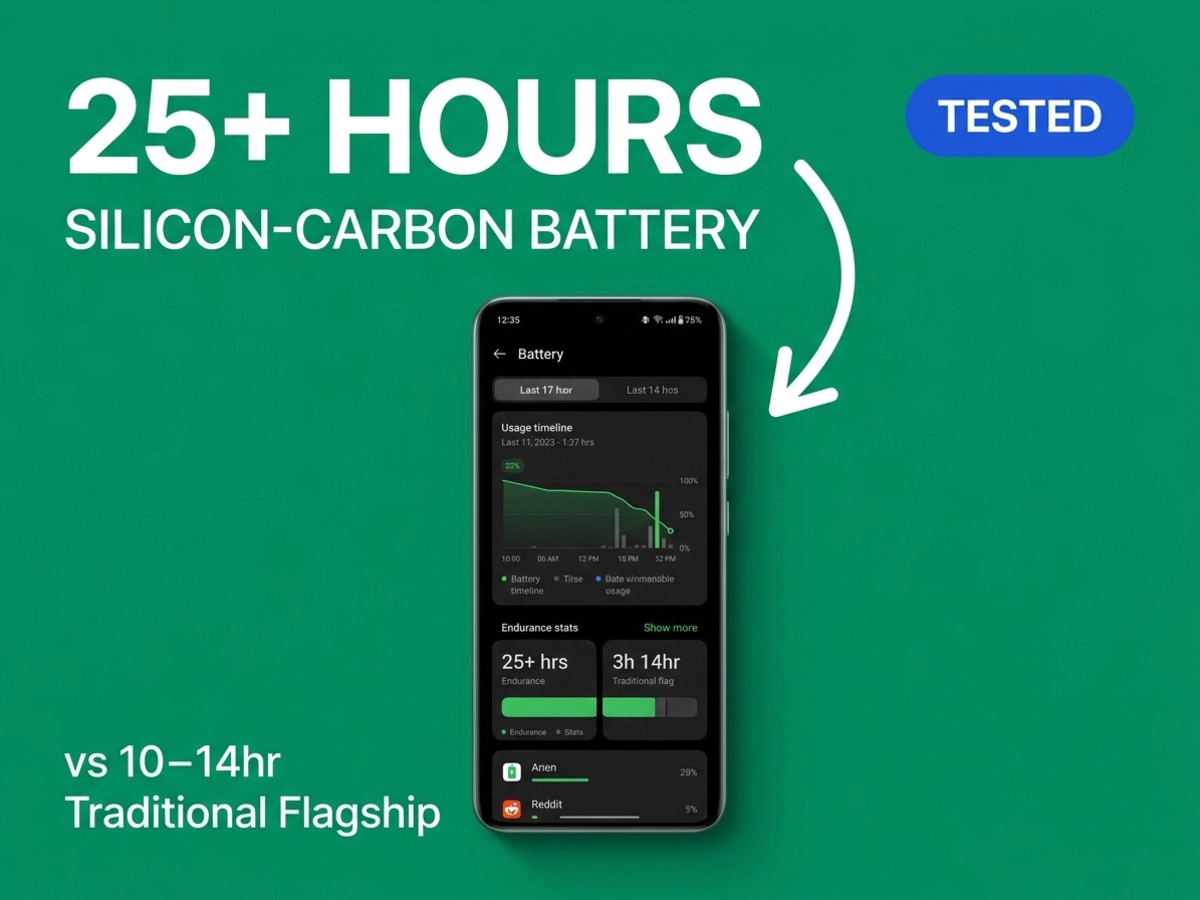
The OnePlus 15 proves silicon-carbon batteries deliver more than promises. Testing shows 25+ hour endurance compared to 10-14 hours from traditional flagship phones. Real users report comfortable two-day usage without nightly charging rituals. Here's what the performance data actually means for your daily phone habits.
Battery life claims from smartphone manufacturers have earned a reputation for optimism. "All-day battery" turns out to mean "if your day ends at 5 PM." Silicon-carbon batteries change that calculation in ways that show up in standardized testing, extended reviewer use, and the behavior of the people writing those reviews.
The OnePlus 15 carries a 7,300mAh dual-cell silicon-carbon battery. In Tom's Guide's standardized battery test, which runs continuous web browsing over a cellular connection at 150 nits brightness until the phone dies, the device recorded 25 hours and 13 minutes. That is the best result the publication has ever recorded for a smartphone.
A single benchmark from one outlet could be a methodology quirk. The pattern doesn't hold up as a quirk. PhoneArena's compound battery estimate, which combines scores from three separate tests, reached 10 hours and 44 minutes for the OnePlus 15, their highest result ever. The component breakdown tells the story more granularly: over 30 hours in their web browsing simulation, 12.5 hours of continuous video playback, and over 14 hours in their 3D gaming test. The previous OnePlus 13 scored 7 hours and 30 minutes in that same compound test. The OnePlus 15 improved by more than three hours despite using the same testing methodology.
Both sets of data confirm the same conclusion, but the more interesting evidence comes from behavior. Multiple reviewers from separate publications documented the same unusual outcome: they stopped checking their battery percentage. Tom's Guide noted the reviewer was still at 68% at the end of a typical first day and, after a month of use, continued to see 60% or more remaining at bedtime on most nights. Reviewers at Android Authority and Droid-Life documented traveling short distances without bringing a charger, a behavioral shift that rarely results from a hardware change alone.
When depletion becomes practically impossible within a normal day's use, monitoring behavior stops entirely. That convergence across independent outlets validates the benchmark numbers from an experiential angle that standardized tests cannot fully capture.
The capacity advantage starts at the chemistry level, specifically in the part of the battery called the anode, which is the component that stores lithium ions during charging.
Traditional lithium-ion batteries use graphite for the anode. Graphite is stable, predictable, and manufacturable at enormous scale. But its storage capacity has a hard ceiling. According to Android Authority's detailed chemistry breakdown, graphite stores approximately 372 milliamp-hours per gram of material, while pure silicon stores roughly 4,200 milliamp-hours per gram. That is more than 10 times the theoretical storage capacity in the same mass.
That 10x theoretical advantage has been known for decades. The problem is that silicon physically swells when it absorbs lithium ions during charging. Pure silicon can expand by as much as 300% when fully charged, a degree of volumetric stress that ruptures the anode's structure and breaks electrical connections after just a few cycles. Early silicon anode research produced batteries that were impressive for a single charge and destroyed within weeks.
Silicon-carbon batteries don't use pure silicon. They embed silicon particles within a carbon matrix that provides structural support, constraining the expansion to 10–20% depending on silicon content, which is comparable to graphite's natural expansion during normal charging. This structural containment maintains both the anode's electrical conductivity and its mechanical integrity across hundreds of cycles.
The engineering compromise is significant: that real-world improvement is 10–20% in energy density per unit of cell volume, not the 10x theoretical maximum that pure silicon would suggest. A 10–20% energy density improvement is still substantial, particularly when combined with stacking multiple cells. The OnePlus 15 achieves 7,300mAh using two cells of 3,650mAh each, a dual-cell configuration that also keeps each individual cell below the dangerous goods threshold for air transport.
The carbon composite approach costs roughly 15–20% more to manufacture per cell than standard graphite anodes, and demands tighter engineering tolerances. Those economics explain why silicon-carbon has spread through flagship devices first and is only now moving into mid-range phones. The technology works, but it's not cheap, and building it reliably at scale requires precision that increases per-unit cost.
It's worth noting that silicon-carbon's energy density advantage gives manufacturers a real choice: pack more capacity into a phone the same size, or maintain the same capacity in a dramatically thinner body. Most flagship silicon-carbon phones have chosen the former, prioritizing endurance over slimness. If you've been drawn toward ultra-slim flagships and found yourself compromising on battery life, that trade-off deserves a closer look before committing to a device.
To put the OnePlus 15 benchmark results in context, the leading conventional flagships provide a meaningful ceiling. TechRadar's standardized testing measured the iPhone 17 Pro Max at 17 hours 54 minutes and the Galaxy S25 Ultra at 14 hours 27 minutes, both using identical methodology to the tests applied to other devices.
The iPhone 17 Pro Max carries 5,088mAh in its US configuration. The Galaxy S25 Ultra holds 5,000mAh. Both use conventional lithium-ion chemistry with graphite anodes. At those capacities, the two phones represent the top of what conventional battery technology currently delivers in a mainstream flagship form factor.
The OnePlus 15's 7,300mAh silicon-carbon battery holds roughly 46% more capacity than these leading conventional flagships. In Tom's Guide's test, it outperformed the iPhone 17 Pro Max by more than 7 hours and the Galaxy S25 Ultra by more than 10 hours. The OPPO Find X9 Pro, which carries a 7,500mAh battery, placed just below the OnePlus 15 in PhoneArena's compound ranking, despite holding slightly more capacity.
A 46% capacity advantage over the iPhone 17 Pro Max translates to roughly 40% more test time in Tom's Guide's benchmark and significantly more in PhoneArena's compound scoring. If the gap were purely proportional to capacity, you'd expect a 46% performance improvement. The actual gaps are consistently larger than that. The OPPO Find X9 Pro comparison makes this concrete: a slightly larger conventional battery still underperforms a slightly smaller silicon-carbon implementation. The pattern across both methodologies points to a chemistry efficiency advantage in how silicon-carbon cells discharge under moderate workloads, not just the raw energy they store.
Historically, putting a large battery in a phone meant accepting longer charging times. The OnePlus 15 resolves that trade-off in a way that isn't obvious until you look at the lab data.
GSMArena's lab testing measured a complete charge from empty in 41 minutes using the included 80W SuperVOOC charger, with a peak recorded output of approximately 77W. When they tested the same phone with a standard USB Power Delivery charger, it peaked at around 40W and completed the charge in nearly the same total time. That compatibility matters for users who travel or work in environments where proprietary charging hardware isn't available.
At the 30-minute mark, Tom's Guide documented 81% capacity using the included charger. That 30-minute milestone equates to a substantial portion of a full day's capacity in the hands of most users, recovered during a lunch break or a morning meeting.
The OnePlus 15 also supports 50W wireless charging through its AIRVOOC system, with full wireless charges completing in under 90 minutes. OnePlus includes the 80W SuperVOOC charger in the US retail box, a detail that has become uncommon among flagship manufacturers. That inclusion matters because the 41-minute full charge time assumes you're using capable hardware, not a slow 5W cube from a previous device.
Bigger battery or faster charging was, until recently, a forced trade-off. The combination of 7,300mAh capacity and sub-45-minute full charge represents a genuine resolution of that trade-off. The bypass charging feature, which routes power from the charger directly to the phone's components during gaming sessions rather than through the battery, also reduces heat buildup during intensive use, which has a direct effect on long-term cell health.
Silicon-carbon batteries involve a real durability trade-off, and addressing it clearly serves readers better than downplaying it.
Battery longevity is typically measured in charge cycles, defined as the number of full charges before the battery retains only 80% of its original capacity under EU measurement standards. Android Authority's comparison across the OnePlus lineup puts the numbers in useful sequence: the OnePlus 12 used a conventional lithium-ion battery rated for 1,600 cycles. The OnePlus 13 introduced first-generation silicon-carbon and was rated for only 1,000 cycles. The OnePlus 15's second-generation silicon-carbon rates at 1,400 cycles. The technology has improved across generations, but it has not yet matched conventional lithium-ion's cycle durability.
The expansion management that makes silicon-carbon commercially viable, embedding silicon nanoparticles within a carbon matrix, constrains swelling but doesn't eliminate it. Engineers and battery researchers note that silicon-carbon anodes still experience more mechanical stress per cycle than graphite anodes, contributing to a steeper early degradation curve. Manufacturers have responded with mitigation strategies. 9to5Google reported that Nothing Phone 3 physically contains a 5,500mAh silicon-carbon cell but ships in most global markets with the capacity software-capped to 5,150mAh. Keeping the battery from reaching full charge on most cycles substantially extends its cycle life, since lithium-ion and silicon-carbon cells both stress more at the upper end of their charge range. The OnePlus 15's bypass charging serves a similar function during gaming, reducing heat that would otherwise accelerate degradation.
A silicon-carbon battery degraded to 80% of its original capacity still holds 5,840mAh. The Galaxy S25 Ultra's conventional battery holds 5,000mAh new. Even at end-of-rated-life, the OnePlus 15's battery outperforms the current Samsung flagship's battery on its first day. The 1,400-cycle rating represents roughly 3–4 years of once-daily charging, a range within which most users will have already upgraded. For most typical upgrade cycles of 2–3 years, this concern is unlikely to materially affect the user experience. Multi-year owners planning 4–5 year ownership should weigh this more carefully, though the starting capacity buffer works in their favor.
One important caveat: no independent multi-year field data yet exists for silicon-carbon phones in wide circulation. Manufacturer ratings are based on controlled lab standards, not years of real-world use across varying climates, usage intensities, and charging habits. A clearer picture of real-world degradation will emerge by 2027–2028 as first-wave silicon-carbon devices age.
Chinese manufacturers including OnePlus, OPPO, Honor, Xiaomi, Realme, and Vivo have broadly adopted silicon-carbon across recent flagship releases. Samsung, Apple, and Google have not. Understanding why requires looking at two separate problems, not one.
The first problem is validation. At Galaxy Unpacked in early 2026, Samsung's Executive VP and Head of Smartphone R&D, Sung-Hoon Moon, addressed the question directly. TechRadar reported his statement that silicon-carbon had not cleared Samsung's "very rigorous validation standards" and that Samsung had been "a bit un-innovative on that front." The Galaxy S26 lineup ships with conventional lithium-ion cells: 4,300mAh in the base S26, 4,900mAh in the S26+, and 5,000mAh in the S26 Ultra.
This isn't evasion. Samsung's internal battery validation culture was shaped by the Galaxy Note 7 recall, which required removing hundreds of thousands of devices from the market after thermal battery failures. A battery chemistry change that hasn't accumulated years of large-scale field validation represents a calculated risk that Samsung's current quality standards are designed to prevent.
The second problem is supply chain scale. The Galaxy S25 Ultra alone sold approximately 11 million units in its first year. Silicon-carbon battery manufacturing is currently concentrated in China, and the production capacity available to Chinese OEMs serving their own volume is distinct from what would be required to serve Samsung's global lineup across all tiers. Even if Samsung cleared its validation requirements, sourcing enough silicon-carbon cells for its full production volume would require significant supply chain development that doesn't yet exist at the necessary scale.
Samsung's executive VP acknowledged publicly that the technology is delivering results Samsung can't currently match with conventional cells. Yet Samsung still ships conventional lithium-ion. That gap is not a judgment that the technology doesn't work — Samsung's decision reflects two compounding structural constraints. The barriers are organizational and logistical, and they are barriers that a manufacturer with 7-year software support commitments and tens of millions of units per model run cannot responsibly ignore.
Apple's situation follows similar logic. The stakes attached to a battery-related failure at Apple's production volumes are reputational and financial on a scale that makes early adoption of any battery chemistry change genuinely high-risk.
Silicon-carbon batteries solve a specific problem: running out of charge before your day ends. The technology eliminates that problem comprehensively for most usage patterns. Whether eliminating it changes your actual behavior depends on whether you experience it now.
If you plug in during the afternoon, carry a power bank, or regularly end the day below 20%, silicon-carbon phones directly address your bottleneck. Reviewers documenting their heaviest use days, five or more hours of screen-on time, still found substantial charge remaining when they plugged in at night, typically well above a third of total capacity. That's the difference between charging once every two days and the daily outlet-hunting routine. The behavioral shift is immediate and significant.
If you plug in nightly out of habit rather than necessity, silicon-carbon won't change your charging routine. You'll simply plug in with more battery remaining. The value shows up in convenience: business travel without packing a charger, long flights without outlet anxiety, weekend trips that no longer require managing battery levels. The two-day capability becomes a buffer against inconvenience rather than a daily behavioral change.
Light users, people who typically finish the day at 60% or more on a conventional flagship, may find the silicon-carbon advantage is largely psychological. The technology provides substantial headroom, but they weren't running out of headroom with conventional batteries either.
For anyone planning 4+ year ownership, the 1,400-cycle rating deserves weight. The degradation trajectory from OnePlus 13's first-generation silicon-carbon (1,000 cycles) to the OnePlus 15 (1,400 cycles) shows improvement, but the conventional lithium-ion baseline of 1,600 cycles is still ahead. The 5,840mAh degraded capacity buffer helps, but without multi-year real-world data from silicon-carbon phones in wide use, a longer-term owner is accepting some uncertainty.
Silicon-carbon phones currently come primarily from Chinese manufacturers. If you rely on Apple, Samsung, or Google's ecosystem, the technology is not yet available in those products. OnePlus's ecosystem is capable but narrower: software updates run for four years, which is competitive but below Samsung's seven-year and Apple's long support windows.
For users open to OnePlus or other Chinese OEMs, the performance data makes a compelling case on battery alone. Whether battery life is the deciding factor in a phone purchase depends on what else matters to your daily use, but as a technical problem, silicon-carbon has solved the battery anxiety question clearly and measurably.
Does the OnePlus 15 work with non-OnePlus fast chargers?
Yes. GSMArena's lab testing confirmed the OnePlus 15 peaks at approximately 40W when using a standard USB Power Delivery charger, with a complete charge time close to what the proprietary 80W SuperVOOC charger achieves. The phone supports multiple charging standards including UFCS, 55W PPS, 36W PD, and 36W Quick Charge, giving it broad compatibility with third-party hardware.
When might Samsung or Apple release silicon-carbon phones?
Samsung's executive VP confirmed publicly in early 2026 that the company is working toward silicon-carbon but hasn't cleared its internal validation requirements. No timeline was given. Given Samsung's validation standards and supply chain development needs, adoption before 2027 would be early. Apple has not commented on silicon-carbon timelines publicly. A realistic window for Samsung adoption is 2027–2028; Apple may follow a year or more behind that.
Does the OnePlus 15's battery degrade faster than a conventional phone's battery?
The rated cycle count of 1,400 cycles before reaching 80% capacity is lower than a conventional lithium-ion flagship's typical 1,600 cycles. The first-generation silicon-carbon in the OnePlus 13 was only rated at 1,000 cycles, so the technology has improved between generations. The practical consideration is that even at 80% capacity, the OnePlus 15's battery holds 5,840mAh, which exceeds the Galaxy S25 Ultra's full 5,000mAh. No independent multi-year field data yet exists for silicon-carbon phones; manufacturer ratings reflect controlled lab testing.
What other phones use silicon-carbon batteries?
Current silicon-carbon flagship phones include the OPPO Find X9 Pro (7,500mAh), the Nothing Phone 3 (5,500mAh, software-capped to 5,150mAh in most markets), and multiple Xiaomi, Honor, Realme, and Vivo flagship releases from 2024–2025 onward. Silicon-carbon is also moving into upper-mid-range devices from these manufacturers. No Apple, Samsung, or Google flagship currently uses the technology.
How does a 15-minute charge help in practice?
Approximately 15 minutes of charging delivers around 45% capacity. That figure makes the OnePlus 15 practical for users who charge in short windows, such as between meetings or during a commute, rather than requiring extended overnight charging sessions to top up. A 30-minute charge delivers over 80% capacity, enough to cover a full additional day for most usage patterns.