Finished reading? Continue your journey in Tech with these hand-picked guides and tutorials.
Boost your workflow with our browser-based tools
Share your expertise with our readers. TrueSolvers accepts in-depth, independently researched articles on technology, AI, and software development from qualified contributors.
TrueSolvers is an independent technology publisher with a professional editorial team. Every article is independently researched, sourced from primary documentation, and cross-checked before publication.
Chip binning is now behind four Apple products simultaneously — and if you're trying to decide whether the iPhone 17e, iPhone Air, MacBook Air M5, or MacBook Neo is the right choice, you need to understand what that actually means for the tasks you do every day. The GPU performance gap is real, but it's also predictable in a way that most coverage hasn't made clear. And Apple's approach to binning turns out to be structurally different from how Qualcomm handles the same practice — which has direct consequences for what you can expect from a binned device.
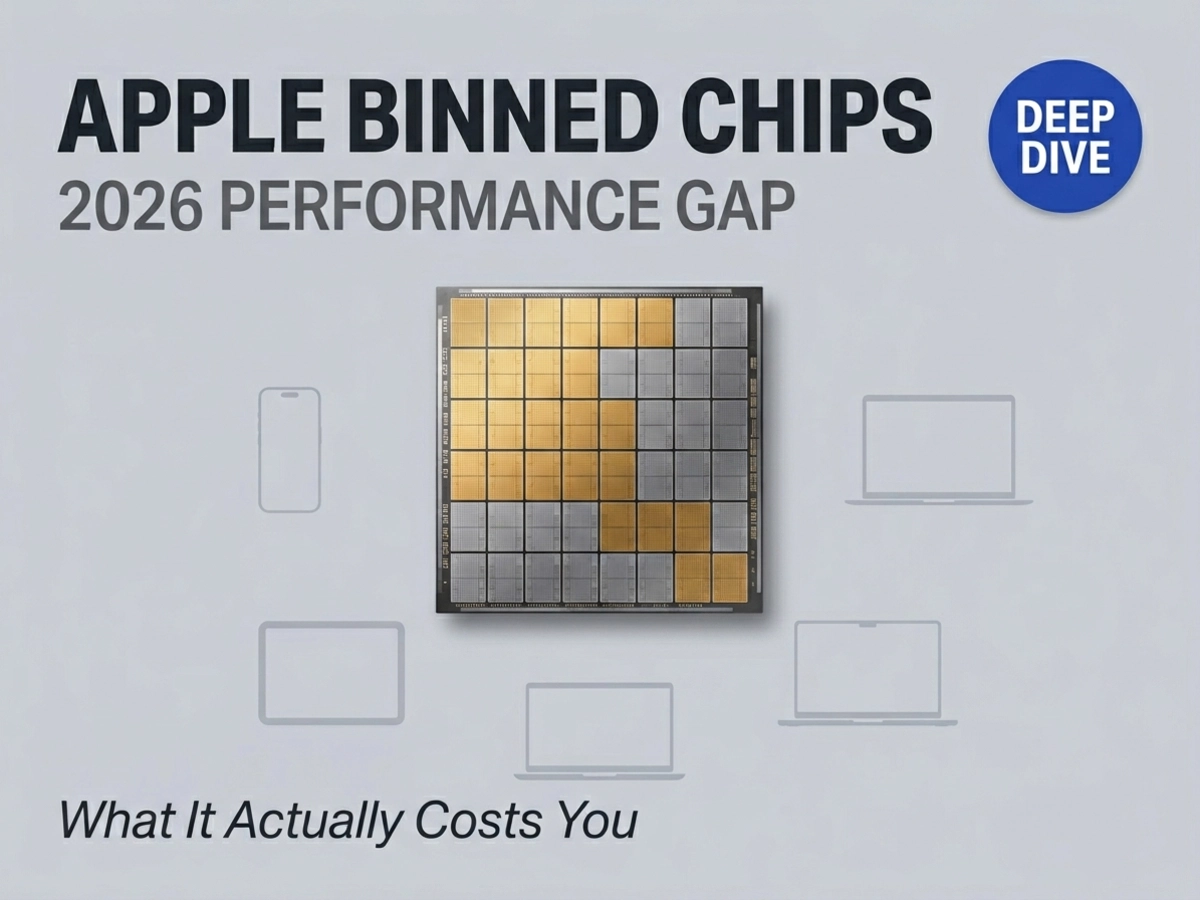
Chip binning, at its most basic, is the practice of disabling one or more functional blocks inside a processor — usually a GPU core — to create a lower-tier variant from the same physical design. It has been standard practice for decades at Intel, AMD, and Nvidia. Apple has used it for roughly a decade as well, with the A12X chip in the 2018 iPad Pro arriving with seven GPU cores when the underlying design had eight, because early manufacturing yields forced Apple's hand. What's different in 2026 is the scale: four major products across Apple's lineup now run on binned chips simultaneously.
The reason this is economically viable comes down to how modern chips are architected. GPU cores within a single chip are functionally identical copies of each other — when one has a manufacturing flaw, it can be electronically disconnected through a hardware fuse baked into the design, leaving the rest of the chip fully operational. This redundancy isn't accidental; chip designers build it in precisely to allow recovery from individual core failures without scrapping the entire die. The result is that a chip destined for the trash can become a saleable product in a lower-tier device, improving the number of usable chips Apple gets per wafer and reducing the cost of each one. That cost saving is what makes an iPhone at $599 with current-generation silicon possible.
Apple A19 Wikipedia documents the full GPU core picture across the current iPhone family. The iPhone 17e carries an A19 with a 4-core GPU, while the standard iPhone 17 gets an A19 with 5 cores — one core disabled, same chip family. The iPhone Air steps up to the A19 Pro but receives only 5 of its 6 GPU cores, and the iPhone 17 Pro and Pro Max get the complete 6-core configuration. The price separation between the 17e and the standard 17 is $200: the 17e starts at $599 with 256GB of storage, the iPhone 17 at $799.
On the Mac side, Apple Support's tech spec page for the 13-inch MacBook Air M5 lists both 8-core and 10-core GPU configurations for the same base M5 chip, with the entry model shipping with 8 cores and every other configuration — higher storage, more RAM, the 15-inch — stepping up to 10. Everything else in the chip is identical: same 10-core CPU, same Neural Engine, same media engine, same 153GB/s memory bandwidth. The only chip-level variable is the GPU. This means Apple can create a genuine product-tier separation without designing a separate, lower-end chip from scratch — a substantial cost and engineering advantage that competitors who don't control their own silicon cannot replicate in the same way.
The MacBook Neo represents the most striking use of binning in Apple's current lineup. Launching on March 11 at $599 — or $499 for students and educators — it uses an A18 Pro chip originally designed for the iPhone 16 Pro. The iPhone 16 Pro's A18 Pro carried 6 GPU cores; the MacBook Neo's version has 5. It is the most affordable Mac Apple has ever sold by a significant margin. For context, the iPhone 17e's predecessor, the iPhone 16e, cost $700 with only 128GB of storage — the 17e's $599 price tag with double the storage represents a genuine value shift, made possible in part by the economics of binned chip production.
The simplest mental model for understanding binning's performance impact is also the most accurate: the percentage of GPU cores removed equals the percentage of GPU performance you lose, and almost nothing else changes. This holds across CPU performance, battery life benchmarks, and — critically — AI task performance, where the Neural Engine does the heavy lifting regardless of GPU core count.
LTT Labs measured a 20–23% GPU performance gap between the iPhone 17 and iPhone 17e in 3DMark benchmarks. CPU performance between the two phones differed by only 2–5% — well within noise for real-world use. Early Geekbench results documented by MacRumors showed the iPhone 17e achieving Metal compute scores of roughly 31,000–31,500, against approximately 37,000 for the iPhone 17 — a measurable gap, though slightly smaller than the theoretical ceiling because real-world GPU workloads rarely push every core to maximum simultaneously.
LTT Labs recorded a 20–23% GPU gap between the iPhone 17 and iPhone 17e in 3DMark, the iPhone Air trails the Pro by approximately 17%, and the M5 Air's 8-core model tracks precisely 20% behind the 10-core in graphics loads — three products, three chips, one pattern. The reduction in GPU cores is the floor for your performance loss, not the ceiling. Across the iPhone and Mac lineups, GPU performance scales almost exactly proportionally to the core count reduction, which means buyers can calculate their trade-off in advance rather than discovering it after purchase.
The categories where this gap registers are specific: gaming, GPU-accelerated video rendering, and compute-heavy graphics filters. For everything else — web browsing, document work, video calls, app switching, Apple Intelligence features — the binning is effectively invisible. Apple Intelligence tasks rely on the Neural Engine, which is present in full and identical across every variant. A user spending most of their time in Safari, Slack, and Mail on a MacBook Air M5 will not feel the 2-core GPU reduction. A user who plays demanding 3D games regularly will notice it, and they should factor it into their decision.
The line between "defect salvage" and "strategic product tiering" has effectively disappeared inside Apple's chip supply chain — and the MacBook Neo supply shortage of 2026 is the clearest evidence yet that Apple is now producing deliberately binned chips at scale, not just recycling manufacturing imperfections.
Here is what happened: the MacBook Neo launched in March using stockpiled A18 Pro chips that had been set aside during iPhone 16 Pro production. When a GPU core failed quality testing during iPhone 16 Pro manufacturing, those chips didn't get discarded — Apple stored them and, months later, found a product for them. The MacBook Neo was that product. When demand exceeded all forecasts, Apple exhausted this stored supply and commissioned a new A18 Pro production run specifically for the Neo. The MacBook Neo (13-inch, A18 Pro) Tech Specs page confirms the tested configuration as a 5-core GPU, one core fewer than the iPhone 16 Pro's A18 Pro — and the new production run needs to match that specification exactly.
The most coherent reading of the available supply chain reporting suggests that new run involves Apple intentionally disabling a perfectly functional GPU core on chips that would otherwise pass full iPhone 16 Pro specifications. That is not a scandal — it is what chip manufacturers do when demand for a lower-tier product outpaces the natural supply of defects. But it does reveal that Apple's binning strategy is proactive and deliberate, not simply an opportunistic response to manufacturing imperfection. TSMC's 3nm yields reached approximately 90% by summer 2025, compared to Samsung's 50% at the same node. Higher yields mean fewer naturally defective chips — so sustaining a budget product tier requires Apple to intentionally produce the lower-spec variant at scale.
This is the structural distinction that separates Apple's binning from Qualcomm's. Qualcomm released a 7-core variant of the Snapdragon 8 Elite targeting OEMs that needed a lower-cost chip option — technically the same binning practice. But Qualcomm then hands that chip to Samsung, Xiaomi, OnePlus, and others, each of whom builds a different product around it with different thermal management, different RAM configurations, and different software layers. Qualcomm must design its chips for worst-case thermal conditions across every OEM's implementation simultaneously; Apple designs its chip and its device as a single system. When a GPU core is disabled in an iPhone 17e, the entire product — cooling, software, RAM speed, power envelope — is engineered around that specific configuration. The 20% GPU gap you measure in benchmarks is the gap you get in real use, reliably.
Apple has secured more than 50% of TSMC's initial 2nm production capacity for 2026, which means it has the manufacturing scale and supply chain control to plan product tiers around anticipated chip configurations rather than scrambling to fill gaps. Qualcomm and its OEM partners lack that degree of vertical coordination. That manufacturing relationship is also under active strategic development: Apple recently formalized a chip deal with Intel as a way to create TSMC pricing leverage — a move explored in depth in Why Apple Really Needs Intel — And What Intel Gets Back. The result for buyers, regardless of how Apple manages its foundry relationships, is that purchasing a binned Apple product carries a known, calculable performance delta. Purchasing a phone built on a binned Qualcomm chip carries a performance delta that depends on which OEM made it, how they tuned the cooling, and which Android skin they applied on top.
The core decision rule is straightforward: how much of your time is spent on GPU-bound tasks? If the honest answer is "very little," the binned version is almost certainly the right buy. If gaming or GPU-accelerated creative work is central to why you want the device, the full-core version deserves serious consideration.
For the iPhone 17e at $599, the primary audience is someone upgrading from a device that is several generations behind. The CPU performance of the A19 is functionally identical to the standard iPhone 17, Apple Intelligence features work exactly the same on both — the Neural Engine and RAM are identical across the two phones — and MagSafe support, absent from the 16e, brings the 17e into the full Apple accessory ecosystem. The GPU gap matters if you're regularly playing graphically demanding games at high settings. For everyone else, the display size difference (6.1 inches at 60Hz versus 6.3 inches at 120Hz) and the camera system (one rear lens versus two) will be larger practical differentiators than the GPU core count.
For the MacBook Air M5, the entry model with an 8-core GPU is the right choice for almost any productivity or student workload. The gap to the 10-core configuration is exactly 20% in GPU-heavy tasks, but the vast majority of what MacBook Air users do — writing, spreadsheets, video calls, light photo editing, browsing — runs on the CPU and Neural Engine, not the GPU. The one use case where the upgrade matters is sustained, GPU-intensive gaming or heavy 3D rendering. For that specific user, the 10-core option is worth the premium.
The MacBook Neo is the most specialized case. At $599, it delivers performance comparable to an M1 MacBook Air for everyday tasks, with the added benefit of fanless silent operation and a distinctive colorful chassis. It is not designed to compete with the M5 MacBook Air — it exists below that tier, targeting first-time Mac buyers and students who need macOS, a keyboard, and all-day battery at the lowest possible entry point. The 5-core GPU handles casual games and light creative work; it is not the right tool for professional video export or high-fidelity gaming.
The one-core or two-core GPU reduction across all four products is not hidden or unpredictable — it is exactly what the math says it will be, and Apple has engineered each product to make that trade-off feel deliberate rather than like a shortfall. Buyers who understand which column they fall into — GPU-sensitive or not — can make the right call with confidence.
No meaningful evidence supports any difference in reliability between a binned chip and its full-core counterpart. The mechanism for disabling a GPU core — an electronic fuse baked into the chip's design — creates a permanent, hardware-level disconnection of that section. The rest of the chip is architecturally complete and unmodified. When Apple stockpiles chips that were binned due to a manufacturing defect in one GPU core, the defective section is isolated; it doesn't interact with or degrade the surrounding silicon over time.
This is further reinforced by the MacBook Neo story: Apple has intentionally disabled GPU cores on otherwise fully functional A18 Pro chips to keep up with Neo demand. Those chips would have passed complete iPhone 16 Pro specifications — meaning the 5-core variant in the Neo is, in many cases, a chip with no physical flaw whatsoever. Long-term reliability concerns apply to all semiconductor devices equally; the presence or absence of binning has no documented bearing on failure rates in any publicly available chip reliability data.
Yes — Apple Intelligence performance is effectively identical across binned and non-binned versions of the same chip generation. The features that power Apple Intelligence, including on-device Siri, Writing Tools, Image Playground, and Live Translation, run on the Neural Engine and the CPU, not on the GPU cores that binning affects. All A19 variants — including the 4-core iPhone 17e version — carry the same 16-core Neural Engine, and the Neural Accelerators integrated into each GPU core are also present in proportion to the active cores.
Both the iPhone 17e and the standard iPhone 17 ship with 8GB of RAM, meaning the memory available for on-device model processing is identical. The practical implication is that if you're choosing between the iPhone 17e and iPhone 17 primarily because of Apple Intelligence, the chip binning should not influence that decision. The GPU gap matters for graphics-intensive workloads; for AI and machine learning tasks, the experience across the binned and standard variants is the same.