Finished reading? Continue your journey in Tech with these hand-picked guides and tutorials.
Boost your workflow with our browser-based tools
Share your expertise with our readers. TrueSolvers accepts in-depth, independently researched articles on technology, AI, and software development from qualified contributors.
TrueSolvers is an independent technology publisher with a professional editorial team. Every article is independently researched, sourced from primary documentation, and cross-checked before publication.
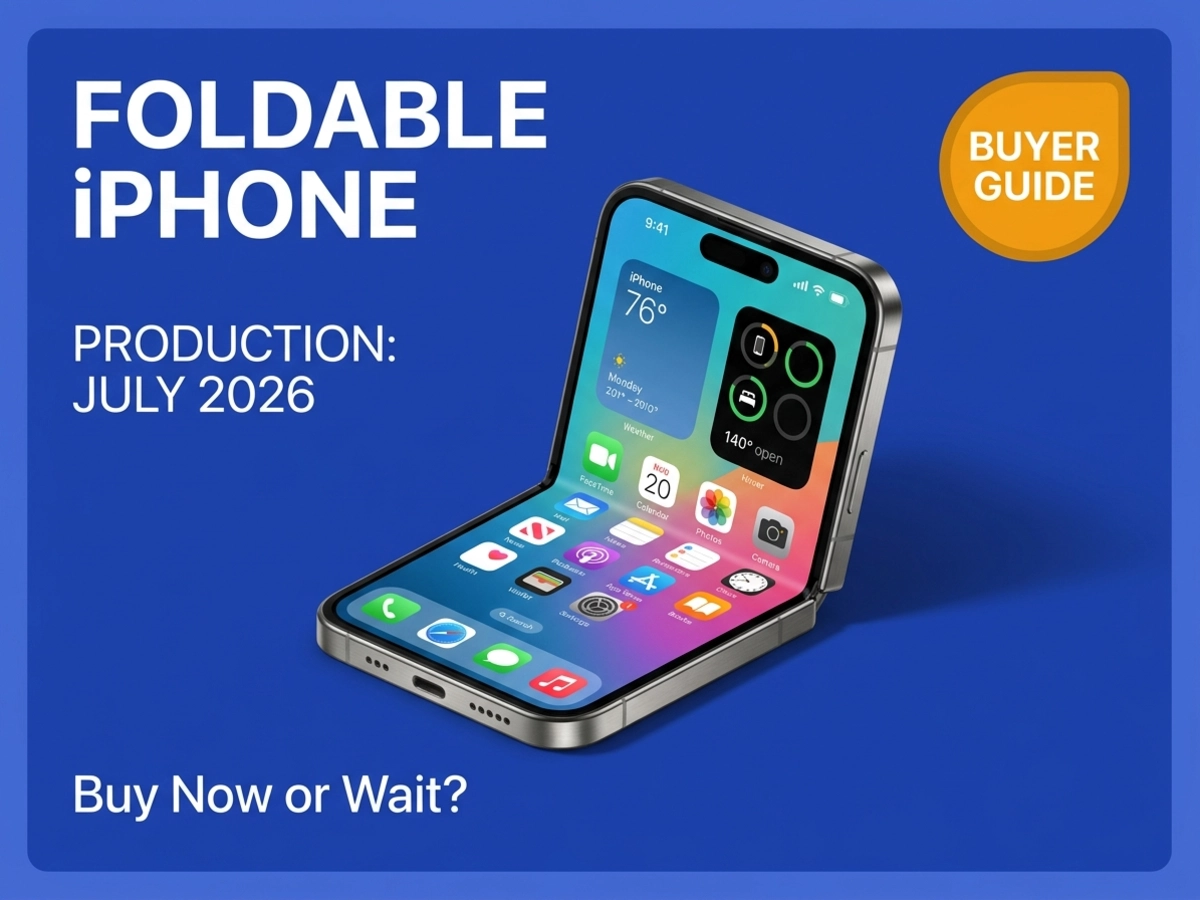
Reports indicate Apple's foldable iPhone display production starts July 2026, matching the manufacturing schedule for iPhone 18 Pro models targeting September announcements. This timeline alignment reveals supply chain confidence but raises critical questions for buyers deciding between waiting for Apple's foldable debut or purchasing proven flagship devices. Production schedules signal manufacturing readiness, yet they don't address whether first-generation foldable technology delivers the multi-year reliability iPhone buyers expect. Understanding what July production actually means requires examining both Apple's manufacturing confidence and the durability track record of foldable smartphones across the industry.
The question most buyers want answered isn't whether the iPhone Fold is real. It's whether they'll actually be able to buy one before 2027.
According to a WCCFTech report citing Weibo leaker "Momentary Digital", both the iPhone Fold and the iPhone 18 Pro are entering mass production in July. That parallel launch cadence carries a specific meaning: Apple treats the Fold as a full-tier September flagship, not a limited experimental release timed separately from its main lineup. Every major iPhone launch since 2011 has followed the same arc: display and component production begins in July, the product is announced in the first or second week of September, and sales begin roughly two weeks after that. A July production start for the Fold places it squarely in that sequence.
That's the confident signal. The cautionary one arrived in December 2025, when analyst Ming-Chi Kuo published a note warning that, despite the fall announcement timeline remaining on track, smooth shipments of the iPhone Fold may not occur until 2027 due to early-stage yield challenges and manufacturing ramp-up difficulties. Kuo drew an explicit comparison to the iPhone X, which Apple announced on schedule in September 2017 but remained genuinely difficult to purchase for weeks after its eventual ship date. Demand far outpaced supply for the first full quarter of availability.
By September 2025, Kuo revised his iPhone Fold shipment targets upward, placing 2026 unit projections at 8-10 million, an increase from earlier estimates and a sign of growing confidence in the device's market reception. But confidence in demand and confidence in production throughput are separate variables. Early in any new form factor's manufacturing life, yield rates on complex components the flexible inner display, the hinge mechanism, the ultra-thin glass with variable thickness run below the efficiency targets Apple's suppliers reach in later production cycles. A 2026 launch with constrained supply is a plausible and well-precedented outcome.
The July milestone gives buyers one reliable piece of information: a September announcement appears on track. What it cannot deliver is assurance about how many devices Apple will have available at launch, or how quickly supply will meet demand. Buyers treating July production as a green light to expect easy September purchases are reading a stronger signal than the data currently supports.
The most visible engineering achievement in the iPhone Fold's development history is the crease. Production line data shared by Weibo leaker "Fixed Focus Digital" places the crease depth below 0.15mm and the crease angle below 2.5 degrees figures that, if accurate, would represent a meaningful departure from every foldable currently on the market. No competing manufacturer publishes equivalent specifications, which makes direct comparison impossible. What can be said is that reducing crease depth to sub-0.15mm requires engineering the hinge to distribute mechanical bending stress across a wider surface area rather than concentrating it at a single fold line.
Apple's approach to that engineering challenge involves a liquid metal hinge, a material the company has held commercialization rights to since 2010. Liquid metal alloys, produced through a rapid heat-and-cool die-casting process, achieve an amorphous molecular structure rather than the crystalline alignment of conventional metals. The result is a material substantially tougher than titanium alloy under repeated bending stress Kuo has cited the improvement at roughly 2.5 times the structural strength. Applied to a phone hinge, liquid metal resists the micro-deformation that accumulates in traditional designs over thousands of folding cycles. That is a genuine structural advance, and it explains why Apple's crease measurements have impressed supply chain observers.
Understanding what this engineering accomplishes requires separating two distinct physical problems. The hinge and crease solution addresses how stress is distributed at the fold in the device's structural frame. The inner display's soft flexible substrate is a different layer entirely, and it obeys different physics.
Current foldable inner displays require a flexible polymer surface rather than hardened glass because the glass would shatter under repeated folding. That flexibility comes at the cost of surface hardness. Independent durability testing by JerryRigEverything, covered by NotebookCheck, found that the Galaxy Z Fold 7's new hinge design is 27% thinner and 43% lighter than its predecessor and yet the inner display still scratches at level 2 on the Mohs hardness scale, meaning a fingernail leaves a permanent mark. A full inner screen replacement without Samsung's first-year complimentary protector coverage costs $589. The Z Fold 7 represents Samsung's most structurally advanced foldable, and it is still vulnerable at the display surface.
Apple's ultra-thin glass technology uses varying glass thickness across the fold zone to reduce crease formation. Whether it meaningfully improves scratch resistance relative to the Z Fold 7 is unknown until real devices undergo independent testing. The two engineering problems crease distribution and surface hardness are related but not identical. A hinge that distributes stress effectively does not automatically produce a harder surface layer.
Every foldable generation since 2019 has improved crease visibility and hinge structural integrity. None has solved inner display softness, because solving it requires a flexible substrate that somehow achieves the hardness of conventional glass, and that material does not yet exist at scale. Apple's advances are real. They answer the crease question. The surface vulnerability question remains open for first-generation buyers.
The fall 2026 premium iPhone decision is, for most buyers, a two-device choice: the iPhone Fold or the iPhone 18 Pro. The Fold's pricing is estimated in the $2,000-$2,500 range across multiple analyst projections. The iPhone 18 Pro starts at approximately half that cost. That spread represents a meaningful per-unit premium for the Fold, and understanding what it buys and doesn't buy in camera capability is central to the decision.
Analyst reporting cited by 9to5Mac indicates the iPhone Fold will carry two rear cameras: a main lens and an ultrawide, with no telephoto. The iPhone 18 Pro carries three: main, ultrawide, and telephoto. The Pro's main camera also gains variable aperture, which adjusts the optical opening to balance light intake and depth of field in ways a fixed-aperture lens cannot. Both features appear to be Pro-exclusive, unavailable on the Fold.
The camera gap has a practical dimension. Telephoto reach whether for portraits at natural compression, zoom on subjects at distance, or close-up work is among the most-used features in the iPhone Pro line. Buyers who regularly use the 3x or 5x optical zoom on a current Pro model would be trading that capability away entirely when moving to the Fold. Both devices share the same A20 chip, so the performance gap isn't in processing power. It's optical.
There's also a biometric change to consider. Apple's space constraints in the Fold's narrow folded profile led to the return of Touch ID, placed in the power button. Face ID isn't present. For buyers who have used Face ID since the iPhone X era, the transition back to fingerprint authentication is a tangible daily change, particularly in situations where Face ID's hands-free convenience is most apparent.
The Fold's premium is paid for a larger inner display and a new form factor — real benefits for specific use cases, particularly media consumption, document work, and the multitasking advantages of a near-tablet screen. But they are form factor benefits, not feature advantages. For buyers who are camera-focused, the iPhone 18 Pro delivers a more capable camera system at a substantially lower price point, which makes it the more defensible value proposition for most buyers in 2026.
The conventional framing for the Fold launch is a binary: wait for the Fold or buy the Pro. Apple's production cadence and Kuo's shipment revisions suggest a third scenario deserves equal weight in buyer planning.
This is the lowest-risk path for buyers who prioritize camera capability, availability certainty, and proven multi-year reliability. The iPhone 18 Pro will be available on launch day in volume, carries Apple's three-camera system with variable aperture, includes Face ID, and builds on a form factor with decades of engineering refinement behind it. Battery longevity, display durability, and mechanical component reliability follow well-documented patterns. For buyers who use zoom photography regularly, or who want a device they can confidently plan to own for three years without surprises, the Pro is the straightforward choice.
This is the right path for buyers who genuinely value the book-fold form factor as a daily utility improvement, understand first-generation constraints, and are prepared to absorb some uncertainty. The inner display will require a protective film; that film is the outer barrier against the surface-scratch vulnerability that affects every current foldable. The approximately 7.8-inch inner screen offers a genuinely different experience for reading, media consumption, split-view multitasking, and AI-assisted tasks that benefit from larger context windows. If those use cases align with how someone actually uses a phone, the Fold's form factor may justify its premium and its risks.
The supply caveat applies here: even buyers who commit to Scenario 2 should plan for a launch-window wait rather than guaranteed day-one availability. Kuo's iPhone X comparison, which he drew explicitly, is the most useful mental model. The iPhone X was announced in September 2017 but didn't broadly ship until November, and early pre-order windows filled in minutes with delivery times extending well into the following month. A similar dynamic for the Fold is plausible, particularly if 2026 yield rates land at the lower end of projections.
This scenario doesn't get discussed enough, and Kuo's yield warnings make it worth naming directly. A buyer who wants an Apple foldable but prefers not to serve as a first-generation real-world tester at $2,000+ has a coherent strategy: let 2026 iPhone Fold buyers surface any systematic issues, let Apple refine manufacturing for a second production cycle, and purchase a second-generation device with better availability, potentially improved inner display protection, and the benefit of hinge engineering that has already been stress-tested in consumer hands.
The iPhone X precedent points in both directions. First-generation buyers encountered genuine friction points that Apple addressed significantly by the iPhone XS cycle. First-generation Fold buyers may have a similar experience, and second-generation buyers would enter with a more polished product and far fewer supply constraints.
The July production start is the best signal yet that the iPhone Fold is a real, imminent product. What it cannot tell buyers is which of these three scenarios fits their situation. That determination depends on how much they value form factor innovation, how much camera capability they're willing to trade, and how much patience they have for a supply situation that may not resolve until well into 2027.
Will Apple offer special warranty coverage for the iPhone Fold's inner display?
Apple has not confirmed foldable-specific warranty terms. Standard iPhone coverage protects against manufacturing defects for one year, with AppleCare+ adding accidental damage protection. Whether Apple will offer a complimentary screen protector replacement policy similar to Samsung's first-year program is unconfirmed. Given the inner display's known softness relative to conventional iPhone glass, warranty terms will be a meaningful differentiator to evaluate at the launch announcement.
How does the iPhone Fold's inner display size compare to the iPad mini?
The iPhone Fold's inner display measures approximately 7.76-7.8 inches, placing it close to the iPad mini's 8.3-inch display. In practice, the aspect ratio and the foldable form factor mean the usable screen area feels different from the mini's wider canvas, but content consumption and reading use cases are genuinely comparable in scale.
Is the iPhone Fold water resistant?
A specific IP rating for the iPhone Fold has not been confirmed. The current Galaxy Z Fold 7 carries IP48, which blocks particles above 1mm but not fine debris like sand. Apple's liquid metal hinge design may allow for better sealing than Samsung's current architecture, but no official rating has been published ahead of the launch announcement.
Will the iPhone Fold work with existing iPhone accessories?
No accessory compatibility details have been confirmed. The folded profile's dimensions differ substantially from the iPhone 18 Pro, meaning MagSafe accessories, cases, and stands designed for the Pro line will not be compatible. Apple will likely introduce a dedicated Fold accessory ecosystem at the announcement event.
Should buyers preorder immediately or wait for initial reviews?
Given Kuo's supply shortage warning, buyers who are confident about purchasing should plan to preorder promptly, as launch-window availability is likely to be constrained. Buyers who want review data first should expect extended delivery windows if they place orders after launch day. Waiting for professional durability assessments of the inner display and hinge longevity is a reasonable trade for a longer delivery timeline.