Finished reading? Continue your journey in Tech with these hand-picked guides and tutorials.
Boost your workflow with our browser-based tools
Share your expertise with our readers. TrueSolvers accepts in-depth, independently researched articles on technology, AI, and software development from qualified contributors.
TrueSolvers is an independent technology publisher with a professional editorial team. Every article is independently researched, sourced from primary documentation, and cross-checked before publication.
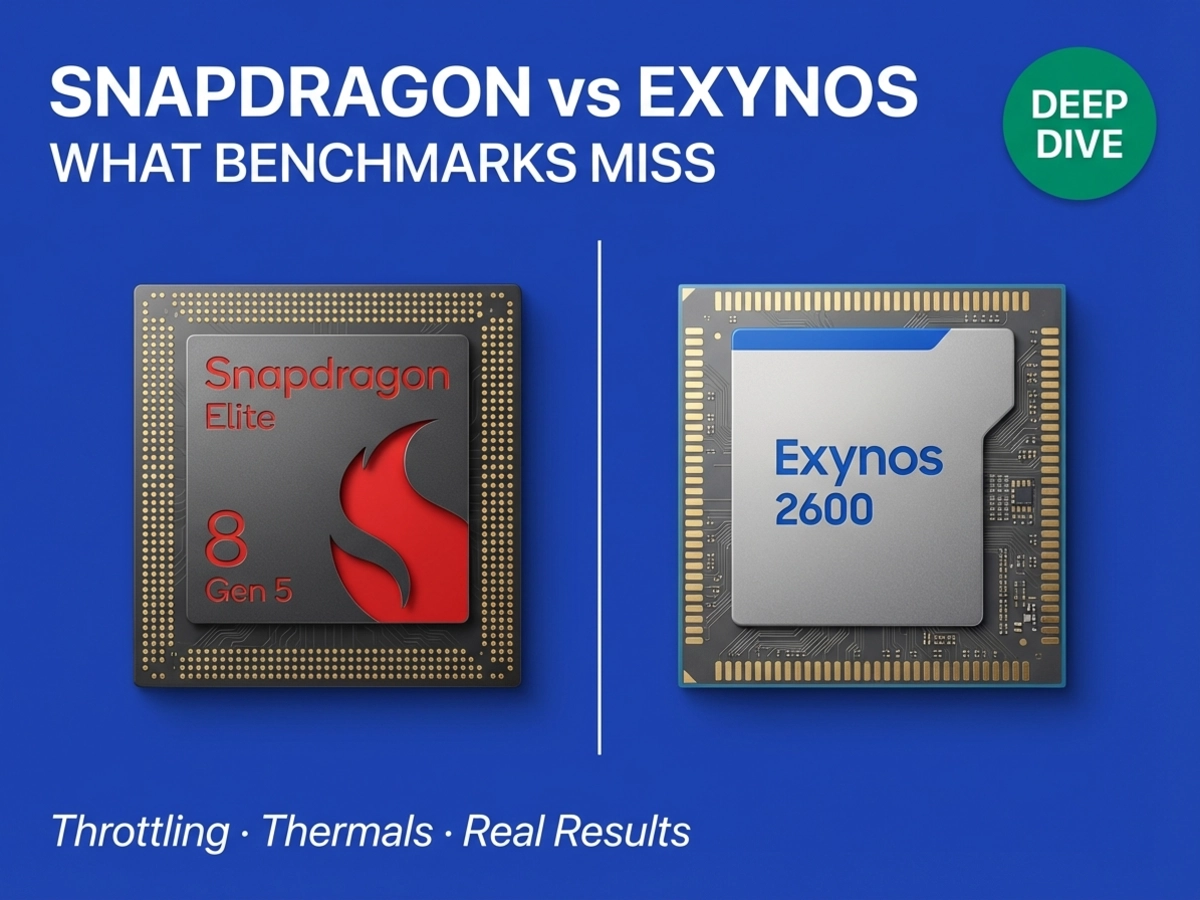
The Snapdragon 8 Elite Gen 5 wins every benchmark headline. The Exynos 2600 is built on the world's first 2nm mobile process. Neither fact tells the full story. We break down what the throttling data, thermal tests, and real-device results reveal, so you can choose the chip that matches how you actually use your phone.
Choosing between the Snapdragon 8 Elite Gen 5, the Dimensity 9500, and the Exynos 2600 should be straightforward: one chip scores higher, you buy that chip's phone. But the numbers hide a more interesting situation. The chip that scores highest on a 30-second benchmark test drops to less than 30% of its peak output after 15 minutes of sustained gaming on most retail hardware. The chip that scores lowest was built on a more advanced process node than either rival. And the chip nobody talks about delivers the most consistent frame rates of the three. This article unpacks what those benchmark numbers actually mean, and what they leave out.
Three chips, three different architectural bets. Understanding what each manufacturer prioritized explains why the benchmark results turn out the way they do.
The Snapdragon 8 Elite Gen 5 and Dimensity 9500 both use TSMC's 3nm FinFET manufacturing process, announced in September 2025. The Exynos 2600 arrived three months later, built on Samsung Foundry's 2nm Gate-All-Around (GAA) process, becoming the first 2nm mobile chip on the market.
The distinction between GAA and FinFET is a transistor physics difference. In a FinFET design, the gate controls current on three sides of the channel. A GAA transistor wraps the gate around all four sides, giving it tighter electrostatic control at sub-3nm gate lengths. The practical result is lower current leakage and better switching efficiency per transistor. Samsung had already used GAA at 3nm before this generation, which is why the company arrived at 2nm GAA with more production experience than TSMC, which switched from FinFET to GAA only at 2nm itself.
Tweaktown, citing Samsung's Q3 2025 earnings statement, documented that the SF2 process delivers 5% better performance, 8% better efficiency, and 5% better area density compared to Samsung's own 3nm GAA second-generation node. Notice what those figures are measuring: Samsung against Samsung, not Samsung against TSMC. The comparison is internally valid but does not directly quantify the advantage over the TSMC 3nm FinFET process that powers Snapdragon and Dimensity.
What the spec sheet alone cannot tell us is whether the 2nm advantage translates into better real-world performance or merely better theoretical efficiency.
The Snapdragon 8 Elite Gen 5 uses Qualcomm's third-generation Oryon CPU cores in an 8-core configuration: two prime cores at 4.6GHz and six performance cores at 3.62GHz. Qualcomm developed Oryon through the Nuvia acquisition, and it has delivered the fastest single-core Android performance of any chip for two consecutive generations.
The Dimensity 9500 and Exynos 2600 both use ARM's new C1-series CPU architecture, but configure it differently. MediaTek's chip runs 8 cores: one C1-Ultra at 4.21GHz, three C1-Premium at 3.5GHz, and four C1-Pro at 2.7GHz. Samsung's chip expands to 10 cores: one C1-Ultra at 3.8GHz, three C1-Pro at 3.25GHz, and six C1-Pro at 2.75GHz. Crucially, the Exynos 2600 uses no dedicated efficiency cores at all. Every core is a performance-class core. Samsung is betting that the 2nm process delivers enough power savings per transistor to eliminate the need for a separate efficiency cluster, replacing architectural efficiency management with process-node efficiency.
The Exynos 2600's prime core peaks at 3.8GHz, compared to 4.21GHz on the Dimensity 9500 and 4.6GHz on the Snapdragon 8 Elite Gen 5. That clock speed gap is a significant factor in benchmark results, and its origin is more about manufacturing yield than architecture ceiling.
The Snapdragon 8 Elite Gen 5 uses Qualcomm's Adreno 840 GPU with a dedicated high-performance cache and full ray-tracing support. The Dimensity 9500 pairs with ARM's Immortalis G1 Ultra MC12, a 12-core design that also supports ray tracing. The Exynos 2600 carries Samsung's Xclipse 960, built on AMD's graphics IP, with support for ray tracing and ENSS (Exynos Neural Super Sampling), Samsung's version of AI-assisted upscaling and frame generation, functionally similar to what DLSS and FSR do on PC.
On the AI side, all three chips include dedicated neural processing units. The Exynos 2600's NPU has 32,000 MAC units and delivers generative AI performance 113% ahead of its Exynos 2500 predecessor. It also supports SME2 (Scalable Matrix Extension 2), a newer ARM instruction set than the SME supported by Snapdragon, enabling certain lightweight AI tasks to run directly on the CPU without waking the NPU at all.
Spec comparison at a glance:
Snapdragon 8 Elite Gen 5: TSMC 3nm FinFET / 8-core (2+6) / Prime core 4.6GHz (Oryon Gen 3) / Adreno 840 GPU / Hexagon NPU (agentic AI) / LPDDR5X / UFS 4.1 / Snapdragon X85 integrated 5G modem
Dimensity 9500: TSMC 3nm FinFET / 8-core (1+3+4) / Prime core 4.21GHz (C1-Ultra) / Immortalis G1 Ultra MC12 GPU / MediaTek NPU 990 / LPDDR5X / UFS 4.1 / Integrated 5G modem
Exynos 2600: Samsung 2nm GAA / 10-core (1+3+6) / Prime core 3.8GHz (C1-Ultra) / Xclipse 960 GPU / 32K MAC NPU (SME2) / LPDDR5X / UFS 4.1 / Shannon 5410 external 5G modem
The headline results are clear and consistent across tools. The Snapdragon 8 Elite Gen 5 takes the top position in every aggregate benchmark. But the breakdown underneath those totals tells a more interesting story.
In benchmark testing by Gizmochina using the Galaxy S26 Ultra (Snapdragon), Vivo X300 Pro (Dimensity 9500), and Galaxy S26 Plus (Exynos 2600), the Snapdragon posted 3,725 points in the single-core test, Dimensity 9500 reached 3,452, and Exynos 2600 scored 3,040. The single-core gap between Snapdragon and Exynos is 22%, driven almost entirely by the clock speed difference: 4.6GHz vs 3.8GHz on the prime core.
Multi-core results shift the picture. The Snapdragon reached 11,318, but the Exynos 2600 scored 10,290, edging out the Dimensity 9500's 10,128 by roughly 1.6%. Exynos's 10-core design delivers more parallel compute than the 8-core configurations on its rivals, offsetting the clock speed disadvantage when all cores work together.
The AnTuTu totals follow the same pecking order: Snapdragon at 3,893,781; Dimensity 9500 at 3,548,426; Exynos 2600 at 3,210,573. Within those totals, the Exynos 2600 takes the memory subcategory with 413,700 points, beating Snapdragon's 411,037 and Dimensity's 385,723. It also leads Dimensity in the CPU subcategory (1,065,772 vs 1,028,694). The GPU subcategory gives Snapdragon a clear lead at 1,568,941, with Dimensity second at 1,413,659 and Exynos third at 1,212,568.
A note on the Dimensity 9500 AnTuTu figure: on the Vivo X300 Pro, the chip registered 3,331,723 in independent testing, noticeably below MediaTek's launch-event projection.
Key benchmark figures:
Geekbench single-core: Snapdragon 3,725 / Dimensity 3,452 / Exynos 3,040
Geekbench multi-core: Snapdragon 11,318 / Exynos 10,290 / Dimensity 10,128
AnTuTu total: Snapdragon 3,893,781 / Dimensity 3,548,426 / Exynos 3,210,573
AnTuTu CPU: Snapdragon 1,162,784 / Exynos 1,065,772 / Dimensity 1,028,694
AnTuTu memory: Exynos 413,700 / Snapdragon 411,037 / Dimensity 385,723
3DMark Wild Life Extreme best: Snapdragon 7,786 / Dimensity 7,163 / Exynos 7,061
3DMark Wild Life Extreme stability: Dimensity 57.0% / Snapdragon 48.2% / Exynos 46.4%
The 3DMark Wild Life Extreme results are where the benchmark story gets complicated. Snapdragon peaks at 7,786, Dimensity at 7,163, Exynos at 7,061. Peak scores go to Snapdragon. But the stability column reverses the ranking entirely. Dimensity 9500 achieves 57% stability, meaning its lowest loop score is 57% of its highest. Snapdragon manages only 48.2%. Exynos trails at 46.4%.
What the stability percentages reveal, and what aggregate benchmark scores obscure, is that peak performance and sustained performance are measuring fundamentally different things.
Samsung's 2nm SF2 process delivered a stated 5% performance gain and 8% efficiency improvement over its own 3nm GAA, figures that explain both the Exynos 2600's genuine efficiency edge and the ceiling of what process node alone can accomplish without higher clock speeds. Samsung Foundry's yields on 2nm improved from roughly 30% early in production to approximately 50-60% by the time Galaxy S26 launched, sufficient for mass production but still below TSMC's mature 3nm output. A chip manufactured under those yield constraints is engineered for stability and consistency, not frequency racing. The 3.8GHz prime core is not a limitation of the 2nm GAA architecture: it is a conservative clock choice made during a yield ramp that prioritized process stability over peak frequency.
The standard benchmark narrative misses one category where the Exynos 2600 takes the top position. In the PowerBoard Vitro GPU benchmark, a test specifically weighted toward ray-tracing computation, Beebom Gadgets found the Exynos 2600 scored 8,321 points, compared to Snapdragon's 7,649 and Dimensity's 7,075. The Xclipse 960's AMD RDNA-based architecture gives it a structural advantage in the ray-tracing workload that Snapdragon's Adreno 840 and ARM's Immortalis G1 Ultra cannot match in this specific test. Whether that advantage eventually carries into actual game titles depends on whether mobile game developers adopt ray-tracing pipelines that favor RDNA's specific approach, which as of early 2026 remains limited.
Lab benchmarks run for 30 seconds to a few minutes. Gaming sessions run for 30 minutes or more. The difference between those two time scales is where the real ranking gap appears.
The Snapdragon 8 Elite Gen 5 is a powerful chip. On Qualcomm's own reference device, a 6.8-inch 1440p phone with 24GB RAM and optimal thermal management, it posted benchmark numbers that no retail device has matched. The warning from launch-day reviewers was clear: retail hardware will deliver less.
Android Authority's testing on the Realme GT8 Pro, a mainstream Snapdragon 8 Elite Gen 5 flagship without active cooling, found the chip dropped to 28.6% of its peak performance in the 3DMark Solar Bay (ray tracing) stress test at a device temperature of 44.1°C. In the older 3DMark Wild Life Extreme test, it held 38.9% of peak. For context, the previous Snapdragon 8 Elite never dropped below 70% of its initial output in equivalent tests. This generation's performance headroom is substantially larger, but the thermal envelope on a mainstream slim smartphone has not expanded to match it.
Gaming phones with active liquid cooling and fans can sustain Snapdragon peak performance, but at surface temperatures exceeding 56°C, far outside comfortable extended handheld use. The real-world choice is not between peak and zero: it is between a chip that starts high and drops steeply under sustained load, and chips that start lower but hold their output more consistently.
The Exynos 2600's Heat Path Block is a copper-based heat sink placed in direct contact with the application processor die, using High-k EMC material to conduct heat away while relocating DRAM to the side of the package. WccFTech's thermal imaging tests showed Galaxy S26 running League of Legends at 32°C average surface temperature, while the Galaxy S26 Plus (Exynos) held Genshin Impact at a peak of 38°C front and 37.5°C back, and Honkai at 39°C front and 38°C back, all at 26°C ambient temperature. The characteristic heat-bubble pattern visible in infrared imaging around the CPU area of prior Exynos chips was entirely absent. HPB achieves a thermal resistance reduction of up to 30%, delivering measurably cooler operation under gaming load than prior Samsung flagship silicon.
Real-device gaming results on the Galaxy S26 Plus confirm the improvement holds under actual sustained play. TechNetBook's testing found that in Genshin Impact at performance mode settings, the chip maintained stable frame rates and 5W power draw through a 30-minute session, reaching 49.5°C before thermal throttling engaged to manage temperature. The Exynos 2600's GPU can draw up to 23W during the most demanding Vulkan-optimized titles, and Fan-Out Wafer-Level Packaging helps disperse that heat more efficiently than traditional substrate packaging. The HPB then channels the residual heat through the chassis rather than back into the die.
Whether HPB's thermal advantage holds across all chassis designs rather than just the Galaxy S26 line remains an open question, as third-party device makers licensing the Exynos 2600 may implement different cooling architectures.
The Dimensity 9500's 3DMark Wild Life Extreme stability score of 57% is the best of the three chips. Its lowest benchmark loop score was 4,092 against a best of 7,163. That 57% stability figure means a Dimensity 9500 device delivers its seventh-minute gaming frame rates at a significantly more predictable level than either rival. On a reference device running the standard CPU Throttling Test, the Snapdragon 8 Elite Gen 5 dropped to 58% of peak performance after four consecutive stress runs. The Dimensity 9500 held to 59% of maximum CPU performance in its own throttling test, a narrower decline from a lower starting point.
The gap that opens between Snapdragon 8 Elite Gen 5's peak benchmark score and its 28.6% GPU stability floor on mainstream devices is not a flaw in the chip; it is a flaw in how we evaluate chips. The Dimensity 9500 and the Exynos 2600, which score lower on peak tests, both deliver more of their stated performance across the duration of an actual gaming session. The benchmark chart ranks Snapdragon first; the sustained performance chart puts it last among the three on mainstream hardware.
Benchmark comparisons sourced from launch-day reference devices tell one story. Retail hardware from actual Galaxy S26 units tells another.
Tom's Guide ran Geekbench 6 directly on retail Galaxy S26 devices and found the Exynos 2600 variant scored 3,314 single-core and 10,992 multi-core, against the Snapdragon variant's 3,726 single-core and 11,121 multi-core. The single-core gap was 12%, narrower than the 22% seen in tests using Qualcomm's reference device configuration. Multi-core performance was separated by only 1.2%, a difference with no practical relevance in daily phone use.
The 3DMark Wild Life Unlimited results from the same hands-on test are striking: the Exynos Galaxy S26 scored 7,250, while the Snapdragon Galaxy S26 scored 7,059. The Exynos variant led in sustained graphics at the base model level. Tom's Guide concluded that the performance margin is not large enough to be noticeable in ordinary use and does not justify going out of the way to purchase a Snapdragon variant.
The generational context matters here. The Exynos 2600 is 31.5% faster than the Exynos 2500 and 22% faster than the Exynos 2400 in PCMark productivity tests. For anyone upgrading from a 2023 or 2024 Samsung flagship with a prior-generation Exynos chip, the improvement is substantial regardless of which rival chip it is being compared against.
Samsung's yield trajectory reinforces why the real-device results matter more than launch benchmarks. The Galaxy S25 used Snapdragon across all models after Exynos 2500 yields proved insufficient for volume production. PhoneArena documented that this cost Samsung approximately $400 million more than planned. For the Exynos 2600, yields improved from the low 30% range to approximately 50-60% by launch, making mass production viable but requiring clock-speed conservatism to maintain reliability. As yields mature, future Exynos generations could unlock higher clock headroom that the 2nm architecture is theoretically capable of supporting.
For a deeper look at how the Exynos 2600 performs specifically in the Galaxy S26 across real-world use cases, including camera performance, day-to-day battery behavior, and software optimization, the detailed device analysis covers what synthetic benchmarks cannot capture.
Whether the multi-core parity seen in retail Galaxy S26 testing generalizes to third-party Exynos 2600 devices remains to be seen as more hardware ships through 2026.
Samsung moved the Shannon 5410 modem off the Exynos 2600 die and confirmed as much directly to Android Authority, and the reason was neither oversight nor cost-cutting alone: freeing that silicon real estate is what funded the Xclipse 960 GPU upgrade and the enlarged NPU. At 2nm, the die area available is finite and expensive. Samsung made a deliberate choice to allocate it toward compute rather than connectivity. The Exynos 2600 is better at gaming and AI inference because it does not also have to house its own cellular modem on the same substrate.
The result of the external modem decision is that Exynos 2600 actually posts the fastest peak cellular speeds of the three chips. The Shannon 5410 reaches download speeds up to 14.79 Gbps and upload speeds up to 4.9 Gbps. The Snapdragon X85 modem reaches 12.5 Gbps download and 3.7 Gbps upload. The Dimensity 9500's integrated modem reaches 7.4 Gbps download. For peak 5G throughput, Exynos leads.
The Snapdragon chip carries a separate but important connectivity advantage: the X85 modem has been through multiple carrier certification cycles across dozens of networks worldwide. Qualcomm's carrier relationships and modem maturity translate to better real-world cellular performance on varied global networks, even where Exynos's peak speeds are theoretically faster. This modem maturity is a meaningful difference for frequent travelers and users on less common networks.
For Wi-Fi 7, the Dimensity 9500 leads with a peak speed of 7.3 Gbps, against Snapdragon's 5.8 Gbps. Exynos 2600 supports the same Wi-Fi 7 standard without a comparable published peak figure.
The external modem introduces a real, if difficult to quantify, power trade-off. Moving data between the application processor and a physically separate modem requires additional power overhead compared to an integrated design. This overhead accumulates during streaming, extended video calls, and large downloads. Samsung has not released a comprehensive efficiency figure for the Exynos 2600 as a whole chip, a notable absence in the official documentation.
Apple has operated with external modems on iPhones for years while maintaining strong battery life results, but iOS and Android manage background processes differently enough that the comparison is not directly transferable.
Battery life comparisons between Exynos 2600 and Snapdragon variants remain inconclusive as of early 2026, the external modem efficiency penalty is theoretically real, but Samsung's system-level optimization between the 2600 and Shannon 5410 may partially offset it, and long-term data is still accumulating. The efficiency penalty this creates depends on usage patterns, with heavy mobile data users facing a larger impact than those predominantly on Wi-Fi.
One connectivity-adjacent advantage of the Exynos 2600 goes largely undiscussed in benchmark roundups: its support for SME2, the second-generation Scalable Matrix Extension instruction set. Where Snapdragon's Oryon cores support only the first-generation SME, the Exynos 2600's ARM C1 cores support SME2, which adds multi-vector instructions, weight compression, and support for compact neural network formats. This means lightweight AI tasks, predictive text, image classification, real-time translation, can run at the CPU level without waking the NPU, reducing both power consumption and startup latency for those specific workloads. Qualcomm is not expected to incorporate a comparable HPB thermal solution until the Snapdragon 8 Elite Gen 6 generation, suggesting Samsung's advantage in both thermal management and CPU-level AI efficiency may persist for at least the next 12 months.
The performance gap between these three chips in daily phone use is mostly invisible. Tom's Guide characterized the Exynos-versus-Snapdragon margin as one a user would not notice in regular usage. For the vast majority of tasks, browsing, social media, messaging, streaming, photography, any 2026 flagship powered by any of these three chips will perform identically. The differentiation emerges at the margins, and those margins matter only to specific users.
If sustained gaming frame rate consistency is a priority, the Snapdragon 8 Elite Gen 5 is the wrong chip to optimize for on a mainstream slim flagship. Its 48.2% 3DMark stability and 28.6% Solar Bay GPU floor under sustained load mean that extended sessions on a standard flagship chassis will deliver substantially less than the benchmark headline implies.
The Dimensity 9500 offers the best measured stability of the three at 57%, maintained across sustained 3DMark loops. Its GPU performance is competitive, its thermal behavior is consistent, and MediaTek's HyperEngine optimization suite handles frame pacing well. For users in markets where Dimensity 9500 phones like the Vivo X300 Pro are accessible, it is the rational gaming chip for a non-gaming-phone flagship.
The Exynos 2600 in the Galaxy S26 line is a competitive alternative if HPB's thermal management works as documented, and the thermal imaging evidence suggests it does. The sustained 3DMark Wild Life Unlimited lead over Snapdragon at the base Galaxy S26 model level confirms that for comparable-tier devices, Exynos delivers equal or better sustained graphics.
All three chips support triple ISP designs capable of processing 320MP single-camera captures and 8K video recording. Both the Snapdragon 8 Elite Gen 5 and Exynos 2600 support the APV (Advanced Professional Video) codec for lossless professional video capture. Camera performance on a specific phone will depend more on the manufacturer's computational photography software and sensor hardware than on chipset ISP differences alone.
The Xclipse 960's 9% ray-tracing lead over the Adreno 840 in the PowerBoard Vitro benchmark is a modest advantage today. The larger argument for future-proofing is structural: RDNA-based architectures have a geometric advantage in ray-tracing workloads that tends to compound as rendering complexity increases. As mobile game developers expand ray-tracing adoption over the 2026-2027 lifecycle of these phones, the Xclipse 960's advantage is more likely to grow than to shrink.
Our reading of the full data set is that Dimensity 9500 is the overlooked chip in this trio: it offers the best sustained gaming stability of the three and the fastest Wi-Fi 7 speeds, making it the rational choice for users who prioritize consistent frame rates over peak scores. But its availability is concentrated in specific markets, and most users outside of China and Southeast Asia will not have easy access to Dimensity 9500 devices in premium tiers.
For users choosing between Galaxy S26 lineup variants: the Snapdragon S26 Ultra delivers the highest peak scores and the best modem carrier compatibility for global travel. The Exynos S26 and S26 Plus deliver competitive daily performance, better sustained gaming thermal management, the ray-tracing GPU lead, and the SME2 AI efficiency advantage. The choice between them is not a performance decision; it is a use-case priority decision.
Use-case matching:
Extended gaming on a mainstream flagship: Dimensity 9500 or Exynos 2600 (best sustained frame-rate stability)
Peak single-core tasks and global carrier coverage: Snapdragon 8 Elite Gen 5 (fastest CPU, most carrier-certified modem)
Ray-tracing and future GPU workloads: Exynos 2600 (Xclipse 960 RDNA lead in ray-tracing tests)
Wi-Fi 7 performance (non-cellular): Dimensity 9500 (7.3 Gbps peak, best of the three)
Lightweight AI tasks with low power overhead: Exynos 2600 (SME2 CPU-level inference without NPU activation)
That gap, the distance between what these chips score in a 30-second test and what they deliver in a 30-minute session, is the thing most comparison articles fail to show.
The Galaxy S26 Ultra ships with Snapdragon 8 Elite Gen 5 globally, including in the United States, China, and Japan. The Galaxy S26 and Galaxy S26 Plus use the Exynos 2600 in most other markets, including Europe, India, and Southeast Asia. This split mirrors the pattern Samsung has used in prior years, though the Exynos 2600 is the first competitive Exynos chip since the Exynos 2400 to appear without significant performance concessions vs. the Snapdragon variant, based on retail device testing.
The Dimensity 9500 appears in devices including the Vivo X300 Pro, primarily in China and select Asian markets. Third-party device makers adopting the Exynos 2600 for non-Samsung phones are expected throughout 2026, though availability outside Samsung's own lineup will vary by region.
In prior years, the answer would have been yes for many users, given the performance gap between Exynos and Snapdragon variants. Based on current retail data, the answer is no for most users. Tom's Guide's hands-on testing confirmed the performance margin is imperceptible in daily use, and the Exynos 2600 variant actually leads the Snapdragon variant in 3DMark Wild Life Unlimited sustained graphics at the base Galaxy S26 model level.
The one case where importing a Snapdragon variant makes sense is for users who travel extensively across diverse international carrier networks and need the Snapdragon X85 modem's breadth of carrier certifications. For domestic users or those who use primary data connections on established carriers, the Exynos variant's Shannon 5410 modem's peak 5G speeds exceed the X85, and no practical performance gap justifies the import cost and potential warranty complications.
The Exynos 2600 leads both the Snapdragon 8 Elite Gen 5 and Dimensity 9500 in the PowerBoard Vitro ray-tracing benchmark by approximately 9% and 18% respectively. Whether that benchmark lead translates to better in-game performance depends on developer adoption, and as of early 2026 that adoption is limited on mobile platforms.
The structural argument for Exynos is that RDNA-based architectures handle ray-tracing geometry in a way that compounds its advantage as scene complexity increases. Game studios have historically optimized mobile titles first for Qualcomm's Adreno ecosystem due to its market dominance. The Exynos 2600 has a ray-tracing ceiling that rivals cannot match, but that ceiling has not yet been reached by available software. Users who plan to hold this phone through its full two-to-three year lifecycle may see the Xclipse 960 advantage become more meaningful as mobile ray-tracing matures.
In daily non-gaming use, the three chips are functionally equivalent. The Dimensity 9500's single-core Geekbench score of 3,452 and multi-core of 10,128 fall between Snapdragon and Exynos in both categories. For app launches, multitasking, browsing, and social media, the differences are not perceptible in regular use.
Where the Dimensity 9500 stands out is in sustained gaming stability (57% 3DMark consistency vs. 48.2% for Snapdragon and 46.4% for Exynos), in Wi-Fi 7 peak throughput (7.3 Gbps vs. Snapdragon's 5.8 Gbps), and in the value it delivers in mid-to-high-range Android flagships in specific markets. Its main limitation relative to the other two is availability: accessing a Dimensity 9500 flagship outside of specific Asian markets requires deliberate effort, and the chip does not power any of the top-tier camera-focused flagships available globally.