Finished reading? Continue your journey in Tech with these hand-picked guides and tutorials.
Boost your workflow with our browser-based tools
Share your expertise with our readers. TrueSolvers accepts in-depth, independently researched articles on technology, AI, and software development from qualified contributors.
TrueSolvers is an independent technology publisher with a professional editorial team. Every article is independently researched, sourced from primary documentation, and cross-checked before publication.
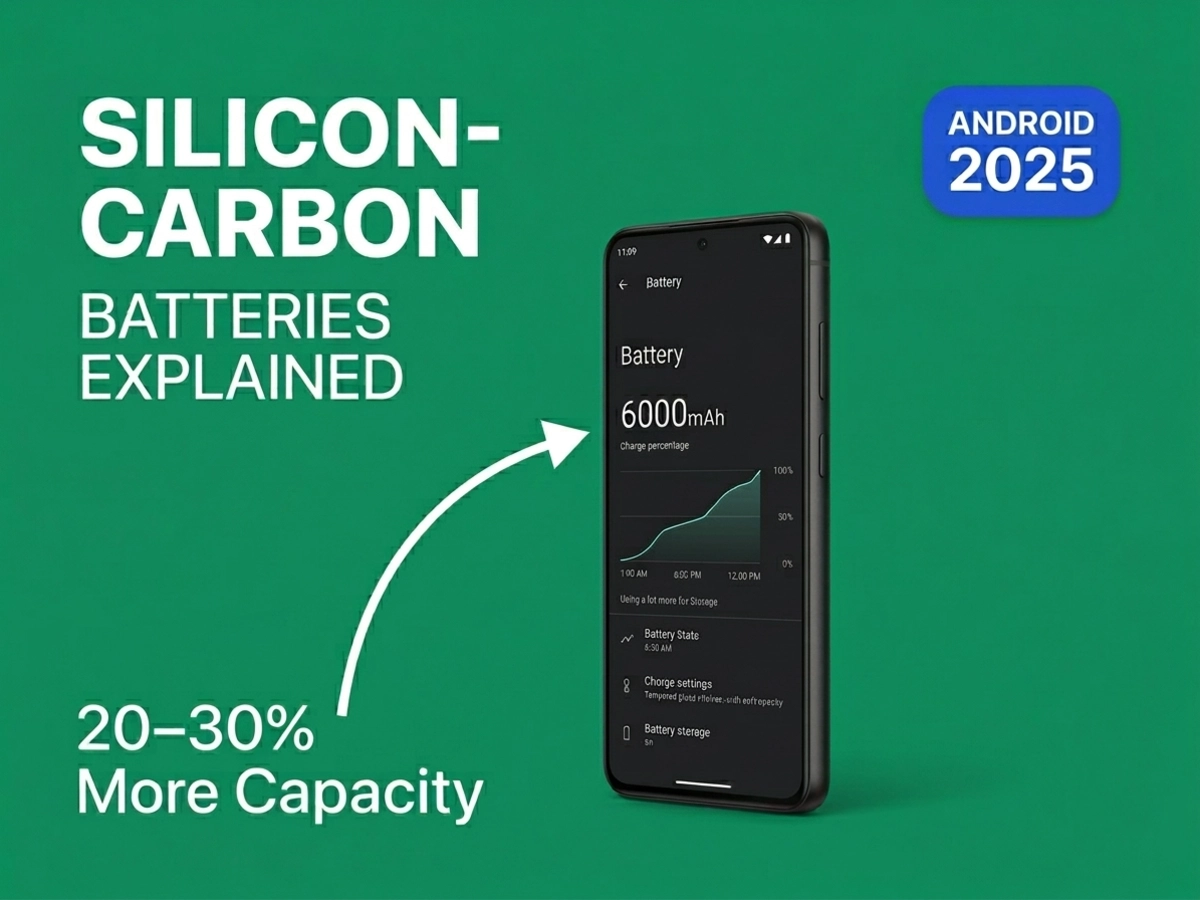
Chinese Android manufacturers deployed a battery chemistry upgrade throughout 2024 and 2025 that Western brands still haven't matched. Silicon-carbon batteries replace traditional graphite anodes with silicon-infused composites, cramming 10-30% more capacity into identical physical dimensions. The OnePlus 13 packs 6,000mAh into an 8.5mm body while Samsung's Galaxy S25 Ultra maintains its six-year-old 5,000mAh lithium-ion design. This isn't incremental optimization. It's a fundamental materials change that transforms multi-day usage from aspiration to routine.
Your phone reaches 20% battery at 6 PM. You already know the choreography: find an outlet, plug in, wait. That experience is normal on flagship phones costing $1,000 or more. It is increasingly abnormal on Chinese flagships that ship with silicon-carbon batteries, where the same 6 PM check shows 58%.
The numbers that prove this gap are not marketing claims. They come from independent lab tests run on standardized protocols. Tom's Guide measured the OnePlus 15 at 25 hours and 13 minutes on its web-browsing battery test, a result the publication described as a new record in its testing history. In that same test, the Galaxy S25 Ultra ran for 14 hours and 27 minutes and the iPhone 17 Pro Max reached 17 hours and 54 minutes. The OnePlus 15 outlasted the Samsung by more than 10 hours.
On the OnePlus 13, which carries a 6,000mAh silicon-carbon battery, Tom's Guide recorded 19 hours and 45 minutes on the same standardized test. PhoneArena's web-browsing benchmark at 200 nits yielded 21 hours and 30 minutes. Either way, the OnePlus 13 finished the day with charge to spare.
The "20-30% capacity improvement" framing significantly undersells what silicon-carbon batteries deliver in practice. The OnePlus 15's 7,300mAh is roughly 46% larger than the Galaxy S26 Ultra's 5,000mAh — but in standardized endurance testing, the gap in hours is closer to 74%. The combination of more raw capacity and lower internal resistance produces endurance gains that outstrip what the capacity ratio alone would predict. Users don't experience a 46% longer day. They experience a phone that ends the day at 68% battery, where they never needed to think about charging at all.
Traditional lithium-ion batteries store energy by shuttling lithium ions into and out of a graphite anode during charge and discharge cycles. Graphite handles this well because it intercalates lithium ions between its layers without significant physical deformation. The tradeoff is storage capacity: graphite holds roughly 372 milliamp-hours per gram. Silicon can hold approximately 4,200 milliamp-hours per gram, around ten times more.
The reason silicon wasn't used decades ago is physical. Silicon doesn't intercalate lithium; it forms an alloy with it. That alloying process causes silicon to swell by up to 300% of its original volume when fully charged, then contract back during discharge. No cell structure survives that mechanical stress across hundreds of cycles. By the third year, a pure silicon anode would be physically disintegrating.
Silicon-carbon composites solve this by distributing silicon particles within a carbon matrix at controlled concentrations, typically between 5% and 15% silicon by composition. The carbon performs two distinct functions simultaneously. It acts as a mechanical buffer that limits expansion to roughly 10-20% instead of 300%, absorbing the stress that would otherwise shatter the anode structure. It also stabilizes the solid electrolyte interphase, the protective layer that forms on the anode surface and gradually depletes over cycles. Without stable SEI formation, every charge cycle consumes a small amount of lithium permanently, reducing the battery's effective capacity over time.
The silicon percentage is not an on-off switch but a performance-versus-durability dial. A 5% silicon anode delivers modest capacity gains with minimal cycle-life impact, essentially resembling a slightly improved traditional lithium-ion cell. At 15%, the gains are substantial but the expansion stress is greater, demanding more precise carbon scaffolding and more sophisticated manufacturing. OnePlus claims 15% silicon content in the OnePlus 15's Silicon NanoStack battery, describing it as the highest silicon concentration available in a silicon-carbon design in mass production.
Silicon-carbon is not a single technology but a manufacturing spectrum. Two phones can both be marketed as having silicon-carbon batteries while sitting at meaningfully different points on that spectrum, with corresponding differences in capacity gain and cycle-life behavior.
The first smartphone to use a silicon-carbon battery was the Honor Magic 5 Pro, announced at Mobile World Congress in February 2023. That was three years ago. At the time, it was a curiosity: a single device from a brand most Western consumers hadn't purchased. By the first half of 2025, silicon-carbon had penetrated more than 60% of flagship phone launches in the Chinese market, crossing that threshold within two years of first commercial deployment. A technology that took lithium-ion a decade to standardize ran that same arc in 24 months inside Chinese manufacturing.
Chinese manufacturers have collectively treated 7,000mAh as the expected ceiling for premium devices, not a special feature.
The OnePlus 15 ships with a 7,300mAh silicon-carbon battery, globally, with no regional capacity reduction. The OPPO Find X9 Pro carries 7,500mAh in a body measuring 7.99mm thick. The Xiaomi 17 series pushes past 7,000mAh. The iQOO 15 matches the OnePlus 15 at 7,300mAh. In each case, the larger battery is not achieved by making the phone thicker or heavier; it occupies the same physical volume as the traditional lithium-ion cell it replaced.
OPPO's third-generation silicon-carbon design achieves 850 watt-hours per liter in energy density and carries a five-year health promise from the manufacturer. OnePlus guarantees 80% capacity retention after four years on both the OnePlus 13 and OnePlus 15.
The charging systems paired with these batteries reflect the same engineering philosophy. OnePlus supports 120W wired charging with an optional adapter; the OnePlus 15 reaches 81% charge in 30 minutes on 80W wired. The 50W wireless charging standard available on these devices exceeds what Samsung currently offers on any Galaxy model.
At Galaxy Unpacked in February 2026, Samsung's Executive VP and Head of Smartphone R&D, Sung-Hoon Moon, addressed the battery gap directly when asked about it during a roundtable session. He acknowledged Samsung may have been "a bit un-innovative on that front" and confirmed the company is preparing a smartphone with silicon-carbon anode technology, to arrive "in due course." This was the first time a Samsung executive publicly acknowledged a competitive gap in battery technology at a flagship launch event.
The Galaxy S26 series announced at that same event tells the story of the gap. Official Samsung specifications list the Galaxy S26 at 4,300mAh, the Galaxy S26+ at 4,900mAh, and the Galaxy S26 Ultra at 5,000mAh. The S26 Ultra's capacity is identical to the Galaxy S20 Ultra released in 2020. Seven consecutive generations of Samsung's most expensive flagship phone without a capacity increase.
Samsung's stated reasoning centers on validation standards. The company has a documented history of battery safety failures, most notably the Galaxy Note 7 recall in 2016, and has since built quality control processes that new chemistries must pass before mass deployment. Moon's comments suggest silicon-carbon cells have not yet cleared that bar: not because the technology is inherently unsafe, but because Samsung's internal standards require more validation cycles.
The scale argument is also real. Samsung's Galaxy S25 Ultra reportedly sold approximately 11 million units in its first year. Sourcing validated silicon-carbon cells for 11 million devices is a fundamentally different supply-chain problem than what OnePlus or Honor had to solve for their much smaller production volumes. A chemistry failure at Samsung's scale would be a global event, not a niche recall.
The cycle-life concern is harder to maintain as a complete rationale now that the S26 Ultra's own durability metrics have emerged. Samsung's official S26 announcements include a seven-year software update commitment. Yet EU Energy Label filings confirm the Galaxy S26 Ultra is rated at 1,200 charge cycles before reaching 80% capacity retention, down from the Galaxy S25 Ultra's 2,000-cycle guarantee. A battery that degrades to 80% within 1,200 cycles creates a tension with that longevity promise that the company has not publicly resolved. Meanwhile, OPPO is claiming 80% health after five years on its silicon-carbon Find X9 design. Samsung's hesitation is legitimate. It is also being eroded from both sides simultaneously: its own devices are showing shorter cycle guarantees than their predecessors, while its competitors are demonstrating improving silicon-carbon durability through successive generations of iteration. Samsung has not disclosed cycle test data for the cells currently under evaluation, so direct comparison remains speculative, but the directional shift is notable.
Silicon-carbon batteries age differently from traditional lithium-ion. Battery engineers have noted that silicon-carbon cells show more noticeable capacity loss in the first two to three years compared to traditional cells at the same age. This is consistent with the physics: the expansion-contraction cycle, even when buffered by the carbon matrix, accumulates mechanical stress over time in ways that graphite, with its minimal volume change, does not.
The SEI layer challenge compounds this. Each time the silicon particles expand and contract, they crack the protective solid electrolyte interphase layer on the anode surface. Each crack exposes fresh silicon to the electrolyte, triggering a new SEI formation reaction that consumes lithium ions and permanently reduces capacity. Managing this process is the core materials engineering challenge at higher silicon concentrations.
Manufacturers are deploying software countermeasures that many users don't realize exist. Some brands implement charge limits that prevent the battery from ever reaching its stated 100% capacity, capping effective charge at around 94-95% of the rated mAh figure. A phone sold as having a 7,300mAh battery may routinely charge to approximately 6,900mAh in practice. This reduces voltage stress at high states of charge, which is one of the primary drivers of lithium-ion degradation in any chemistry. The user experiences slightly less top-end capacity in exchange for meaningfully better long-term health.
Lower silicon concentrations deliver cycle life that genuinely approaches traditional lithium-ion. Higher-concentration designs like the OnePlus 15 show faster early aging, mitigated by the software charge limits described above. OnePlus guarantees 80% retention after four years; OPPO claims the same threshold at five years. Long-term real-world degradation data in consumer devices is still accumulating. The oldest mass-market silicon-carbon phones, starting with the Honor Magic 5 Pro from early 2023, are now approaching two to three years of consumer use. The next 12 months of real-world data from those devices will be more definitive than any manufacturer projection.
Capacity figures translate differently depending on how someone actually uses a phone. The practical significance of silicon-carbon batteries isn't uniform across user types, but the threshold the technology has crossed is meaningful for almost everyone who owns a smartphone.
Heavy users who spend five to seven hours daily on their device and previously managed a day on a 5,000mAh phone now finish the day with something left in reserve. The math changes from "I hope I make it" to "I know I will." For moderate users at three to four hours of screen time daily, reaching end-of-day with 60-70% remaining is not unusual. Two-day usage becomes a realistic default rather than careful rationing.
Tom's Guide's reviewer testing the OnePlus 15 noted the phone showed 68% battery at the end of a full day of use. That number changes the psychological relationship with the phone more than any benchmark. The behavioral shift happens not at the capacity specification but at the experience threshold. When you know you will end the day at 68%, you stop managing battery at all.
Charging speed data reinforces this. OnePlus 15 owners reaching 81% charge in 30 minutes means even two-day users who do charge nightly spend roughly a third of the time plugged in compared to the roughly 60-minute full-charge required by Samsung's Galaxy S25 Ultra. For overnight charging habits, this distinction is largely irrelevant. For users who top up during a lunch break or at an airport, the difference between 15 minutes to 56% and 30 minutes to 72% is materially different to how they plan their day.
Power-saving mode loses its role as daily protection for most silicon-carbon users. On traditional 5,000mAh flagships, activating battery saver at 50% to guarantee end-of-day survival is a familiar habit. On the OnePlus 15 generation, that habit becomes unnecessary for all but the heaviest use patterns.
The technology is not yet universal. Samsung and Google remain on traditional lithium-ion at lower capacities, though Samsung has confirmed silicon-carbon phones are coming at an unspecified future date. For buyers choosing a flagship phone today, silicon-carbon is available primarily from Chinese manufacturers: OnePlus, OPPO, Xiaomi, Honor, iQOO, and Vivo. For buyers invested in Samsung's or Google's ecosystem, that choice involves a genuine trade-off in battery endurance that the specifications alone will not communicate clearly enough. It's also worth noting that Apple's ecosystem is itself in flux: iOS 26.3 introduces direct iPhone-to-Android data transfer and cross-platform notification forwarding to any smartwatch, which could lower the switching cost for iPhone users considering a move to silicon-carbon Android devices for the endurance advantage.
Will silicon-carbon batteries last as long as traditional lithium-ion?
It depends on silicon concentration and how the manufacturer has tuned the software. Lower-silicon implementations approach traditional lithium-ion durability closely. Higher-concentration designs, like the OnePlus 15's 15% silicon content, show faster early aging, though manufacturers including OnePlus and OPPO claim 80% retention at four and five years respectively. Independent long-term data is still accumulating, as the first mass-market silicon-carbon phones date only to early 2023.
Why does Samsung still use traditional lithium-ion batteries?
Samsung cites validation standards as the barrier, a meaningful concern given its production scale of roughly 11 million units per flagship model annually. Samsung's EVP confirmed at Galaxy Unpacked 2026 that silicon-carbon phones are coming "in due course," but no specific launch timeline has been committed. The Galaxy S27 series is the earliest credible deployment window based on current information.
Do silicon-carbon phones charge faster too?
Generally, yes. The lower internal resistance of silicon-carbon cells enables faster charging with less heat generation. OnePlus and OPPO deploy 80-120W wired charging with their silicon-carbon phones. Samsung's Galaxy S26 Ultra upgraded to 60W wired charging with the S26 generation, still below the OnePlus tier.
Should I wait for Samsung to release silicon-carbon batteries?
If you are committed to Samsung's ecosystem, there is no confirmed timeline beyond a general statement that the technology is coming. If battery endurance is your primary concern and you are open to OnePlus, OPPO, or Xiaomi, silicon-carbon phones with proven multi-day results are available now at competitive flagship prices. The OnePlus 15 is priced at $899, placing it comfortably within flagship pricing territory.
Are there silicon-carbon phones under $600?
Silicon-carbon adoption is beginning to appear in the upper mid-range tier in China, with devices like the iQOO Z10 series and Redmi K80 incorporating the technology. Global mid-range availability is limited as of early 2026, but the diffusion pattern from Chinese flagships to mid-range mirrors how previous battery advances spread, suggesting broader availability within 12-18 months.