Finished reading? Continue your journey in Tech with these hand-picked guides and tutorials.
Boost your workflow with our browser-based tools
Share your expertise with our readers. TrueSolvers accepts in-depth, independently researched articles on technology, AI, and software development from qualified contributors.
TrueSolvers is an independent technology publisher with a professional editorial team. Every article is independently researched, sourced from primary documentation, and cross-checked before publication.
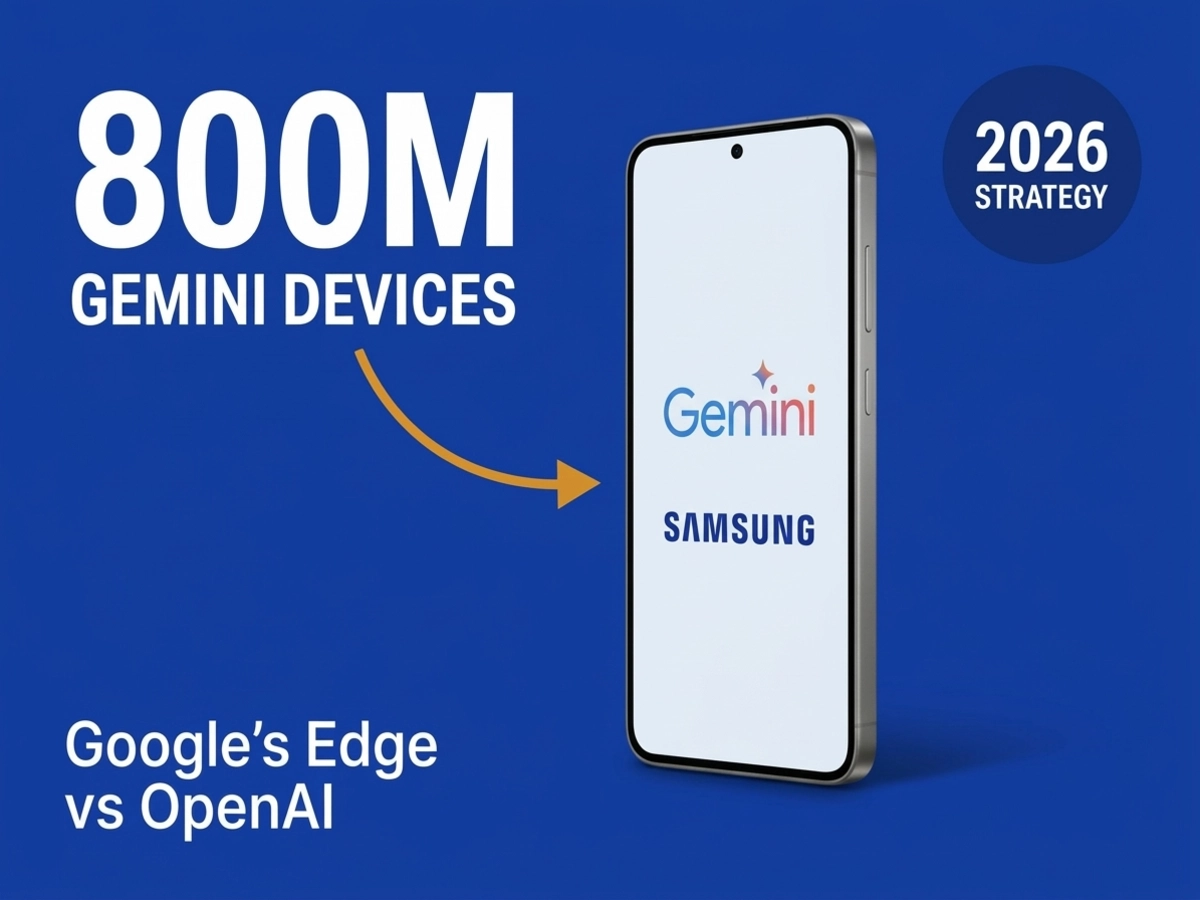
Samsung's plan to double Gemini-powered devices to 800 million units in 2026 is more than an expansion - it's a strategic edge for Google that OpenAI can't easily match: direct access to how billions use AI in real daily workflows. While ChatGPT leads web traffic, Samsung embeds Gemini where users live, building unmatched feedback loops. Yet ongoing memory chip shortages risk derailing this timeline, forcing Samsung to navigate tight supplies amid its push for dominance.
The headline number is Samsung's. The strategic prize belongs to Google.
In his first interview since becoming Samsung co-CEO in November 2025, TM Roh told Reuters the company intends to expand its Gemini-backed Galaxy AI device fleet from roughly 400 million units in 2025 to 800 million by end of 2026. The scope runs across every product category Samsung touches: smartphones, tablets, wearables, televisions, and home appliances, under what Roh calls the company's "Connect Future" strategy. The stated ambition is to push AI into every product, function, and service the company ships.
What makes this announcement land differently from typical device deployment targets is where that AI lives. Gemini is not an app users download or a website they visit. It activates inside the camera, inside Samsung search, inside messaging and translation tools that users already open dozens of times a day. The AI does not need to compete for attention in the way a standalone product does. It inhabits existing behavior.
This distinction matters enormously when reading the competitive scoreboard. Web traffic metrics show ChatGPT holding roughly 68% of AI chatbot market share, a figure that dominates coverage of the AI platform race. But web traffic measures destination visits, and destination visits require deliberate action. When someone edits a vacation photo and Gemini handles the background replacement, no deliberate AI invocation occurred. The interaction is invisible as a "ChatGPT session" but entirely real as an AI usage event. Google's Gemini grew from approximately 5.4% to 18.2% of web AI market share in twelve months, and that growth reflects only the measurable, destination-visit portion of its reach. Samsung's embedded deployment operates beneath that measurement layer entirely.
Samsung is the world's largest Android platform supporter, and Gemini's exposure across its hardware spans a breadth that pure web-based training cannot replicate. A budget Galaxy A-series device with 6GB of RAM teaches the model how to operate under memory constraints. A Galaxy Tab running a translated work document teaches something different. A Galaxy Watch processing a health summary teaches something different again. The usage diversity that comes from deploying across a global hardware spectrum at scale is not available through chat sessions on a website.
The form factor and workflow context in which an AI operates shapes how deeply it embeds in user behavior — which means Samsung's 800 million device count understates what the target actually represents. Those 800 million interactions are real tasks, real constraints, and real user feedback generated without the user ever deciding to "use AI."
The Samsung announcement would be significant on its own. Then, one week later, the competitive picture changed again.
Apple and Google announced on January 12, 2026, a multi-year collaboration under which Google's Gemini models and cloud infrastructure will power the next generation of Apple Foundation Models, including a revamped, more personalized Siri. Apple evaluated multiple AI providers before selecting Gemini, a detail both companies confirmed in the joint statement. Privacy architecture, including on-device processing and Private Cloud Compute, was preserved as part of the implementation design. The arrangement is not exclusive: Apple maintains a separate integration with OpenAI for certain Siri functions. But for the primary foundation model layer powering Apple Intelligence going forward, Google is the choice.
The implications for Google's competitive position compound quickly. Samsung's 800 million devices give Gemini default embedded access across the Android ecosystem at unprecedented scale. Apple's partnership gives Gemini the same foundational status across iOS. The two announcements, read together, place Google's model as the default AI layer across both of the world's major mobile platforms simultaneously.
Sundar Pichai confirmed on Alphabet's Q4 2025 earnings call that Gemini had surpassed 750 million monthly active users, growth driven in part by Android integration that removes the need for any user action to access the AI. Galaxy AI brand recognition in Samsung's internal surveys jumped from approximately 30% to 80% in a single year, an unusually fast normalization curve for any new technology category.
The companies gaining durable share are not those whose AI tests best in isolation: they are those whose AI activates within the workflows users already run. The Samsung partnership provides that activation layer across Android. The Apple partnership extends it across iOS. OpenAI is not embedded as a default in either ecosystem. Its estimated 810 million monthly active users depend on deliberate app launches or website visits, which creates a structurally different relationship with daily user behavior than a foundation model layer woven into a phone's operating intelligence.
This cross-platform default position is the most concentrated AI distribution advantage any single provider has held since search engines became default in browsers. Whether regulators allow it to persist in that form is a separate question, but the structural reality of where Gemini now sits, as of early 2026, represents a strategic position that neither OpenAI nor any other model provider currently matches.
The AI boom driving demand for Gemini-powered devices is the same force compressing the supply needed to build them.
IDC characterizes the current memory shortage as a permanent, strategic reallocation of global wafer capacity, not a temporary supply-demand imbalance, and projects 2026 DRAM supply growth at 16% year-over-year, below historical norms. The underlying mechanism is straightforward: High Bandwidth Memory used in AI accelerators requires roughly three times the wafer capacity per gigabyte compared to standard DRAM. When Microsoft, Google, Meta, and Amazon are all racing to expand AI infrastructure simultaneously, that disproportionate wafer consumption pulls capacity away from the LPDDR5X modules that power smartphones. Every wafer stack running in an Nvidia GPU is one fewer available in a Galaxy device.
The three dominant memory producers, Samsung Electronics, SK Hynix, and Micron, collectively control the majority of global production and have all shifted priorities accordingly. SK Hynix reported heading into 2026 with its HBM, DRAM, and NAND allocations already committed. Micron made the strategic decision to exit the consumer memory market and focus entirely on enterprise and AI customers. What was once an industry organized around consumer device refresh cycles now operates on hyperscaler procurement rhythms.
Samsung's Galaxy S26, unveiled at Galaxy Unpacked in San Francisco in February 2026, launched at a starting price of $899, a $100 increase over its predecessor and the first entry-level price hike in the Galaxy S series since the Galaxy S22. That single pricing fact is the memory shortage moving from analyst projection to consumer reality. TM Roh did not soften the underlying cause when speaking to Reuters: some cost impact, he said, was "inevitable."
For consumers deciding whether to upgrade or extend the life of their current devices, rising flagship prices change the calculus significantly. Apple device owners navigating the same pressures face a related decision about repair windows and service timelines: understanding when Apple's vintage designation closes repair access and how long battery service remains available can materially affect whether holding a current device for another year makes financial sense compared to absorbing a premium-tier upgrade cost.
Washington Times coverage of Galaxy Unpacked documented preorders in South Korea reaching 1.35 million units, surpassing the Galaxy S25 figure, but at a price point that prices out a portion of the market the 800 million target requires.
Samsung's semiconductor division posted operating profit of 20 trillion won in Q4 2025, a 208% year-over-year increase, driven largely by HBM demand from the same AI infrastructure buildout straining its device division's component costs. The chipmaking side of Samsung is a significant beneficiary of the AI boom. The handset side is absorbing its costs. These are not separate companies: they share a balance sheet, a brand, and a strategic agenda to deploy 800 million AI devices by year's end.
This internal tension does not stop Samsung from executing its deployment target. It does constrain how that deployment reaches the mid-range and budget segments where the largest volume of new Galaxy AI users would need to come from to hit 800 million. The Galaxy S26 Ultra and flagship models will deliver the full on-device AI capability set. The Exynos 2600, the world's first 2nm smartphone processor, introduces a Visual Perception System that handles AI-powered camera tasks with dedicated silicon. Getting that depth to the broader device fleet requires component economics to improve on a timeline the current supply structure does not support before 2027.
New fabrication capacity from SK Hynix and Samsung's own fab expansion is not expected to reach meaningful volume until late 2026 at the earliest, with more substantial relief arriving in 2027. Samsung's 800 million device deployment is racing a timeline that the memory market has not yet cleared.
The most instructive comparison for understanding what Samsung's deployment actually delivers for Google is not ChatGPT. It is Microsoft Copilot.
Copilot has native integration into Windows, Microsoft 365, and the Edge browser, a combined installed base running into hundreds of millions of devices and active users. It draws on the same underlying OpenAI models that power ChatGPT, meaning model quality is not the variable explaining its performance. And yet, Recon Analytics measured Copilot's paid-subscriber market share falling from 18.8% to 11.5% between July 2025 and January 2026, even as Microsoft deepened its Office 365 integration. When US paid enterprise subscribers had access to all three major platforms, only 8% chose Copilot. Web AI market share data from Similarweb puts Copilot at approximately 1.1%, essentially unchanged across a year of aggressive distribution investment.
The contrast with Gemini across the same period is precise. Gemini grew from 5.4% to 18.2% web market share. Its mobile app share grew from 14.7% to 25.2%. Copilot's accuracy net promoter scores were persistently negative throughout the measurement period, while Gemini satisfaction scores ran 23 points higher in the same enterprise survey population.
The variable separating the two outcomes is not model capability alone. More structurally: Copilot presents itself as a named AI assistant that requires a user to consciously decide to invoke it. Gemini activates within tasks users are already executing. The distinction is between a tool that waits to be chosen and an intelligence woven into the existing action.
Scale gives a platform the right to be tried, not the right to be kept. Copilot proves that embedding an AI product across hundreds of millions of devices does not generate adoption when the product fails to earn recurring preference on its own merits. Gemini's market share trajectory demonstrates it has cleared that bar: users who encounter Gemini within their existing workflows are forming habits that compound over time. Samsung's 800 million device deployment gives Gemini 800 million new conversion opportunities. The deployment matters because Gemini has already demonstrated it knows what to do with access when it gets it.
This is the distinction that makes the Samsung play strategically significant for Google specifically, not for any AI provider that could theoretically reach a distribution agreement with Samsung. Distribution at this scale benefits the model that has earned trust through quality. The two properties compound each other.
The strategic value of Samsung's deployment breaks down into three specific competitive advantages, each operating on a different timescale.
The first is feedback loop richness. When Gemini handles 800 million devices across a hardware spectrum that runs from budget phones with constrained RAM to flagship devices with full capability, the interaction diversity exposes the model to use patterns that a web-based interface does not generate. A user translating a real-time conversation at a restaurant is solving a different problem under different constraints than a user drafting an email on a desktop. Each device category, smartphone, tablet, TV, appliance, contributes a different context window to Gemini's understanding of what users actually need from AI versus what they do when given a free-form chat interface. That context-rich feedback is the practical substance of the competitive critical mass the Samsung deployment creates.
The second is switching cost accumulation. Galaxy AI brand recognition reached 80% in Samsung's internal surveys, up from 30% a year earlier. Users who have integrated Gemini into photo editing, translation, and summarization routines within their existing Samsung applications face real friction in migrating to a competitor. The friction is not technical; it is behavioral. Rebuilding habits around a different AI embedded differently in a different ecosystem is not a zero-cost switch. Similarweb data documented Gemini referral traffic growing 388% year-over-year, compared to 52% for ChatGPT, a signal that users have moved past experimentation toward reliance on Gemini recommendations.
The third advantage is geographic and demographic reach. Samsung's global distribution places Gemini in front of users across economic segments, languages, and usage contexts that a premium-device-first competitor cannot easily access. A budget Galaxy device in an emerging market represents a different training signal than a flagship device in Western Europe. That breadth of signal, accumulated across 800 million interactions in daily workflows, represents a training advantage that cannot be replicated by expanding a web-based chat interface.
Each device category — smartphone, tablet, TV, appliance — contributes a different context window to Gemini's understanding of what users actually need from AI. That context-rich feedback, accumulated across 800 million interactions in daily workflows across a globally distributed device fleet, is the Samsung play's most durable advantage: not any single quarter's market share number, but the compound behavioral data that accumulates when AI operates at the intersection of real tasks and real constraints.
The honest limits are real, however, and worth naming. Samsung is not running an exclusive Google platform. TM Roh has confirmed Perplexity as an integrated AI search partner and has signaled openness to a third AI collaboration. Samsung is building a multi-vendor AI ecosystem deliberately, preserving optionality rather than committing to a single provider. Samsung's multi-vendor strategy introduces a variable that makes Google's actual share of AI interactions on Samsung devices harder to measure than raw device numbers imply, and that share faces competitive pressure from within the Samsung ecosystem itself.
The memory shortage further constrains how richly AI features can be delivered on the mid-range and entry-level segments that represent the largest share of the 800 million target. The full capability set of on-device AI, as demonstrated in the Exynos 2600's Visual Perception System on the Galaxy S26, is a premium-tier experience. Getting that depth to the broader device fleet requires component economics to improve on a timeline the current supply structure does not support before 2027.
The Apple-Google partnership, which dramatically amplifies the strategic picture for Google, carries its own complexity. The arrangement is non-exclusive: OpenAI retains a presence in Siri's feature set. Apple's history suggests it will not permit any single partner to hold irreplaceable leverage over its platform. Whether Gemini's position as the primary foundation layer persists beyond the initial multi-year term depends on performance and competitive dynamics that will play out through the mid-2020s.
What Samsung's 800 million target buys Google is a window: the most concentrated embedded access to daily AI interactions across a global device fleet that any AI provider has achieved. What it does not buy is permanence. The compound advantage of scale, behavioral data, and switching cost accumulation builds toward a durable competitive position only if Gemini continues to earn the preference its distribution creates the opportunity for. The Copilot parallel makes clear what happens when a well-distributed AI fails that test. The first twelve months of Gemini's growth trajectory suggest it is passing it.