Finished reading? Continue your journey in Tech with these hand-picked guides and tutorials.
Boost your workflow with our browser-based tools
Share your expertise with our readers. TrueSolvers accepts in-depth, independently researched articles on technology, AI, and software development from qualified contributors.
TrueSolvers is an independent technology publisher with a professional editorial team. Every article is independently researched, sourced from primary documentation, and cross-checked before publication.
One UI 8.5 promises a redesigned interface and a rebuilt Bixby powered by Perplexity. But Samsung's eligibility list covers nearly 100 devices while the full AI feature set requires hardware most of them don't have. Here's exactly what each Galaxy generation actually receives, when the stable update will arrive, and what is already being left behind.
The Galaxy S26 series launched in late February 2026 with One UI 8.5 preinstalled, making it the first device family to ship with the finished build. Samsung had opened the beta program for the Galaxy S25 series in December 2025, running six-country trials before the S26's Unpacked reveal. The update runs on Android 16 QPR2, a newer platform build than the Android 16 QPR1 base that One UI 8.0 used, unlocking additional framework features from Google layered beneath Samsung's own additions.
The visual overhaul Samsung calls Ambient Design reconfigures how the interface sits on the screen. Status bars and navigation strips no longer sit as rigid visible bands across the display; they recede into the screen surface and reappear when an interaction calls for them. App navigation shifts to floating pill shapes, and Quick Settings receives its most thorough restructuring in years, giving users free control to resize, reorder, and reorganize toggles rather than working within a fixed grid. The design direction is deliberate: Samsung wants the interface to recede during content consumption rather than compete with it, a practical payoff on Galaxy's high-resolution panels.
Photo Assist, Samsung's generative image editing suite, drops the save requirement between edits. A chain of actions, erasing a subject, relocating an element, swapping a background, can now run in a single continuous session without save points interrupting the workflow. Now Nudge is a new layer that reads what is on the screen and surfaces relevant action prompts: when an address and a time appear together in a message, it offers to create a calendar event.
Secondary additions include Storage Share, which opens direct file access to other Galaxy devices through the My Files app; Audio Broadcast, which uses Bluetooth LE Auracast to turn the phone into a microphone broadcasting to compatible hearing aids or headphones; partial screen recording that captures a defined region rather than the full display; Privacy Protection, which automatically blurs sensitive information when a document or screen is shared; and a fingerprint recalibration tool that improves accuracy without requiring full re-registration.
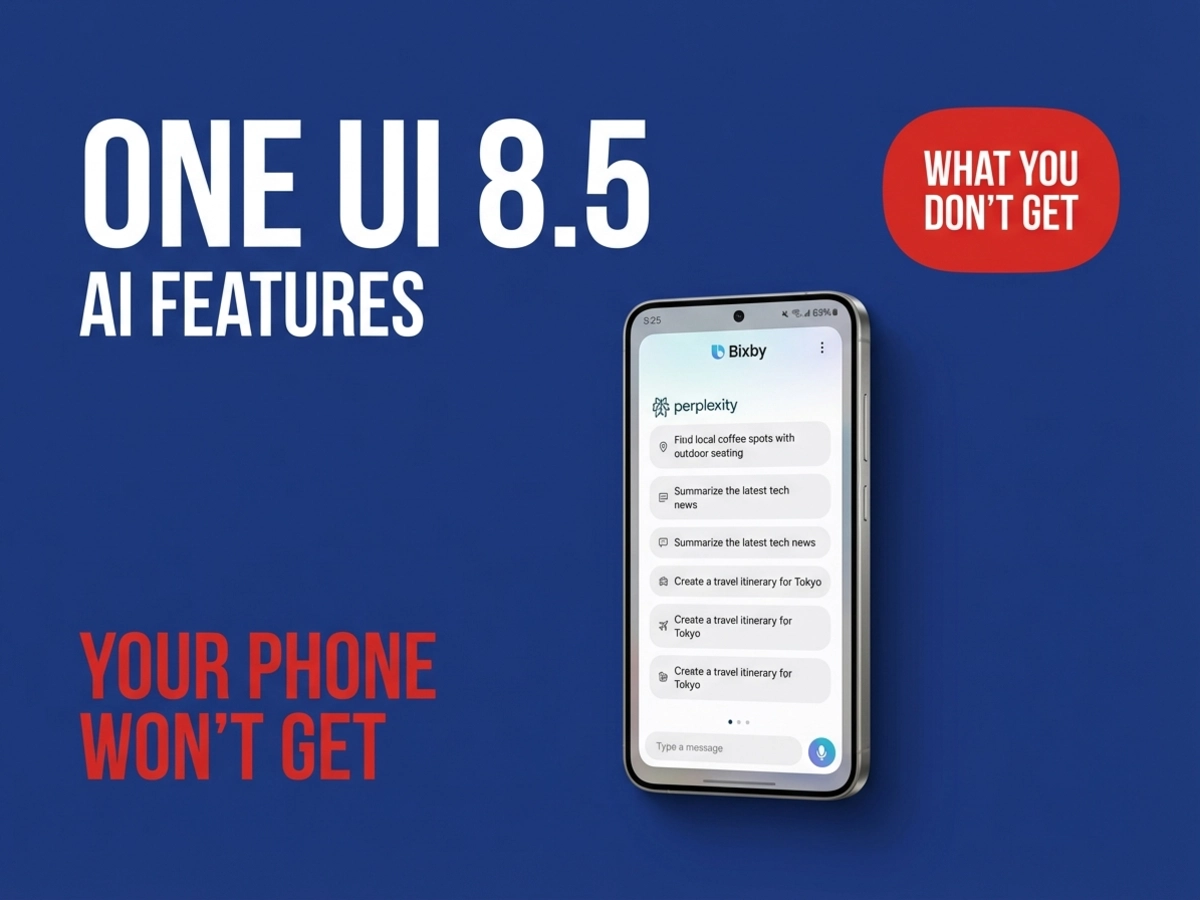
The AI story in One UI 8.5 centers on Bixby's rebuild. Samsung confirmed the integration of Perplexity into Bixby as version 4.0.50.4 running One UI 8.5 beta, with screenshots from SammyGuru verifying the configuration before the S26 launch.
The architecture splits responsibility across three assistants. Gemini handles Google-powered tasks, including app-level workflows and queries that tap into Google's services. Bixby retains its long-standing strength in device control and Samsung ecosystem navigation, the tasks where it has consistently outperformed general-purpose assistants. Perplexity steps in for research-style queries that require web grounding and cited answers, functioning similarly to how Apple routes Siri queries to ChatGPT when its own processing is insufficient.
Samsung launched the integration with a "Hey Plex" wake phrase, then removed it in the Galaxy S26's first post-launch software update. Perplexity CEO Aravind Srinivas confirmed via social media that the replacement phrase would be "Hey Perplexity," though that phrase had not gone live as of late March 2026. Until it does, S26 owners must launch Perplexity manually. GSMArena's review of the Galaxy S26+ documented a practical multi-step task: a Perplexity request to create a calendar event and send the details by email completed without issues in a single voice interaction.
Samsung has not published a unified document explaining which assistant handles which category of request; our reading of the individual product announcements is that the domains overlap enough to create friction for casual users who don't know which to invoke.
The practical consequence of running three AI engines simultaneously is that each handles a different type of task and none of them replaces the others. A user who wants to set a timer uses Bixby. A user who wants to research a topic uses Perplexity. A user who wants to manage a Google task uses Gemini. The requirement is knowing which engine to address before speaking, a division Samsung's marketing has not adequately communicated and which One UI 8.5 does not resolve through any unified routing interface.
The Galaxy S22 and the Galaxy S23 FE share the same Snapdragon 8 Gen 1 and Exynos 2200 chipsets, yet when One UI 8 arrived in 2025, the S23 FE received the full Galaxy AI suite and the S22 received none of it, a precedent that has direct implications for how to read the One UI 8.5 eligibility list.
NotebookCheck documented this outcome as "particularly puzzling" given that the hardware between the two devices is functionally identical. The S22 received the updated OS, the refreshed apps, and the latest security patch. It received none of the generative AI additions that the S23 FE unlocked on the same silicon.
The pattern continued with the Galaxy S23 series and One UI 8.0. SamMobile documented that the Now Brief feature, present in the first One UI 8.0 beta for the Galaxy S24, was absent from the equivalent beta for the Galaxy S23. Critically, SamMobile verified that a sideloaded version of Now Brief ran successfully on S23 hardware, demonstrating that the exclusion was a software policy choice rather than a processing limitation.
Android Central's Galaxy AI tracker confirms that some exclusions do stem from genuine hardware constraints. On-device AI features requiring heavier NPU workloads, specifically Audio Eraser and Natural Language Search, are excluded from the Galaxy S23 series, fifth-generation foldables, and the Tab S9 lineup because their on-device processing demands exceed what those NPUs can deliver at acceptable speed without cloud fallback. Samsung's stated privacy rationale for on-device processing, keeping data on the device rather than routing it through cloud servers, is also the reason features with high NPU demands cannot simply be redirected to the cloud for older hardware.
Two factors therefore determine whether a device on the eligibility list gets the full One UI 8.5 AI experience. The first is whether the hardware NPU can handle the processing load without degrading to unacceptable performance. The second is whether Samsung has chosen to extend a given feature to that device generation at all, a decision that the Now Brief sideload experiment confirms is not always hardware-driven.
Samsung has not published a device-by-device AI feature breakdown for One UI 8.5; the hardware exclusion pattern we describe is inferred from the One UI 8 precedent and Android Central's published tracking of NPU requirements. What is clear from combining those sources is that being on the eligibility list tells users they will receive the OS update. It does not tell them which AI features will be active when the update arrives.
The Galaxy S26, S26+, and S26 Ultra shipped with One UI 8.5 preinstalled. Samsung began the stable rollout to existing S26 units on March 11, 2026, covering units that had been on One UI 8.x builds from the pre-release period.
The Galaxy S25 series entered the One UI 8.5 beta program in December 2025 and was on its seventh or later beta build by mid-March 2026. No stable release date had been announced for any S25 variant as of late March 2026.
The Galaxy Z Fold 7 and Z Flip 7 entered the One UI 8.5 beta on March 12, 2026, covering four markets: India, Europe, South Korea, and the United States. The Galaxy S25 Edge was excluded from the beta program entirely, a notable omission given its flagship specifications and a price point comparable to the S26+.
Samsung has not formally committed to an April 2026 stable date for the Galaxy S25 series; we note the company has published no official rollout calendar for One UI 8.5.
As of mid-March 2026, the Galaxy S24 family was in internal testing for One UI 8.5. April 2026 is the most-cited projection for stable delivery to this generation, based on the sequential rollout structure Samsung has used with previous updates.
The Galaxy S23 lineup and fifth-generation foldables are not expected to enter beta until the S24 series is past its beta milestone. Beebom documented May 2026 as the projected timeline for stable delivery to the Galaxy S23 series and fifth-generation foldables.
SammyFans documented that as of mid-March 2026, stable One UI 8.5 had not reached any eligible device other than the Galaxy S26, and Samsung had published no official schedule for when other models would receive it, a notable departure from its communication around One UI 8, which came with a published roadmap.
Budget and mid-range devices are expected to receive stable One UI 8.5 beginning in late May, with full distribution across the A, M, and F series and the Galaxy Tab lineup targeted for completion by the end of June 2026.
Samsung's rollout sequencing follows a consistent pattern: the newest flagship hardware goes first, carrier certification for affected markets runs in parallel for each tier, and mid-range hardware follows once the stability metrics for the previous tier have locked in. This approach reduces the risk of a critical bug reaching the entire user base simultaneously, but it also means that adding new device families to the beta program, as happened when Z Fold 7 and Z Flip 7 entered on March 12, extends the overall timeline rather than running in parallel with existing beta tracks.
Galaxy A, M, and F series owners waiting for stable One UI 8.5 are not simply dealing with a delay. They face a structural timing problem that makes their update window far shorter than the eligibility list implies.
One UI 9 is expected to debut publicly around mid-2026, most likely as the launch software for the Galaxy Z Fold 8 and Z Flip 8. A public beta for One UI 9 on high-end devices could begin as early as May 2026. Mid-range Galaxy owners, meanwhile, are projected to receive stable One UI 8.5 by June 2026 at the earliest. The gap between "got One UI 8.5 stable" and "One UI 9 is publicly announced" may be measured in weeks.
That compression matters beyond the update cycle itself. One UI 9 is set to bring its own layer of AI differentiation across Samsung's software stack — including advances to Samsung Browser that put it in territory Chrome on Android does not currently occupy. For mid-range owners who receive One UI 8.5 stable just as One UI 9 launches, the more capable version will already be in public conversation before they have had meaningful time with the current one.
Whether a One UI 9 beta launches before One UI 8.5 stable reaches budget devices is an open question; we observe that the timelines are close enough to converge, which means some Galaxy A and M series owners may be receiving One UI 8.5 stable at the same moment Samsung is announcing the next major cycle to press.
Samsung uploaded the first Android 17-based One UI 9 firmware build, identified by the firmware string BZC5 on the Galaxy S26 Ultra, to its internal test servers in mid-March 2026, while the Galaxy S25 was still cycling through beta builds and the Galaxy S24 had not entered beta at all. The same pattern that compressed the window between One UI 8 and One UI 8.5 for non-flagship users is repeating, and for A-series and M-series owners, it means receiving a given update cycle at the precise moment the next one begins. The practical benefit window for any given update narrows to near zero before the next announcement resets attention.
The Galaxy S22 series appears on the One UI 8.5 eligibility list. The framing of that appearance deserves attention.
S22 owners will receive One UI 8.5. They will get the Ambient Design visual refresh, the restructured Quick Settings, and the updated security baseline. They will not receive the AI additions, as the One UI 8 precedent demonstrated. One UI 8.5 will be the last major OS update they receive from Samsung.
Samsung's 7-year software commitment launched with the Galaxy S24 series in January 2024, and the S22 shipped under the earlier 4-year policy, which is why One UI 8.5 is its last major update regardless of how long the hardware physically operates. The difference is not a consequence of the hardware aging into obsolescence. It is a consequence of when the device launched and which update promise it was sold under.
In early February 2026, Samsung officially moved the Galaxy S22 series and the Galaxy Z Fold 4 to a quarterly security schedule, the transition state that precedes full end-of-support. Beebom confirmed that One UI 8.5 is the final major OS update for the Galaxy S22 series, consistent with the 4-year policy under which those devices were sold.
The S22 still functions. Security patches will continue on a quarterly schedule for a defined period after One UI 8.5 lands. But its presence on the eligibility list is a sendoff, not a continuation. S22 owners who interpret it as the beginning of an extended software future will be disappointed when the next eligibility list appears and their model is absent.
The Galaxy S21 FE occupies an even more uncertain position. Samsung has not confirmed whether the S21 FE will receive One UI 8.5; we note that the company's silence on this device, combined with its lifecycle position, points toward exclusion rather than inclusion, though that assessment will not be confirmed until Samsung makes a formal statement or a firmware build for the device appears in certification databases.
The practical One UI 8.5 experience splits into four distinct tiers based on NPU generation, a structure Samsung has not publicly codified but that Android Central's NPU tracking, NotebookCheck's chipset analysis, and SamMobile's feature-sideload findings collectively support.
Both generations receive the full One UI 8.5 experience. The Galaxy S26 family, running either the Exynos 2600 on a 2nm process in most global markets or the Snapdragon 8 Elite Gen 5 in the US, China, and Japan, has the hardware to run every AI feature One UI 8.5 includes. The Galaxy S25 series shares the Snapdragon 8 Elite (first generation) and Exynos 2500, which cleared the NPU threshold for the current Galaxy AI suite. The S25 may face minor exclusions if Samsung introduces new features requiring S26-tier silicon specifically, but for the confirmed One UI 8.5 feature set, both generations access the full package.
The Galaxy S24 family is positioned just below the current flagship tier. Its hardware cleared the threshold for most Galaxy AI features under One UI 8.0, and One UI 8.5 is unlikely to introduce AI requirements that suddenly exclude it. Owners should expect near-full feature access, with the possibility of minor exclusions if Samsung segments a specific new capability for the S25 and S26 only.
This is the first tier where confirmed exclusions apply. Audio Eraser and Natural Language Search are already blocked from the Galaxy S23 series under existing Galaxy AI policy. One UI 8.5's expanded AI capabilities, particularly those requiring continuous on-device generative processing, are likely to carry the same or broader exclusions for this generation. The visual design changes, Quick Settings restructuring, and security updates will arrive. Heavier on-device AI features will not.
These devices receive One UI 8.5 as a final update with no AI additions. The Ambient Design visual refresh, the Quick Settings overhaul, secondary features like partial screen recording and Privacy Protection, and the updated security baseline arrive. The Galaxy AI suite does not, consistent with the One UI 8 precedent. This generation is now on a quarterly security schedule following its final major OS update.
The AI feature picture for budget and mid-range devices depends on specific chipset configurations, which vary across this broad lineup. Devices running recent Exynos 1380 or Dimensity 7000-class silicon will receive the visual and security updates with no AI additions. Devices running higher-end chips in the A7x tier may receive select Galaxy AI features. The practical expectation for most A, M, and F series owners is a meaningful visual upgrade and improved security, not an AI capability expansion.
Galaxy tablets on the One UI 8.5 eligible list face the same NPU-based exclusion pattern as their smartphone counterparts. The Galaxy Tab S11 series, running current-generation Snapdragon hardware, is positioned to access the full AI feature set. The Galaxy Tab S9 series is already confirmed to be missing Audio Eraser and Natural Language Search under existing Galaxy AI policy, and that exclusion extends forward to One UI 8.5's deeper AI capabilities. Tablets running A-series chipsets will receive visual and security improvements without AI additions.
The cross-device features introduced in One UI 8.5, including Storage Share for direct file access to other Galaxy devices, require all participating devices to share the same Samsung account with both Wi-Fi and Bluetooth active. Samsung's December 2025 announcement specified that PC integration additionally requires a Galaxy Book 2 or later on Intel, or a Galaxy Book 4 or later on Arm. Smart TV integration is limited to Samsung TV models from the U8000 series and later from the 2025 lineup.
Yes. Navigate to Settings, then Software Update, and select Download and Install. Samsung's servers deliver OTA updates on a staggered regional schedule, so the update may not appear immediately even after stable rollout begins for a given device tier. Checking manually can surface the update before an automatic notification arrives, but it will not accelerate Samsung's regional delivery queue.
Samsung has not confirmed this either way as of late March 2026. Beebom's device eligibility research flagged the S21 FE as a probable exclusion based on its lifecycle position. Until Samsung publishes an official statement or a firmware build for the S21 FE appears in certification databases, its status is unconfirmed. S21 FE owners should watch Samsung's official update announcements rather than assume eligibility based on third-party projections.
The practical summary for Galaxy owners is straightforward. If the device is a Galaxy S24 or newer, One UI 8.5 arrives with the full feature set and a realistic timeline of April through May 2026 for stable delivery. If the device is a Galaxy S23 or a fifth-generation foldable, the OS update and visual changes arrive but key AI features do not, and the timeline extends to May or later. If the device is a Galaxy S22 or a Z Fold 4, One UI 8.5 is the final major update, carrying cosmetic improvements and no AI additions, and the quarterly security schedule that follows confirms the software lifecycle has ended. For A, M, and F series owners, the update is real and coming, but arriving at the precise moment Samsung's attention turns to One UI 9.