Finished reading? Continue your journey in Tech with these hand-picked guides and tutorials.
Boost your workflow with our browser-based tools
Share your expertise with our readers. TrueSolvers accepts in-depth, independently researched articles on technology, AI, and software development from qualified contributors.
TrueSolvers is an independent technology publisher with a professional editorial team. Every article is independently researched, sourced from primary documentation, and cross-checked before publication.
Apple's M5 Pro and M5 Max chips are arriving soon, but the decision to wait isn't as simple as comparing benchmark numbers. Current M4 Pro and M4 Max models are available with significant discounts, while a major MacBook Pro redesign looms just months after the M5 launch. The right choice depends on your specific workflow demands, budget flexibility, and tolerance for missing the next big hardware update. Here's how to decide whether waiting delivers enough value to justify the delay.
Most buyer guides frame this as a binary: wait for M5 or buy a discounted M4 now. That framing misses a third option that the 2026 MacBook Pro calendar makes genuinely compelling: skip the M5 generation entirely and wait for the M6 redesign expected later this year.
MacRumors, citing Bloomberg's Mark Gurman, reported that Apple is planning two separate MacBook Pro refreshes in a single calendar year: the M5 Pro and M5 Max models that launched in March 2026, followed by a substantially redesigned M6 Pro and Max targeted for Q4 2026. Two MacBook Pro generations in one calendar year is historically unusual. The M6 redesign is expected to bring an OLED Tandem display, a touchscreen interface, Dynamic Island replacing the existing notch, a thinner chassis, and M6 chips on TSMC's 2nm process. Importantly, Gurman reported via 9to5Mac that this redesign will be limited to M6 Pro and Max models, not the base MacBook Pro.
This means anyone buying an M5 Pro or M5 Max right now will be one generation behind a landmark design refresh before the end of 2026. That is not automatically a reason to skip the M5 entirely the machine is genuinely excellent hardware but it changes the logic of the decision.
Samsung Display production data, aligned analyst reporting from multiple credible sources, and Apple's own behavior building touch input support directly into macOS are pointing at the same Q4 2026 window simultaneously. That convergence is not typical pre-launch speculation. Apple has occasionally delayed hardware redesigns before, and anyone making a purchase decision around a rumored product is accepting real timing risk — but the supply-chain grounding here is stronger than anything seen in the MacBook Pro's Apple Silicon era.
The right starting point, then, is not "M4 or M5" but rather: where does your situation land across all three positions?
The M5 Pro and M5 Max are a meaningful architectural departure from their predecessors, not merely a spec sheet refresh.
Both chips are built on what Apple calls Fusion Architecture: two third-generation 3nm dies bonded into a single system-on-chip with high-bandwidth, low-latency interconnects between them. This is the same structural approach Apple uses in its Ultra-class desktop chips, brought for the first time into a MacBook Pro. The practical consequence is that both the M5 Pro and M5 Max now share an identical 18-core CPU configuration: six high-performance super cores and 12 efficiency-tuned performance cores. The previous generation had different counts by tier (M4 Pro was 14-core; M4 Max was 16-core). Equipping both laptop variants with the same CPU die simplifies Apple's manufacturing and gives the company more flexibility in how it scales GPU cores and memory bandwidth across configurations going forward.
Apple claims up to 30% faster CPU performance for pro workloads, up to 50% higher GPU performance, and up to 4x faster AI compute compared to M4 Pro and M4 Max. These are vendor-sourced figures tested on Apple's own workloads in February 2026 on preproduction systems; independent sustained-workload reviews had not yet arrived at time of writing. The GPU core counts remain unchanged from M4 (20 cores on the M5 Pro, 40 cores on the M5 Max), but the architecture inside those cores has been redesigned. Neural Accelerators now sit inside every GPU core, delivering the AI compute gains Apple claims, and the ray-tracing engine is up to 35% faster than its M4 Pro counterpart.
Memory bandwidth climbs from 273GB/s on the M4 Pro to 307GB/s on the M5 Pro, and from 546GB/s on the M4 Max to 614GB/s on the M5 Max. Storage performance doubles, reaching up to 14.5GB/s on both M5 Pro and M5 Max. Both chips include Wi-Fi 7 and Bluetooth 6 via Apple's new N1 wireless chip; the M4 generation topped out at Wi-Fi 6E. Battery life on the 14-inch M5 Max extends to 20 hours, up from 18 hours on the equivalent M4 Max configuration, while M5 Pro battery life is essentially unchanged from M4 Pro.
The M3-to-M4 transition was a spec sheet refresh. The M5 Pro/Max is not that. Dual-die design in a laptop-class Pro chip is a structural first for Apple Silicon, and it sets the scaling architecture for future generations. Whether that matters for your current work is a separate question.
Early Geekbench 6 data provides the most concrete read on M5 Max performance ahead of full third-party reviews. The first result recorded for the M5 Max showed a single-core score of 4,268 and a multi-core score of 29,233, which topped the M3 Ultra's multi-core result of 27,726 placing the M5 Max above Apple's own desktop chip despite having fewer total cores. The Metal GPU compute score came in at 232,718, the second-highest result in the Geekbench database at time of testing.
For context, the M4 Max averages 3,915 in single-core and 25,702 in multi-core testing. Against those baselines, the M5 Max delivers approximately 9% better single-core performance and roughly 14% better multi-core performance. Those are real gains, but they are not transformative for workflows that run primarily on CPU throughput. GPU and AI compute gains, by contrast, are substantially larger based on Apple's own application benchmarks.
The M5 Pro/Max upgrade case splits sharply by what the workflow actually hammers. For 3D rendering, machine learning inference, AI-accelerated video work, and ray-tracing-heavy game development, the GPU and Neural Accelerator improvements are large enough to translate into meaningful time savings at professional scale. For standard video editing in common codecs, RAW photo processing, software compilation, and most everyday creative work, the CPU-tier gains of 9 to 15% will not change the character of the workday. These benchmark numbers are also early; sustained-workload testing on shipping hardware will give a more complete picture of thermal performance under extended load.
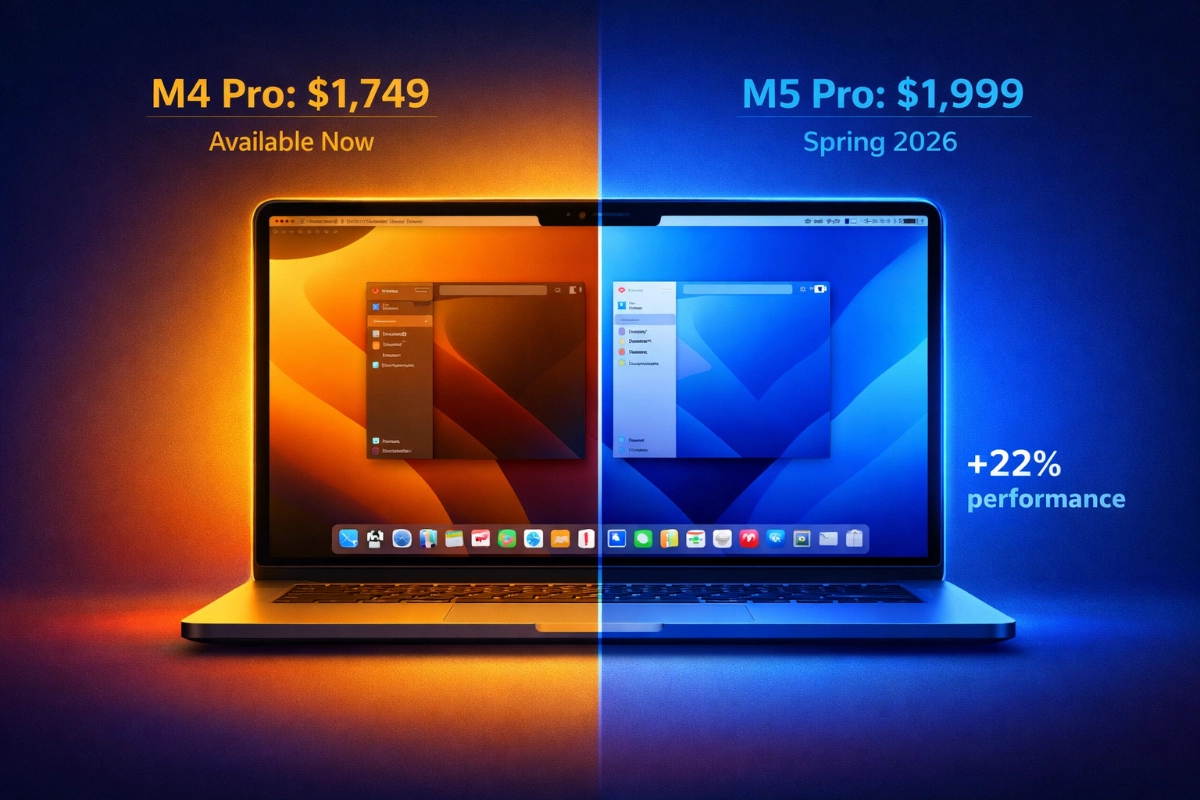
Coverage of the M5 Pro pricing has widely described it as a price increase: $2,199 for the 14-inch M5 Pro versus $1,999 for the M4 Pro. That framing is technically accurate but misleading. Macworld's pricing analysis found that the M5 Pro 14-inch ships with 1TB of storage at $2,199, while the M4 Pro 14-inch at $2,199 (after the required $200 storage upgrade from 512GB to 1TB) cost exactly the same. Apple eliminated the 512GB SSD option entirely for Pro and Max models. The same storage-adjusted parity holds for M5 Max configurations versus equivalent M4 Max configurations.
The M5 is not more expensive than the M4 was at the same storage level. The apparent price increase is an artifact of comparing base-tier M4 (with less storage) against base-tier M5 (with more).
The clearance M4 story is different, and this is where genuine savings live. Retailers are currently selling the 16-inch M4 Pro MacBook Pro at $260 off list price at Amazon, with M4 Max models also available at meaningful discounts. These are real dollar savings compared to M5 MSRP prices, and for buyers whose workflows fall outside the AI and GPU-intensive categories where M5 shines, that gap represents genuine value. Clearance windows typically close within weeks of a new generation's launch, so anyone considering this path should act without assuming the deals persist.
The M6 question is where this purchase decision diverges most from any prior MacBook Pro buying cycle.
Macworld, citing Samsung Display supply chain reporting, found that Samsung Display is beginning mass OLED panel production in May 2026, with the redesigned MacBook Pro targeted for Q4 2026. Both 14-inch and 16-inch M6 Pro and Max models will receive the new design. The feature set of the redesign is substantial: Tandem OLED display with dramatically improved brightness and contrast, full touchscreen support, Dynamic Island integration where the notch currently sits, a meaningfully thinner chassis, 5G cellular connectivity, and M6 chips on TSMC's 2nm manufacturing process. macOS is being redesigned in parallel to accommodate touch gesture input including pinch-to-zoom and fast scrolling.
Samsung Display mass production starts in May 2026. Multiple credible analysts align on a Q4 2026 launch window. macOS is being redesigned in parallel to accommodate touch input. When aligned analyst reporting, production-line data, and software redesign evidence converge simultaneously, Apple rarely misses the target window by more than a quarter. The M6 OLED MacBook Pro is not a distant possibility; it is a Q4 2026 product with a production timeline that has already begun.
That said, a seven-to-nine-month wait is real time. If your current machine is failing, project-critical, or limiting your output in ways that cost revenue today, the M5 Pro or M5 Max is an excellent machine that will serve a multi-year ownership cycle well. The M6 argument is for buyers who can afford to wait and who will use the machine for three or more years.
Two buyer profiles have the strongest case for purchasing the M5 Pro or M5 Max without hesitation.
The first is anyone upgrading from an M1 Pro, M1 Max, or earlier Apple Silicon. Apple's performance figures show up to 2.5x faster multithreaded CPU performance and up to 8x faster AI compute compared to M1 Pro and M1 Max. For users still on M1, the cumulative gains across every dimension export speeds, real-time rendering, battery efficiency under load, AI-accelerated workflows are transformative rather than incremental. The M6 redesign will be a better machine in several respects, but M1 Pro/Max users are already leaving substantial performance on the table every workday.
The second profile is professionals whose daily work runs on GPU compute and AI inference: machine learning engineers, 3D artists, game developers, visual effects artists working with ray tracing, and video editors using AI-accelerated tools like Topaz Video. Apple's claimed 3.5x improvement in AI video enhancement and 3x improvement in DaVinci Resolve video effects for M5 Max over M4 Max describe real workflow acceleration for this category. The Neural Accelerators embedded in every GPU core represent a genuine architectural investment in AI-forward work that M4 Pro and M4 Max did not match. For professionals evaluating Apple's broader creative software ecosystem alongside this hardware decision, the cost structure of Apple Creator Studio's subscription versus purchasing individual apps outright is worth understanding before committing to a platform investment at this price level.
Buying the M5 Pro or M5 Max while a landmark redesign is seven to nine months away might look like settling. It is not. Anyone who needs maximum performance today, can justify the spend, and is not anchored to the idea of buying the longest-lived design available is well-served by an M5 Pro/Max purchase now. The machine will be excellent hardware for three to four years regardless of when M6 arrives.
Two other buyer profiles are better served by routes other than the M5 Pro/Max at MSRP.
The clearance M4 Pro path makes sense for buyers whose workflows fall outside the AI and GPU-intensive categories, who are on a constrained budget, or who plan to upgrade again in two years rather than holding hardware for an extended cycle. The M4 Pro remains a fully capable professional machine for video editing in standard codecs, software development, photography, audio production, and most creative work. A $260 discount on a 16-inch M4 Pro is real money, and for teams equipping multiple workstations or professionals who cycle through hardware frequently, that savings compounds. The M4 Pro is not aging hardware; it is a mature, well-reviewed platform with known performance characteristics.
The wait-for-M6 path is the most rational choice for a specific and important buyer: anyone who cares about display quality for color-critical work, who expects to hold their next machine for three or more years, and who has the flexibility to wait until Q4 2026. Video professionals working in HDR delivery, photographers editing for print, and color graders who rely on screen accuracy will find the step from LCD to Tandem OLED consequential. The OLED display in the M6 redesign is not a cosmetic upgrade; it represents a fundamental shift in how the MacBook Pro handles brightness, black levels, and color volume.
The "buy M4 clearance or wait for M6" case is strongest when display quality and design longevity are the primary criteria. The "buy M5 now" case is strongest when performance headroom and immediate availability dominate. For most buyers, the decision is not actually ambiguous once those criteria are identified clearly. The confusion comes from treating this as a single question when it is, in practice, three separate questions: How much do you need right now? How long will you hold this machine? And does the OLED display matter to your work?
Does the M5 Pro or M5 Max support Apple Intelligence features that M4 Pro/Max does not?
Both M4 Pro/Max and M5 Pro/Max support Apple Intelligence. The M5 generation's Neural Accelerators improve local AI processing speed significantly, which benefits on-device features like faster AI writing tools, image generation, and Siri responses. M4 Pro/Max owners will not lose access to Apple Intelligence features, but tasks that lean on the Neural Engine will complete faster on M5 hardware.
If I'm upgrading from an M2 Pro or M2 Max, is the M5 worth the jump over M4?
Upgrading from M2 Pro/Max to M5 Pro/Max is a strong generational jump. The CPU and GPU gains are large enough to feel meaningful across most workflows, and the addition of Neural Accelerators means capabilities that simply did not exist in M2-era chips. Waiting for M6 is still reasonable if you can hold your M2 machine for another seven to nine months, but M2 Pro/Max owners do not need to skip M5 the way M4 Pro/Max owners might.
Will M4 Pro/Max trade-in values drop significantly after the M5 launch?
Trade-in values typically soften after a new generation ships. M4 Pro/Max trade-in values at Apple and major retailers declined modestly at the M5 launch, as expected. Anyone planning to trade in M4 hardware should not delay; values will continue to normalize as M5 units accumulate in the market.
Is the M6 OLED redesign confirmed, or is it still a rumor?
It sits between confirmation and rumor. Samsung Display supply chain reporting points to OLED panel mass production starting in May 2026, and multiple credible analysts align on a Q4 2026 launch. This is more production-grounded than typical Apple pre-launch speculation. It is not, however, an official announcement, and Apple has occasionally delayed redesigns. Buyers should treat Q4 2026 as a credible window, not a guarantee.
Does the M5 Max's memory bandwidth improvement matter for non-AI workflows?
The jump from 546GB/s to 614GB/s on the M5 Max (and 273GB/s to 307GB/s on M5 Pro) benefits any task that moves large amounts of data through the unified memory architecture: high-resolution video processing, large Photoshop files, complex audio projects with dense sample libraries, and scientific computing. The gains are noticeable but not dramatic for typical creative work; they are more consequential for workloads that were previously memory-bandwidth-constrained on M4 Max.