Finished reading? Continue your journey in Tech with these hand-picked guides and tutorials.
Boost your workflow with our browser-based tools
Share your expertise with our readers. TrueSolvers accepts in-depth, independently researched articles on technology, AI, and software development from qualified contributors.
TrueSolvers is an independent technology publisher with a professional editorial team. Every article is independently researched, sourced from primary documentation, and cross-checked before publication.
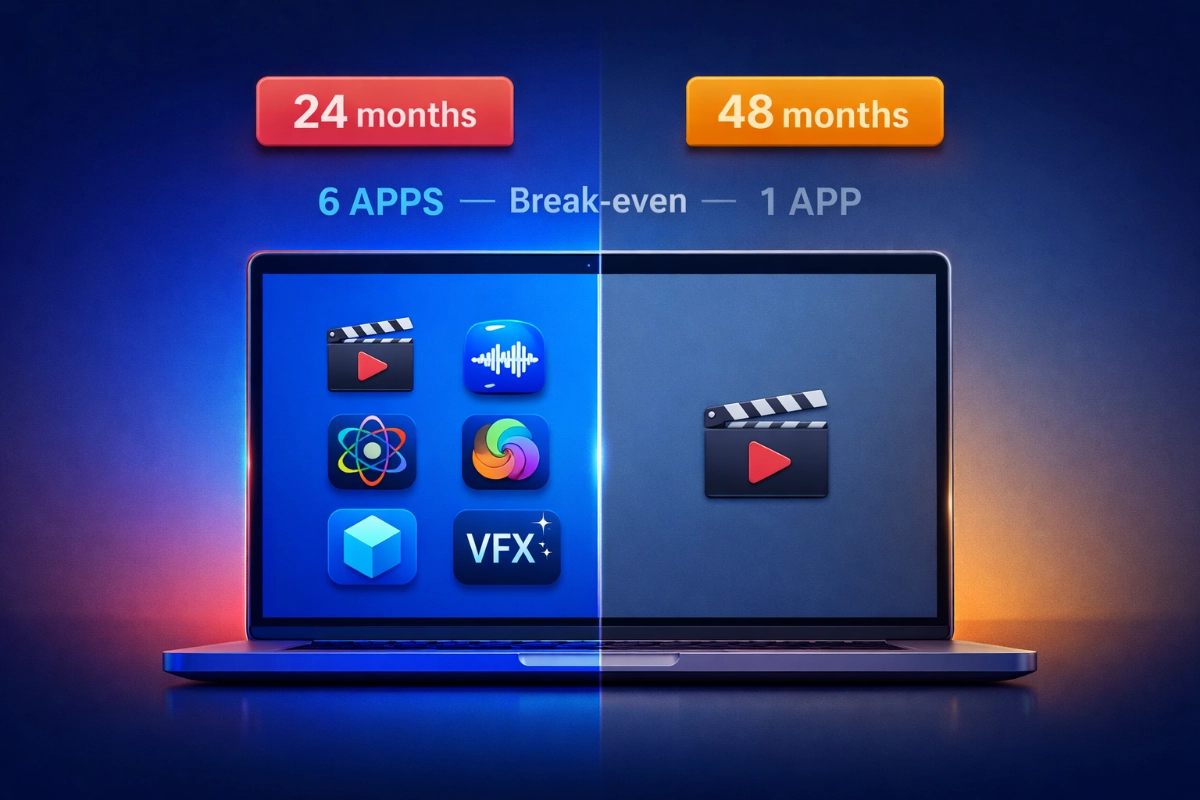
Apple's new Creator Studio subscription bundles six professional apps for $12.99 monthly, but the break-even timeline against individual purchases varies dramatically based on how many apps you actually need. Single-app users reach ownership parity in under two years, while users needing the full suite break even after four years. iPad users face subscription-only access with no purchase alternative, fundamentally changing the cost equation.
The math starts with two fixed inputs. Buying all six Creator Studio apps outright on the Mac App Store costs $629.95 total: Final Cut Pro at $299.99, Logic Pro at $199.99, Pixelmator Pro at $49.99, Motion at $49.99, Compressor at $49.99, and MainStage at $29.99. The subscription runs $12.99 per month or $129 per year.
That price difference means the clock to break-even ticks at different speeds depending on which apps you actually use. Here is how the math resolves across the most common usage scenarios, comparing monthly subscription billing against one-time purchase cost:
All six apps ($629.95 to own outright): Break-even at 48.5 months on the monthly plan, approximately 59 months on the annual plan.
Final Cut Pro and Logic Pro combined ($499.98): Break-even at 38.5 months on the monthly plan, approximately 46 months annually.
Final Cut Pro only ($299.99): Break-even at 23.1 months on the monthly plan, approximately 28 months annually.
Logic Pro only ($199.99): Break-even at 15.4 months on the monthly plan, approximately 19 months annually.
Pixelmator Pro only ($49.99): Break-even at 3.8 months on the monthly plan, approximately 5 months annually.
The Pixelmator row is worth pausing on. At $49.99 for a one-time purchase, a Pixelmator Pro-only Mac user reaches ownership parity in under four months. Subscription makes no financial sense for anyone who needs exactly one lower-priced app and intends to use it for years.
The annual plan at $129 per year accumulates $629.95 in total payments over approximately 59 months. The monthly plan reaches that same figure at 48.5 months. Annual subscribers reach ownership parity about 10 months later than their month-to-month counterparts. For someone deciding purely on lifetime cost, that is a meaningful difference: the same ownership comparison that resolves in four years on the monthly plan takes closer to five on the annual plan.
The break-even framework assumes a purchase option exists. For iPad users, it doesn't.
Final Cut Pro, Logic Pro, and Pixelmator Pro for iPad are available exclusively through Creator Studio. There is no one-time purchase path on iPadOS for any of them. iPad-only creators aren't deciding between subscription and ownership; they're deciding between subscribing and not having the tools at all.
Before Creator Studio launched, Final Cut Pro and Logic Pro for iPad each carried a $4.99 monthly price, totaling $9.98 per month for both. Creator Studio at $12.99 is only $3.01 more per month, and it adds Pixelmator Pro's iPad debut alongside Mac access to all six apps. For iPad users who were already subscribed to both flagship apps, the upgrade cost is minimal.
The picture changes for iPad-only users who previously subscribed to just one app. They move from $4.99 per month to $12.99 per month, a $96 annual increase, with no option to downgrade. Creator Studio is an all-or-nothing subscription; there are no partial tiers. A user who needs Final Cut Pro on iPad but has no interest in Logic Pro or Pixelmator Pro pays the same $12.99 as a user running all three.
It is worth noting that Apple has been expanding platform openness in other areas, with iOS 26.3 introducing interoperability with Android and third-party devices. The iPad creative tools strategy moves in the opposite direction: tighter access, not broader, with subscription as the only entry point.
Pixelmator Pro is new to iPad entirely with Creator Studio's launch. There was no previous iPad purchase option to compare against, and there is no path to owning it on iPad going forward.
Students and educators pay $2.99 per month or $29.99 per year for Creator Studio, a meaningful discount that reshapes the economics for that user group. At the annual rate, a student pays $29.99 per year versus $129 for a standard subscription.
Historically, this comparison had a third option: the Pro Apps Bundle for Education, a one-time $199.99 purchase covering Final Cut Pro, Logic Pro, Motion, Compressor, and MainStage with no recurring fees. That path no longer exists as a standalone choice. Apple stopped selling the bundle as an independent product following Creator Studio's launch; it now only comes bundled with a new Mac purchase through Apple's Education Store.
The education bundle's removal and Creator Studio's launch arrived on consecutive days. A student who previously had a clean permanent ownership option now faces either a subscription or full individual app prices. The math that previously compared student subscription costs against a $199.99 bundle is no longer the right comparison. Students not purchasing a new Mac from Apple have no one-time purchase option for the core professional apps.
On the subscription math alone, a student on the annual plan spends $29.99 per year. Over four years of undergraduate education, that totals $119.96. If that student continues into graduate school and maintains the student subscription for six years total, the cumulative cost reaches $179.94. After graduation, pricing jumps to the standard rate of $129 per year on the annual plan or $155.88 per year on monthly billing.
One limitation applies specifically to student accounts: the discounted subscription cannot be shared through Family Sharing. The cost reduction is real, but it covers only one user.
A standard Creator Studio subscription supports up to five additional family members under iCloud Family Sharing, covering six users total under one $12.99 monthly charge.
At full utilization, the per-person cost drops to $2.17 per month. A three-user household, where each member uses a different combination of apps, pays a combined $12.99 monthly rather than three separate subscriptions or three separate sets of individual purchases. Three individual full-suite purchases would total $1,889.85. A shared subscription reaches that combined figure in just over 12 months of billing.
The Family Sharing advantage compounds with user count. A five-person creative household or small team pays $155.88 annually for the subscription regardless of how many members use how many apps. The subscription-vs-ownership comparison that favors ownership for a single Mac user at four years flips to favor subscription in year one when five users share a single account.
The practical limit is the Family Sharing structure itself. iCloud Family Sharing is designed for households, not businesses. A creative agency with ten employees cannot consolidate staff onto one subscription account. The math that makes Family Sharing compelling for a household does not scale to a professional studio context in the same way.
Every calculation above assumes the subscription and one-time purchase versions of these apps are the same product. That assumption holds for some apps and not for others.
Logic Pro and MainStage have complete feature parity regardless of how you acquire them. Pixelmator Pro does not: its Warp tool is exclusive to Creator Studio subscribers. Final Cut Pro's new AI capabilities, including Visual Search, Transcript Search, and Beat Detection, are available to both subscription and one-time purchase users. However, Apple has confirmed that certain "premium content" will be subscriber-only going forward, without providing a comprehensive list of what that category will include.
This matters for the break-even calculation in a way the raw numbers don't show. A Logic Pro-only buyer has genuine ownership parity: the app they purchase at $199.99 is functionally identical to the subscription version. A Pixelmator Pro buyer does not have that assurance from day one. A Final Cut Pro buyer sits in an uncertain middle ground, with current features confirmed equivalent but future features undefined.
The long-term cost comparison is not just financial; it depends on which app you use and how much you value features that may only exist for subscribers. Apple hasn't outlined what "premium content" means for Final Cut Pro one-time buyers over the next two or three years. That ambiguity is a legitimate factor in the ownership decision, not just fine print.
The project access policy adds another layer. When a Creator Studio subscription ends, projects in Final Cut Pro, Logic Pro, and Pixelmator Pro remain on device but cannot be opened or edited without an active subscription. A professional with ongoing client work built in any of these apps cannot deliver revisions after canceling. This project access dependency creates a trailing liability that standard financial comparisons don't capture. A creator who reaches break-even at month 48 and cancels their subscription may need to reactivate whenever a client requests changes to existing work, extending the effective subscription cost well beyond any calculated endpoint.
Keynote, Pages, Numbers, and Freeform are effectively free but now function as freemium products. AI-powered features in these apps, including presentation generation, smart spreadsheet tools, and Content Hub graphics access, require an active Creator Studio subscription. The apps remain usable without a subscription, but a meaningful tier of their current capabilities sits behind the paywall.
The subscription makes financial sense in four specific situations.
Subscribe if you: need more than two or three apps and plan to use them for fewer than three years; work on iPad, where ownership is not available for the flagship apps; share access across two or more family members, which reduces per-person cost below $3 per month at maximum utilization; or require subscriber-exclusive features including Pixelmator Pro's Warp tool, Content Hub assets, or the AI-powered tools in Keynote, Numbers, and Pages.
The ownership path on Mac makes financial sense in equally specific conditions.
Buy individual apps if you: use one or two apps exclusively and plan to use them beyond the corresponding break-even period; work entirely on Mac, where all six apps still sell as one-time purchases; need certainty about project access regardless of future payment status; or use Logic Pro or MainStage specifically, where confirmed feature parity means ownership delivers an identical product.
The decision that is hardest to make on arithmetic alone involves Final Cut Pro. The break-even is 23 months on the monthly plan, roughly two years. That is close enough that risk tolerance, project workflow, and feature priorities matter as much as the math. A freelancer confident in two-plus years of continuous use has a reasonable case for buying outright. A creator whose project volume is irregular, or who values future subscriber-only features, has a reasonable case for subscribing.
One risk the subscription model carries regardless of current pricing is the trajectory of future price changes. Today's $12.99 per month is the announced rate; Apple can adjust it. Any comparison that extends five or ten years forward is calculating against a number that may not hold. The ownership path eliminates that exposure entirely; buyers pay once and retain full access to the version they purchased, feature divergence notwithstanding.
The clearest guidance applies at the extremes. A single-app Pixelmator Pro user who wants the Warp tool has no ownership path. A single-app Logic Pro user who wants the product permanently and wants to avoid subscription risk has a straightforward case for the $199.99 one-time purchase. Most creators fall somewhere between those poles, and for them, the answer is the specific break-even month that corresponds to their actual usage, measured against how long they honestly expect to use the tools.