|
|
|
|
TrueSolvers is an independent technology publisher with a professional editorial team. Every article is independently researched, sourced from primary documentation, and cross-checked before publication.
IBM and Arm announced a strategic collaboration on April 2, 2026, framing it as a foundational shift in how enterprises will run AI and data-intensive workloads. The announcement landed with confident language about the future of enterprise computing. What it did not include was a product name, a hardware specification, a performance benchmark, or a delivery date. For enterprise infrastructure teams assessing whether this changes their planning horizon, the absence of those details is itself the most informative signal in the announcement.
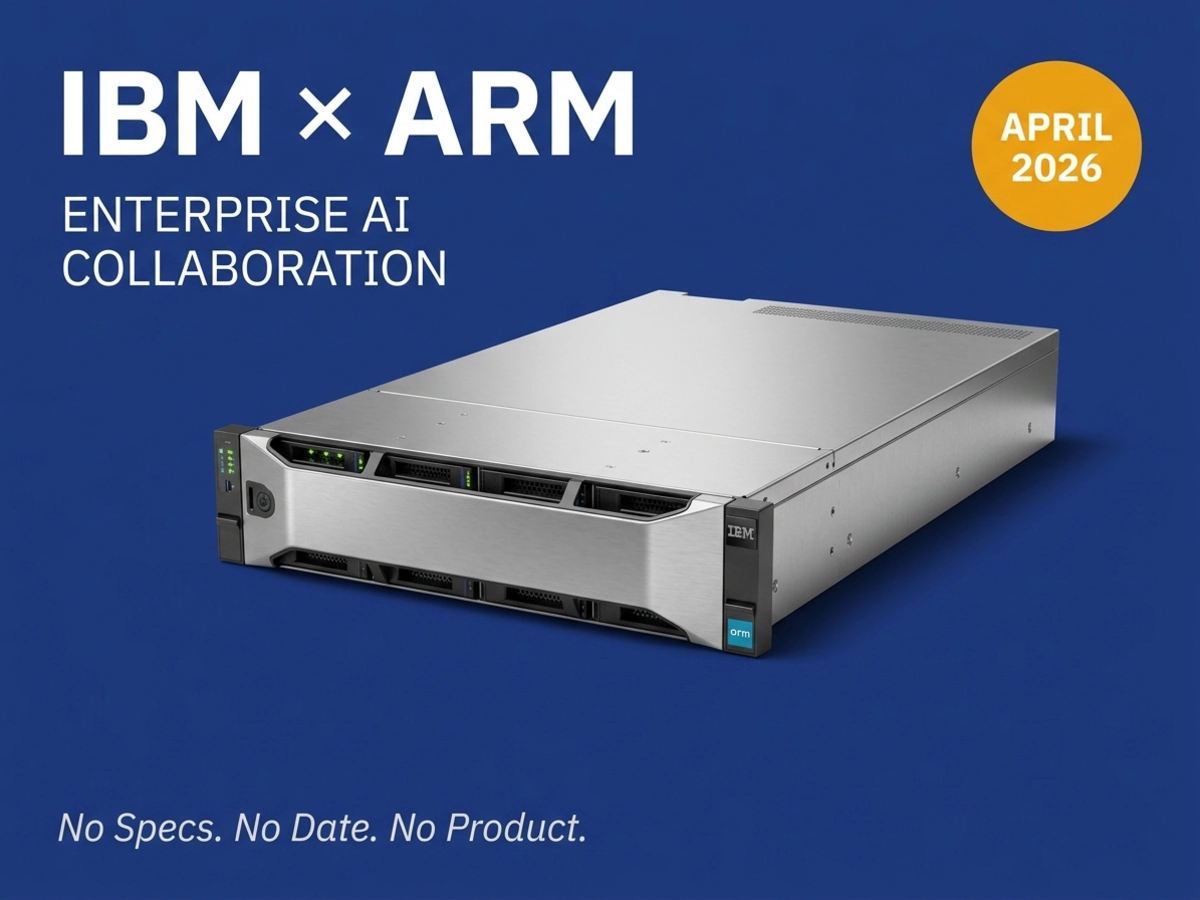
The collaboration, announced through IBM's official newsroom on April 2, 2026, centers on three areas of joint work. First, the two companies plan to expand virtualization capabilities so that software environments built for Arm chips can operate inside IBM's enterprise computing platforms, specifically IBM Z and LinuxONE. Second, they are working to ensure that Arm-based workloads can meet the high-availability, data sovereignty, and security requirements that distinguish mainframe-class infrastructure. Third, they aim to build shared technology layers to support longer-term ecosystem growth and application portability.
The rationale behind the collaboration is clear. IBM Z systems are purpose-built for mission-critical transaction processing, with hardware-level RAS (reliability, availability, and serviceability) properties that general-purpose servers do not match. AI frameworks and cloud-native applications are increasingly developed first for Arm-based environments, creating an ecosystem gap for enterprises that depend on IBM Z for their core workloads. The collaboration is designed to close that gap by allowing Arm-native software to run on IBM's enterprise platforms without requiring a full native port.
Both IBM Chief Product Officer Tina Tarquinio and Arm EVP Mohamed Awad provided statements framing this as a natural extension of their respective positions. Independent analyst Patrick Moorhead described it as reflecting a meaningful level of commitment to long-term platform innovation. IBM's current AI hardware for the Z platform includes the Telum II processor with its on-chip AI accelerator and the Spyre Accelerator, a PCIe-attached card designed for generative AI and large language model workloads. The collaboration announcement explicitly targets "future generations" of these platforms, not the systems shipping today.
What the announcement does not specify — and what we cannot confirm from IBM's public disclosures — is any committed delivery date, product name, or hardware generation. IBM's own filing includes the standard disclaimer that "statements regarding IBM's future direction and intent are subject to change or withdrawal without notice, and represent goals and objectives only." From an investor perspective, the announcement notably lacks the proof points one would expect from a near-term product commitment: no committed roadmap, no named customers, no performance benchmarks.
The announcement calls this "dual-architecture hardware," but IBM's own spokesperson told The Register the goal is to make IBM Z and LinuxONE qualities available to Arm64 workloads: a distinction that reveals the mechanism is software emulation and virtualization, not Arm silicon inside the mainframe. The framing matters because it shapes how enterprise architects should think about what they are actually being offered.
When The Register asked IBM directly what the collaboration would produce, IBM's spokesperson replied: "While it's early days to share specifics, our intent is that the same features and qualities such as security, performance, resilience and cost-effectiveness that distinguish IBM Z and LinuxONE will be available to Arm64 workloads." Tom's Hardware's technical coverage of the announcement specifies that the collaboration is designed to enable software built for Arm to run on IBM Z mainframes in emulation mode. IBM Z systems use the z/Architecture instruction set, also called S390x, which is entirely distinct from the Arm (Aarch64/ARM64) instruction set that most modern AI frameworks and cloud-native tools are compiled against. Running software across those two architectures natively requires a complete port, which is expensive and time-consuming. The collaboration eliminates that requirement by building an emulation or virtualization layer that allows Arm applications to execute on IBM Z without being recompiled.
This approach has real value. Enterprises running core financial, healthcare, or government workloads on IBM Z want to incorporate AI tooling from the broader Arm-native ecosystem without moving sensitive data to external compute platforms. An emulation layer that brings those tools directly onto the mainframe keeps data close to where it is generated and processed, reduces integration overhead, and sidesteps the compliance exposure that comes from replicating enterprise data to cloud-side AI infrastructure. The architectural case is coherent.
The uncertainty sits in the engineering. Cross-architecture emulation always carries a performance overhead relative to native execution. How significant that overhead is depends on the workload type, the emulation implementation, and the specific Arm binaries being run. We cannot yet assess what performance overhead the emulation layer will introduce for specific workload types, as IBM has published no benchmarks. For latency-sensitive mainframe workloads — such as fraud detection running at sub-millisecond response times — the overhead characteristics of any emulation layer are a critical unknown that enterprise architects will need answered before committing to this path.
When The Register asked IBM about delivery timing, IBM said it was "too early to tell" and "dependent on many factors." That is not a holding statement pending final testing; it is the language of a collaboration that has not yet produced a deliverable specification. Both IBM and Arm declined to provide any detail beyond the press release text.
Arm's enterprise datacenter presence over the past six years has been driven primarily by hyperscale cloud deployments: AWS Graviton processors, Google's Axion, Microsoft's Azure Cobalt, and Nvidia's Grace CPUs all run on Arm Neoverse cores. That infrastructure buildout produced a substantial Arm-native software ecosystem of AI frameworks, inference runtimes, cloud-native tooling, and developer toolchains built and tested against Arm as a first-class target. According to an Omdia analyst estimate, Arm-based servers represent approximately 20 to 23 percent of the global data center market. The growth in that software catalog is what IBM wants access to.
Arm announced its first-ever self-designed data center silicon, the AGI CPU, on March 24, 2026, eight days before the IBM collaboration was announced. IBM's spokesperson confirmed to The Register that the AGI CPU is explicitly excluded from this collaboration. The AGI CPU is Arm's first self-designed production chip in its 35-year history, co-developed with Meta as the lead partner, with OpenAI, SAP, Cerebras, and Cloudflare as named launch customers. It is designed for the orchestration layer of agentic AI infrastructure: coordinating accelerators, managing data movement, and sustaining high token throughput at scale. It targets hyperscale AI-native deployments, not traditional enterprise mainframe environments. IBM is not part of that product.
The AGI CPU's customer list tells the story of where Arm's silicon strategy is directed. Meta is deploying it alongside custom MTIA accelerators. OpenAI will use it for AI workload orchestration. Cloudflare and Cerebras are treating it as infrastructure for distributed AI services. None of those customers have mission-critical IBM Z workloads. The IBM collaboration is a separate branch of Arm's expansion strategy: broadening the reach of Arm's established software ecosystem into enterprise environments, not extending Arm's silicon into mainframe form factors.
The IBM collaboration and the AGI CPU both carry Arm's name, but they access entirely different layers of Arm's business: one is a software ecosystem play, the other is a silicon product aimed at hyperscale AI-native deployments. What IBM is gaining is the catalog of AI frameworks, cloud-native tooling, and developer toolchains that Arm's hyperscale partnerships produced — not a share in Arm's silicon ambitions. For IBM Z customers, that means the collaboration could eventually bring a much larger range of AI tooling natively into their mainframe environment, without the compliance burden and cost of porting each tool individually. That is genuinely useful. It is not, however, the same thing as getting Arm processing power inside IBM Z hardware.
The IBM z17 mainframe illustrates exactly how IBM translates strategic direction into enterprise commitment. IBM announced z17 on April 8, 2025, and confirmed its June 18, 2025 general availability the same day: a level of specificity that directly drove enterprise capital allocation decisions. Greyhound Research found that more than 40 percent of technology leaders in financial services, government, and telecommunications had deferred infrastructure refresh decisions into the second half of 2025 waiting for clarity on mainframe timelines, and that IBM's GA date confirmation unblocked those decisions. IBM CFO James Kavanaugh described the z17 launch as achieving the highest annual IBM Z revenue in approximately 20 years. IBM's mainframe business is not a legacy holdout; it is in active commercial expansion.
The IBM-Arm collaboration announcement, by contrast, contains no equivalent commitment. The collaboration explicitly targets "future generations of IBM Z and LinuxONE systems." In IBM's hardware development cadence, z17 represented five years of development with more than 100 client contributors and more than 300 patent applications. Whatever platform follows z17 is not an announced product. This pattern mirrors how IBM has historically signaled hardware directions well ahead of market inflection points — the same pattern that governs the company's longer-horizon technology bets, including its quantum computing roadmap and the engineering decisions that will determine whether fault-tolerant systems arrive on schedule. In both cases, the distance between a directional announcement and a deliverable product is measured in years, not quarters.
The contrast with IBM's other recent partnerships is instructive. When IBM and NVIDIA expanded their collaboration at GTC 2026 in March, that announcement included a specific product commitment: NVIDIA Blackwell Ultra GPUs available on IBM Cloud in early Q2 2026. The IBM-Arm collaboration, announced two weeks later, includes no equivalent anchor. IBM-Arm is, by the evidence of IBM's own disclosures, at the earliest phase of the partnership maturation cycle.
IBM Z's commercial momentum is real, and the collaboration direction is sound. But acting on this announcement before IBM publishes specific availability dates and performance benchmarks would be premature. Enterprise infrastructure decisions built around z17 or LinuxONE 5 are unaffected by this announcement. Planning decisions about what comes after z17 should note this directional signal without treating it as a confirmed roadmap item.
IBM announced z17 on April 8, 2025, and confirmed its June 18, 2025 general availability the same day; the IBM-Arm collaboration announcement explicitly positions its outcomes for "future generations of IBM Z and LinuxONE systems," placing the first tangible deliverable likely no earlier than 2027. This timeline is not confirmed and could compress or extend depending on engineering complexity, and IBM's own statement that "timing is dependent on many factors" suggests no concrete roadmap exists yet. The signals worth watching for: IBM publishing a committed GA date for a specific hardware generation that includes Arm emulation capability; independent benchmark data showing emulation overhead at mainframe-grade latency thresholds; and enterprise software vendors announcing certification of their Arm-native products for IBM Z environments. None of those signals exist yet. When they do, the conversation about incorporating this into infrastructure planning can begin in earnest.
Based on IBM's public disclosures and technical coverage of the announcement, the answer is almost certainly no, at least not in the near term. IBM's own spokesperson, quoted by The Register, described the goal as making "the same features and qualities that distinguish IBM Z and LinuxONE available to Arm64 workloads": language that describes software portability, not a hardware integration. Tom's Hardware's technical reporting on the announcement explicitly states the collaboration is designed to run Arm software on IBM Z systems in emulation mode.
IBM Z's z/Architecture is a distinct instruction set with decades of investment in backward compatibility. Running 1960s-era System/360 binaries unmodified on modern z/OS is a point of pride for IBM's mainframe engineering. Adding Arm processing cores to the same system would represent a significantly more complex architectural change than building an emulation layer, and IBM has not suggested that is what it is exploring. Enterprise architects should plan around Arm software availability on IBM Z via emulation, not Arm silicon in future mainframe hardware.
No benchmarks exist yet for this configuration, and that absence is itself a planning signal. Cross-architecture emulation, running software compiled for one instruction set on hardware that uses a different instruction set, always carries some overhead relative to native execution. The magnitude of that overhead depends on the emulation technique, the workload characteristics, and how aggressively the emulation layer is optimized for the host platform.
For IBM Z, the stakes are high because mainframe workloads often have demanding latency requirements. IBM's Telum II processor delivers AI inferencing at sub-millisecond response times for fraud detection workloads. Whether Arm-compiled AI tooling running through an emulation layer can meet those same thresholds is an open question that IBM has not answered. Enterprise buyers running latency-sensitive applications should wait for published performance data before incorporating Arm-native tooling into IBM Z workload designs. The collaboration is promising; the benchmarks do not exist yet.
IBM Z software certification has always been a distinct category. Enterprise IBM Z deployments rely on a specific set of validated software: database platforms, security tools, monitoring systems, and industry-specific applications that independent software vendors have certified against z/Architecture. Introducing an Arm emulation layer creates a new certification category — Arm-native software running in emulation on IBM Z — and that category does not yet exist.
The practical concern for enterprise architects is support coverage. If an Arm-native AI framework runs in emulation on IBM Z and produces unexpected behavior, the resolution path involves both IBM and the independent software vendor, and the question of whose certification applies depends on how the emulation layer is defined and documented. IBM's historical commitment to backward compatibility provides some confidence that it takes software certification seriously. The specific ISV certification landscape for Arm-in-emulation on IBM Z, however, will take time to develop after hardware and tooling specifications are published. That development timeline is one more reason to treat this announcement as a directional signal rather than a planning anchor.
The IBM-Arm collaboration represents a genuine long-term strategic direction, grounded in real market dynamics: IBM Z's commercial strength and the Arm software ecosystem's growing enterprise relevance. The announcement does not yet represent a product. Enterprise buyers who track it carefully and act when concrete specifications and benchmarks are published will be better positioned than those who either dismiss it or treat it as a near-term planning input.
Boost your workflow with our browser-based tools
Share your expertise with our readers. TrueSolvers accepts in-depth, independently researched articles on technology, AI, and software development from qualified contributors.
Finished reading? Continue your journey in Tech with these hand-picked guides and tutorials.