Finished reading? Continue your journey in Tech with these hand-picked guides and tutorials.
Boost your workflow with our browser-based tools
Share your expertise with our readers. TrueSolvers accepts in-depth, independently researched articles on technology, AI, and software development from qualified contributors.
TrueSolvers is an independent technology publisher with a professional editorial team. Every article is independently researched, sourced from primary documentation, and cross-checked before publication.
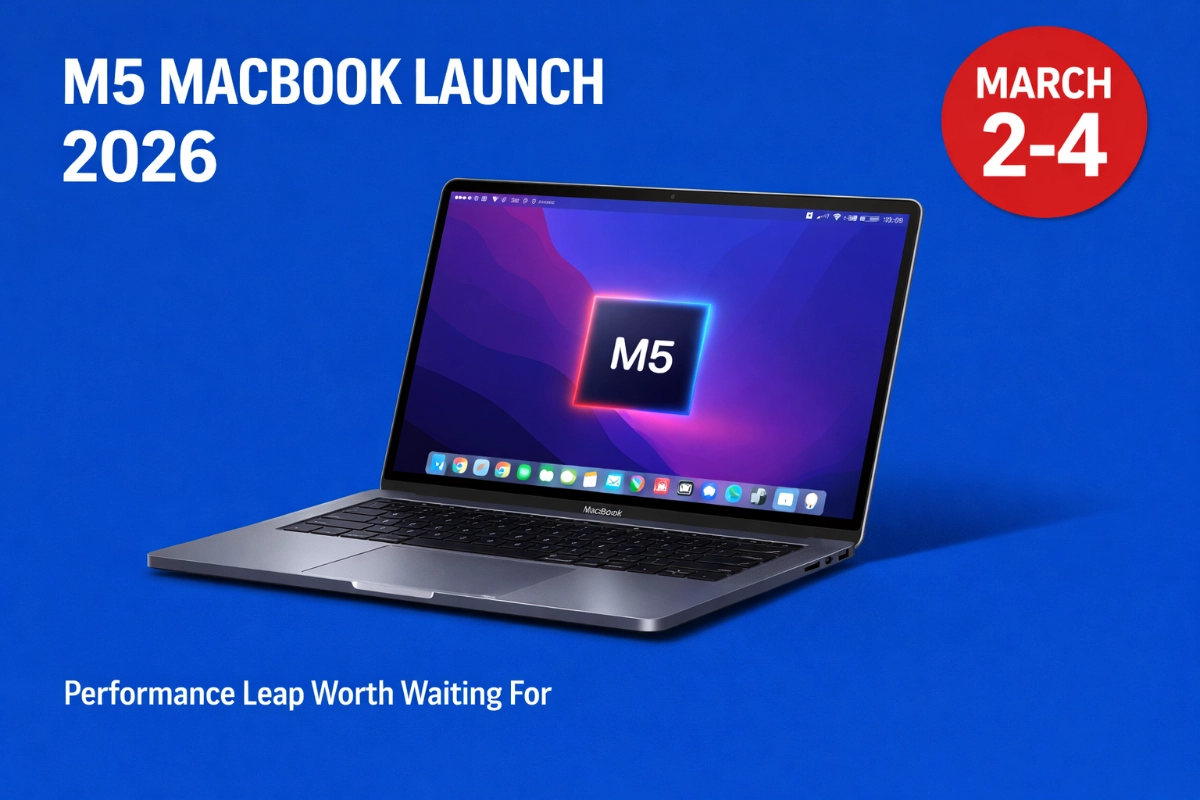
Apple's March 2026 product announcements center on the M5 chip generation, and the performance improvements go beyond typical year-over-year updates. If you're debating whether to buy a discounted M4 MacBook now or wait for M5 models arriving March 2-4, the decision hinges on understanding where M5 actually delivers measurable advantages versus where marketing claims exceed real-world benefits. The M5 architecture fundamentally redesigns how Apple Silicon handles AI workloads, but thermal constraints in fanless models create performance ceilings that could frustrate buyers expecting sustained peak speeds.
The M5 generation makes a structural break that prior generations did not. Every GPU core in the base M5 chip now contains a dedicated Neural Accelerator, converting the graphics subsystem into a parallel AI compute layer rather than a single-purpose rendering engine. The result, according to Apple's own testing, is up to 4x faster performance on AI tasks compared to M4 and up to 9.5x faster compared to the original M1.
Memory bandwidth climbs to 153GB/s on the base chip, roughly 28% higher than M4's throughput. This matters specifically for AI workloads, which spend a disproportionate share of their execution time moving data rather than processing it. Storage speeds double on base M5 as well, a gain that benefits large file transfers and workflows that read from disk frequently.
For M5 Pro and M5 Max, the architecture changes even more substantially. Rather than enlarging a single die as Apple has done in every prior generation, Apple built the M5 Pro and M5 Max using Fusion Architecture, bonding two separate third-generation 3nm dies into a single package. This is a first for Apple Silicon and a genuine engineering departure, not a refinement of an existing approach. The M5 Pro supports up to 64GB of unified memory at 307GB/s bandwidth; the M5 Max scales to 128GB at 614GB/s, with SSD throughput reaching up to 14.5GB/s.
After comparing the M5 base and M5 Pro/Max specifications side by side, the generation contains two meaningfully distinct chip designs that happen to share a name. Buyers considering any MacBook in this lineup are not choosing between faster and fastest versions of the same chip. They are choosing between a refined single-die chip and a fundamentally restructured architecture built for professional memory and bandwidth demands.
The headline AI numbers describe a specific slice of computing, not general-purpose speed. For users running large language models locally, M5 Pro and M5 Max deliver up to 4x faster prompt processing compared to M4 Pro and M4 Max. Video creators using Topaz Video AI see up to 1.9x faster enhancement processing on base M5 and up to 3.5x faster on M5 Max versus its predecessor. DaVinci Resolve video effects rendering runs up to 3x faster on M5 Max compared to M4 Max. Blender rendering accelerates by up to 1.5x on base M5.
These are measurable, workflow-impacting gains, but they require workflows that specifically use the GPU's Neural Accelerators. CPU-bound tasks tell a different story. The performance cores in M5 deliver roughly 15 to 30% faster throughput than M4 for sustained professional workloads, which is a meaningful improvement but not a multiple.
Tom's Guide testing found no perceptible speed difference between M4 and M5 Air on non-AI tasks. That result is not surprising once the architecture is understood: M4 already exceeded the demands of web browsing, document editing, email, media playback, and light photo work. Buyers whose work never touches on-device AI inference, GPU rendering, or local LLMs will experience M5 as a modest upgrade rather than a dramatic one.
This is not a criticism of M5. It reflects what Apple designed it to do. The Neural Accelerator architecture concentrates resources where AI inference actually runs, and the payoff for users in that category is substantial. Everyone else is buying a chip that will outlast their needs regardless of which generation they choose.
The MacBook Air has no cooling fan. That fact constrains M5's performance ceiling during intensive sustained tasks regardless of how the chip performs in short bursts, and anyone planning heavy video renders, extended game sessions, or sustained software compilation on a fanless machine should account for throttling. The aluminum chassis and graphite sheet thermal design that Apple has used since the 2022 Air redesign provide passive cooling only, which means heat accumulates when workloads build continuously.
What has been widely misunderstood, however, is the direction of the thermal situation relative to M4. Max Tech's Cinebench testing found that M5 runs measurably cooler than M4 under the same chassis and single-fan cooling configuration, despite M5's slightly higher power draw. The M5 14-inch MacBook Pro does reach 99 degrees Celsius under sustained Cinebench load, but it arrives at that ceiling from a lower starting temperature than M4 did under identical conditions.
The implication for MacBook Air buyers is that M5's throttling profile is not worse than M4's. It is at least comparable and appears to be slightly improved. Users who accepted M4 Air's thermal behavior for the tasks they run have no additional thermal liability with M5. The relevant question is not "will M5 throttle more than M4?" but "will my work ever push either chip to its sustained limit?" For casual users doing browsing, documents, and occasional photo work, the answer is almost certainly no, and thermal management will never enter the picture.
The M5 MacBook lineup costs more than M4 at every tier. The 13-inch MacBook Air M5 starts at $1,099, and the 15-inch model at $1,299, up from $999 for the M4 Air. MacBook Pro models with M5 Pro and M5 Max run $100 to $400 higher than their M4 equivalents. The headline numbers are accurate, but they describe only part of the story.
What changed alongside price is the storage floor. Apple doubled the base storage across the lineup when moving from M4 to M5. When compared on equivalent storage configurations, the effective pricing across most MacBook Air and MacBook Pro models is largely unchanged between generations. Buyers who previously upgraded storage at purchase are often paying no more in net terms.
The reason for any real increase is not margin expansion. Apple CEO Tim Cook disclosed in January 2026 that the company was experiencing memory costs that were "increasing significantly," with intensifying impact projected through fiscal 2026. A global DRAM shortage driven by AI datacenter demand has diverted memory supply from consumer devices. Other manufacturers including Dell have warned distributors of price hikes as high as 30% across their laptop lines.
Apple's response to this environment is worth noting. RAM upgrade tier pricing across the M5 lineup is identical to M4 pricing; the cost of stepping up from base memory to higher configurations did not increase. RAM upgrade tier pricing across the M5 lineup is identical to M4 pricing; the cost of stepping up from base memory to higher configurations did not increase. Apple absorbed memory cost headwinds by raising the storage floor rather than taxing memory upgrades. For buyers who need higher RAM configurations today, M5 is likely a more predictable purchase than waiting for M6, when memory costs are projected to remain elevated through at least mid-year 2026.
The 14-inch MacBook Pro with M5 Pro starts at $2,199, while the 16-inch version begins at $2,699. These prices reflect not only the chips inside but the Fusion Architecture described earlier, which macOS treats as a single unified processor despite the two underlying dies.
Performance over M4 Pro and M4 Max is substantial across the workloads these chips are designed for. CPU throughput runs up to 30% faster for sustained professional tasks. GPU compute for AI operations exceeds M4 Pro/Max by more than 4x. Ray tracing performance improves by up to 35%. Each Thunderbolt 5 port on the M5 Pro and M5 Max carries its own dedicated on-chip controller, meaning all ports can run at full bandwidth simultaneously without contention. Apple has introduced Memory Integrity Enforcement to Mac for the first time, a feature that monitors memory use continuously in the background without requiring the user to configure it.
Prior chip improvements within a generation followed the same design logic but at different scales. M5 Pro and M5 Max break that pattern. The Fusion Architecture distinction matters for buyers evaluating whether to upgrade from M4 Pro or M4 Max precisely because it represents a different engineering approach, not a refinement of the prior one. The architecture's capacity to scale memory bandwidth and unified memory depth is structurally higher than what a larger single-die chip could achieve, which positions these configurations as forward-looking investments for professional workflows in AI, video, and 3D that will only grow more memory-intensive.
The MacBook Pro's design, display, camera, and audio are unchanged from M4. Buyers expecting a visual refresh with M5 Pro or M5 Max should know that the industrial design carries over from the prior generation entirely.
The base 14-inch MacBook Pro with M5 starts at $1,699. Moving to M5 Pro raises that to $2,199 for the 14-inch and $2,699 for the 16-inch. M5 Max configurations begin at $3,599 for the 14-inch and $3,999 for the 16-inch.
Apple has not discontinued the MacBook Air M4. It remains available at $999 for the 13-inch model, making this the first generation where buyers face three distinct price tiers within the MacBook Air lineup alone: M4 at $999, M5 at $1,099, and M5 at $1,299 for the 15-inch. For users whose workflows do not touch AI tools, the M4 Air at $999 delivers every practical capability of M5 at a $100 discount. That is a legitimate choice, not a compromise.
The calculus shifts for specific user profiles:
Buy M4 Air now if your work lives in productivity software, web browsing, media consumption, and light creative tasks. M4 already exceeds these demands, M5 adds nothing perceptible for these workflows, and $100 in immediate savings is real money.
Buy M5 Air now if you use on-device AI tools actively, work with large language models locally, or process AI video enhancement regularly. The 4x AI gains translate directly into shorter wait times during tasks you perform every day. The doubled storage floor also makes M5 a better long-term value even at $1,099.
Buy M5 Pro now if sustained professional workloads regularly push your current machine and you need active cooling for long rendering or compilation sessions. The Fusion Architecture and memory bandwidth scale matter for workflows that fill memory and run continuously for hours. If you want a deeper look at how the M5 Pro stacks up against the OLED wait decision specifically, we've covered whether the M5 Pro MacBook Pro justifies its price before OLED arrives.
Consider waiting for M6 if your primary dissatisfaction with your current MacBook is the display or the industrial design rather than processor performance. From what we found across the M6 OLED supply chain signals, the case for a late 2026 M6 MacBook Pro is now backed by manufacturing evidence rather than analyst projection alone. Samsung has begun production on the 8.6-generation OLED panels expected for M6 MacBook Pro, and both Bloomberg's Mark Gurman and analyst Ming-Chi Kuo have independently confirmed a late 2026 launch window. While production schedules can shift, the combination of confirmed display manufacturing and dual-source analyst agreement makes this the strongest corroboration any Apple product has received before announcement. The M6 OLED redesign will include a Dynamic Island replacing the notch, touch input, and a thinner chassis, but only for M6 Pro and M6 Max configurations. The base M6 MacBook Pro is not expected to receive the OLED display or the redesigned chassis.
Skip the upgrade entirely if you already own an M4 MacBook Air or MacBook Pro. For existing M4 MacBook Air owners, the performance gains available in M5 do not justify replacement costs on most workflows.
The window between now and a confirmed M6 Pro/Max launch is roughly six to nine months. For buyers who can wait and whose needs center on display quality or a new design, that window is short enough to justify holding. For buyers with immediate AI workflow needs or professional throughput requirements, M5 Pro and M5 Max represent the strongest Apple Silicon generation to date for those specific use cases, and waiting delays real productivity gains without a guaranteed payoff.
Is the MacBook Air M5 worth buying over the M4 Air?
For new buyers, yes, if your budget allows $1,099. The M5 Air delivers meaningfully faster AI processing, doubled storage as standard, and improved SSD speeds. At $999, the M4 Air remains excellent for everyday productivity and is a legitimate purchase. If you already own an M4 Air, the upgrade is not worth it.
Does the MacBook Air M5 throttle more than the M4 Air?
No. Early testing shows M5 runs cooler than M4 under the same fanless chassis. Throttling under heavy sustained loads remains a characteristic of the fanless design for any chip, but M5's thermal profile is comparable to or slightly better than M4's, not worse.
What is Fusion Architecture and does it matter for everyday users?
Fusion Architecture bonds two 3nm chips into a single package for M5 Pro and M5 Max, enabling substantially higher memory bandwidth and larger memory capacity than a single-die design could support. For everyday users on base M5, Fusion Architecture is not relevant; it applies only to M5 Pro and M5 Max. For professionals who saturate memory bandwidth with AI, video, or 3D work, it is the defining feature of the generation.
Should I wait for the M6 MacBook Pro?
If you want an OLED display, touch input, or a redesigned chassis, waiting is reasonable. Supply chain evidence now points to a late 2026 M6 MacBook Pro launch in M6 Pro and M6 Max configurations. The base M6 will not receive those changes. If you need performance improvements now and the current design suits you, M5 Pro or M5 Max is the right choice today.
Why did MacBook prices increase with M5?
A global DRAM shortage driven by AI datacenter demand has raised memory costs across the industry. Apple increased base storage floors across the lineup rather than raising RAM upgrade costs, which means effective prices on equivalent configurations are largely unchanged. The headline price differences reflect doubled storage at base, not pure margin increases.