Finished reading? Continue your journey in Tech with these hand-picked guides and tutorials.
Boost your workflow with our browser-based tools
Share your expertise with our readers. TrueSolvers accepts in-depth, independently researched articles on technology, AI, and software development from qualified contributors.
TrueSolvers is an independent technology publisher with a professional editorial team. Every article is independently researched, sourced from primary documentation, and cross-checked before publication.
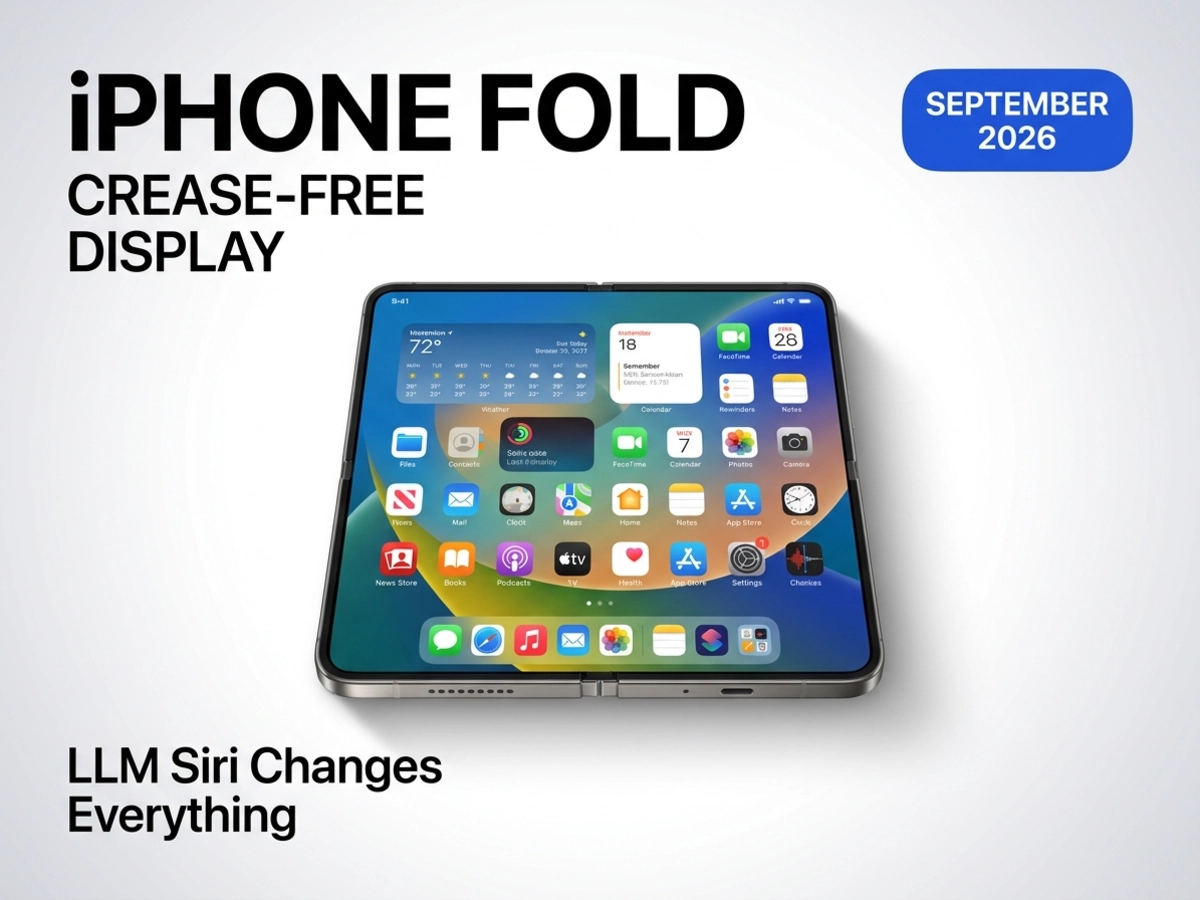
Apple's September 2026 lineup delivers two breakthroughs that unlock capabilities smartphones and tablets couldn't achieve separately. The foldable iPhone eliminates the crease plaguing Samsung's Galaxy Z Fold while expanding to 7.76 inches for tablet-class productivity. LLM Siri arrives in March with personal context awareness that finally makes AI assistants useful for complex tasks.
Every foldable phone shipped in the last seven years has the same problem. Fold it flat, hold it at the wrong angle, sweep a thumb across the center, and the crease announces itself. On the Samsung Galaxy Z Fold 7, that crease measures approximately 0.7mm deep. That's subtle enough that Samsung's marketing can treat it as solved, but substantial enough that users encounter it constantly in daily use.
Apple enters the foldable market with measurements that reframe the conversation. MacRumors reported production data from the iPhone Fold's display supply chain showing a crease depth controlled to under 0.15mm and a crease angle below 2.5 degrees. To give those numbers physical meaning: a standard sheet of paper is roughly 0.1mm thick. The iPhone Fold's crease is shallower than the edge of two stacked sheets. AppleInsider noted the competitive context directly: Apple's production target is roughly one-quarter the depth of Samsung's current flagship foldable.
The engineering approach distributes bending stress differently than Samsung's existing process. Rather than concentrating strain at the fold point, a laser-drilled metal plate spreads the mechanical load across a wider band of the panel. Apple's lamination and material process is developed independently, separate from what Samsung applies to its own Galaxy products.
Samsung's seventh-generation flagship foldable carries a 0.7mm crease. Apple's production target is sub-0.15mm — four to five times shallower. Going from 0.7mm to sub-0.15mm isn't iteration within the same product category. It's a different tactile and visual result. A crease that shallow doesn't feel like "less crease." Under normal use, with light moving across the display at typical viewing angles, it recedes from awareness. That's the distinction Apple needed to make a foldable worth the wait. Production orders for the display panels have been placed, confirming the fall 2026 schedule is on track.
The inner display measures approximately 7.8 inches at a 4:3 aspect ratio, placing it closer to an iPad in geometry than to any current Samsung foldable. Samsung's Galaxy Z Fold lineup uses a taller, narrower format better suited for one-handed use when closed but more awkward for reading and document work when open. Apple's 4:3 inner display allocates more horizontal real estate for wide-format content and side-by-side apps. The cover display measures around 5.3 to 5.5 inches, usable for standard phone tasks when the device is closed.
The choice of aspect ratio appears to be consequential enough that Samsung is already responding. SamMobile reported that Samsung is developing a "Wide Fold" variant designed specifically to match the proportions Apple is bringing to market, a signal that Samsung reads the 4:3 inner format as a competitive differentiator rather than a quirk.
The iPhone Fold runs on Apple's A20 chip, built on a 2-nanometer process. This is the same generation powering the iPhone 18 Pro models shipping simultaneously in September. Authentication shifts to a Touch ID sensor embedded in the power button; Face ID's reliance on a front-facing sensor array creates geometric challenges across folding displays that Apple chose to sidestep rather than solve in the first generation.
MacRumors places the expected price between $2,000 and $2,500, with the most recent supply chain information pointing toward the higher end of that range. SamMobile reported the Galaxy Z Fold 8 is expected in July or August 2026, about two months before the iPhone Fold's September window, giving Samsung a brief head start in fall launch coverage before Apple's entry arrives.
Apple's 4:3 geometry sacrifices some single-handed ergonomics in exchange for a more generous workspace when unfolded. That's a productivity-first philosophy, not a compromise. For buyers who want a foldable as a tablet replacement rather than a larger phone, this is the right trade.
The original Siri architecture was built on rules. It converted voice to text, matched patterns against a decision tree, and triggered predefined responses. That system worked for weather queries and timer setting. It couldn't interpret ambiguous intent, handle multi-step tasks, recover from follow-up questions, or maintain context across a conversation. When Apple realized the scale of improvement users were expecting from an AI-era assistant, the rules-based foundation couldn't support it.
Apple's first attempt at a fix tried to layer AI capability onto the existing architecture. That hybrid approach failed. MacRumors documented Craig Federighi's internal acknowledgment that the first-generation architecture "ended up being too limited" and that Apple's attempt to merge two separate systems produced results that didn't clear the bar for public release. The company scrapped the hybrid and rebuilt from a new LLM-based foundation.
The rebuilt Siri operates through three layers. A planner interprets the user's input and determines what kind of response is needed. A search layer handles both world knowledge and personal data queries. A summarizer generates the response. Apple's own Foundation Models power the personal data search, meaning Calendar, Mail, Messages, Photos, and Files content never passes through third-party infrastructure. On-screen awareness, the ability to read and act on whatever is currently visible on screen, sits on top of this foundation and enables commands that reference live context without any manual copying or switching.
The leadership transition that accompanied this rebuild matters for understanding the timeline. John Giannandrea was removed from Siri oversight; Mike Rockwell now leads the effort, reporting directly to Federighi. The organizational pressure was significant enough that MacRumors reported Meta was offering compensation packages as high as $200 million to recruit Apple AI engineers during the rebuild period.
Apple wasn't running behind a schedule. It was solving a structural problem that couldn't be solved on the original foundation. The delay timeline doesn't capture that distinction, but the architecture failure does. That's a different kind of delay, and it's why the result should be qualitatively different from the assistant users had before.
On January 12, 2026, Apple and Google issued a joint statement confirming a multi-year partnership in which Google's Gemini serves as what Apple described as "the most capable foundation" for Apple Foundation Models. The announcement resolved months of speculation about which external AI provider Apple would deploy for Siri's world-knowledge capabilities.
The privacy architecture that accompanies this deal is the detail that matters most to users uncomfortable with their assistant running on Google's infrastructure. On Apple's Q1 2026 earnings call, Tim Cook confirmed that Gemini-powered Siri processes requests either on-device or through Apple's Private Cloud Compute, not on Google's servers. Cook stated that Apple will "maintain our industry-leading privacy standard." Google has no access to the queries or data that flow through these requests. Apple's Foundation Models handle personal data searches entirely locally, creating a clean separation: Gemini answers questions about the world; Apple's own models answer questions about the user's personal information.
Internally, Apple developed its world-knowledge search capability under the name "World Knowledge Answers." The feature will surface across Siri, Safari, and Spotlight, functioning as an answer engine rather than a search redirect.
Apple tested Anthropic and OpenAI before committing to Google. TechCrunch reported that Anthropic demanded approximately $1.5 billion per year; Apple selected Google at a lower reported figure. This was a cost and timeline decision, not a statement about which model Apple believes is technically superior. The gap between what different AI providers charge and what they deliver is a dynamic playing out across the industry. Understanding how companies position their AI tiers, from full-capability models to constrained free versions, matters when evaluating any AI-powered product, and what big tech won't always disclose about AI model tiers applies beyond coding tools to every AI feature being marketed as a selling point right now.
Apple is simultaneously developing its own large-scale model internally, and the Gemini partnership gives it the capability to launch LLM Siri now while that internal work continues. The deal is a bridge, not a destination.
On the timeline, Apple confirmed 2026 delivery of a more intelligent Siri, with core features targeting iOS 26.4 in spring 2026. Bloomberg's Mark Gurman has flagged that some features may slip to iOS 26.5 or iOS 27. These two statements are consistent: Apple's commitment is to 2026, not to a specific update version. Buyers should expect core capabilities in spring and full chatbot-mode functionality arriving with iOS 27 in September.
On a conventional iPhone, on-screen awareness is a useful shortcut. The AI can read a text message and add an address to Contacts without requiring the user to copy and switch apps manually. That's a genuine improvement over tapping through three steps.
On the iPhone Fold's 7.8-inch inner display, the same capability operates at a different scale. Two full applications are visible simultaneously: a contract in PDF viewer alongside a notes app, or a flight confirmation email beside a calendar. Siri can read both. It can extract information from one and populate the other, while the user monitors what it's doing across a display large enough to make both apps genuinely useful at the same time. The screen space transforms on-screen awareness from a shortcut into a workflow tool.
Bloomberg's Mark Gurman reported that iOS 27 will "prioritize software features tailored specifically to this new form factor," with multitasking features exclusive to the iPhone Fold that won't ship to any other iPhone model. Apple isn't planning to reveal these features at WWDC; they'll be disclosed at the September hardware event alongside the device itself.
LLM Siri's on-screen awareness is powerful in proportion to how much screen is occupied by meaningful content. Personal context search across apps is more useful when you can act on the results in two apps simultaneously. The foldable display doesn't just give LLM Siri a bigger canvas: it gives the AI more things to be aware of and more space to act on what it finds. Neither capability creates this dynamic alone.
Apple launched the iPhone 16 in September 2024 with Siri intelligence as a centerpiece of the marketing. Most of those features didn't ship with iOS 18. Some didn't ship at all. The credibility cost was real: buyers who purchased an iPhone 16 specifically for AI capabilities encountered a standard Siri at launch and waited over a year for meaningful functionality.
The 2026 product sequence looks nothing like that pattern. LLM Siri launches with iOS 26.4 in spring 2026. The iPhone Fold ships six months later in September. Apple reportedly held back its smart home hub for the same reason: the new generation of hardware was designed around LLM Siri's capabilities, and shipping it before those capabilities were proven would have repeated exactly the mistake Apple made in 2024.
LLM Siri launches in spring 2026. The iPhone Fold ships in September. By the time the hardware arrives, the AI will be six months old — a product that hundreds of millions of users have had time to form real opinions about. The foldable iPhone arrives in a world where Siri's capabilities are already lived experience, not marketing copy. Apple has not explicitly stated this, but the evidence supports it directly.
That sequencing does something for the iPhone Fold that no hardware specification can. It removes the AI caveat. When the iPhone Fold ships, the question of whether its AI actually works will have an answer from six months of real-world use. Buyers deciding whether a $2,400 device is worth the investment can make that decision based on evidence rather than anticipation. This reads as deliberate rather than coincidental, and it's arguably the most consequential product decision Apple has made in this cycle.
When does the iPhone Fold actually release? The iPhone Fold is expected in September 2026 alongside the iPhone 18 Pro lineup. Production orders for the display have been confirmed, and the schedule remains on track as of early March 2026.
When does LLM Siri launch? Apple has confirmed a 2026 delivery. Core features are targeting iOS 26.4 in spring 2026, which typically means March or April. Bloomberg has reported that some advanced features may arrive in iOS 26.5 or iOS 27 in September. The spring update should deliver personal context, on-screen awareness, and expanded app integration; full chatbot functionality is expected in iOS 27.
Will the iPhone Fold's crease actually be invisible? Production measurements show a crease depth under 0.15mm at an angle under 2.5 degrees. These are supply-chain figures corroborated by multiple outlets, but they describe a production sample rather than a shipping device. Independent testing of retail hardware will be the definitive answer. For context, Samsung's Galaxy Z Fold 7 crease sits at approximately 0.7mm, roughly four to five times deeper.
Does using Google's Gemini mean Google can access my personal data through Siri? No. Apple has confirmed that Gemini-powered Siri processes requests through Apple's Private Cloud Compute, not Google's servers. Google has no access to user queries or personal data. Apple's own Foundation Models handle all searches of personal information including Mail, Messages, Photos, and Files, entirely on the device or within Apple's own infrastructure.
How does the iPhone Fold compare to the Samsung Galaxy Z Fold 8? The Galaxy Z Fold 8 is expected in July or August 2026, about two months before the iPhone Fold. Samsung's model will likely feature a larger inner display of around 8 inches in a taller, narrower format. Apple's inner display is approximately 7.8 inches in a 4:3 aspect ratio closer to an iPad. The crease gap is the most significant hardware differentiator. Samsung is developing a "Wide Fold" variant in direct response to Apple's geometry choice.
Is the iPhone Fold worth $2,400? That depends on what problem you're solving. If split-screen productivity is something you actively want on a device that fits in a pocket, and LLM Siri's six months of proven performance has met your expectations by September, the combination is coherent. If you primarily use your phone for communication and content consumption, the iPad mini at a fraction of the price covers the same screen-space ground.