Finished reading? Continue your journey in Tech with these hand-picked guides and tutorials.
Boost your workflow with our browser-based tools
Share your expertise with our readers. TrueSolvers accepts in-depth, independently researched articles on technology, AI, and software development from qualified contributors.
TrueSolvers is an independent technology publisher with a professional editorial team. Every article is independently researched, sourced from primary documentation, and cross-checked before publication.
Apple released iPadOS 26.4 beta 1 on February 16, 2026, delivering several Apple Intelligence features while notably omitting the conversational Siri overhaul many developers anticipated. The beta introduces AI-powered playlist generation in Apple Music, groundwork for encrypted cross-platform messaging, and automatic security protections, but the flagship Siri improvements face delays until later updates. Understanding what shipped and what didn't helps developers and power users decide whether this beta warrants installation on their devices.
Build 23E5207q landed on February 16, five days after Bloomberg's report that Siri testing had encountered significant problems. For developers who had been tracking the beta's expected contents, the timing meant the disappointment was already visible before the download began.
The release contains more substance than the minimal iPadOS 26.3 update from the week prior. The major additions include:
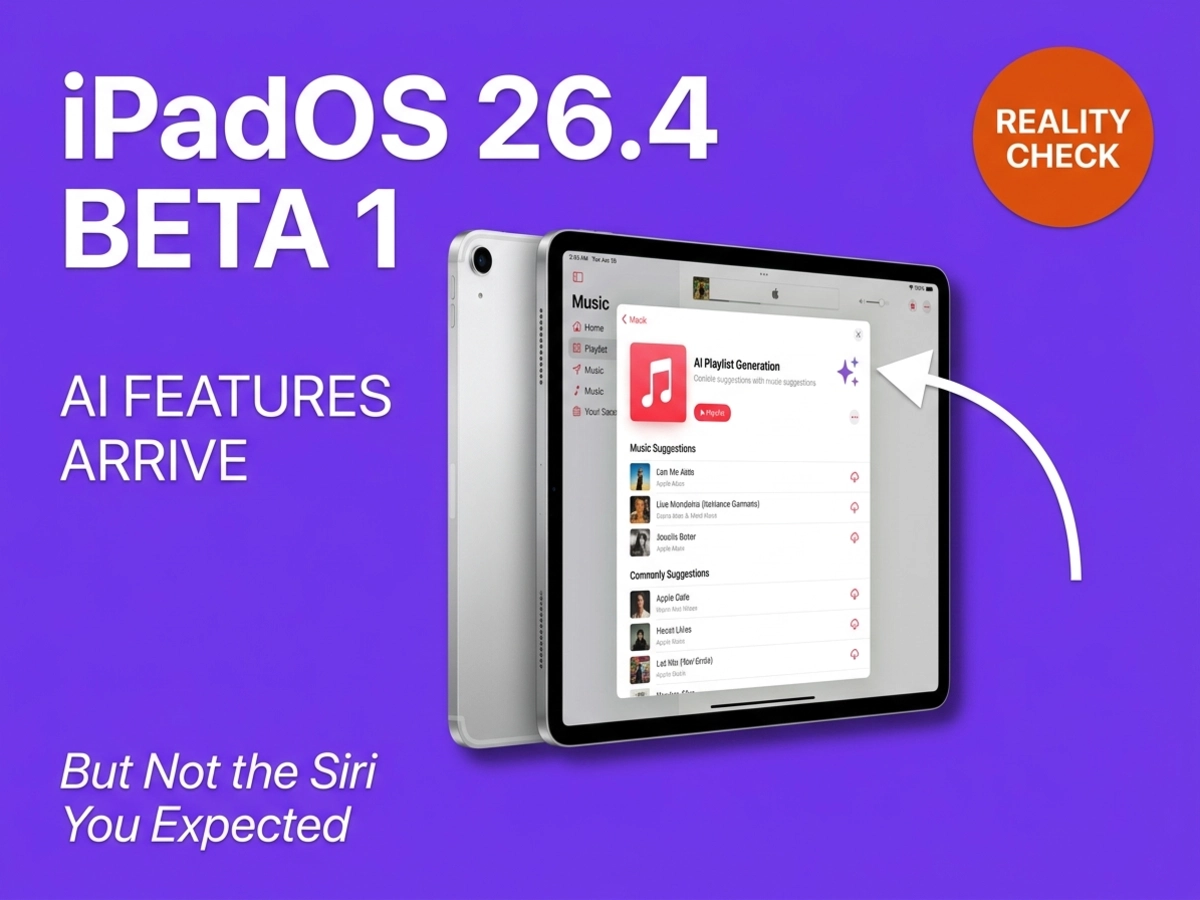
Playlist Playground in Apple Music: AI-generated playlists from typed descriptions, moods, or activities
RCS end-to-end encryption testing: an opt-out toggle in Settings, currently limited to Apple devices in Beta 1 and expanded to Android in Beta 2
Stolen Device Protection now default-on: automatically activates for all users upgrading to iOS 26.4
Video podcast playback in Apple Podcasts: using HLS adaptive streaming technology
Freeform Creator Studio integration: AI image creation tools for subscribers
Safari compact tab bar restored on iPad: available as an option following sustained user feedback
Memory Integrity Enforcement (MIE) expansion: apps can now opt into full MIE protections, building on the spyware-defense system Apple introduced in September 2025
What this list doesn't immediately reveal is that not all these features carry the same hardware requirements. Most Apple Intelligence features are gated to A17 Pro or M1-generation chips. Playlist Playground runs on older devices. That distinction matters, and it's addressed in detail below.
For a complete breakdown of every feature change across both iOS and iPadOS in this release cycle, our full iOS 26.4 feature coverage covers the broader picture alongside what's documented here.
Apple demonstrated a fundamentally different Siri at WWDC 2024: one that could search personal data like emails, messages, and files; understand what was displayed on screen; and perform actions within and across applications. The original internal target was iOS 18.4, the spring 2025 release. Apple missed that target and acknowledged the delay publicly in March 2025, shifting the timeline to iOS 26.4.
That second target collapsed just before this beta. MacRumors, citing Bloomberg's Mark Gurman, reported on February 11 that Siri had run into serious problems during internal testing: the system was mishandling certain queries and responding too slowly. Apple engineers received direction to move continued Siri testing into iOS 26.5 builds rather than finalize the features for this cycle. Bloomberg characterized the situation as "fluid," leaving the door open for partial features in iOS 26.5 (targeted for May 2026) or a larger rollout tied to iOS 27 in September. Internally, iOS 26.5 builds already contain a preview toggle for Siri's personalization feature, along with explanatory notices, though the feature isn't functioning reliably in those builds.
Apple told CNBC on February 13 that the new Siri remains on track for "2026." The company has never publicly committed to a specific version or month, only the calendar year a window wide enough to technically include a September iOS 27 ship date.
Apple announced these features in June 2024 with a suggested spring 2025 launch, delayed them a full year to spring 2026, and now faces another miss, a two-year pattern that goes beyond a schedule slip. The specific failure modes Bloomberg cited, query processing errors and response latency, are foundational problems, not edge cases. A conversational AI assistant that occasionally mishandles queries or responds slowly isn't a privacy or UI problem; it's an accuracy and performance problem that users will encounter constantly. Bloomberg's report moved Apple's stock approximately five percent before Apple issued any public statement, which suggests this was not a controlled narrative. Engineering reality surfaced before communications strategy could shape it.
The Siri delay carries consequences beyond software. Four hardware products Apple has been developing depend on the new Siri's App Intents API as their primary interaction layer.
The smart home hub is the most visible example: originally planned for March 2025, it was delayed once already due to Siri's unreadiness, then retargeted for spring 2026 alongside the Siri overhaul. Also in the queue: a smart doorbell with deep Siri integration, an Apple TV update with an A17 Pro chip bringing Apple Intelligence to the living room, and a first-generation AR Glasses product where voice control is the primary interface model. If Siri doesn't clear its engineering hurdles by iOS 26.5, all four products face meaningful timeline pressure into late 2026 or 2027.
Apple's "2026" confirmation to CNBC is not the reassurance it reads as. iOS 27 ships in September 2026 and is technically within that window. For hardware products that were already delayed once, a slip to iOS 27 dependency means launch timelines compress toward the end of the year, or slip into 2027 entirely.
Playlist Playground is the most accessible new feature in this beta. To access it, open Apple Music, navigate to the Library tab, and tap the "+" button to create a new playlist. Instead of naming the playlist manually, users can type any mood, activity, time of day, or idea "rainy Sunday afternoon," "90s hip-hop workout," "songs that feel like driving at 2am" and the system generates a playlist of roughly 25 tracks with a custom title. Preset prompts like "morning coffee music," "hip-hop party songs," and "disco songs that defined the 1970s" appear as starting points. Users can refine the results with additional text, choose cover art, and add a description. Playlists function identically to any manually created playlist: they appear on profiles and can be shared.
The feature requires AI models to download in the background before it becomes available. Some testers don't see Playlist Playground immediately after updating; force-quitting the Music app typically resolves the delay as the model finishes installing.
Most Apple Intelligence capabilities are locked to A17 Pro and M1-generation hardware, processing models on-device. Playlist Playground works on older devices, which points to server-side computation for this specific feature, a direct trade-off between on-device privacy consistency and reaching the broadest possible user base. Apple Intelligence hardware penetration is still building, and a music feature that only works on recent devices would launch to a fraction of active Apple Music subscribers. That's a deliberate call.
Apple is the last major streaming platform to offer AI playlist generation. Amazon launched its AI playlist tool in April 2024, Deezer followed in July 2024, Spotify expanded text-based playlist creation to the US and Canada in December 2024, and YouTube Music launched its own generator in early February 2026 just days before this beta dropped. Apple had already offered ChatGPT-based playlist generation within Apple Music, but Playlist Playground is the first native implementation carrying Apple Intelligence branding and embedded directly in the playlist creation workflow rather than as an invocable external service.
Apple added basic RCS support to iPhone with iOS 18.1, enabling richer messaging between iPhone and Android users without relying on SMS. The next step encrypting those messages requires upgrading from the RCS Universal Profile 2.4 standard that Apple currently supports to Universal Profile 3.0, which is built on the Messaging Layer Security (MLS) protocol. The GSM Association published that specification in March 2025, and Apple began testing E2EE implementation in this beta approximately one year later.
In Beta 1, the testing is narrow: a toggle labeled End-to-End Encryption appears in RCS Messaging settings, enabled by default, and a lock icon appears in conversations where encryption is active. The testing applies only to iPhone-to-iPhone communication for users who have iMessage disabled. Beta 2, released February 23, expanded the testing scope to include iPhone-to-Android messaging, requiring Android participants to be enrolled in the Google Messages beta.
Apple has explicitly confirmed that E2EE will not ship in the iOS 26.4 final release, instead arriving in a future iOS 26 update. Beyond encryption itself, the Universal Profile 3.0 upgrade also adds message editing, deletion, and inline replies for cross-platform conversations — features that have been part of iMessage for years and will finally extend to RCS when the standard fully ships. What's in this beta is infrastructure, not a deliverable.
Stolen Device Protection arrives as an automatic default for anyone upgrading to iOS 26.4, rather than a manual setting users have to discover. Apple introduced the feature in January 2024 with iOS 17.3, responding to a documented theft method where criminals would observe victims entering their passcodes in public, then steal the devices. With just the passcode, a thief could access the Passwords app, initiate account changes, and disable Find My. The protection blocks this by requiring biometric authentication (Face ID or Touch ID) to access sensitive functions, and adds a one-hour delay before allowing certain account changes when the device is outside trusted locations like home or work.
The beta also expands Memory Integrity Enforcement, a defense system Apple introduced in September 2025 as a countermeasure against mercenary spyware. Previously, MIE operated in Soft Mode for applications. iOS 26.4 allows developers to opt into full MIE protections for their apps. The system provides always-on memory safety across the kernel and more than 70 userland processes without a claimed performance overhead.
Stolen Device Protection moved from a manual toggle to a default-on setting. The RCS encryption toggle also defaults to enabled. Both changes could generate user friction, someone who wants faster account recovery without biometric delays, or a tester who doesn't want their RCS messages flagged as encrypted during testing, has to actively reverse each setting. Across multiple features in this same release cycle, Apple is shifting from security-opt-in to security-opt-out, making a deliberate judgment that the population-level security benefits of broad adoption outweigh the inconvenience to the subset of users who would have opted in anyway.
Apple Podcasts gains native video playback using HTTP Live Streaming technology. HLS handles adaptive quality automatically, adjusting video resolution based on available bandwidth so playback remains smooth across varying network conditions. Users can switch between audio-only and video formats without losing their position in an episode, watch in horizontal full display, and download video episodes for offline playback on both Wi-Fi and cellular.
For podcast creators, the implementation introduces dynamic video ad insertion. The monetization structure mirrors Apple's broader platform approach: creators distribute through Apple Podcasts at no cost, while participating ad networks including Acast, Amazon's ART19, Triton's Omny Studio, and SiriusXM will pay an impression-based fee to Apple for dynamic ad delivery. That arrangement is expected to take effect later in 2026.
Freeform adds access to Creator Studio features for subscribers. A dedicated Content Hub brings professional graphics, photos, and illustrations into the whiteboarding workflow. The AI image creation and editing capabilities in this integration use OpenAI's image models rather than Apple's own on-device generation pipeline, placing Freeform alongside Apple's other cross-company AI arrangements.
Safari's compact tab bar, which disappeared from iPad during an earlier interface redesign, returns as an optional layout. Reminders adds an Urgent smart list that automatically surfaces tasks flagged as Urgent and attaches alarms to them, building on the Urgent priority level added in iOS 26.2. A set of new emoji including trombone, treasure chest, orca, Bigfoot, apple core, and ballet dancers is being added progressively through the beta cycle rather than all at once. Notification forwarding to third-party wearables, which had been removed in an earlier release, is restored.
The decision depends on your specific use case and which features in this beta are relevant to your work.
Developers building against Apple Music integration, RCS messaging behavior, or security-adjacent features have concrete reasons to install. Playlist Playground, the RCS E2EE toggle, and the default Stolen Device Protection state all affect app behavior in ways that require firsthand testing before the public release. The MIE expansion is especially relevant for developers who handle sensitive data and want to evaluate what full MIE protection means for their apps.
Power users invested in Apple Music who want to evaluate Playlist Playground in real use can install with reasonable confidence. The feature works on older devices, meaning it's accessible regardless of hardware generation. Playlist quality varies based on how specific the prompt is vague prompts produce generic results, while more detailed descriptions tend to produce more coherent collections. This is still beta software and feedback during this period shapes the final implementation.
Podcast creators planning video launches should evaluate the HLS implementation directly: how quality adaptation performs across different connection speeds, how seamless audio-to-video switching behaves in practice, and whether offline downloads function correctly for their content type.
Anyone waiting for the new Siri should not install this beta expecting to find any trace of it. The features are definitively absent and will not appear in the iOS 26.4 final release. The earliest realistic timeline for any Siri overhaul features is iOS 26.5 in May 2026, with the full rollout potentially not arriving until iOS 27 in September.
Users running iPad as a primary work device should wait for the public release. Beta software carries the expected risks: app compatibility failures, unexpected crashes, battery performance changes, and sync issues that can surface at unpredictable moments. None of the shipped features justify these risks for a production device.
Anyone expecting immediate RCS encryption with Android contacts should also wait. The feature won't ship in the iOS 26.4 final release by Apple's own confirmation, and Android participants in the current beta testing require enrollment in the Google Messages beta. What's in the beta today is groundwork, not a finished product.
The public release is expected in late March or early April 2026. For most users, that's the right moment the features will be stable, the compatibility issues resolved, and the Playlist Playground AI models already pre-staged for download.