Finished reading? Continue your journey in Tech with these hand-picked guides and tutorials.
Boost your workflow with our browser-based tools
Share your expertise with our readers. TrueSolvers accepts in-depth, independently researched articles on technology, AI, and software development from qualified contributors.
TrueSolvers is an independent technology publisher with a professional editorial team. Every article is independently researched, sourced from primary documentation, and cross-checked before publication.
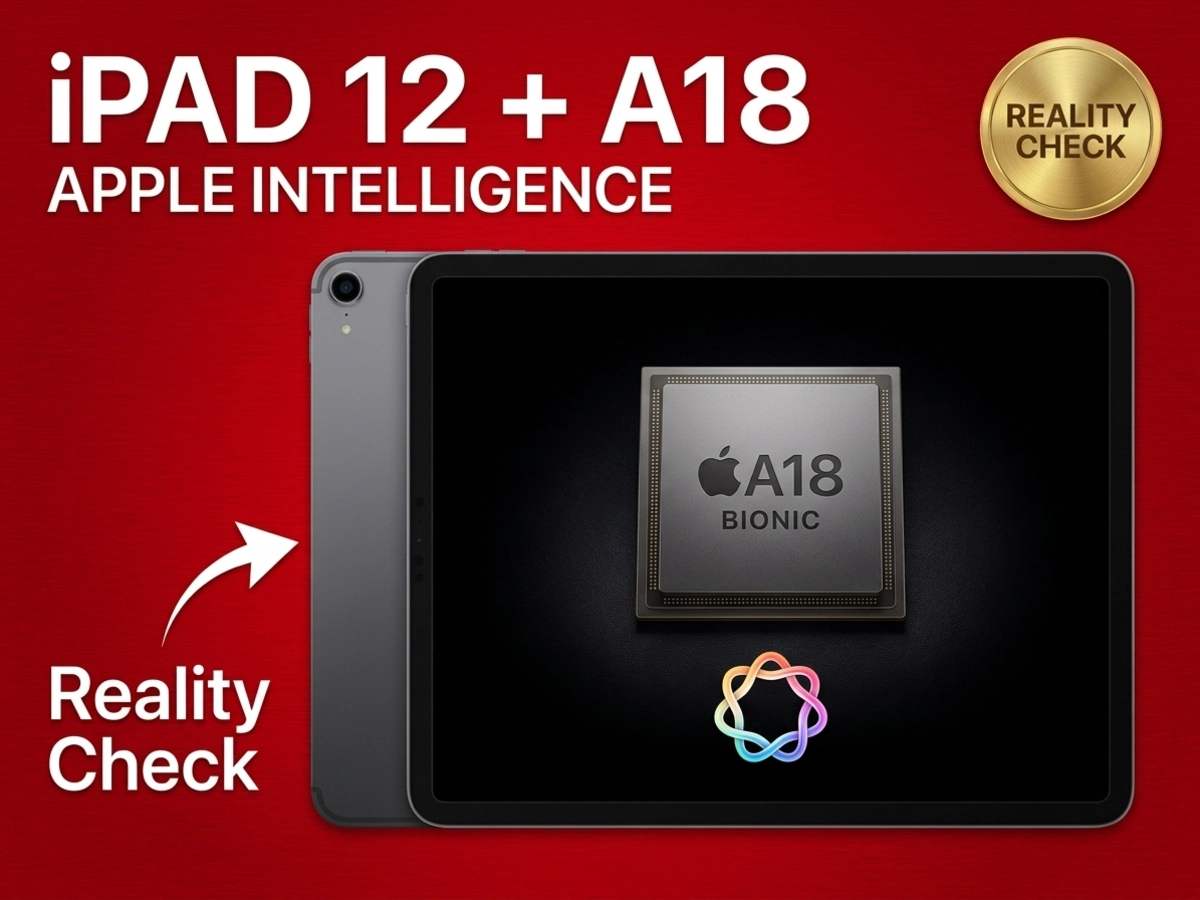
The iPad 12 with A18 chip is expected to arrive in April, completing Apple's run of making every device in its current lineup Apple Intelligence-capable. For buyers at the $349 price point, this matters, but not in the simple way Apple's marketing will suggest. The headline Siri features the company has been building toward since WWDC 2024 are not shipping with this device at launch. What buyers are purchasing is platform access, a genuine chip upgrade, and a more complicated value equation than a spec sheet reveals.
Apple's March product wave brought the MacBook Neo, iPad Air M4, MacBook Air M5, iPhone 17e, and AirPods Max 2, but no base iPad. That absence was deliberate. 9to5Mac, citing Bloomberg's Mark Gurman, reported that the device has been tied to the iOS 26.4 release cycle, which runs through May. iOS 26.4 advanced to its release candidate build in mid-March, making an April announcement the most probable window, with May as a fallback if supply chain variables shift.
The single confirmed hardware change is the chip: A16 out, A18 in. Everything else — the 10.9-inch 60Hz LCD display, the aluminum build, the dimensions, the port, the front camera position — is expected to carry over unchanged. Storage options are anticipated across 128GB, 256GB, and 512GB configurations, and pricing is expected to hold at $349, the same figure the iPad 11 launched at in March 2025.
9to5Mac, citing Bloomberg's Mark Gurman, also confirmed that possible inclusion of the in-house C1 modem and N1 networking chip has not been firmly established; we treat A18 with unchanged connectivity as the baseline expectation.
This is the last mainline Apple product that does not support Apple Intelligence. The iPad mini supports it, via A17 Pro. The iPad Air supports it, via M4. The iPad Pro supports it. Every iPhone Apple currently sells supports it. Every Mac supports it. The base iPad at $349 has been the sole exception, and closing that gap is the driving reason for this refresh.
The A16 chip in the current iPad 11 misses Apple Intelligence's minimum hardware threshold; the company requires A17 Pro or newer, or any M-series chip. The A18 clears it. That is the essential logic of this product.
This interpretation of Apple's motivations is consistent with the available evidence, though not confirmed by Apple: the A18 chip costs substantially less to produce in 2026 than it did when it first shipped in iPhone 16 in 2024. TSMC's older process nodes become cheaper as newer nodes ramp up. Apple's ability to put a formerly flagship-phone chip into a $349 tablet reflects production economics as much as product strategy, and the timing aligns precisely with when completing the Apple Intelligence lineup became both technically feasible and financially straightforward.
The A18 chip clears Apple's A17 Pro-or-newer requirement for Apple Intelligence, and that threshold matters. But clearing the minimum requirement and receiving a complete Apple Intelligence experience are different things, and that difference is precisely what buyers need to understand before purchasing.
The iPad 12 will have access to the Apple Intelligence features currently active across the platform: writing tools available across essentially all apps (proofread, rewrite, tone adjust, summarize), Photo Clean Up for removing unwanted objects from images, notification and email summaries that surface what matters, Genmoji for AI-generated custom emoji, Image Playground for generative images, visual intelligence for identifying objects on screen, Live Translation across Messages and FaceTime, and enhanced Siri with ChatGPT integration for queries requiring broader knowledge. For a student, a parent, or a first-time tablet owner, these are genuinely useful daily tools, not demo features.
The capabilities Apple has been marketing most prominently are a separate category. MacRumors, citing Bloomberg's reporting, documented that personal context awareness (Siri with knowledge of your messages, emails, and calendar), on-screen awareness (Siri that understands what's currently visible and can act on it), and cross-app intents (Siri completing multi-step tasks across different applications) have all been pushed from the iOS 26.4 cycle to iOS 26.5 at the earliest. iOS 27, arriving in September, is the more realistic delivery point for the deepest capabilities.
Apple targeted iOS 26.4 for the Gemini-powered Siri enhancements following the January 2026 Apple-Google partnership. Those features were not present when iOS 26.4 shipped. Apple confirmed to CNBC that the new Siri is still on track for 2026, but no more specific public commitment exists.
Apple's support page states that "more personal Siri features are still in development and will be available in future software updates"; no specific timeline beyond the company's public 2026 commitment is given, and we treat the September iOS 27 window as the more realistic arrival point for the headline capabilities.
The iPad 12 is expected to ship with 8GB of RAM, up from the 6GB in the current iPad 11. This matters independently of the AI story: 8GB is Apple's documented minimum for on-device Apple Intelligence processing, and it also improves multitasking and app retention in memory. iPadOS 26's Stage Manager 2 improvements, including more flexible windowing and desktop-style menu bars, benefit directly from the additional memory headroom.
Siri's personal context awareness, on-screen awareness, and cross-app action features are the three capabilities Apple has been marketing since WWDC 2024. All three are expected in iOS 26.5 at the earliest and more likely iOS 27 in September. The iPad 12 ships into a platform that has those features on the roadmap, not in the box. This is not a criticism unique to the base iPad: no Apple device delivers the full advertised Siri experience yet. But it means that buyers purchasing the iPad 12 specifically for the AI features Apple has been promoting are purchasing access to a platform, not delivery of its most anticipated content. For the $349 buyer, a student or family buyer with tight margin for error, that distinction matters more than it does for someone paying $599 for an iPad Air who already owns an AI-capable iPhone.
The base iPad at $349 is excellent value for a standalone tablet. The base iPad configured as a laptop replacement is a different product, and the MacBook Neo has fundamentally changed the math on that configuration.
9to5Mac reported that buying the base iPad alongside Apple's Magic Keyboard Folio at $249 brings the total to $598. One dollar separates that combination from the MacBook Neo at $599.
Apple's MacBook Neo tech specs page specifies an A18 Pro chip with a 5-core GPU, 8GB unified memory, 256GB SSD, and a 13-inch Liquid Retina display at 219 PPI, all with a keyboard and trackpad included at that $599 price. The MacBook Neo runs full macOS. It supports full desktop application installation. Apple's January 2026 testing confirmed up to 16 hours of video streaming battery life, and the base configuration includes 256GB of storage compared to the iPad's 128GB entry point.
The base iPad with keyboard comes in at 10.9 inches and 128GB of storage at that $598 price point. It runs iPadOS, which, even with iPadOS 26's Stage Manager 2 improvements, still operates within the constraints of the App Store ecosystem: resizable windows and up to twelve simultaneous apps are now possible, but there is no terminal access, no development toolchain, and no software installation outside Apple's review process. For buyers who want those things, macOS on the MacBook Neo is not a comparable option; it is a categorically different capability set.
Apple's MacBook Neo tech specs page specifies an A18 Pro chip with 60GB/s memory bandwidth and a 16-core Neural Engine. Those figures reflect the Pro variant; the standard A18 expected in the iPad 12 shares the same 16-core Neural Engine architecture at the same 3nm process node.
A base iPad at $349 with no keyboard is still a clear $250 cheaper than the MacBook Neo. It does things the Neo cannot: it runs on a battery optimized for tablet use, it has a touchscreen, it weighs approximately 1.05 pounds, and it can be handed to a 7-year-old without worrying about the hinge. The iPad's Center Stage front camera technology, which keeps people centered in FaceTime calls as they move, is absent on the MacBook Neo's 1080p webcam. The Apple Pencil experience exists only on the iPad side of this comparison. For a buyer who specifically wants a tablet, for reading, drawing, media consumption, education apps, or child use, the MacBook Neo does not compete.
It bears noting that the MacBook Neo doesn't run iPadOS, doesn't have a touchscreen, and doesn't weigh 1.05 pounds; for buyers who specifically want those properties, the pricing collision is irrelevant.
The collision is specific: it eliminates the argument for buying a base iPad paired with a keyboard as a budget laptop substitute. That was always a marginal argument, and the MacBook Neo makes it untenable. For the buyer whose primary need is a portable typing device in the Apple ecosystem at roughly $600, the MacBook Neo delivers more, including more storage, a larger screen, a full desktop OS, and a keyboard that doesn't cost extra. The base iPad's keyboard accessory no longer makes sense at that price.
The A18's most-discussed feature is the one it unlocks: Apple Intelligence support. But the performance gains between A16 and A18 are real and worth understanding independently.
The A16 was Apple's chip for the iPhone 14 Pro, introduced in 2022. By the time it shipped in the iPad 11 in March 2025, it was a three-year-old design. The A18, which powered the iPhone 16 lineup, represents a two-generation leap forward. AppleInsider's comparison found the A18 CPU runs approximately 30% faster than the A16, with GPU performance running approximately 40% faster at equivalent workloads, or delivering the same output at about 35% less power draw. The A18 is built on TSMC's 3nm N3E process, a full node below the A16's 4nm architecture, which accounts for both the efficiency gains and its improved thermal behavior.
The A18 also introduces hardware-accelerated ray tracing, a capability absent from the A16. Ray tracing enables real-time lighting simulation in games, the kind of visually detailed rendering that was previously reserved for console hardware. For the iPad 12's audience, this is a secondary benefit, but it does open the device to a generation of games that require A17 Pro-level hardware or better.
The A18's Neural Engine processes approximately 35 trillion operations per second for machine learning tasks, roughly twice the throughput of the A16's Neural Engine. This is the number that determines how quickly the iPad 12 handles Apple Intelligence requests on-device, from writing suggestions to photo cleanup to notification summaries.
The expected RAM upgrade from 6GB to 8GB reinforces the Neural Engine gains. Apple's minimum for on-device AI processing is 8GB; the current iPad 11 falls short of that threshold, which is part of why it doesn't qualify for Apple Intelligence regardless of chip. With 8GB and a substantially faster Neural Engine, the iPad 12 handles AI tasks locally without relying on Private Cloud Compute for basic requests, which means faster responses and no internet connection required for everyday features.
The A18 Pro in the MacBook Neo adds one GPU core and wider memory bandwidth compared to the standard A18 expected in the iPad 12. For the iPad 12's use cases, including browsing, streaming, writing, photography, education apps, and basic productivity, that difference is largely irrelevant. The gap matters for professional video workflows and compute-intensive creative work; it does not surface in daily tablet use.
The iPad 12's value depends almost entirely on what you're upgrading from and what you expect to do with Apple Intelligence. Four buyer situations break down clearly.
The upgrade case is thin. You bought a device a year ago whose hardware experience will be essentially identical to the iPad 12. The A18 adds Apple Intelligence access that the A16 doesn't provide, and the RAM bump from 6GB to 8GB brings genuine multitasking improvements. But the display is the same panel, the design is identical, and the AI features that would most justify the purchase haven't shipped on any device yet.
The calculus changes slightly if you specifically want to run Apple Intelligence tools today. The writing tools, photo cleanup, and notification summaries are available now, and the iPad 11 cannot access them. For most iPad 11 owners, however, that argument is not worth $349, particularly when the headline Siri features remain several months away on every Apple device.
The argument is strong, and it has less to do with Apple Intelligence than most coverage acknowledges. Mayhemcode found that Apple typically supports iOS devices for six to seven years after launch, citing the A15-powered iPhone 13 as an example still receiving full iOS updates as of 2026.
The iPad 9 shipped with an A13 chip in 2021. That device is already outside Apple's software commitment window for full iPadOS updates, and an iPad 12 with A18 and 8GB of RAM, purchased today, should receive major OS updates until approximately 2031–2032, based on Apple's historical support patterns, which can change. The performance gap between an A13 and an A18 is substantial, spanning roughly four chip generations, with enormous improvements in CPU throughput, GPU capability, and memory bandwidth across that span. Apple Intelligence access is a bonus on top of a device that will simply run modern apps faster and receive updates longer. For an iPad 9 owner, this is the clearest upgrade recommendation in the lineup.
Revisit the MacBook Neo before purchasing the keyboard. If your use case is primarily typing, document creation, and browser-based work in the Apple ecosystem, the MacBook Neo at $599 provides a 13-inch display, 256GB of storage, full macOS, and a keyboard already in the box. At $598 for the base iPad plus keyboard, the trade-offs favor the MacBook Neo for productivity-first buyers.
The iPad wins this comparison only if you specifically need a touchscreen, or if you genuinely use the iPad as a tablet when the keyboard is detached. If the keyboard stays attached most of the time, the MacBook Neo is the stronger purchase.
The iPad 12 is a straightforward recommendation. At $349 with Apple Intelligence access, a chip that will receive software updates for years, and the strongest tablet app library on the market, there's no meaningful competition at the price. The nearest Android alternatives at this tier start around $220 to $280 but run on hardware that trails A18 performance by a significant margin. The app library gap further widens the functional difference.
We note that buyers specifically waiting for the headline Siri upgrade should understand the full AI experience on any Apple device is still in development: the iPad 12 is not behind the curve; it's joining a race that hasn't yet finished.
The iPad 12 closes the last gap in Apple's current device lineup. When it ships, every product Apple currently sells supports Apple Intelligence. That platform completeness is what Apple has been building toward, and the iPad 12 is the final piece.
For the $349 buyer, the honest picture is this: a genuine two-generation chip upgrade, a RAM bump that unlocks on-device AI processing, Apple Intelligence features that are useful and available today, and a platform membership that grants access to more capable Siri as those features arrive in iOS 26.5 or iOS 27. The design is unchanged, the display is unchanged, and the most-marketed AI features are still months away on every device in the lineup.
Watch for the announcement tied to the end of the iOS 26.4 cycle. Based on current timing, that means within the next few weeks.
The Apple Pencil Pro requires an Apple Intelligence-capable device running iPadOS 17.5 or later. The iPad 12 with A18 meets the Apple Intelligence hardware requirement that the iPad 11 does not, making Apple Pencil Pro support expected for the new model. The current iPad 11 supports the USB-C Apple Pencil and Apple Pencil Pro on select configurations; the iPad 12 is expected to maintain at minimum the same compatibility and extend Apple Pencil Pro access across configurations given its AI-capable chip. Exact accessory compatibility will be confirmed at announcement.
The iPad Air M4 starts at $599, delivers 12GB of RAM versus the base iPad's expected 8GB, and runs the M4 chip, which is meaningfully faster than the A18 for demanding workloads. For buyers who use processor-intensive apps like video editing software, Photoshop, or high-end music production, the M4's additional headroom is real. The iPad Air also ships with an 11-inch display at a higher resolution than the base iPad's 10.9-inch panel.
For the student or casual user whose primary tasks are browsing, writing, streaming, and general productivity, the performance gap between A18 and M4 does not translate into a noticeably different daily experience. The $250 price difference between the base iPad and iPad Air buys meaningfully more headroom for demanding tasks, a chip that will remain relevant longer for resource-intensive software, and 4GB more RAM. If none of those use cases apply, the base iPad handles standard daily tasks without constraint.
9to5Mac, citing Bloomberg's Mark Gurman, reported that the iPad 12 upgrade from iPad 11 is essentially a chip swap with identical hardware. The case for trading in a one-year-old device to gain Apple Intelligence access depends heavily on how much those features matter to your daily use.
The Apple Intelligence features available today, including writing tools, photo cleanup, and notification summaries, are useful, and the iPad 11 cannot access them. MacRumors, citing Bloomberg's reporting, documented that the more advanced Siri capabilities are delayed to iOS 26.5 at the earliest. If those delayed features are the primary draw, waiting until they actually ship before deciding whether to upgrade is the more defensible choice. The device experience will be identical to what you have today.
No. The base iPad has historically shipped in both Wi-Fi-only and Wi-Fi plus cellular configurations. The Wi-Fi model operates fully without a cellular plan or carrier contract. The cellular model adds the ability to connect on LTE or 5G networks without Wi-Fi and typically carries an additional cost of approximately $130 to $150 over the Wi-Fi base price. Whether N1 networking chip inclusion might expand connectivity options in the Wi-Fi model remains unconfirmed at time of writing.