Finished reading? Continue your journey in Tech with these hand-picked guides and tutorials.
Share your expertise with our readers. TrueSolvers accepts in-depth, independently researched articles on technology, AI, and software development from qualified contributors.
TrueSolvers is an independent technology publisher with a professional editorial team. Every article is independently researched, sourced from primary documentation, and cross-checked before publication.
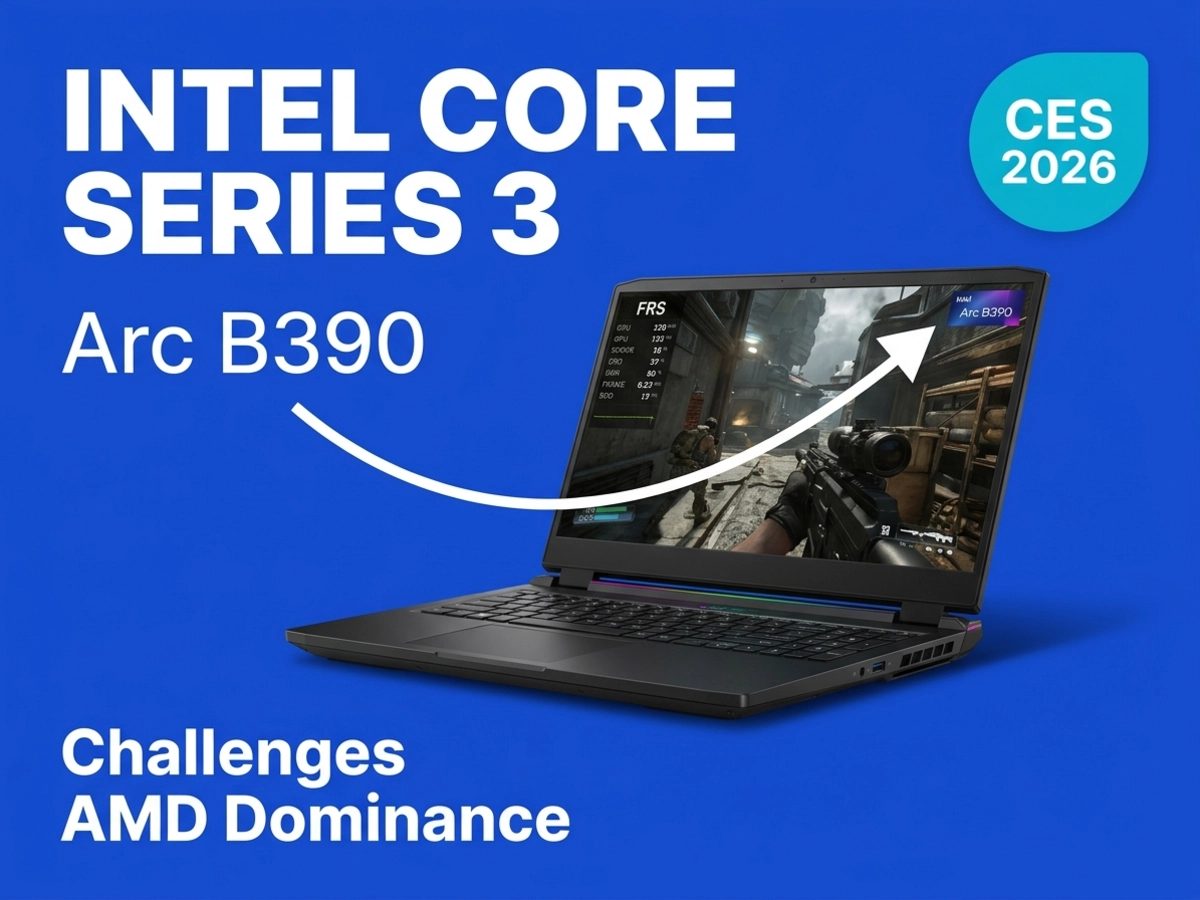
Intel (INTC) announced Core Ultra Series 3 processors at CES 2026, introducing integrated graphics that match discrete GPU performance. The Arc B390 delivers results that could reshape which devices need dedicated graphics cards. Intel's partnerships with Acer, MSI, and others signal a coordinated challenge to AMD's handheld gaming dominance. For gamers considering upgrades, these processors present the first viable x86 alternative to AMD's Ryzen solutions in portable gaming.
Buying a gaming laptop or handheld device in early 2026 means navigating a market where Intel has returned to competitive relevance after years of integrated graphics that barely registered in gaming conversations. The Arc B390, the flagship GPU in Intel's new Core Ultra Series 3 (Panther Lake) processors, has produced benchmark results that were difficult to ignore at CES 2026: up to 77% faster gaming than the previous Lunar Lake generation at equivalent power levels, with early low-power testing producing 46.6 fps in Black Myth: Wukong at just 15 watts. Those numbers set expectations. What independent reviewers found when they compared the B390 against the full range of AMD's current portfolio tells a more nuanced story about exactly where Intel leads, where it doesn't, and what it means for the devices you're considering.
The Arc B390 sits at the top of the Core Ultra Series 3 graphics stack, found in X9 and X7 processor SKUs. Below it, base and mid-range models carry a four-core Arc variant with substantially lower throughput. The 12-core B390 configuration delivers 96 execution units and over 1,500 shader processors. Most of its peak gaming performance remains accessible even when the chip operates below its ceiling: at 30 watts, independent testing showed approximately 90% of full-throttle output, which matters considerably for thin laptops that run cooler under sustained load.
Against AMD's Radeon 890M, the integrated GPU found in current mainstream AMD processors, the B390 led by 82% at native 1080p in Intel's own benchmark set, with the Intel chip consuming 45 watts versus AMD's 53 watts during the same comparison. That means Intel claimed both a performance and efficiency advantage simultaneously, which is an unusual combination at the integrated graphics tier.
What those numbers translate to in practice: games like Assassin's Creed Shadows and Black Myth: Wukong run in the low-to-mid 30s fps range with upscaling active, landing in the playable-but-not-comfortable zone for fast action. Competitive titles like League of Legends and Rocket League run without frame generation and still push toward 300 fps. The Arc B390 is not a chip for maxing out demanding titles at high settings; it is a chip that makes thin, light laptops viable for gaming that previously required bulkier discrete-GPU designs.
The 77% generational gain and the 82% Radeon 890M lead are both real and independently confirmed — but they describe Intel's performance ceiling against AMD's mainstream tier specifically. When independent reviewers included AMD's Strix Halo platform in the same comparison, the picture shifted significantly. The B390's benchmark position versus AMD depends entirely on which AMD product appears in the test.
Intel's CES comparison charts focused on the Radeon 890M, found in AMD's mainstream Ryzen AI 300 series processors. AMD's Rahul Tikoo, Senior Vice President and General Manager of the Client segment, addressed Intel's performance claims directly at CES 2026 and drew a clear line between AMD's product tiers. Referring to AMD's Strix Halo platform (the Ryzen AI Max series with up to 40 RDNA 3.5 compute units), Tikoo told Tom's Hardware that Strix Halo "will kill it. It's not even a fair fight at that point, because it's discrete-level graphics." At CES, AMD also expanded its Strix Halo lineup to include new 8-core and 12-core processor models, all carrying the full 40-compute-unit GPU configuration.
Independent benchmark coverage validated the competitive positioning Tikoo described. Testing by NotebookCheck across gaming workloads found the B390 running 20–35% behind AMD's Strix Halo (the Radeon 8060S variant) in gaming benchmarks, depending on the title. That same NotebookCheck analysis also found the B390 trailing Nvidia's RTX 4050 laptop GPU by 6–25% depending on the title, a wider range than Intel's CES slides suggested. Intel claimed an average 10% lead over the RTX 4050; reviewers found results that span a considerably wider band in both directions.
None of this undermines the B390's genuine achievement at the mainstream tier, where it clearly outperforms every other standard integrated GPU available today. But the nuance matters for anyone evaluating a purchase: AMD's mainstream Ryzen AI 300 chips have weaker integrated graphics than the B390, while AMD's premium Ryzen AI Max (Strix Halo) chips have substantially stronger integrated graphics. The B390 occupies the space between those two AMD tiers, not above both of them.
Intel's benchmark strategy at CES was deliberate: by selecting the Radeon 890M as the primary comparison point, the company produced impressive-looking delta numbers while sidestepping the Strix Halo comparison. The relevant competitive question for buyers isn't "Intel vs. AMD" in the abstract; it's which specific Intel chip they're comparing against which specific AMD chip in which specific form factor and price range.
Panther Lake's significance as an engineering achievement lies primarily on the CPU side of the die. The processor's compute tiles are manufactured using Intel's own 18A process node, which marks a reversal from Lunar Lake, the previous generation, which relied on TSMC for its primary compute tile. Intel's 18A introduces backside power delivery (PowerVia) and gate-all-around transistor geometry (RibbonFET), two structural improvements that reduce power leakage and improve transistor density simultaneously.
What the Arc B390's gaming performance does not come from is Intel's 18A process. The 12-core GPU tile in the B390 is manufactured on TSMC's N3E node, not Intel's own fab. The I/O platform tile uses TSMC's N6. Panther Lake is a multi-tile design with flexible foundry sourcing, and the gaming gains are attributable to Battlemage Xe3 GPU architecture improvements combined with the core count increase from 8 Xe2 cores in Lunar Lake to 12 Xe3 cores in the top B390 configuration, not to any in-house manufacturing breakthrough on the graphics side.
The 18A yield story is honest but imperfect. As Tom's Hardware reported, CFO David Zinsner stated: "We would have liked to have gotten yield stabilized sooner, but as we were adjusting performance, yield tends to be what gets impacted." Intel confirmed that Panther Lake products are shipping commercially but that profit margins on the platform will fall below typical targets through 2026 while the manufacturing ramp matures.
The 18A narrative is better understood as two separate stories. Intel successfully brought its own compute tile manufacturing back in-house for the first time in years — that is a genuine manufacturing milestone. The gaming performance improvement in the B390, however, came primarily from a chiplet sourced from TSMC, benefiting from Xe3 architectural development rather than from Intel's fabrication processes. Both achievements are real; conflating them overstates the 18A node's contribution to the gaming experience buyers will actually encounter.
Intel's official battery life figure for a Lenovo IdeaPad reference design running Core Ultra Series 3 was 27.1 hours of Netflix streaming, a number that reflects the chip's genuine efficiency during light media workloads. Independent reviewers reached comparable conclusions through their own testing. Club386's full platform review of an Asus Zenbook Duo built around the top-tier Core Ultra X9 388H processor recorded 17 hours and 53 seconds in a PCMark office benchmark before an unrelated software error interrupted the run, with battery charge still registering. That result came from a real device available for purchase, not from a reference design under controlled conditions.
The gap between plugged and battery gaming is remarkably small. During gaming sessions on the Zenbook Duo, Cyberpunk 2077 performance dropped by approximately three frames per second when disconnected from power — a difference that requires a frame counter to notice. The battery figures also confirm, though, that gaming mode depletes charge faster than office productivity. Standard balanced gaming sessions lasted approximately 2.5 hours, which is honest context for buyers planning to game away from an outlet.
For thin-and-light laptop buyers in the market now, the implications are clear. Systems became available for purchase beginning January 27, 2026, spanning major manufacturers across a range of price points. The X9 and X7 processor variants carry the full 12-core B390 GPU. Buyers who primarily play esports titles, story-driven games with upscaling active, or competitive games at moderate settings will find that the Arc B390 makes a discrete GPU either optional or redundant in a thin laptop form factor. The battery and gaming results together validate a practical use case that the previous Lunar Lake generation couldn't credibly deliver.
The most consequential claim from Intel's CES 2026 presentation was that Core Ultra Series 3 silicon could form the basis of a competitive handheld gaming platform. The supporting evidence is genuinely interesting. Testing by Tom's Guide using a laptop version of the Core Ultra X9 388H chip throttled to 15 watts measured 46.6 fps in Black Myth: Wukong at 720p low settings. At 10 watts, the same chip reached 30 fps in the same title. For context, the ROG Xbox Ally X, AMD's current flagship handheld running the Ryzen AI Z2 Extreme, managed 16.6 fps at 35 watts in Cyberpunk 2077 at 720p Ultra settings. The comparison is not perfectly like-for-like across game titles and settings, but the efficiency ratio Intel demonstrated is striking.
AMD's counter-argument is architectural rather than benchmark-based. Tikoo described Intel's notebook chip as carrying "baggage" ill-suited to a handheld context: "If you're putting a notebook chip like Panther Lake in there, you have all this baggage that Panther Lake is going to carry around its chiplet architecture. The interconnects of the chiplet architecture, the I/O that they have in there. I mean, it's a Swiss Army Knife." Intel's own response referred to AMD's Z2-series silicon as "ancient" relative to the Panther Lake node advantage.
Intel's path toward dedicated handheld hardware runs through its Core G3 series, Panther Lake chips tuned specifically for the handheld power envelope. The Core G3 Extreme variant is expected to carry 12 Xe3 GPU cores under an Arc B380 designation, slightly downclocked relative to the laptop B390. A base Core G3 model with 10 Xe3 cores (Arc B360) fills out the lineup. The series was initially positioned for late Q1 2026 but has since been delayed into Q2 2026. Partners confirmed for the handheld ecosystem include MSI, Acer, GPD, and OneXPlayer.
The handheld contest is genuinely unresolved and should be treated as such. The low-power efficiency data that Intel cited and that Tom's Guide tested comes from a laptop chip operating below its designed range, not from a purpose-built handheld chip. AMD's architectural critique of the chiplet approach carries enough technical merit that it cannot be dismissed until Core G3 devices ship and reach independent reviewers. The real-world performance of Core G3 in dedicated handheld hardware remains to be validated. Until that testing exists, treating Intel's laptop-class low-power data as a direct proxy for Core G3 handheld outcomes requires some caution. The next several months will resolve this question in a way that CES announcements cannot.
XeSS 3's multi-frame generation is the Arc B390's most durable competitive differentiator in the integrated graphics space. AMD had no comparable feature available at CES 2026; the technology is Intel's alone in the iGPU segment. Since the CES announcement, Intel has rolled out XeSS 3 multi-frame generation to all Arc GPU hardware through a driver update, meaning the capability isn't exclusive to Panther Lake but extends across Intel's broader Arc ecosystem.
What multi-frame generation does is use AI inference, running on the chip's neural processing unit, to synthesize additional frames between rendered frames, multiplying perceived smoothness without requiring the GPU to render each frame from scratch. The theoretical ceiling can approach a fourfold framerate multiplier. The practical outcome depends heavily on two variables: the base framerate the GPU can maintain before frame generation activates, and the refresh rate of the display being used. At base framerates below roughly 45–50 fps, generated frames can introduce latency artifacts that undermine the smoothness benefit. At base framerates above 60 fps with a display above 120Hz, the improvement is noticeable and largely artifact-free.
This kind of on-chip AI inference, where dedicated silicon handles computationally expensive tasks that would otherwise consume GPU cycles, is increasingly central to how hardware companies are positioning their next-generation products. The race to embed AI acceleration directly into consumer silicon runs parallel to much larger capital investments in AI infrastructure, including physical-world AI platforms like Project Prometheus that are targeting applications in aerospace and automotive rather than the software-layer AI that powers features like XeSS 3. For gaming hardware buyers, the relevant takeaway is that the AI silicon race is producing real, measurable consumer benefits today, not just abstract potential.
XeSS 3 multi-frame generation is most consequential for gaming laptop use cases rather than handheld scenarios. A thin laptop running the B390 at 30–45 watts, paired with a 120Hz or 165Hz display, sits in the sweet spot where the base framerate is high enough for frame generation to work cleanly and the display refresh rate is high enough to realize the benefit. A handheld device operating at 10–15 watts faces a different situation: base framerates in demanding titles at that power level may be low enough that frame generation needs to work harder and produces more variable results. The feature is real and represents a meaningful gap between Intel and AMD in the integrated graphics tier; its value is just more reliable in the context where the base hardware has headroom to spare.
The correct answer to "should I buy Intel or AMD?" depends on which devices and price points you're actually comparing. The Arc B390's competitive position shifts significantly depending on that context.
The B390 makes a strong case in the thin-and-light segment. Systems have been available since January 27, 2026, spanning major manufacturers across a range of price points. For buyers whose gaming diet includes esports titles, RPGs, and story-driven games where upscaling is acceptable, an X7 or X9 system eliminates the need for a discrete GPU while delivering battery life in the 15–18 hour office range. The only AMD competition at this form factor and performance tier is the Radeon 890M in mainstream Ryzen AI 300 chips, which the B390 outpaces significantly.
The caveat is supply: Intel's 18A manufacturing ramp means production throughput is building gradually through 2026, and top-tier X9 configurations face potential stock constraints. Early buyers may also pay a slight premium reflecting the manufacturing cost environment while Intel's 18A yields mature toward full profitability.
Core Ultra Series 3 chips provide a CPU foundation that won't bottleneck Nvidia's current discrete GPU lineup. The 60% multithread improvement over Lunar Lake at equivalent power levels means the processor side scales cleanly with higher-end graphics cards. AMD's Ryzen AI 400 series, announced at CES, did not introduce meaningful integrated graphics improvements over the previous generation, meaning AMD isn't currently offering a competing answer to the B390 in this segment.
Handheld buyers face a straightforward split: AMD is the proven option available today, Intel is the unvalidated option arriving mid-year. The Ryzen AI Z2 Extreme in the ROG Xbox Ally X has established game compatibility and developer optimization. If a handheld device is needed before mid-2026, AMD is the only viable x86 choice.
For buyers who can wait, Intel's Core G3 devices are targeting Q2 2026. The efficiency data from laptop testing is promising. Whether AMD's architectural critique of the chiplet approach proves meaningful in real Core G3 handheld hardware is an open question that only independent testing will resolve. The handheld segment is genuinely contested for the first time, and the answer for buyers who wait will be clearer than anything available to assess today.
Does the Arc B390 beat AMD's Radeon 890M? Yes, by a significant margin in gaming. Independent testing confirmed Intel's benchmark claims of roughly 73–82% better performance at comparable or lower power draw. The 890M is found in mainstream AMD Ryzen AI 300 chips used in thin laptops and current handheld devices.
Does the Arc B390 beat AMD's Strix Halo? No. AMD's Strix Halo platform, found in Ryzen AI Max processors used in premium thin laptops and some handheld devices, leads the B390 by 20–35% in gaming benchmarks. The B390 occupies a competitive position between AMD's mainstream iGPU and AMD's premium iGPU tier.
When will Intel-powered handheld gaming devices be available? Intel's dedicated handheld chip series, the Core G3, has been delayed from Q1 into Q2 2026. Handheld devices from partners including MSI, Acer, GPD, and OneXPlayer are targeting mid-2026 launches. No Intel-based handheld gaming PCs were commercially available at the January 2026 launch.
Is the Arc B390's gaming performance driven by Intel's new 18A manufacturing process? Only partially. The CPU compute tiles are on Intel 18A. The 12-core GPU tile that delivers gaming performance is manufactured on TSMC's N3E process. The I/O tile uses TSMC N6. Panther Lake is a multi-tile design with mixed foundry sourcing, and the gaming gains reflect Xe3 architectural improvements rather than solely an in-house manufacturing achievement.
What is XeSS 3 multi-frame generation and does it require specific hardware? XeSS 3 multi-frame generation uses AI inference running on the chip's NPU to synthesize additional frames between rendered frames, multiplying perceived smoothness. Intel has since rolled out this feature to all Arc GPUs through a driver update, so it is not exclusive to Core Ultra Series 3. It works best when the base framerate exceeds approximately 50 fps and the display runs at 120Hz or higher.
Should I wait to buy a gaming laptop, or buy one with the Arc B390 now? For thin-and-light gaming laptops, there is no strong reason to wait. Core Ultra Series 3 systems are available now, battery life is independently validated, and gaming performance at 45 watts outpaces the previous generation substantially. For high-end gaming laptops pairing discrete Nvidia GPUs with Intel CPU performance, the platform is equally ready. The waiting argument applies specifically to handheld gaming devices, where Intel's dedicated Core G3 chips arrive in Q2 2026.