Finished reading? Continue your journey in Tech with these hand-picked guides and tutorials.
Boost your workflow with our browser-based tools
Share your expertise with our readers. TrueSolvers accepts in-depth, independently researched articles on technology, AI, and software development from qualified contributors.
TrueSolvers is an independent technology publisher with a professional editorial team. Every article is independently researched, sourced from primary documentation, and cross-checked before publication.
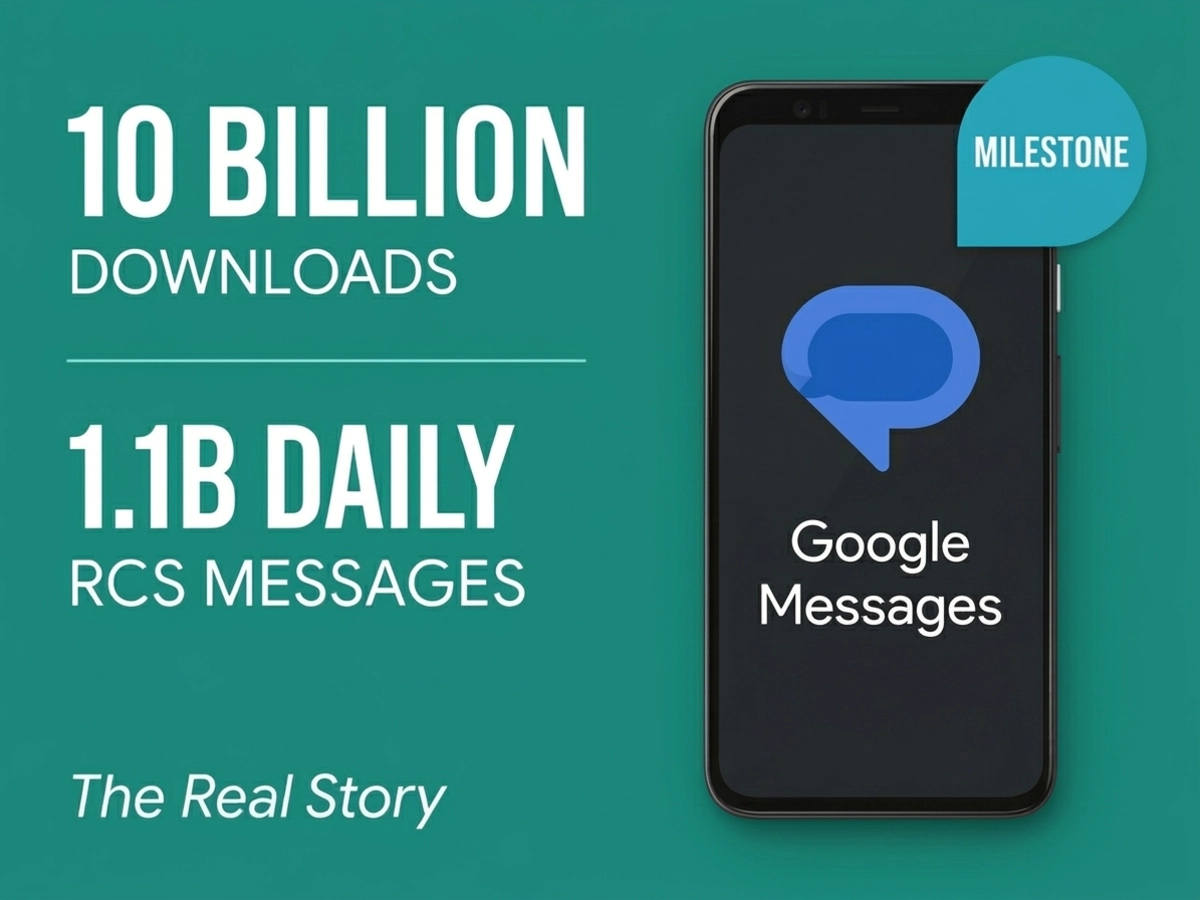
Ten billion downloads is a staggering number, and Google Messages has earned its place in an exclusive club on the Play Store. But if you want to understand what this milestone actually means for how you text with friends on different phones, the more important figure is 1.1 billion. That is the number of RCS messages sent through Google Messages in the United States every single day. The download count reflects Android's reach. The daily message count reflects something more meaningful: a protocol that spent a decade as a promising standard nobody could make work reliably has finally crossed into mass adoption, and the last significant gap between RCS and a dedicated messaging app is now being closed in a beta build shipping to developers right now.
9to5Google reported that Google Messages crossed 10 billion Play Store downloads in late March 2026, doubling from 5 billion in roughly two and a half years. The app had reached 1 billion downloads in May 2020, crossed 5 billion in September 2023, and now joins a group that includes Google Search, YouTube, Gmail, Chrome, and Google Maps. Phone by Google, the companion dialer app, crossed 5 billion downloads around the same time, landing alongside Files by Google, Google Calendar, and YouTube Music.
Those companion numbers are worth noting because they reveal what this group of apps actually represents: the core suite preloaded on Android devices worldwide. Every time someone activates an Android phone with a Google account, these apps register toward that install count. The download figure is real, but it measures Android's infrastructure scale as much as it measures product adoption.
The figure that is harder to dismiss is the daily active usage data. PhoneArena documented approximately 110 million daily active users in the US, about 185 million monthly active users in the US, and 750 million daily active users globally. More than 1.2 billion people use Google Messages at least once a month worldwide. The US figure for daily RCS messages sent through the app: 1.1 billion. Globally, 14 billion RCS messages travel through Google Messages every day.
Those are engagement numbers, not install counts. RCS, or Rich Communication Services, is the modern messaging protocol that replaces SMS with read receipts, typing indicators, high-resolution photo and video sharing, and end-to-end encryption for Android-to-Android conversations. It works inside the native messaging app on a phone; users do not need to download anything separate. No confirmed public timeline exists for several upcoming features, and we note that carrier support for specific capabilities varies significantly by market.
The 10 billion download number carries a subtext that the milestone framing tends to obscure. The majority of Google Messages installs did not come from people browsing the Play Store and choosing it over alternatives. They came from two structural decisions that effectively redirected the Android messaging market.
The first was Samsung. Starting with the Galaxy Fold 6 series, Samsung stopped preloading Samsung Messages on its devices and made Google Messages the default. That decision covered the largest Android device manufacturer in the world. Samsung subsequently took the further step of removing Samsung Messages from the Google Play Store entirely. Samsung's own discontinuation page confirms Galaxy S26 owners cannot download Samsung Messages from the Galaxy Store at all, and Samsung's official discontinuation page confirms that the full platform discontinuation is scheduled for July 2026.
The second was Verizon. Verizon's support documentation confirms that Advanced Messaging, its branded RCS service inside Samsung Messages, was discontinued in January 2025. The carrier explicitly directed customers to switch to Google Messages to continue using RCS features.
Samsung Messages dropped Verizon RCS support in January 2025. Samsung's own page now confirms Galaxy S26 owners cannot even download Samsung Messages from the Galaxy Store. Google Messages didn't win Android messaging; it was handed it, piece by piece, through a consolidation that eliminated the fragmentation blocking RCS reliability.
This matters beyond the download count because Samsung Messages had represented the principal source of Android messaging fragmentation. The app ran its own RCS implementation, which created inconsistency between devices and carriers. Google Messages uses Google's Jibe infrastructure to deliver RCS even when a carrier does not operate its own RCS network, which means users get RCS regardless of their carrier's configuration. With Samsung's exit, that reliability advantage extends across essentially the entire Android ecosystem.
Android represents more than 70% of global smartphone market share, which means RCS's potential user base has always been enormous in raw numbers. The problem is that in the United States, Android holds roughly 45% of the market. Apple's approximately 60% US share meant that any Android user texting an iPhone user was falling back to SMS for years, losing read receipts, quality media sharing, and typing indicators the moment the conversation crossed platforms.
Apple added RCS support to the iPhone with iOS 18 in September 2024. The effect on RCS traffic was immediate and dramatic. Infobip analyzed more than 530 billion interactions on its platform and documented a fivefold increase in global RCS traffic following the iOS 18 update, with North America specifically recording a 14x surge. Android Authority confirmed with T-Mobile that its customers alone were sending an average of 613 million RCS messages per day in 2025, including traffic from MVNOs like Mint Mobile and Google Fi. In 2020, that T-Mobile figure was 224.5 million messages per day, making the growth nearly threefold over five years.
What changed with Apple's adoption was not that iPhone users suddenly discovered RCS features. Many of those features have existed on Android for years. What changed is that the US iPhone user base, which had been a structural barrier to RCS's network effect, became part of the RCS ecosystem. We observe that the green bubble issue persists visually on iPhones even with RCS active, but the underlying protocol gap that made cross-platform messaging genuinely inferior has largely closed for features that matter daily.
Infobip's platform recorded a 14x surge in North American RCS traffic after iOS 18 dropped. T-Mobile customers alone were sending 613 million RCS messages per day by mid-2025, more than half of the national total. What those numbers show isn't feature adoption. It's the moment a network-effect threshold got crossed.
RCS has offered richer features than SMS for years, but one gap has kept it a step below Signal and iMessage for anyone who cares about security: until cross-platform E2EE ships, a message from an Android phone to an iPhone is encrypted in transit but readable by carriers and servers at the endpoint.
That gap is being closed right now. The foundation was laid when the GSMA, the international standards body that manages RCS, published Universal Profile 3.0 in March 2025. The specification defines end-to-end encryption for RCS using the Messaging Layer Security protocol, an open IETF standard. The GSMA described UP 3.0 as positioning RCS to become the first large-scale messaging service with interoperable end-to-end encryption across different providers' client implementations. Apple helped co-develop this specification alongside the GSMA.
Google has offered end-to-end encryption for Android-to-Android RCS conversations since 2020, using the Signal protocol. That protection, however, does not extend to iPhone-to-Android conversations. Those conversations have been protected by TLS, which secures the message as it travels through networks but leaves it accessible at servers along the route. The cross-platform E2EE testing that began with iOS 26.4 beta 2 in February 2026 marked the first time Apple and Google jointly tested the encrypted RCS connection across platforms. Apple's developer release notes for that beta cycle confirmed the feature would not ship in iOS 26.4 and would arrive in a future iOS, iPadOS, macOS, and watchOS 26 release.
Testing has since moved to iOS 26.5 beta, where Gadget Hacks confirmed that cross-platform E2EE between iPhone and Android is active for users running the beta alongside the latest version of Google Messages on a supported carrier. When the feature is active, a lock icon appears in the conversation confirming that message content cannot be read by anyone in the routing path. No confirmed public release date for cross-platform E2EE exists as of this writing, and we note that Apple has not committed to a specific iOS 26.x version for the feature.
Two practical details matter for users thinking through what this protection means. First, the RCS encryption implementation defaults to on but can be disabled, unlike iMessage which enforces encryption without a toggle. Second, content encryption does not cover metadata: the record of who you texted, when, and how often remains outside the protection scope. For everyday conversations, this level of protection is more than adequate. When that lock icon eventually appears by default in both Google Messages and Apple Messages, the practical privacy difference between RCS and a dedicated secure app narrows significantly for most users, though metadata remains outside the encryption scope. For users with serious privacy needs, Signal remains the appropriate tool because it addresses metadata as well as content.
The specification work behind RCS has accelerated considerably. The GSMA released Universal Profile 3.0 in March 2025, followed by Universal Profile 3.1 that summer, and most recently Universal Profile 4.0 in March 2026. Three major version releases in under 12 months represents a sharp compression of what had historically been a multi-year specification cycle. Universal Profile 4.0 adds rich text formatting such as bold, italics, and strikethrough, higher-quality media exchange through device-negotiated encoding, and video streaming in rich cards for business messaging.
The standard caveat for specification timelines is real: consumer availability typically lags a published specification by 12 to 18 months. The E2EE feature defined in UP 3.0 in March 2025 is still in beta testing a year later. Feature development at this cadence is meaningful, but users should expect the gap between what the standard defines and what appears on their phone to remain for some time after each release.
The commercial signals point in the same direction as the technical ones. The global RCS market was valued at approximately $3 billion in 2025 and is projected to reach $9 billion by 2030, with open rates around 72% and engagement levels roughly ten times higher than SMS due to the interactive elements that rich media and suggested replies enable. Those business messaging dynamics are one reason carriers and device manufacturers have moved decisively toward consolidation around a single RCS client.
The trajectory is clear enough that readers planning around messaging infrastructure can treat encrypted cross-platform RCS as a 2026-2027 reality rather than a distant promise, though carrier support timelines remain the variable we cannot pin down with precision.
Ten billion downloads marks Google Messages' arrival as Android's settled messaging infrastructure. The number worth watching from here is the day the lock icon appears by default in iPhone-to-Android threads. That is the moment RCS finishes what it started.