Finished reading? Continue your journey in Tech with these hand-picked guides and tutorials.
Boost your workflow with our browser-based tools
Share your expertise with our readers. TrueSolvers accepts in-depth, independently researched articles on technology, AI, and software development from qualified contributors.
TrueSolvers is an independent technology publisher with a professional editorial team. Every article is independently researched, sourced from primary documentation, and cross-checked before publication.
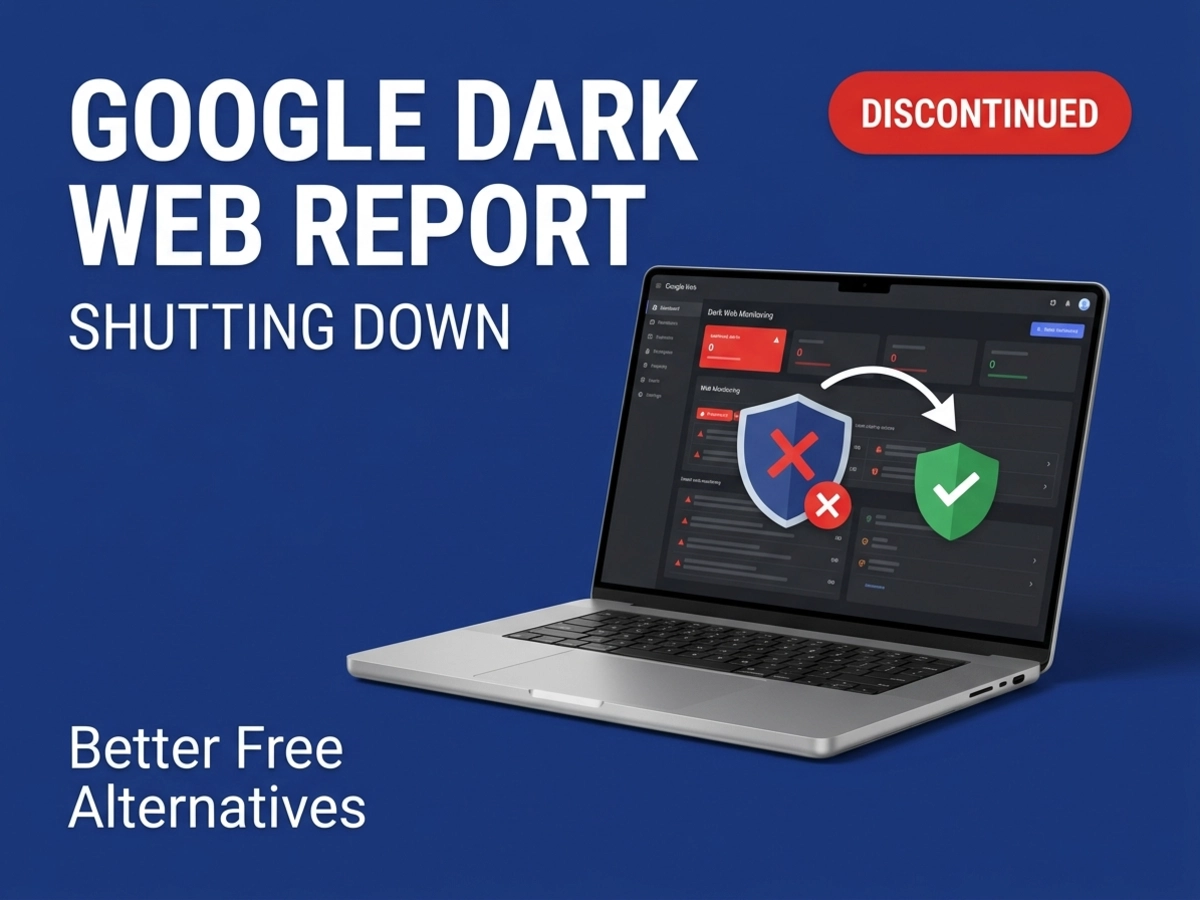
Google just discontinued its Dark Web Report feature originally launched as a Google One Dark Web monitoring tool for paid subscriber. If you've been using it to monitor whether your personal data appeared in criminal databases, you're probably wondering what protection you're losing and where to turn next. The answer might surprise you: you're losing less than you think, and the free alternatives available right now actually work better.
If you received an email in mid-December 2025 telling you that Google was retiring its Dark Web Report, you're not alone in wondering what just happened. According to 9to5Google, Google halted all new breach scans on January 15, 2026 and permanently deleted the tool along with all associated monitoring data on February 16, 2026. The stated reason, pulled directly from Google's own support documentation: the tool "did not provide helpful next steps" for people dealing with potential identity exposure.
That's an honest admission. Google didn't shut this down because of technical failure or low usage. It shut it down because the tool fundamentally couldn't tell you what to do when it found something. It would surface an alert, confirm that your email or personal information appeared in a breach database, and then largely leave you to figure out the rest. No specific account identified. No password flagged for immediate change. The alert arrived, the anxiety spiked, and the path forward stayed murky.
The feature launched in March 2023 as a perk for paid Google One subscribers, then became available to all Google account holders in July 2024. The shutdown timeline means the tool spent less than 18 months as a universal offering before Google concluded it created more stress than protection.
What makes the timing notable is that Google wasn't alone. Mozilla shut down Monitor Plus, its paid dark web and data broker scanning service, on December 17, 2025, just two days after Google's announcement. Mozilla cited issues with its data removal vendor; Google cited the actionability gap. Different stated reasons, but the same direction: two of the largest consumer technology companies exiting monitoring-adjacent features within 48 hours of each other.
Two of the largest consumer technology companies exiting monitoring-adjacent features within 48 hours of each other is less a coincidence than a category-level signal. Google cited the actionability gap; Mozilla cited vendor issues. Different stated reasons, but passive breach notification, a tool that tells you data is out there without specifying which account to act on, is a product model neither company believes serves users well enough to sustain. The implications of that judgment are worth understanding before you decide what to replace it with.
Google's Dark Web Report scanned for a defined set of personal identifiers: name, email address, phone number, physical address, and date of birth. For US account holders who verified billing information, Social Security number monitoring was also available, though that category required additional identity confirmation steps and was not automatically included for everyone.
When the tool found a match in known breach databases, it surfaced the result in redacted form and sent a notification. It could confirm that your email had appeared somewhere. It could not tell you which website's database had been compromised, which specific account credentials were involved, or whether the breach was from last month or three years ago. The tool was designed to detect presence, not to enable targeted response.
That limitation isn't specific to Google's implementation. It reflects something structural about how free consumer dark web monitoring tools operate. These services scan breach databases that have already surfaced on publicly accessible sites, meaning the data was stolen, privately sold, traded between criminal networks, and eventually leaked to public repositories before any monitoring service could index it. By the time you receive an alert, the breach itself is old news in criminal circles.
The criminal landscape has also shifted in ways that make "dark web monitoring" increasingly incomplete as a description of what these services actually cover. BreachForums, one of the most prominent forums for trading stolen credentials, was shut down by the FBI in 2025. Rather than disappearing, that activity has largely migrated to Telegram channels, thousands of which are now dedicated to buying and selling stolen account credentials. Automated consumer monitoring tools cannot scan these channels. Neither can paid enterprise services in any comprehensive way.
Google's stated reason for the shutdown describes a universal problem rather than a product-specific failure. Every free consumer monitoring service alerts you to data that's already been publicly circulating for some time, stolen, privately sold, traded between criminal networks, and eventually leaked to public repositories before any monitoring service could index it. None of them can reach the private sales channels or Telegram communities where freshly stolen data is actively traded. The honest framing is that these tools monitor the historical record of public breaches, not the current state of the criminal marketplace.
The shutdown creates a real gap, but understanding its actual size matters more than the emotional response the loss of a security tool tends to trigger.
What you no longer have: automated scanning of publicly known breach databases tied to your specific Google account, with results surfaced in a single dashboard. You had one place to check whether your name, phone number, or email had appeared in major public data breaches. That convenience is genuinely gone.
What wasn't there to begin with: access to invite-only criminal communities, fresh breach data before it reaches public repositories, private credential sales, financial account numbers, credit card data, or any mechanism to tell you which specific account or password was compromised. The tool monitored public signals only, and it couldn't close the gap between "your email appeared somewhere" and "change this specific password on this specific account."
The threat environment has not improved in the meantime. According to Gen's Q4 2025 Threat Report, as cited by Norton, the volume of breach events climbed 175% quarter-over-quarter, with a steady upward trend throughout the year. More breaches happening doesn't mean a tool that could only detect old, public-facing ones was protecting you from most of them.
The actual protection provided by passive monitoring services is proportional to how actionable the alert is. A notification that tells you a specific password was found in a specific breach, and which account to log in and change right now, has genuine value. A notification confirming your email appeared somewhere in a public database without further detail provides awareness without leverage. Google's tool was firmly in that second category.
Troy Hunt's Have I Been Pwned remains the most reliable free alternative for breach monitoring, and it covers more than Google's tool did.
The database currently indexes 959 breached websites and continues growing as new breaches are confirmed and processed. In November 2025, Hunt completed processing a dataset from Synthient, a threat intelligence platform that compiles credential stuffing data. As documented by Paubox, citing Hunt's announcement, the dataset contained approximately 2 billion unique email addresses and 1.3 billion unique passwords. Of those passwords, 625 million had never previously appeared in HIBP's database. Verification of a sample showed many of those passwords remain actively in use on current accounts.
HIBP operates at two levels that Google's Dark Web Report did not. The Pwned Passwords service lets you check any specific password against the breach database, separate from your email address, so you can determine whether a password you're currently using has ever appeared in known stolen data. And HIBP's breach data increasingly includes information about which specific websites credentials were entered into, which means the alert can point you toward a specific account to secure rather than simply confirming your email exists somewhere in a dump. Both capabilities go beyond what Google offered.
Both of those capabilities go beyond what Google offered. You can check any email address without creating an account. Setting up ongoing notifications for future breaches is free and requires only an email confirmation. The service operates with no subscription requirement.
Mozilla's monitoring service has operated under various names since 2018, starting as Firefox Monitor before rebranding to Mozilla Monitor in February 2024. As noted in the shutdown timeline above, Mozilla retired Monitor Plus, its paid data broker removal service, on December 17, 2025. That paid tier cost $13.99 per month and provided automated scanning and removal requests to data brokers.
The free Mozilla Monitor service, powered by HIBP's breach database, continues operating. Following the Monitor Plus shutdown, Mozilla expanded free monitoring coverage to support up to 20 email addresses per user. The free service provides real-time breach alerts and step-by-step guidance for resolving each breach it finds, including which accounts to prioritize and what specific actions to take. That guided remediation is the element Google's tool was missing.
If you previously used Firefox Monitor or Mozilla Monitor, nothing has changed for the free tier. If you were a Monitor Plus subscriber, that service is gone, and the removal features it provided are no longer available through Mozilla.
The practical case for using what Google still offers is stronger than it might seem after a discontinuation notice.
Password Checkup, accessible at passwords.google.com, scans your saved passwords against known breach databases and flags exactly which ones have been compromised. Unlike Dark Web Report, it doesn't tell you that your email appeared somewhere; it tells you which specific password on which specific account needs to change right now. That's the actionable gap the discontinued tool never filled.
Security Checkup provides a broader review of your entire Google account's security configuration, including account recovery options, connected third-party apps, and two-step verification status. Both tools are free and don't require any subscription.
Passkeys represent a meaningful shift for the accounts that support them. Rather than creating a password that could later appear in a breach database, passkeys authenticate using cryptographic keys stored on your device, tied to biometric verification. They cannot be phished, and because no password is transmitted or stored on the service's servers in the traditional sense, there is nothing for a breach to expose from your side of the equation. The list of sites supporting passkeys has grown considerably and includes Google, Apple, Microsoft, and a substantial portion of major consumer services.
Monitoring services occupy the least powerful position in the personal security hierarchy. They detect something that has already happened and has likely been happening for months before the alert reached you. The tools that matter most are the ones that make stolen credentials worthless rather than simply confirming they've been stolen.
A unique password for every account is the foundational change. When one site is breached, a stolen password only unlocks that single account rather than cascading into every other service that shared the same credentials. A password manager handles the generation and storage, removing the practical barrier to doing this at scale. The inconvenience argument against unique passwords largely disappeared once password managers became standard in every major browser.
Multi-factor authentication closes the gap that remains even when a password is confirmed stolen. With MFA enabled, an attacker holding valid credentials still cannot access the account without the second factor. Authenticator apps provide stronger MFA than SMS-based codes, though even SMS-based two-step verification meaningfully raises the cost of account compromise. The same logic extends to software updates: keeping devices and apps current removes the exploitable vulnerabilities that attackers target during the window between a patch release and its widespread adoption, a pattern we examined in detail in our analysis of how attackers exploit patching delays.
Every security researcher, vendor, and monitoring service converges on the same hierarchy: credential hygiene and authentication methods at the top, monitoring services at the bottom. Monitoring tells you about past failures. Strong authentication absorbs the damage those failures would otherwise cause.
The criminal marketplace context reinforces this hierarchy. As stolen credential trading migrates increasingly to Telegram channels and other spaces that no consumer monitoring tool can reach, the window between a breach and an alert has grown. Passkeys for the accounts that support them and unique passwords plus MFA for everything else represent protection that doesn't depend on the monitoring layer catching anything at all.
Google's decision to retire Dark Web Report is, in that sense, internally consistent. The tool that tells you credentials were stolen is less valuable than the tools that prevent stolen credentials from being useful. Password Checkup, passkeys, and Security Checkup are all still in place. The monitoring layer is gone. What remains is the part that actually does the work.
Do I need to do anything before February 16, 2026? If you want to preserve any record of past breach alerts from Google's tool, you should export or screenshot that information before February 16, 2026. After that date, Google permanently deletes all monitoring data associated with the feature. The practical value of that historical data is limited, since the recommended response to any past alert remains the same: change the passwords on affected accounts and enable two-step verification.
Is paid dark web monitoring worth it if the free tools aren't enough? Paid services from security vendors cover more data categories than free tools: credit card numbers, bank account details, driver's license numbers, home title monitoring, and USPS address change alerts. They also access more breach sources than HIBP indexes. Whether that's worth the subscription cost depends on your specific risk profile. For most individuals, the combination of HIBP monitoring, Google Password Checkup, and strong credential hygiene addresses the practical threat. Paid services add breadth, but the marginal protection for most users is modest relative to what's already available at no cost.
Do passkeys eliminate the need for breach monitoring? For accounts using passkeys, monitoring for password-based credential theft becomes irrelevant because there is no password to steal. The breach monitoring question then becomes about the other data types: email addresses, phone numbers, physical addresses. Those identifiers still appear in breach databases regardless of your authentication method, so HIBP monitoring for email addresses retains value even for fully passkey-enabled accounts. The combination of passkeys where supported and HIBP notifications for everything else represents the current practical ceiling for free personal security monitoring.
Can I still use Firefox Monitor or Mozilla Monitor? Yes. The free Mozilla Monitor service continues operating with breach alerting powered by HIBP data, now covering up to 20 email addresses per user. What's gone is Monitor Plus, the paid data broker removal tier. If you were on the free service, nothing has changed except expanded coverage.