Finished reading? Continue your journey in Tech with these hand-picked guides and tutorials.
Boost your workflow with our browser-based tools
Share your expertise with our readers. TrueSolvers accepts in-depth, independently researched articles on technology, AI, and software development from qualified contributors.
TrueSolvers is an independent technology publisher with a professional editorial team. Every article is independently researched, sourced from primary documentation, and cross-checked before publication.
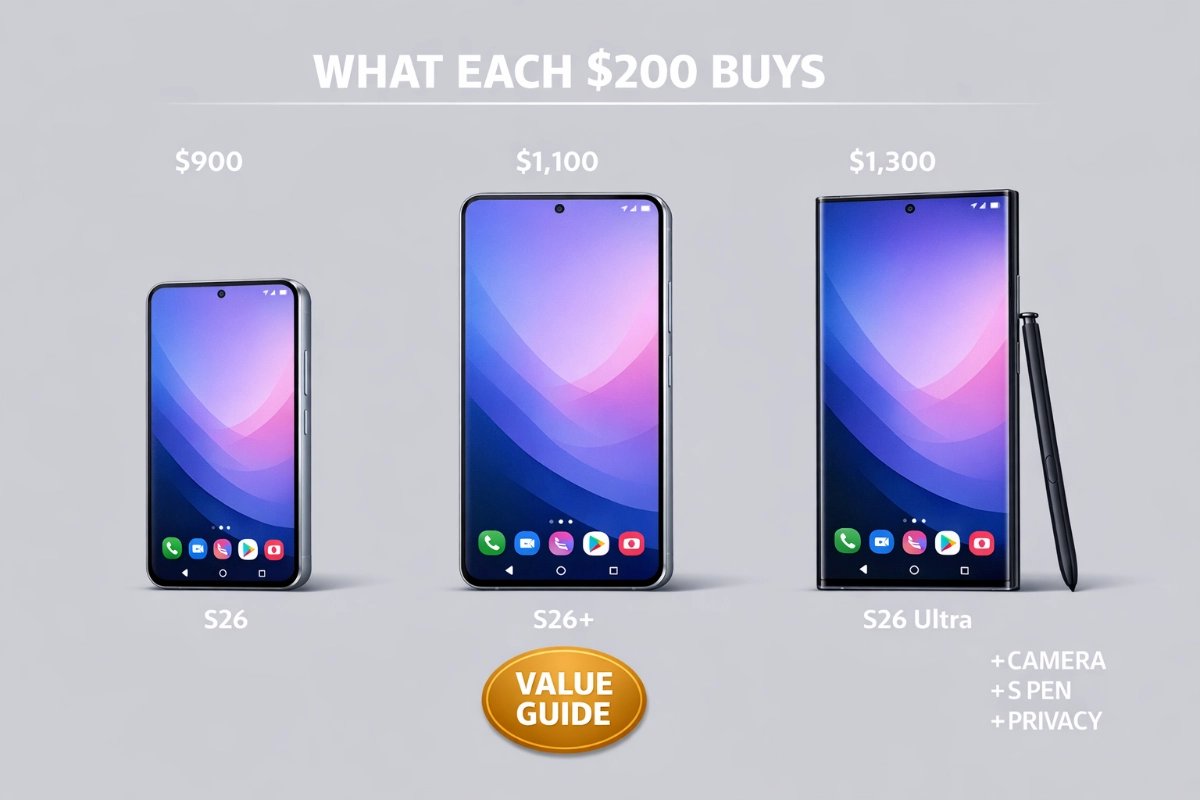
Samsung's Galaxy S26 lineup arrives with three models spanning $400 in price, but the spec sheet won't tell you which differences you'll actually notice daily. The base S26 costs $900, the Plus rings up at $1,100, and the Ultra commands $1,300. That's straightforward enough until you realize Samsung removed the 128GB option entirely, forcing every buyer into 256GB minimum storage at prices $40 to $100 higher than last year's equivalent models. Meanwhile, Apple's iPhone 17 with 256GB sells for $830. The pricing pressure creates an uncomfortable question: what are you getting for each $200 jump, and does it matter for how you'll use the phone? Marketing materials highlight megapixel counts and display sizes, but real-world performance gaps tell a different story. Some differences justify the cost. Others don't.
The Galaxy S26 lineup did not get more expensive because Samsung upgraded more. It got more expensive because of what's happening to computer memory, and Samsung's own leadership said so publicly.
Samsung's mobile COO Won-Joon Choi confirmed at the Galaxy Unpacked event that a global DRAM shortage made a significant contribution to the price increases across the S26 lineup, a situation he referred to as "RAMageddon." Server farms building out AI infrastructure have become the dominant buyers of advanced memory, locking up production lines that would otherwise supply consumer devices. The economics favor this shift heavily: chips destined for AI accelerators command far higher margins than the DRAM inside a smartphone. Samsung manufactures its own memory and still could not absorb the cost, which tells you the magnitude of the imbalance.
According to PhoneArena's pricing confirmation, the base S26 lands at $899.99, the S26+ at $1,099.99, and the S26 Ultra at $1,299. The iPhone 17 starts at $799 with 256GB; the iPhone 17 Pro Max at $1,199 is $100 cheaper than Samsung's flagship. The 128GB storage tier is gone across the entire lineup, so every comparison with last year's models needs to use 256GB equivalents as the baseline.
As SamMobile reported, the S26 Ultra's "flat price" claim applies only to the base 256GB configuration. The 512GB Ultra is $1,499, up $80 from last year's equivalent; the 1TB Ultra is $1,799, up $140. Samsung protected the headline number while passing costs to buyers who need more storage.
Samsung held the Ultra entry price flat specifically to preserve its competitive framing against the iPhone 17 Pro Max. The base S26 and S26+ absorbed the real increases. The Ultra's upper tiers absorbed the rest quietly. Buyers who go into this comparison looking at launch headlines will see a stable Ultra price. Buyers who price-configure will see something different.
All three Galaxy S26 models share significant common ground. They run Android 16 with Samsung's One UI 8.5, carry seven years of guaranteed software and security updates, support identical Galaxy AI features including Circle to Search and the AI-powered photo editing suite, use 120Hz adaptive AMOLED displays with IP68 water resistance, and ship with 256GB of base storage at launch.
The divergence between them falls into six specific dimensions.
The base S26 carries a 6.3-inch FHD+ display at 2,340 by 1,080 pixels. The S26+ steps up to a 6.7-inch QHD+ panel at 3,120 by 1,440 pixels. The S26 Ultra matches the Plus at QHD+ but extends to 6.9 inches. For streaming and media consumption, the QHD+ panels on the Plus and Ultra render noticeably sharper at close viewing distances.
The S26 and S26+ carry a 50MP main camera, 12MP ultrawide, and 10MP 3x telephoto. These are identical to each other. The Ultra adds a fourth lens: a 50MP periscope telephoto for 5x optical zoom, and its main camera carries a wider aperture. Camera hardware is covered in detail in the next section.
EU standardized endurance testing shows the base S26 at 51 hours per charge, with the S26+ and Ultra both at 55 hours. The prior generation hit 37 hours (base S25), 44 hours (S25+), and approximately 45 hours (S25 Ultra). That is a 38% improvement for the base model from a battery capacity increase of roughly 7%. The battery cell grew by less than 8%, yet endurance improved 38%. The gains come from the processor, modem, and display pipeline working more efficiently, not from larger cells.
The three models charge at different speeds. The base S26 supports 25W wired and 15W wireless. The S26+ handles 45W wired and 25W wireless. The Ultra reaches 60W wired and 25W wireless, with Samsung claiming 75% charge in 30 minutes from the wired connection. None of the three include magnetic Qi2 support built in; that requires a compatible case.
Coverage of this dimension is in its own section below, because the geography-based chip split affects every buyer differently.
Privacy Display and the embedded S Pen exist only on the S26 Ultra. These are addressed in detail after the camera and processor sections because they drive the Ultra's $400 premium over the base S26.
GSMArena's hands-on coverage confirmed what is becoming a defining characteristic of Samsung's mid-range flagship strategy: the S26 and S26+ carry the same camera hardware they have shipped with for four consecutive generations, going back to the Galaxy S22 and S23 era. If you owned an S23, S24, or S25, and you buy the S26 or S26+, you are shooting with the same sensors and lenses.
The Ultra is different. GSMArena also confirmed the Ultra's main camera aperture widened from f/1.7 to f/1.4, a change Samsung characterizes as capturing 47% more light. The 5x periscope telephoto improved from f/3.4 to f/2.9, capturing 37% more light. These are aperture improvements, not sensor size upgrades. The practical benefit concentrates in low-light conditions: indoor shooting without flash, nighttime outdoor photography, events in dim venues. In bright daylight, the aperture difference between the S26 Ultra and the base S26 is minimal; both have ample light to work with.
The Ultra also introduces APV, an open professional video standard supported at up to 8K/30fps. This is the first smartphone implementation of the codec, and it matters specifically for creators doing multi-generation video editing where quality preservation through repeated exports is the goal. Most buyers will not use it.
Samsung is shipping the same sensors and lenses in its mid-range flagships for the fourth consecutive generation while marketing AI-driven improvements that apply across all three models equally. The hardware improvements, aperture, optical zoom, low-light performance, live exclusively in the Ultra. Buyers upgrading from an S23 or S24 to an S26 or S26+ are paying for a better processor, better battery life, and AI software maturity. They are not paying for better glass.
The dual telephoto on the Ultra (10MP 3x plus 50MP 5x) enables up to 100x digital zoom versus 30x on the other models. Practical zoom quality in the 3x to 10x range is where the gap between models matters most. Beyond 10x, digital magnification degrades rapidly on all three. For concerts, sports, and wildlife at range, the Ultra's 5x optical anchor gives it a genuine quality advantage in that mid-telephoto window.
The Galaxy S26 lineup is not one phone sold globally. It is two phones sold under identical names at identical prices.
In the United States, Canada, China, and Japan, all three models ship with the Snapdragon 8 Elite Gen 5. In Europe and most other global markets, the S26 and S26+ receive Samsung's Exynos 2600 instead. The S26 Ultra ships with Snapdragon everywhere, making it the only model that avoids this geographic split.
NotebookCheck's post-launch benchmark analysis placed the Snapdragon ahead of the Exynos 2600 by roughly 10 to 18% in single-core CPU testing, depending on the run, while multi-core scores landed within approximately 5% of each other. The Exynos GPU, built on AMD's RDNA4 architecture under the Xclipse 950 branding, matched or edged the Snapdragon in OpenCL graphics rendering.
Early benchmark data captures short-burst performance rather than sustained workloads, and on that basis European buyers of the S26 and S26+ are receiving a chip that is meaningfully behind in single-core CPU speed but competitive in graphics rendering. For everyday use, messaging, social media, streaming, and standard photography, the gap is unlikely to be perceptible in practice. For sustained gaming sessions or extended 8K video recording, the Snapdragon's CPU advantage is more likely to surface. This early data does not yet fully characterize how the Exynos 2600 performs under prolonged thermal load, a dimension where prior Exynos generations struggled.
For a deeper look at why Samsung made the 2nm manufacturing bet on Exynos and what it means for heat management over time, see our full analysis of the Galaxy S26 chip strategy.
The disclosure problem is not new but worth stating plainly: Samsung does not prominently communicate the chip difference. The model numbers are identical. The prices are identical. Buyers paying £879 in London and $899 in New York are receiving objectively different hardware.
The battery story across the Galaxy S26 lineup runs in two directions: dramatically better for the next four to five years, and quietly worse after that.
The EU endurance figures (51 hours for the base S26, 55 hours each for the Plus and Ultra) represent the most significant improvement Samsung has delivered in years. The base S26 improved 38% over its predecessor despite a battery cell that grew by less than 8%. That efficiency gain applies regardless of which of the three models you buy, making it the one upgrade that every buyer in this lineup receives equally. The S26 base achieves nearly the same runtime as the two more expensive models despite carrying 600 to 700mAh less capacity. For most buyers who charge nightly, all three models will clear a full day without effort. The Plus and Ultra provide meaningful headroom for heavy users or extended travel days, but the gap is smaller than the price difference implies.
The long-term concern is the battery health rating. EU certification documentation shows Samsung rated the S26 lineup to maintain 80% battery capacity through 1,200 charge cycles, down from the 2,000 cycles Samsung rated the S25 series. At roughly 250 cycles per year of typical use, the S26 series reaches its 80% threshold in four to five years. The S25 series was rated for approximately eight years at the same threshold. Samsung improved present-day performance and shortened the long-term ownership curve at the same time.
The silicon improvements that delivered the dramatic endurance gains also operate with a different cell chemistry profile, a deliberate trade. Buyers who plan to own their phone for five or more years should factor this in. Buyers on two to three year upgrade cycles are unlikely to notice.
Charging speed varies by tier in meaningful ways. The base S26's 25W wired charging is adequate but slower than competitors at its price point. The S26+ at 45W wired lands in a more competitive position. The Ultra's 60W wired is Samsung's fastest to date. None of the three models include magnetic Qi2 functionality natively, which continues to give the iPhone an ecosystem advantage for charging accessory compatibility.
The S26 Ultra's defining differentiation over any Samsung phone previously released is a display that physically prevents side-angle viewing rather than filtering it through a software overlay or adhesive film. Samsung's Flex Magic Pixel technology accomplishes this by using two pixel types in tandem: narrow pixels for on-axis visibility and wide pixels for broad brightness. Privacy Display turns off the wide pixels, collapsing visible brightness for anyone not looking straight at the screen.
AndroidAuthority reported on UL Solutions' independent testing, which measured 3.5% of normal brightness retained at 45 degrees off-axis and 0.9% at 60 degrees, compared to roughly 40% for a typical smartphone screen at similar angles. The feature applies in all four directions and can be configured for the full display or specific areas, such as masking notification popups while leaving the rest of the screen visible. For finance, healthcare, legal, or other fields where shoulder-surfing is a genuine security concern, the capability is real and independently verified.
Privacy Display works exactly as Samsung describes, UL Solutions' numbers confirm it. The tradeoff is one most comparison articles omit: the dual-pixel panel design that enables Privacy Display also affects display performance when the feature is off. Tom's Guide's lab testing found the S26 Ultra's display measurably dimmer at side angles than the S25 Ultra even with Privacy Display completely disabled. This is not a malfunction; it is an inherent consequence of the LEAD 2.0 dual-pixel panel architecture. Buyers who frequently share their screen with others or regularly show content at an angle should weigh this before purchasing.
The S Pen remains embedded in the Ultra's body, which means no extra case, no separate charging, no risk of leaving it behind. It enables genuinely different workflows: precise handwritten note-taking, document annotation, photo editing with a stylus tip. What it no longer does, for the second consecutive generation, is connect via Bluetooth. The Air Actions gestures that allowed remote camera control and presentation navigation are gone for the second year running. The stylus is now purely a direct-contact input tool.
Samsung also removed titanium from the Ultra's frame this cycle, returning to aluminum across all three models. The S26 Ultra weighs 214 grams with a 7.9mm profile, 4 grams lighter than last year. Gorilla Glass Armor 2 covers the front and back of the Ultra; the base and Plus use Gorilla Glass Victus 2.
The right Galaxy S26 depends on which of the six dimensions above matters to your daily use, not on which spec list looks more complete.
The S26 makes the clearest value case in the lineup. The battery efficiency improvements that took it from 37 hours to 51 hours of rated endurance fixed the most common complaint about the prior generation. It shoots with a triple-camera system that handles everyday photography competently. It is the smallest and lightest of the three at 6.3 inches. For buyers in Snapdragon markets, it runs the same processor as the rest of the lineup. The S26 delivers roughly 90% of the S26 Ultra's daily experience for 69% of the Ultra's price.
The S26+ costs $200 more than the base S26 and delivers identical camera hardware. The $200 premium buys a larger 6.7-inch QHD+ display, faster 45W wired charging, and mmWave 5G support. It buys nothing photographically: the camera hardware is identical to the base S26. It includes neither Privacy Display nor the S Pen. For buyers who specifically want a larger screen and find the base S26 too small, the Plus delivers on that narrow use case. For any buyer weighing camera capability or exclusive features, the Plus offers no upgrade path and no hardware differentiation from the $200-cheaper model below it.
The Ultra earns its premium when two conditions are met: the buyer will genuinely use the exclusive capabilities, and they are comparing within the Samsung ecosystem rather than across brands. Privacy Display provides documented privacy protection for professionals in sensitive fields. The S Pen enables a handwriting and annotation workflow that no touchscreen-only phone can match. The wider-aperture cameras deliver measurably better results in low-light conditions where the base model struggles.
The cross-brand comparison is harder to dismiss this cycle. The iPhone 17 Pro Max sells for $1,199, $100 less than the S26 Ultra, with its own competitive camera system and a strong ecosystem case. Buyers in Europe receive an S26 Ultra with Snapdragon worldwide, making the Ultra the only model in the lineup that avoids the regional processor split entirely, which adds a real geographic premium to its value in those markets.
The Ultra is the wrong choice if Privacy Display will go unused and the S Pen will stay embedded. Buying the Ultra for camera bragging rights while shooting primarily in daylight conditions where the aperture advantage disappears produces an expensive phone with underused hardware.
The $900 to $1,300 range this cycle covers genuinely different products. The base S26 is a well-optimized daily driver with meaningful efficiency gains. The Plus is a larger-screen variant with faster charging. The Ultra is a professional tool with privacy and productivity hardware that justifies its cost only when those tools get used.