Finished reading? Continue your journey in Tech with these hand-picked guides and tutorials.
Boost your workflow with our browser-based tools
Share your expertise with our readers. TrueSolvers accepts in-depth, independently researched articles on technology, AI, and software development from qualified contributors.
TrueSolvers is an independent technology publisher with a professional editorial team. Every article is independently researched, sourced from primary documentation, and cross-checked before publication.
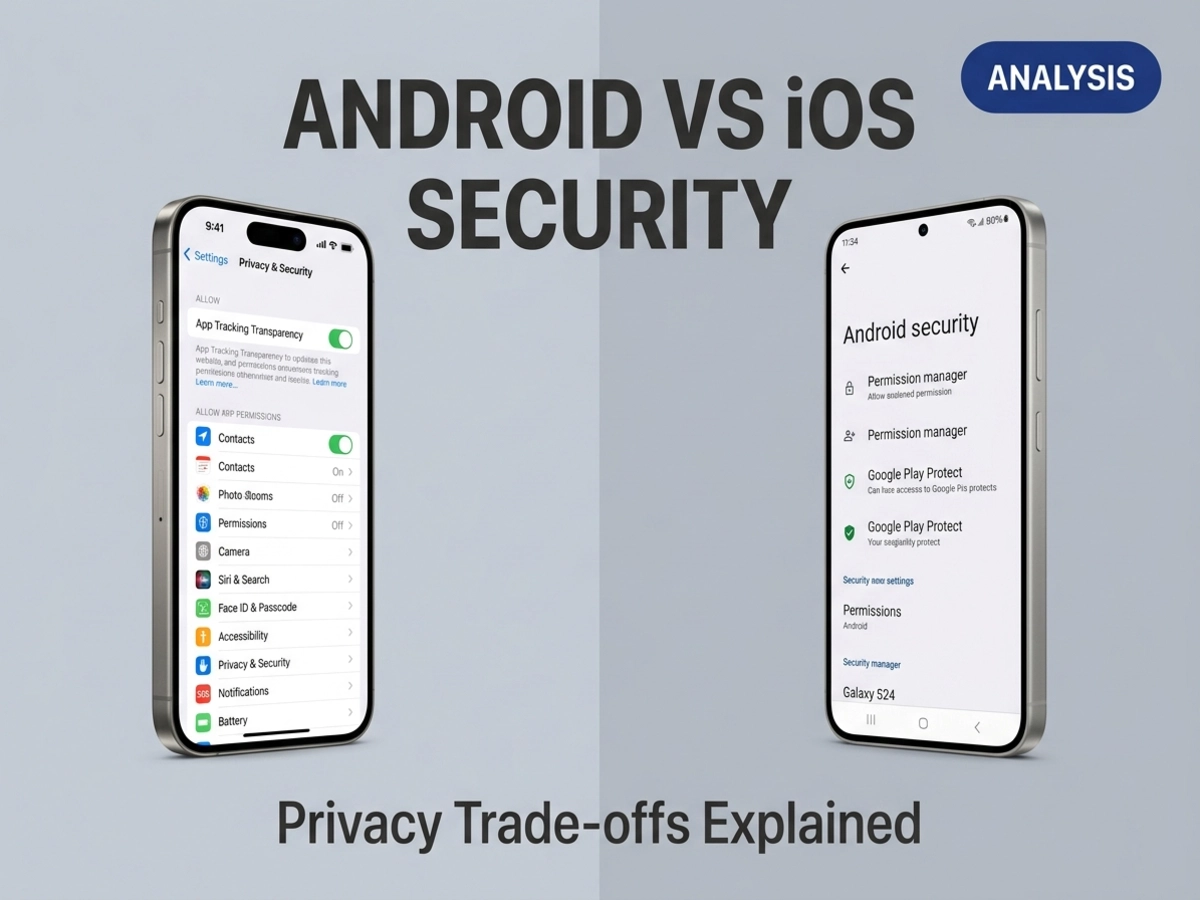
Mobile security isn't a simple contest with a clear winner. iOS and Android make fundamentally different security sacrifices that affect your data protection in specific ways. Apple's locked-down ecosystem prevents many attacks but restricts your control. Android's open architecture offers transparency and flexibility while expanding potential attack surfaces. Understanding what each platform trades away helps you choose based on which vulnerabilities actually threaten you.
Security on a smartphone begins before you install your first app, configure a single permission, or choose a PIN length. It begins with a design philosophy baked into the platform at the manufacturing level, and the two dominant platforms made opposite choices.
Apple builds iOS as a vertically integrated system. The same company designs the hardware, writes the operating system, develops the hardware security module (the Secure Enclave) that stores biometric data and encryption keys, and operates the only official channel through which software reaches your device. This compression of control into a single entity creates extraordinary consistency. Every supported iPhone runs the same software, protected by the same security architecture, updated through the same deployment pipeline.
Android starts from a different premise entirely. Google develops the core operating system and releases it as open-source code, which manufacturers then customize for their own devices. Samsung adds its own interface layer. Xiaomi adds another. A budget device manufacturer adds another still, and carriers may add customizations on top of that. Each layer is a potential divergence from Google's security baseline. The same code that enables this flexibility, the Android Open Source Project, also enables researchers worldwide to inspect it for vulnerabilities before attackers do. Transparent architecture cuts both ways.
Apple earns revenue from hardware sales. Google earns revenue from advertising. These aren't incidental facts about two technology companies — they're the source code for every design philosophy, default setting, and permission model each platform implements. Security and privacy function as competitive differentiators for Apple without creating internal tension. For Google, the data flows that advertising requires sometimes pull against the strictest privacy configurations. These incentive structures flow downstream into the architecture before any engineer writes a line of code.
Neither approach eliminates risk. Each one decides where the risk concentrates.
The malware statistics for Android are striking. Kaspersky's 2024 full-year threat report documented 33.3 million blocked mobile attacks and a 196% surge in banking trojan incidents, with attack volumes climbing from 420,000 incidents in 2023 to 1,242,000 in 2024. The acceleration has continued: Kaspersky recorded 29% more Android attacks in the first half of 2025 compared to the same period the previous year. These numbers invite an obvious conclusion. They don't quite support it.
Android commands roughly 72% of global smartphone market share. A platform serving that proportion of the world's devices will attract attackers in proportion, regardless of its underlying security quality. More meaningfully, the threat distribution within Android tells a different story than the totals do. Adware remains the most prevalent threat category by volume of affected users. Banking trojans are growing fastest but still rank fourth by share of users who actually encounter them. The attack vector that drives the most severe infections is consistently identified across threat research as sideloading: installing apps from outside the official Play Store.
Google Play Protect identified 27 million new malicious sideloaded apps in 2025, more than double the 13 million identified in 2024. Google blocked 2.36 million policy-violating apps from the Play Store in 2024 as a separate line of defense. The implication is significant: the apps reaching users through official channels were blocked before installation; the 27 million identified as malicious were found precisely because they came from elsewhere.
The raw Android statistics and the actual threat exposure for a Play Store–only user describe two different realities. The statistical weight comes disproportionately from devices that sideload, from budget hardware sold in markets with preloaded malware, and from devices running outdated software on long-discontinued update timelines. A user who installs exclusively from the Google Play Store faces a threat profile that is meaningfully smaller than those totals suggest. Android's openness is both its defining feature and its largest exploitable property — and whether that openness reaches you depends almost entirely on how you install software.
iOS malware exists but targets differently. The App Store's mandatory distribution model filters threats before installation rather than detecting them after. The trade-off is that Apple's gatekeeping is imperfect: sophisticated actors have navigated App Store review processes, and no proactive filter catches every malicious app. But the absence of any official sideloading mechanism, at least until recently in the European Union, closes one of Android's primary attack vectors entirely for most of the world.
Every iOS app that reaches users in most of the world passes through Apple's App Store review. The system combines automated scanning with human review, checking submissions for privacy violations, malicious behavior, and policy compliance before installation is possible. This creates a security baseline that's consistent across the entire device population: every app any user installs has cleared the same gate.
The approach has documented weaknesses. Sophisticated actors have successfully placed malicious apps through App Store review, including convincing imitations of trusted software. Proactive filtering is only as effective as the filters, and novel attack techniques can outpace review processes. Promon's research found that over 90% of top iOS apps are vulnerable to repackaging attacks, a technique where legitimate apps are modified to contain malicious code and redistributed. This matters more now than it did before 2024.
Google Play Protect relies on AI-driven scanning that operates after apps are submitted and, in some cases, after they're installed. The system scans at enormous scale and uses behavioral analysis to catch threats that signature-based detection would miss. When Google blocked 1.75 million policy-violating apps in 2025, down from 2.36 million the prior year, the reduction reflected AI deterrence displacing bad actors before submission rather than reduced threat activity.
The reactive model carries inherent risk: threats can reach users before detection patterns are established. Users who install apps from sources outside Google Play receive substantially less protection. Play Protect monitors Google Play installations; it cannot extend the same coverage to APK files pulled from websites or distributed through messaging apps.
The European Union's Digital Markets Act, which took effect for Apple in March 2024 and was implemented in iOS 17.4, forced a change that Apple had structurally resisted for the platform's entire existence. EU users gained access to alternative app marketplaces outside the App Store with that update. With iOS 17.5, direct downloads from developer websites became possible in EU countries.
Apple implemented a Notarization system for these alternative distribution channels, involving both automated malware scanning and human review. Apple's own documentation for the DMA changes explicitly acknowledges that these alternative pathways introduce risks the company cannot fully contain. The repackaging vulnerability Promon identified becomes considerably more consequential in a distribution environment where unverified apps can reach users directly. The iOS security advantage from mandatory App Store distribution has been partially eroded in EU jurisdictions. For EU users, the platform gap has narrowed.
Security patches only protect devices that receive them. This distinction drove iOS's most durable security advantage for years: Apple deploys patches simultaneously to all supported devices, without manufacturer customization layers or carrier approval delays. Android's multi-manufacturer architecture meant patches traveled from Google to manufacturers to carriers before reaching users, and some devices never received them at all.
That gap has narrowed substantially at the premium end of the Android market. Google Pixel 8 series and later, along with Samsung Galaxy S24 series and later, now carry seven-year commitments for both OS and security updates. In December 2024, Google retroactively extended Pixel 6 and Pixel 7 models to five years of support. Honor's Magic 7 Pro joined the seven-year tier in the same period.
Mid-range Android phones commonly receive three to four OS updates with four to five years of security patches. Budget devices frequently reach end of support within two years of purchase, leaving large numbers of users running software with documented, unpatched vulnerabilities. The iOS advantage on update longevity now applies specifically to the segment of the Android market where it has always been most acute: mid-range and budget devices.
Apple's supported device window for recent models runs approximately five to six years. That number no longer represents a categorical iOS advantage for anyone buying a current-generation Pixel or Galaxy S device. It remains a real and significant disadvantage for the majority of Android users globally, since the budget segment where support is shortest is also where most Android devices are sold, particularly in markets across Latin America, Africa, and South Asia.
The update infrastructure is also evolving within Android. Google's Project Mainline enables certain critical security components to update independently of full OS upgrades, meaning some patches can reach devices that have otherwise aged out of manufacturer support timelines. This doesn't eliminate the fragmentation problem, but it reduces its severity for a subset of critical vulnerabilities.
The business model difference between Apple and Google creates fundamentally different default privacy configurations, and defaults matter more than most users realize. Most people never visit a settings menu they weren't directly prompted to open. The platform that protects users passively, without requiring active configuration, provides meaningfully stronger protection for the median user.
Apple's App Tracking Transparency framework, introduced in iOS 14.5, requires apps to request explicit permission before tracking users across other applications and websites. The feature is widely cited as a major privacy win, and it is. The specific figures cited in its favor, however, deserve scrutiny.
Both platforms offer hardware-level security through dedicated security modules. Apple's Secure Enclave and Google's Titan M2 chip perform the same essential functions: storing cryptographic keys, processing biometric data, and ensuring that sensitive operations occur in hardware-isolated environments that malicious software cannot reach. Both platforms also implement application sandboxing, restricting apps from accessing data outside their designated storage areas without explicit user permission. Apple's payment ecosystem extends this hardware security architecture into financial transactions; if you use Apple Pay specifically, the security prerequisites and verification layers that determine whether transactions actually succeed involve the same Secure Enclave protections discussed here, with some configuration gaps that standard setup guides routinely overlook.
Where the platforms diverge is in default configuration. iOS makes restrictive behavior the default and requires apps to explicitly request permission for data access, location, camera, microphone, and tracking. Android provides comparable permission controls but relies more heavily on users to engage with privacy dashboards and configure protections actively. For users who understand and use these tools, Android's permission model is at least as capable as iOS's. For users who do not, iOS's restrictive defaults provide protection that Android's active-configuration model cannot replicate passively.
Privacy Manifests became mandatory in the iOS App Store in May 2024, requiring developers to declare all data collection practices in advance. Apple reviews these declarations as part of the submission process. This creates an accountable, auditable record of what each app claims to collect, though declared practices and actual practices can diverge.
The most important distinction between iOS and Android security is often stated too simply. iOS is described as more secure against targeted attacks. That's technically accurate but meaningfully incomplete.
For users who need to move beyond both stock platforms, Android's open-source architecture creates an option iOS structurally cannot: GrapheneOS. This privacy-focused Android fork, supported only on Google Pixel devices due to their hardware security architecture, extends sandboxing substantially beyond stock Android and implements additional exploit mitigations. Privacy Guides recommends it as the leading privacy-focused Android distribution. Its principal limitation is practical: installation requires unlocking the device bootloader, which is a technical process that creates its own temporary security exposure and places this option outside the reach of most users.
The preceding analysis doesn't resolve into a simple recommendation because the correct answer depends entirely on which threats are most likely to affect you specifically.
iOS holds a clear advantage. The App Store's mandatory review process eliminates sideloading as an attack vector for users outside the EU. Android's openness to multiple installation sources creates substantially more exposure to malicious apps disguised as legitimate software, even accounting for Play Protect's scanning capabilities. If you install apps casually and without evaluating sources carefully, iOS's structural restrictions provide protection Android cannot match without significant user effort.
Android's open architecture, particularly through custom configurations or GrapheneOS, enables privacy controls iOS cannot accommodate by design. Installing privacy-focused apps from outside official channels, using system-level network monitoring tools, and implementing configurations that treat even Google's own services as untrusted are all available on Android. Each capability comes with a complexity requirement: the protection is only as strong as the configuration, and misconfigured privacy tools provide no real protection.
iOS's restrictive defaults and mandatory ATT consent requests provide passive privacy protection that functions without active user engagement. Android offers equivalent or greater privacy capabilities in principle, but realizing them requires navigating permission dashboards, evaluating app sources, and making informed decisions that most users never actually make.
The correct answer here now depends on which device you're buying. A current-generation Google Pixel or Samsung Galaxy flagship carries a seven-year update commitment that matches Apple's historical support window. A mid-range Android device at the $300 to $400 price point will likely receive three to four OS updates and lose security support within four to five years. A budget Android device may stop receiving patches within two years. iOS provides consistent support across its device range. The iOS update advantage is most consequential not for flagship buyers but for users who will purchase the same device category across both ecosystems at sub-flagship price points.
Is iOS more secure than Android overall? Neither platform is unambiguously more secure. iOS provides stronger protection against opportunistic malware and offers more passive privacy protection through restrictive defaults. Android's premium flagship tier now matches iOS for update longevity, and Android's open architecture enables privacy configurations iOS prohibits. The better question is which platform is more secure against the specific threats relevant to your situation.
Does iOS's App Tracking Transparency actually stop apps from tracking me? ATT creates a structural barrier that requires apps to request explicit permission before tracking you across other apps and websites. It is a genuine privacy protection. However, opt-in rates globally reached 50% by Q1 2024, meaning roughly half of users in many markets are granting this permission. ATT reduces unwanted tracking; it does not eliminate it.
Is GrapheneOS worth the effort? For most users, no. The installation process requires technical comfort with bootloader unlocking, and everyday usability involves trade-offs around app compatibility. For high-risk individuals who need to treat even platform services as potentially hostile, GrapheneOS represents the strongest available Android configuration and is worth the investment in setup time.
Which platform is better for long-term device ownership? For flagship devices, the gap has essentially closed: current Google Pixel and Samsung Galaxy S series devices carry seven-year update commitments matching Apple's historical window. For mid-range and budget Android devices, iOS retains a clear advantage. If you buy a new iPhone or a current-generation Android flagship, you can expect roughly equivalent support duration. If you buy a sub-$300 Android phone, iOS will outlast it on security support.
Can Android's privacy settings match iOS's privacy protections? In capability, yes. In practice for most users, no. Android's permission system is at least as granular as iOS's, and additional tools available through Android's open ecosystem extend privacy configurations beyond what iOS permits. But iOS enforces restrictive defaults that function without user action. Equivalent Android privacy requires deliberate configuration that most users do not undertake.