Finished reading? Continue your journey in Tech with these hand-picked guides and tutorials.
Boost your workflow with our browser-based tools
Share your expertise with our readers. TrueSolvers accepts in-depth, independently researched articles on technology, AI, and software development from qualified contributors.
TrueSolvers is an independent technology publisher with a professional editorial team. Every article is independently researched, sourced from primary documentation, and cross-checked before publication.
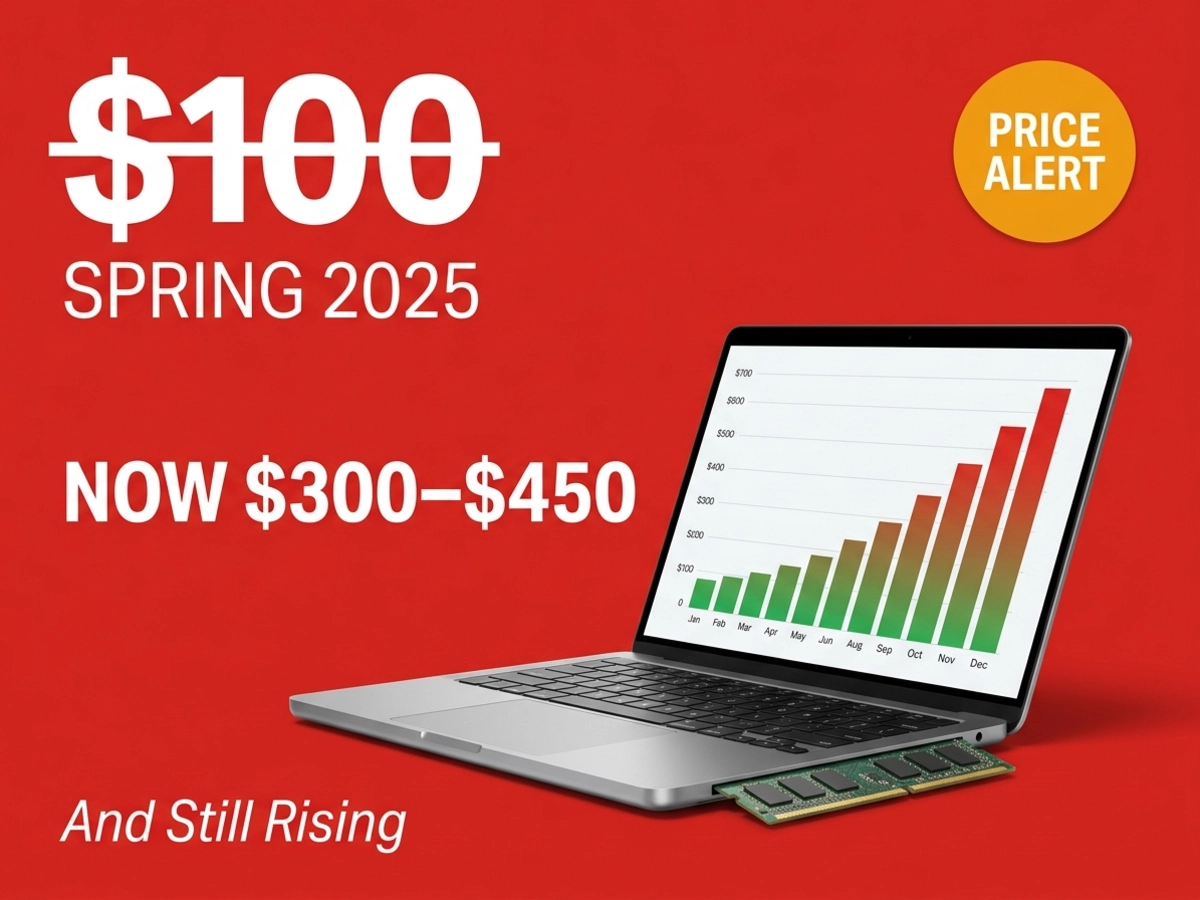
The memory inside your next laptop or desktop just became one of the most expensive components you'll buy. What was a $100 upgrade in spring 2025 now costs $300 to $450, and industry analysts are warning anyone planning a PC purchase that 2026 could be the most expensive year for consumer electronics in recent history. This isn't a temporary price spike. It's a fundamental restructuring of who gets access to memory chips, and PC buyers are losing.
RAM prices in 2026 are high for a reason that has nothing to do with how many PCs people want to buy. Samsung, SK Hynix, and Micron manufacture essentially all of the world's DRAM, and starting in late 2024, all three companies made the same calculation: the artificial intelligence infrastructure boom was substantially more profitable than serving PC and laptop buyers, and their manufacturing capacity should reflect that.
The mechanics are important to understand. High-bandwidth memory, the specialized chip architecture that powers AI accelerators from Nvidia and others, requires approximately three times the wafer manufacturing capacity per bit compared to standard consumer DRAM. AI companies don't just pay more for this memory; they also place open-ended purchase commitments, agreeing to take as much supply as manufacturers can produce. When the hyperscalers poured an estimated $650 billion into AI data center buildout in 2026 alone, up from $217 billion just two years earlier, the memory manufacturers were presented with a straightforward choice between two customer types.
The consequences are visible in allocation data. According to IDC, DRAM supply growth in 2026 is tracking at only 16% year-over-year, well below historical norms, while AI demand growth is outpacing that increase by a wide margin. IDC characterizes the shift as something more durable than a typical shortage cycle: a deliberate, long-horizon redirect of wafer output, where manufacturers have structurally deprioritized consumer memory rather than simply underestimated demand. The PC industry's share of that constrained supply is falling not because demand for PCs has collapsed, but because demand for AI memory has become overwhelming.
The scale of AI's memory commitments became tangible in October 2025, when Samsung and SK Hynix signed a letter of intent with OpenAI to supply 900,000 DRAM wafer starts per month toward OpenAI's Stargate infrastructure project. To put that in context, this single commitment represents a substantial fraction of total global DRAM output. Consumer memory demand didn't disappear; it was simply outbid.
New fabs coming online are not the same thing as new consumer memory coming to market. Samsung's P4 facility and SK Hynix's M15X plant are both ramping production in 2026, but the output of those facilities is committed primarily to advanced AI memory, not consumer DRAM. Manufacturers would need to make an active commercial decision to redirect a portion of that capacity toward consumer products. Given that AI customers are paying premium prices and have indicated they'll take all available supply, manufacturers have every financial incentive not to make that choice voluntarily. The shortage resolves when that calculation changes, not simply when physical capacity increases.
Price movements in late 2025 were unusually violent even by the standards of an industry that cycles through shortage and glut regularly. Spot market data tracked by Tom's Hardware via DRAMeXchange shows a 16Gb DDR5 chip averaging $6.84 on September 20, 2025. By November 19, that same chip cost $24.83. By December 1, it had reached $27.20, with session prices ranging from $19 to $37 depending on timing. The raw memory alone for a standard 16GB module was running more than $200 before any PCB, assembly, testing, or component costs were added.
For consumers buying retail kits rather than chips, the impact translated directly into sticker shock. A 32GB DDR5 kit that cost $90-120 in spring 2025 rose to $300-450 or more by early 2026. A 64GB kit that held steady around $200 through mid-2025 spiked to roughly $800-900 by year's end, a roughly 400% increase in six months. Even DDR4, the older memory standard that many expected to remain affordable, saw kit prices double or triple as manufacturers wound down production and enterprise buyers consumed available inventory.
The magnitude of Q1 2026 increases broke previous records. Counterpoint Research documented memory prices rising 80-90% quarter-over-quarter, describing the surge as "unprecedented and record-breaking." DDR4 laptop memory saw an estimated 91% quarter-over-quarter increase in Q1 2026 after rising 35% the previous quarter. Server RAM was tracking toward a 98% quarterly increase. Storage was moving simultaneously: NAND flash prices were projected toward a 100% quarter-over-quarter increase, meaning both the memory you compute with and the storage you save to were getting more expensive at the same time.
Consumer DDR4, consumer DDR5, server DRAM, and NAND flash all surged in the same quarters. A demand spike in one category typically reflects shifting buyer preferences. A supply constraint hits everything. The simultaneous across-category movement confirms that this is a manufacturing capacity problem, not a demand fluctuation in any individual segment.
On December 3, 2025, Micron Technology announced it was exiting its Crucial consumer brand entirely. Consumer product shipments from Crucial wrapped up at the close of February 2026. In a statement accompanying the announcement, Micron's chief business officer Sumit Sadana explained the decision plainly: the AI-driven surge in data center demand had grown large enough that the company needed to redirect supply toward "larger, strategic customers in faster-growing segments."
The Crucial brand had served consumer buyers for close to three decades. Its disappearance means that only Samsung and SK Hynix now supply consumer memory at any meaningful scale. This matters for reasons beyond simple competition. Third-party module makers, including Corsair, G.Skill, Kingston, and others that sell branded retail kits, do not manufacture their own chips. They buy chips from the same pool of manufacturers and assemble them onto PCBs. Micron's exit from consumer retail doesn't create a new supply constraint for these module makers; it reflects that the upstream chip supply situation had already tightened to the point where Crucial was no longer a viable retail business.
Micron's exit is not an additional cause of the shortage but rather the most explicit acknowledgment of it. When one of three global DRAM manufacturers concludes that selling RAM to individual consumers is no longer worth continuing, that signals how thoroughly the economics have shifted toward AI customers. Micron still manufactures DRAM; it simply no longer considers individual PC buyers a customer worth serving. That's a structural change, not a corporate housekeeping decision.
For anyone who built their own PC in the past decade, one of the reliable assumptions was that sourcing components independently would beat the price of prebuilt systems. That assumption broke in late 2025 and hasn't recovered.
The reason comes down to inventory timing rather than any structural advantage. Large OEMs like Dell, Lenovo, HP, and Asus secure RAM through rolling volume contracts, often locking prices six to twelve months in advance. When the shortage hit spot markets in Q4 2025, these manufacturers still had substantial warehoused inventory purchased at pre-crisis prices, along with existing contracts that hadn't expired yet. DIY builders, buying from retail at current prices, faced the full force of spot-market price increases with no buffer.
The pricing gap was documented concretely. Tom's Guide's December 2025 analysis found that an Alienware system with an RTX 5070 Ti, Intel Core Ultra 7 265F, 16GB DDR5, and 1TB SSD, priced at $1,529 from Dell, cost more than $200 extra to replicate from individual retail components before adding a case. That inversion would have been unthinkable a year earlier.
HP made explicit just how dramatically memory costs have shifted. The company disclosed that RAM costs had doubled in a single quarter and now accounted for 35% of laptop component cost, a figure that would have seemed absurd in 2024, when memory was a relatively minor line item. Dell's COO Jeff Clarke stated publicly that he had never witnessed costs escalating at the pace he was seeing across DRAM, storage, and NAND simultaneously.
Dell implemented price increases of 15-20% in December 2025. Lenovo invalidated all existing customer quotes effective January 1, 2026, according to IDC's tracking of OEM responses. HP has indicated that its contracted inventory covers through around May 2026, at which point its pricing will shift to reflect current market rates. Each major OEM is running on a different contract timeline, which means the prebuilt advantage is closing in waves, not all at once. The window to benefit from a manufacturer's older-priced inventory is real but specific to each company's contract cycle, and it is narrowing with every passing month.
The shortage affects different buyers differently, both in terms of budget impact and in terms of what the right configuration actually is. Making the wrong call in either direction has real costs: too little RAM creates daily friction, while overspending on memory at peak prices can blow a budget without proportionate benefit.
In the $400-700 range, the temptation to accept 8GB configurations is real. Manufacturers are actively using what some consumer advocates call "shrinkflation" to maintain familiar price points: a $600 laptop in 2026 may look nearly identical to its 2025 predecessor but have been quietly downspecced to 8GB of RAM to keep the sticker price in range. Windows 11 runs on 8GB, and basic tasks, including browsing, email, and document editing, function adequately.
The problem arrives quickly. Modern browsers consuming dozens of open tabs, background update processes, and Windows' own memory overhead collectively push an 8GB system toward its limit during routine use. A system that feels adequate today will feel noticeably slower within one to two years as software requirements grow. For Chromebooks, the calculation differs: ChromeOS is more memory-efficient than Windows, and 8GB serves most Chromebook users well. For Windows-based budget laptops, though, 8GB should be treated as a last resort rather than a deliberate choice.
The real trap in the budget segment is accepting 8GB today to hit a price point, then facing an earlier-than-planned replacement cycle because the system can't keep up. A slightly more affordable CPU or lower-resolution display is a better sacrifice than reduced memory.
For laptops and desktops in the $800-1,400 range, 16GB is where the performance floor sits in 2026. Microsoft's Copilot+ PC designation, which unlocks locally-run AI features in Windows 11, requires a minimum of 16GB. Even without any interest in AI features, 16GB comfortably handles heavy browser use, light media editing, video conferencing, and the kind of multitasking that characterizes typical professional or academic work.
The pricing pressure hits this segment hardest because 16GB DDR5 is precisely what has become most expensive relative to its previous price. IDC has confirmed that major PC vendors including Lenovo, Dell, HP, Acer, and ASUS are passing through 15-20% price increases, meaning the $1,000 laptop from 2025 may carry a $1,150-1,300 price tag in 2026 for equivalent specifications. Accepting 8GB to stay within an older budget isn't a bargain; it's buying a configuration you'll regret within a year.
Gaming requirements are stated conservatively in system requirement lists, and those stated minimums don't reflect actual use. Newer titles list 16GB as a recommended configuration, which is technically accurate for running the game alone. A typical gaming session also includes voice chat, a streaming window, a browser with open tabs, and background applications running simultaneously. In those real-world conditions, 32GB provides meaningful headroom over 16GB, and Steam's user data shows 32GB adoption rising steadily among the enthusiast segment.
The DIY path for gamers is particularly challenging right now. Memory modules face the same spot-market pricing that makes other retail component purchases expensive. Motherboards for current Intel and AMD platforms support only DDR5, which means opting for older DDR4 platforms to save money involves a meaningful tradeoff in upgrade longevity. DDR4 isn't the bargain it once seemed: as manufacturers wind down DDR4 production to free cleanroom space for DDR5 and AI memory, supply tightens even as demand from consumers on older platforms persists. Legacy memory can become more expensive than its successor when the market stops producing enough of it to meet ongoing demand.
For gamers building in 2026, buying a prebuilt with memory already installed costs meaningfully less than sourcing components separately. That reversal of the traditional DIY advantage deserves to be taken seriously.
Professionals using systems for engineering, software development, large dataset processing, media production, or AI inference already knew their RAM requirements were above the consumer baseline. The shortage has simply made meeting those requirements more expensive.
Mobile workstations typically start at 32GB as a practical baseline, with many workflows benefiting from 64GB or more. Desktop workstation platforms can scale to 256GB or beyond, and certain applications, including simulation, rendering, and large in-memory data pipelines, genuinely use everything available. For professionals who need ISV-certified hardware (systems certified by Adobe, Autodesk, SolidWorks, and similar vendors for guaranteed software compatibility), there's no practical workaround. The certifications are tied to specific configurations, and adequate memory is part of meeting those specifications.
Large manufacturers retain better access to memory through volume contracts and have more pricing flexibility than retail channels. For high-specification professional systems, buying directly from Dell, Lenovo, or HP may be the only realistic path to both reasonable availability and certified configurations.
Since late February 2026, some retail markets have shown signs of memory prices pulling back from their peaks. Corsair kits tracked on Amazon Germany declined from peaks near €480 to the €425 range, while Kingston kits dropped from approximately €550 to the €460-465 range, according to Tom's Hardware's CamelCamelCamel price tracking in February 2026. American prices showed plateau behavior, with some kits stabilizing while others continued gradual increases.
This data is real. The interpretation, however, matters enormously. These declines appear to reflect not an improvement in supply but rather buyers reaching a psychological limit and simply stopping purchases. When prices rose fast enough to cause widespread sticker shock, the volume of people actually transacting at those prices dropped, which mechanically creates downward pricing pressure even without any change in how much memory is being manufactured or allocated to consumer markets. Economists call this demand destruction: the price rose high enough to destroy its own demand.
The distinction matters because demand-destruction ceilings are fragile. If AI infrastructure spending accelerates further and manufacturers redirect even more capacity toward AI customers, the ceiling breaks upward. If current wholesale inventory runs lower than expected, prices resume climbing. The underlying constraint, the wafer allocation decisions described earlier in this article, has not changed. Prices have stabilized at a level buyers found intolerable, not at a level the market would describe as fair or normalized.
Even after the February declines, average 32GB DDR5 kit prices in European markets remained more than 300% above where they sat in September 2025. A retreat from 350% above baseline to 310% above baseline is not the beginning of a crisis resolving. It is a buyer strike expressing exhaustion at extreme prices.
Forecasting this market is genuinely difficult. Timeline projections from credible sources range from mid-2026 on the optimistic end to 2029 or beyond at the pessimistic extreme, depending heavily on assumptions about AI spending trajectories that nobody can reliably predict. What can be said with more confidence is what the central case looks like and why.
Samsung's P4 facility is ramping DRAM production through 2026, and SK Hynix's M15X plant began mass production in February 2026. Both represent real increases in global DRAM manufacturing capacity. The complication is that both are focused primarily on HBM4 for AI applications. Consumer memory benefits from these facilities only as spillover capacity, and only if manufacturers choose to direct some of their expanded output toward consumer products rather than maximizing AI allocation.
The consensus among industry participants clusters around late 2027 as the central estimate for meaningful relief. TeamGroup's GM placed normalization in that 2027-2028 window. Asus Director of Technical Marketing Sascha Krohn offered a similar read, describing 2027 as his personal estimate while acknowledging the range spans from mid-2026 to 2028 and beyond. Krohn also identified a second obstacle that most forecasts skip past: even after supply normalizes, "nobody wants to be the first one to lower prices." Companies that survived and profited at elevated prices have no incentive to break ranks on discounting. That dynamic could delay price normalization by months or even quarters beyond when supply technically improves.
The 2027 estimate tracks with known fab construction schedules rather than speculative demand forecasts, which is why it holds up as a credible central case. The timeline for prices returning to levels consumers remember from 2024 extends further still. A best-case scenario, assuming steady AI demand growth, gradually increasing fab capacity, and no new supply disruptions, puts average DRAM prices back to something resembling 2024 levels in real terms by 2028. That is two years of elevated costs for anyone buying today.
NAND flash and SSD storage face the same pressure. Enterprise hard drive capacity from Western Digital was committed in full before February 2026, a sign that the storage squeeze extends well beyond DRAM. SSD prices are tracking toward 40% or more increases in the short term. Anyone budgeting for a new PC needs to treat both primary storage and working memory as expensive items simultaneously.
Given where the market stands, the question for most PC buyers isn't whether RAM prices are high; it's which action makes the most sense given individual circumstances.
Buy a prebuilt with memory already installed rather than sourcing components individually. The prebuilt price advantage documented in December 2025 is real but eroding. Major OEMs are resetting contracts and adjusting prices in waves through 2026. Dell and Lenovo have already repriced. HP has indicated its contracted inventory carries through around May.
The practical implication: a prebuilt from a major manufacturer purchased before their inventory cycles to current-priced components could save $200-400 over a comparable DIY build or a prebuilt from a vendor that has already reset pricing. Compare actual component configurations rather than headline prices, and check when each manufacturer last raised its pricing.
Wait until late 2027 if your existing setup meets your minimum needs. The consensus timeline for relief runs through 2027, and prices returning to anything resembling 2024 levels likely requires 2028 or beyond. An upgrade delayed by 18-24 months could save several hundred dollars on a system with identical specifications, assuming the shortage resolves roughly as projected. That assumption carries real risk, but it is bounded: every major manufacturer has new fab capacity coming online, and AI spending cannot grow at triple-digit rates indefinitely.
Accept that 2026 builds cost significantly more than 2024 builds for identical performance. A realistic gaming build equivalent to a $1,200 configuration from 2024 is running $1,600-1,800 today. Factor memory into your total budget from the start rather than treating it as a line item to cut later.
Watch for motherboard and CPU bundles that include memory at a bundled discount. Retailers periodically bundle components to move inventory while protecting margins, and these deals can represent genuine savings over spot pricing. They sell quickly, so set price alerts.
Specialty modular laptop makers like Framework update RAM pricing monthly as their supplier costs shift, meaning prices you see today may not reflect what's at checkout next week.
Consider refurbished or open-box systems from late 2024 or early 2025. Year-over-year processor performance improvements are incremental rather than generational. A refurbished system from 18 months ago with adequate RAM will serve most users better than a new system with undersized RAM purchased to hit a familiar price point.
Undersized memory is the mistake that announces itself every day. An older processor, slower storage, or less capable graphics card are compromises that rarely announce themselves in normal use. The single most important variable in PC satisfaction over a multi-year ownership period is whether the system has enough RAM to handle the workload without constant paging and slowdowns. If budget forces a tradeoff, protect the RAM configuration before sacrificing elsewhere.
Does this shortage affect SSDs and storage pricing too?
Yes. NAND flash, the memory type used in SSDs, faces the same manufacturing capacity constraints as DRAM. Both draw on overlapping fabrication resources, and AI data centers require substantial NAND storage alongside memory. SSD prices are tracking significant increases in 2026. Anyone budgeting a new PC should treat both RAM and storage as expensive items rather than assuming storage remains affordable while only RAM is squeezed.
Is DDR4 cheaper than DDR5 as an alternative?
Not meaningfully, and the gap is narrowing. DDR4 was expected to remain a budget option as the market transitioned to DDR5, but the math hasn't worked out that way. As manufacturers wind down DDR4 production to free cleanroom space for DDR5 and HBM, DDR4 supply tightens even though demand from older platforms persists. Most output from remaining DDR4 production goes to enterprise and server buyers under contract rather than reaching retail channels. Additionally, current-generation motherboards for Intel and AMD platforms support only DDR5, meaning choosing DDR4 to save money requires building on older platforms with more limited upgrade paths.
Are third-party brands like Corsair, G.Skill, and Kingston unaffected?
These brands assemble their kits from chips purchased from Samsung, SK Hynix, and Micron. They don't manufacture chips themselves. When upstream chip supply tightens and wholesale prices spike, kit prices from third-party assemblers follow immediately. Corsair, G.Skill, and Kingston kits are subject to the same shortage as any manufacturer-branded memory because they're drawing from the same constrained chip supply.
Should I buy a Mac instead to avoid Windows RAM pricing?
Apple Silicon Macs use unified memory architecture, where the RAM and GPU memory share a single pool. This memory is soldered and not upgradeable after purchase, which means the configuration decision is permanent. Apple has not been immune to the shortage: Tim Cook warned publicly that the DRAM shortage would compress iPhone margins. Apple's scale and contract relationships have somewhat insulated retail Mac pricing in the near term compared to the Windows PC market, but the relevant comparison is always total system cost at a given memory configuration, not component prices in isolation. For a detailed look at how Apple's 2026 budget lineup holds up on this measure, see our analysis of Apple's Budget MacBook 2026: What $699-$999 Gets You vs Windows Rivals.
What about waiting for LPDDR6 or next-generation memory standards?
LPDDR6 specifications exist but mass-market consumer availability in laptops is not anticipated within the shortage window. Early adopters of new memory standards typically pay premiums rather than saving money; volume pricing normalizes over subsequent product generations. The shortage is occurring at the manufacturing capacity level, and new standards don't resolve the wafer allocation problem in any near-term scenario.