Finished reading? Continue your journey in Tech with these hand-picked guides and tutorials.
Boost your workflow with our browser-based tools
Share your expertise with our readers. TrueSolvers accepts in-depth, independently researched articles on technology, AI, and software development from qualified contributors.
TrueSolvers is an independent technology publisher with a professional editorial team. Every article is independently researched, sourced from primary documentation, and cross-checked before publication.
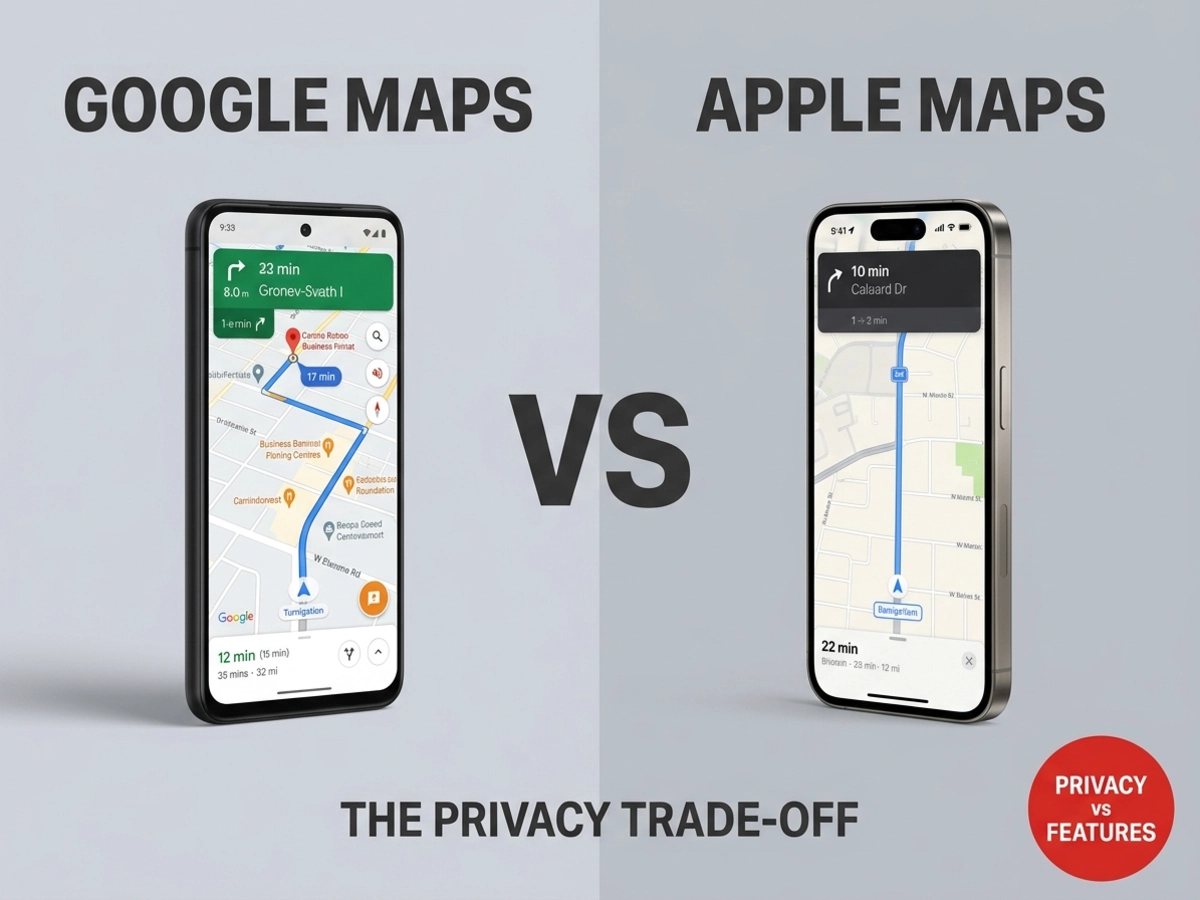
Google Maps and Apple Maps navigate equally well in 2025, but they are built on opposing architectures. Google's features exist because of data collection. Apple's privacy protections exist because data collection is structurally prevented. That is not a policy difference you can bridge through settings. The choice comes down to how you actually navigate: if your daily use involves discovery, exploration, or cross-platform access, Google's data advantage translates into genuine utility. If it involves legally sensitive destinations, routine commutes, or a preference for data that simply does not exist on any server, Apple's architecture provides protection no amount of Google configuration can replicate.
For most of the past decade, the choice between Google Maps and Apple Maps resolved itself through performance. Google's data advantage translated into better routing, more accurate ETAs, and richer business information. Apple Maps had gaps. The choice had an obvious answer.
That answer is no longer obvious. In 2025, both apps route reliably, provide comparable arrival time estimates, and cover similar ground in most major cities and internationally. After comparing both apps on their core function, route quality and traffic handling, the difference has narrowed to the point where navigation accuracy should not determine which app you use. Something else should.
That something else is architecture, specifically how each company has built its system to handle the location data your phone generates every time you open a map. And here is where the two apps diverge sharply, not in execution quality, but in fundamental design intent.
Google Maps reached 2 billion monthly users in late 2024, a milestone Alphabet CEO Sundar Pichai confirmed at the company's Q3 earnings call. It runs on Android, iOS, and web browsers. Android holds roughly 72% of the global smartphone market, which means Google benefits from a data contribution base that is structurally unmatched. Apple Maps, by contrast, exists only within Apple's device ecosystem. It cannot follow you across platforms, and that limitation is not an accident. It is a design choice consistent with an architecture that prioritizes restricting data collection over maximizing data utility.
The accuracy parity means you are not choosing between good directions and great ones. You are choosing between two different relationships with your own location data, and the consequences of that choice depend entirely on how you move through the world.
The privacy difference between these two apps is commonly described as a matter of settings and policies. That framing undersells the actual distinction. Apple's privacy properties are not features a user can enable or configure. They are the result of infrastructure decisions that make certain types of data collection architecturally impossible.
Start with the most basic element. Apple states directly in its Maps privacy documentation that it does not collect personal data associated with Maps usage. Users are not required to sign in with an Apple Account for basic navigation functionality, which means there is no account to tie location behavior to by default. When users do sign in, features like Visited Places and Pinned Locations are protected with end-to-end encryption that Apple itself cannot decrypt.
Location data receives structural protection before it even leaves the device. Apple's privacy documentation describes a process called "fuzzing," in which the precise origin of a map search is automatically converted to a less-specific general area within 24 hours. This is not a privacy setting users can turn on. It is automatic and universal. The device's interaction identifiers also rotate multiple times per hour and are not linked to an Apple Account, preventing the construction of long-term behavioral profiles from navigation data.
The clearest evidence of this architecture comes from iOS 26, which introduced a feature called Preferred Routes. The feature learns commute patterns and proactively alerts users to delays on frequently traveled roads. It sounds like the kind of capability that requires cloud processing and behavioral profiling, but it does not. Apple's official announcement confirmed the feature uses on-device intelligence, and the in-app permission prompt users see when activating it removes any ambiguity: the prompt reads, "Preferred routes and predicted destinations are learned by and stored privately on your device. Only the apps you choose can access them. Preferred routes and predicted destinations are not associated with your Apple Account." That language does not come from a marketing page. It comes from the iOS permission dialog itself.
Apple's privacy protections are not replicable through Google Maps' privacy settings. A user who wants Apple-level data minimization cannot configure Google Maps to achieve it. The distinction is not about which company has stricter policies. It is about which company has built a system that physically cannot collect certain data in the first place. That structural difference is what the privacy trade-off is actually about.
Google's feature advantages over Apple Maps are not incidental to its data collection. They are the same thing expressed in two different ways. The data collection is how the features exist.
Google's 2 billion users collectively contribute more than 20 million pieces of information to Maps every day, a rate that exceeds 200 updates per second. Business hours change, new locations open, traffic incidents develop, and parking situations shift. That crowd-sourced intelligence is what makes Google Maps' business information more current than Apple's, especially outside major cities and in international destinations where Apple's contributor base is thinner.
The November 2025 Gemini integration extended this advantage into AI-powered navigation. In a direct integration with Maps, Gemini can now handle multi-step queries while driving, answer discovery questions conversationally, and provide landmark-based navigation that replaces distance-based cues with references to visible features along the route. According to Google's official announcement, the system draws on information from 250 million places in the Maps database, using Street View imagery to match landmarks to what a driver sees through the windshield. A follow-up November 2025 update added a "know before you go" tips section that surfaces insider venue information from user reviews, and an EV charger availability predictor that uses AI to estimate how many chargers will be free upon arrival.
Google made a significant privacy change in late 2023 that deserves honest assessment. Location History, the feature that powered the location database Google maintained in the cloud, was moved to on-device storage by default. This change, which finished rolling out in 2024, eliminated Google's ability to respond to geofence warrants for that data, because the data no longer sits on Google's servers. The default auto-delete period for Location History also dropped from 18 months to 3 months.
The 2023 change is a genuine improvement. But the picture is more complex than most coverage acknowledges. Google collects location data through signals beyond Location History, and those signals remain on Google's servers and remain subject to legal requests. The on-device change closes one specific legal exposure; it does not eliminate location data collection from Google's architecture. That distinction matters for users evaluating whether Google Maps' privacy commitments are sufficient for their specific circumstances.
Both Apple and Google added significant AI capabilities to their maps in 2025. The comparison between them is frequently framed as Apple catching up to Google's lead. That framing is not accurate, and the reason it is not accurate matters for how users should evaluate the trade-off.
Apple's contribution is Apple Intelligence-powered natural language search, available on iPhones with an A17 chip or newer. The feature, introduced with iOS 26, allows users to enter multi-component queries like "coffee shops near the park with outdoor seating" rather than single-keyword searches. 9to5Mac's hands-on testing confirmed that queries of this kind would have returned poor results in iOS 18, while iOS 26 with Apple Intelligence parsed the components accurately. The improvement is real and meaningful for Maps search usability.
Google's Gemini integration does something qualitatively different. It provides personalized recommendations based on what it knows about a user's preferences, answers contextual driving questions conversationally, and surfaces venue-specific insider information. The reason Gemini can do this and Apple Intelligence cannot is not that Google built better AI. It is that Gemini has access to behavioral data across 2 billion users and to individual user history from their Google Account. Apple Intelligence operates on-device with no equivalent data foundation.
The capability gap is not a development lag that will close as Apple improves its models. It is the direct consequence of Apple's privacy architecture. To provide the level of personalization that Gemini navigation offers, Apple would need to collect and process the behavioral data its system is specifically designed not to collect. The trade-off is structural: Apple chose privacy over AI capability, and that choice has permanent consequences. Users who want both Gemini-level personalized assistance and Apple's data minimization protections cannot have both from a single app. The architecture does not allow for it.
The privacy trade-off between these apps is not primarily about advertising preferences or abstract data philosophy, although those are legitimate concerns. For some users, it carries concrete legal and professional stakes.
Between 2016 and 2022, law enforcement served Google with more than 11,500 geofence warrants in a single year alone, requests for the location data of every device present in a defined area during a defined time window. These warrants were used to investigate a wide range of events, from crimes to protests to civil activities that intersected with changing legal frameworks. Google's 2023 policy change ended its ability to fulfill new geofence warrants for Location History data. That is a real and significant protection.
The limitation of that protection is also real. Accountable Tech and EPIC documented that, in approximately half of experiments testing Google's 2022 privacy commitment regarding sensitive location categories, Google still retained data revealing visits to abortion clinics. That research preceded the 2023 on-device change. But the concern it documents is not addressed by that change: Google still collects location signals through mechanisms other than Location History, and those signals remain accessible to legal requests. The on-device change closes one specific exposure; it does not close the gap between Google's privacy commitments and their implementation that warrants attention from users who depend on location privacy for safety or professional reasons.
Apple's architecture does not have this vulnerability because it does not collect the data. There is nothing on Apple's servers to subpoena for Maps navigation data. That is not a policy claim. It is a consequence of how the system is built.
Beyond legal considerations, Apple Maps is the clearer choice for anyone with advertising objections to their movement patterns informing targeted profiles, anyone operating in a professional context where visited locations carry confidentiality implications, and anyone who simply prefers the certainty of knowing the data does not exist rather than the uncertainty of knowing it is protected by policies that could change.
For users embedded in Apple's ecosystem, the integration benefits reinforce the architecture advantages. Apple Maps connects natively with Siri, Apple Watch, and CarPlay, and the interface itself is designed for driving usability, with controls positioned at the bottom of the screen and turn instructions delivered in landmark terms rather than distance measurements.
Google Maps' advantages are genuine and, in specific use cases, they are not easily substituted.
In unfamiliar cities and international destinations, Google's contributor base produces more current business information, more recent photos, and more up-to-date operational details than Apple Maps. The gap is most pronounced outside major markets, where Apple's smaller update volume leads to staler business listings and less reliable hours. For travelers or anyone regularly navigating new places, this difference has practical daily consequences.
Discovery use cases favor Google strongly. Gemini's ability to answer natural language discovery queries conversationally and surface insider tips from user reviews changes the navigation experience from route-finding into local guidance. This capability has no equivalent in Apple Maps at any level of configuration.
For electric vehicle drivers, Google's charger availability prediction provides a practical advantage that requires exactly the kind of aggregate usage data Apple cannot collect. Estimating how many charging bays will be free upon arrival requires pooling real-time and historical occupancy data from thousands of drivers. Apple's architecture cannot support that feature without changing its privacy model.
Cross-platform users who move between Android devices, iPhones, tablets, and web browsers have no equivalent option in Apple's ecosystem. Apple Maps is Apple-device exclusive, and for users who share locations with people on different platforms or need consistent map access across devices, Google Maps is the only viable choice. It is worth noting that iOS 26.3 introduced new interoperability between iPhone and Android and third-party devices, which may shift how some users weigh this limitation going forward as Apple's ecosystem becomes less isolated.
Google's feature advantage concentrates almost entirely in discovery and exploration contexts. The gap is significant when searching for something new in an unfamiliar place, when needing EV charging information, or when wanting AI-assisted venue recommendations. It is nearly invisible when navigating a familiar commute or driving to a known destination. The privacy cost, however, accrues in both scenarios.
According to Loopex Digital, 67% of smartphone users prefer Google Maps as their navigation app of choice, a figure that reflects both the platform's cross-device availability and the depth of its discovery features. That preference is rational for users whose navigation behavior leans toward exploration. For users whose behavior leans toward routine, the calculus looks different.
For most people, this decision comes down to a single clarifying question: does your navigation behavior regularly involve discovery?
If the majority of your maps usage consists of familiar routes, commutes between known points, and occasional navigation to specific destinations you have already identified, both apps serve that use case essentially identically. The Preferred Routes and commute alert features in iOS 26 mean Apple Maps now handles proactive commute intelligence on-device. The feature gap in this scenario is minimal, and the privacy cost of choosing Google Maps is real while the feature benefit is largely theoretical.
If your navigation regularly involves searching for places you have not decided on yet, exploring unfamiliar neighborhoods, traveling internationally, or relying on AI-assisted recommendations, Google's advantages are genuine and frequent. The privacy cost becomes a deliberate trade you are making for practical utility you actually use.
If your navigation involves locations that carry legal, professional, or personal sensitivity, Apple's architecture provides protection that Google's settings cannot replicate. This applies to healthcare visits in jurisdictions with uncertain legal frameworks, to professional activities where location confidentiality matters, and to political or religious activities in environments where surveillance is a concern. For these users, the feature differences are secondary to the structural protection Apple's architecture provides.
The honest summary is that neither app is universally better, and neither trade-off is universally right. Google Maps delivers more feature richness, and it delivers that richness through data aggregation that is built into how the product works. Apple Maps delivers stronger privacy protection, and that protection comes with genuine constraints on what the app can offer. The choice is not about which company to trust. It is about which set of consequences fits how you actually use navigation in your daily life.
Can I make Google Maps as private as Apple Maps by adjusting settings?
No. Google Maps offers meaningful privacy controls, including Incognito mode, Location History deletion, and reduced data sharing options. But these controls operate on top of Google's data architecture; they do not change how the underlying system is built. Apple's privacy properties come from architectural decisions about what data the system collects in the first place. A user who turns off Location History in Google Maps still uses an app built on a data aggregation model. Apple Maps is built on a data minimization model. The two cannot be made equivalent through settings alone.
Does Apple Maps work as well as Google Maps for turn-by-turn navigation?
In most North American cities and major international destinations, yes. Route quality, ETA accuracy, and real-time traffic handling are comparable between both apps as of 2025. The most notable differences appear in business information currency (Google is more current, especially outside major markets), discovery features (Google's Gemini capabilities have no Apple equivalent), and international coverage depth in smaller cities. For basic navigation to known destinations, the performance difference is minimal.