Finished reading? Continue your journey in Dev with these hand-picked guides and tutorials.
Boost your workflow with our browser-based tools
Share your expertise with our readers. TrueSolvers accepts in-depth, independently researched articles on technology, AI, and software development from qualified contributors.
TrueSolvers is an independent technology publisher with a professional editorial team. Every article is independently researched, sourced from primary documentation, and cross-checked before publication.
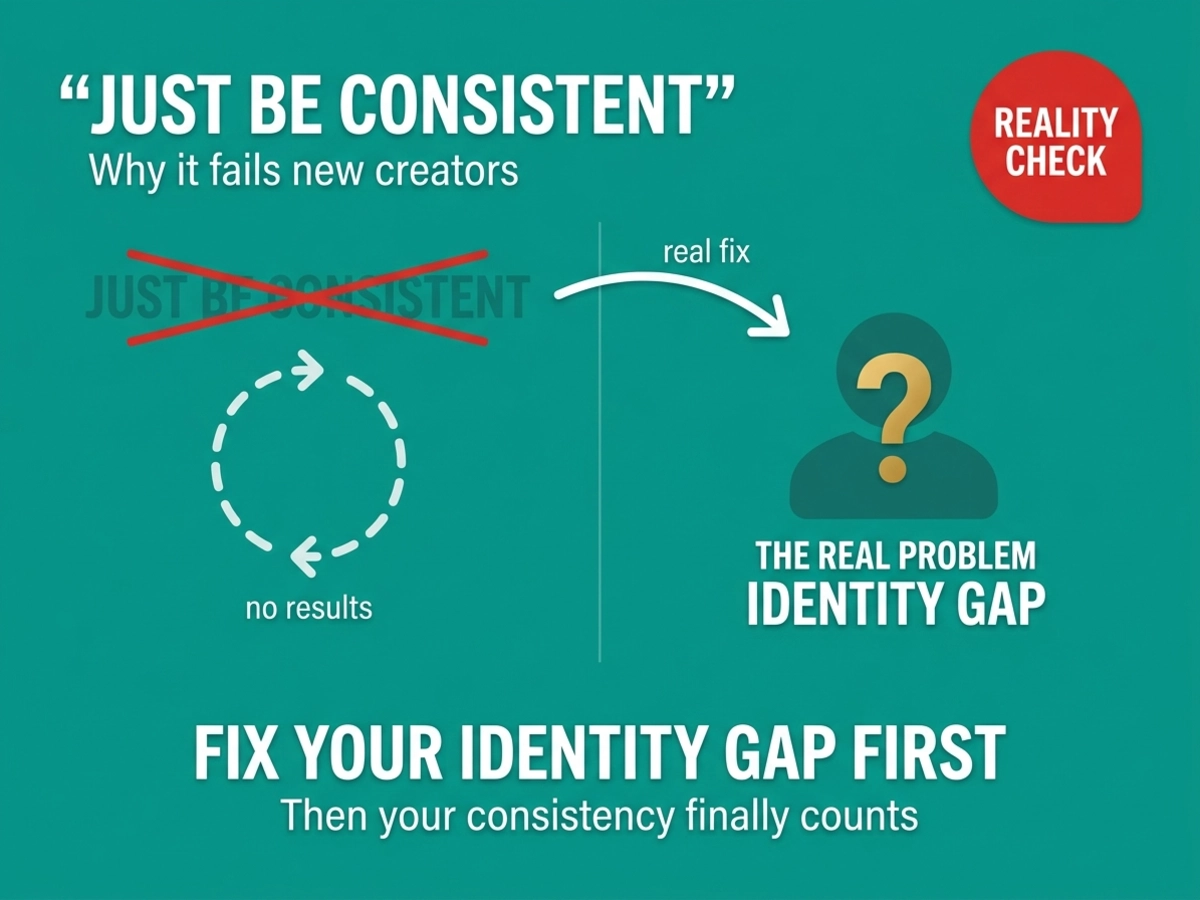
Most new creators waste months posting consistently with no results. The real problem isn’t their schedule it’s that search systems don’t recognize them as real people with real experience. Fix this identity gap first, and your consistency finally counts.
You post every week. You stay on topic. You write carefully. And after six months, your analytics show the same numbers they showed on day one.
The standard response is to post more, post better, post differently. But the problem usually isn't the content at all. It's that the search system doesn't know you exist.
Search engines don't rank activity. They rank recognized entities. Before any content can accumulate trust, the system needs to confirm that a real, verifiable person published it. Without that confirmation, every article you produce is treated as an anonymous document technically present, but attached to no one.
Creators who post consistently and still gain no traction are almost never missing a content insight, they're missing a technical one. They're adjusting headlines, posting frequency, and keyword research. Meanwhile, Google has no structured way to connect their name to their work, their work to their expertise, or their expertise to their subject area. Consistency in that situation isn't a strategy. It's repetition into a void.
The framework that governs how search quality raters evaluate content makes the gap explicit. In December 2022, Google updated its Search Quality Rater Guidelines to add a second "E" for Experience to the existing framework of Expertise, Authoritativeness, and Trustworthiness. The updated E-E-A-T standard now requires raters to look for evidence that the content creator has actually done what they're writing about not just studied it from a distance. A product reviewer who used the product is treated differently than someone who compiled specs from manufacturer pages. An advisor who has navigated the process they're explaining carries different weight than someone who synthesized articles about it.
None of those four pillars start with "shows up regularly." They start with proof that you are a real person who has genuinely engaged with your subject. Consistency only compounds after that proof exists.
Before Google can route trust to your content, it needs a technical anchor for your identity. That anchor is built through structured data, and it matters more at the start of a creator's journey than at any other point.
Google's ProfilePage markup documentation describes the schema as built for "any site where creators share first-hand perspectives" and states explicitly that it exists to help Google understand the creators posting in an online community. This is the mechanism by which a creator stops being a byline and starts being an entity in Google's system.
The practical setup is straightforward but requires precision. A Person or Organization schema block belongs on your About page or homepage. Every article page should reference the same author entity using a consistent @id value a stable URL that identifies the same person across all your published work. If your byline reads "Jane Doe" but your structured data uses "J. Doe," the system sees a mismatch, not a confirmation.
The sameAs property in structured data extends your entity beyond your own site by linking it to recognized external sources. Wikipedia entries, Wikidata entries, and your Google Knowledge Graph ID are all valid connection points. Social media profiles are not Google deprecated sameAs for social URLs, so those connections should come through other visibility channels, not structured data.
Most new creators publish for months, then add structured data as an afterthought. The earlier content continues floating unattributed because the entity anchor wasn't present when Google first encountered it. Setting up Person or Organization schema before publishing substantially increases the probability that content accumulates toward an entity from the first post, rather than starting as an anonymous collection that needs to be retroactively connected. The sequence matters.
Consistency across every platform compounds this foundation. The bio on your LinkedIn page, the description on your YouTube channel, the author box on your blog when all three describe the same person with the same expertise claim and the same name, the verification task becomes easier for the systems evaluating you. When they differ, those signals introduce friction rather than clarity.
Understanding that E-E-A-T exists is not the same as satisfying it. The Experience standard is the most commonly misunderstood requirement, and it's the one that most new creator content fails before any other factor is assessed.
The test is concrete: would this content require first-hand involvement to produce? A listicle of marketing tactics that any generalist could assemble from public sources fails this test. A process walkthrough backed by a real project, with specific decisions documented and specific outcomes noted, does not. The difference isn't writing quality. It's evidence that the author lived the problem they're solving. Research into the engagement collapse pattern behind surface-level content shows why this matters beyond SEO: content that mimics depth without demonstrating it tends to lose audience retention even when it initially earns clicks.
Original assets are the mechanism for meeting this standard. These are pieces of work that only someone with direct experience could create: a comparison table built from first-hand testing, a dataset from your own clients or customers, a case study documenting a process you ran, a tool or template you built because you needed it and nothing existing worked. These assets carry a signal that paraphrased summaries simply cannot generate.
Original assets serve two functions simultaneously, and most advice on this topic only accounts for one of them. They satisfy the Experience standard that human quality raters are trained to evaluate. And they resist AI summarization in a way that generic, explanatory content cannot. An AI Overview can summarize the concept of content marketing in seconds. It cannot reproduce your anonymized client data or replicate the interactive calculator you built from your own process. That structural resistance is not incidental to the asset's value. It is part of its authority function.
The compounding effect is real and measurable. A single piece of original research can generate citations from other publishers and surface in AI-generated summaries for years after publication. Even modest first-party data a survey of your own audience, a compiled dataset from your testing positions your site as a primary source rather than a secondary one. Third-party mentions, even without backlinks, reinforce your entity signals in Google's system. The goal of publishing original work is not just to satisfy a quality rubric. It's to become the kind of source that other people quote.
This reframes what it means to earn authority through consistency. Thirty posts that could have been written by anyone compounds to nothing. One post with a genuine original asset starts a compounding chain.
The arrival of AI Overviews at scale has made the identity and originality gap more consequential, not less. The effect is not a uniform shift in how organic traffic behaves. It's a bifurcation.
According to Semrush's study of over 10 million keywords, AI Overview prevalence grew rapidly through early and mid-2025, peaking near 25% of all queries before settling to approximately 16% by late in the year. As that coverage expanded, featured snippets declined substantially in co-occurrence with AI Overview results, from roughly 34% co-occurrence in early 2025 to 18% by November, suggesting Google views the two features as competing for the same position.
For new, unverified creators, the practical consequence is severe. Their content is not being cited in AI-generated summaries. It sits below the fold, behind a summary that already answered the question. The click goes nowhere.
For recognized entities with strong authority signals, the picture is different. Seer Interactive tracked 3,119 informational queries across 42 organizations and found that organic CTR dropped from 1.76% to 0.61% on AI Overview SERPs overall. But when a brand was cited within the AI Overview itself, organic CTR climbed rather than fell. Paid CTR for cited brands increased as well. Being named in the summary generates traffic; being absent from it accelerates invisibility.
The bifurcation is directionally durable, though causality is not clean: brands that earn AIO citations may already carry authority signals that independently boost CTR. What the data does show consistently is that entity establishment and original content are the two inputs most correlated with citation eligibility. Creators who close the identity gap before the market consolidates around established voices are better positioned than those who wait for rankings to motivate action.
Rankings are a lagging indicator. By the time they move meaningfully, the authority signals that drive them have already been accumulating for months. There is an earlier, more actionable signal available, and it exists in Search Console.
Branded search growth measures something different from keyword rankings. It shows whether an audience is beginning to associate your name with your subject area. A new creator with no traffic can still see branded queries in their data even a small number represents real humans typing their name into a search engine. That is entity formation in its earliest measurable stage.
In November 2025, Google launched an official branded queries filter in Search Console that uses an AI-assisted classification system to automatically separate branded from non-branded queries. It covers name variations and common misspellings and does not require any manual configuration or regex patterns. The filter shows clicks, impressions, CTR, and position broken out by branded versus non-branded queries, giving creators a clean read on whether their identity investment is producing recognizable associations.
Rising branded query volume is the earliest confirmation that the structured data, platform consistency, and original content work is connecting. It does not require high traffic volume. It requires only that some portion of an audience is beginning to search for you specifically rather than for a topic generally.
Two caveats are worth noting. The filter is only available for sites with sufficient query volume to classify, so the earliest weeks of a new site may not produce data. And AI Overview prevalence shifts frequently the exact figures above will have moved by the time you read this. The directional finding, however, is durable: entities with recognizable identities and original, citable content are the ones that survive and benefit from AI-assisted search. Ones without those signals get displaced by it.
Build the identity layer first. Publish proof of experience second. Let consistency do its job third. In that order, it works.
How long does it take for structured data to affect how Google perceives my site?
There is no fixed timeline. Google can process and index structured data within days of implementation, but the entity formation process Google connecting your schema to your published work and to external mentions typically develops over weeks to months. Sites that implement structured data before publishing any content tend to build that connection faster than those who add it retroactively.
What qualifies as an "original asset" if I haven't run formal research?
Formal research is not the threshold. An original asset is any piece of work that required your direct involvement to produce: a checklist built from your actual process, a comparison table from your own testing, a documented case study from a real project (even with anonymized details), or a framework you developed and applied. The test is whether someone who hadn't done the work could have produced the same thing from public sources alone. If the answer is no, it qualifies.
Does every article need an original asset, or just some of them?
The strongest impact comes from anchoring your highest-priority content your core pillar pages and most competitive topic pages with original assets. Supporting content can function without them. The goal is to ensure that the content most closely tied to your authority claim contains evidence that you have genuinely engaged with the subject, not that every post makes that case from scratch.
Can I build entity signals without a standalone website?
Structured data requires a site you control, so a standalone website is the most direct path. That said, consistent presence on platforms that carry their own authority weight a well-maintained LinkedIn profile, a Google Business Profile, contributions to recognized publications contributes to entity formation even before a personal site is fully established. The website remains the recommended primary entity home because it is the only environment where you fully control the structured data.