|
|
|
|
Insights and perspectives on technology, AI, software development, and industry trends from the TrueSolvers team
Apple released iOS 26.2 on December 12, 2025, patching two actively exploited WebKit vulnerabilities and a critical kernel flaw. But here's what most security advisories won't tell you: the moment Apple published those patch details, your iPhone entered its most dangerous window if you haven't updated yet. Security research shows 12% of vulnerabilities get exploited within 24 hours of patch disclosure, and 56% within the first week. The first 48 hours represent peak risk for unpatched devices.
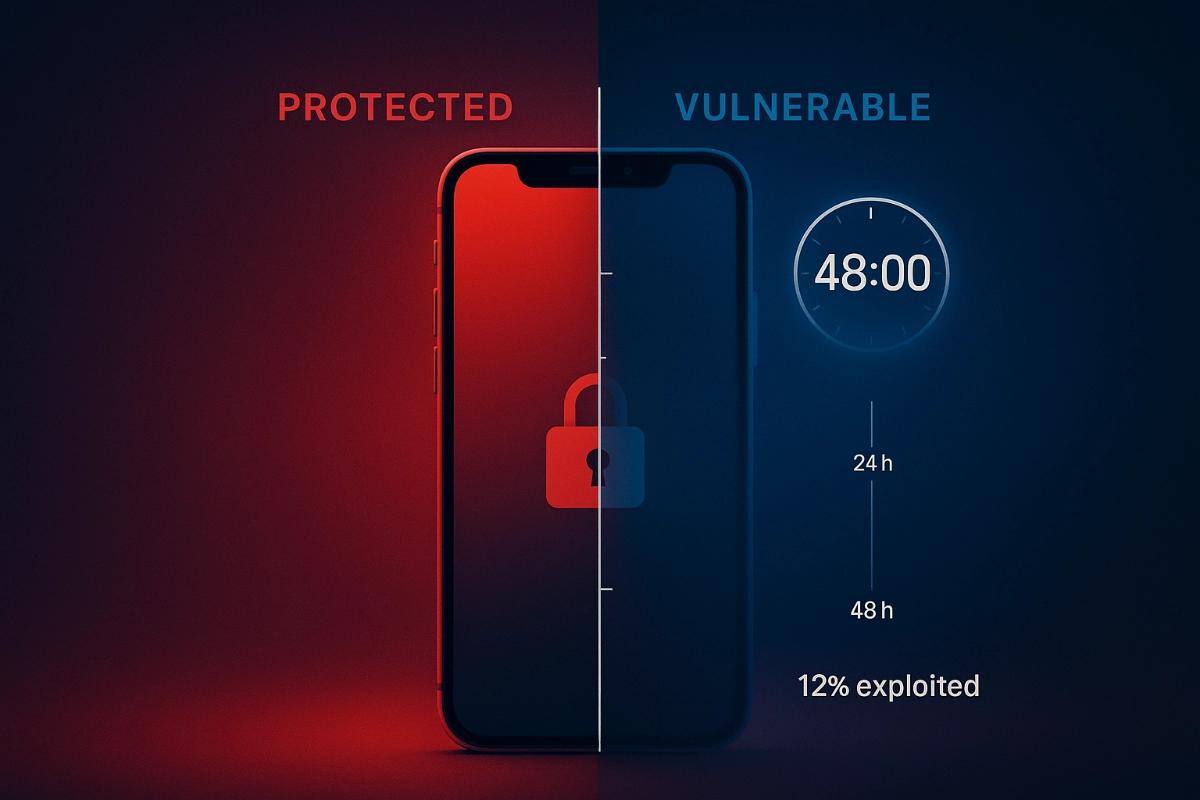
When Apple ships a security update, the company simultaneously publishes technical documentation explaining what was fixed. Those patch notes become an instruction manual for attackers. Skilled reverse engineers compare the patched code against vulnerable versions to identify exactly what changed. They're essentially reading Apple's homework to understand the weakness.
This creates a dangerous inversion. Before the patch, only sophisticated attackers who discovered the vulnerability independently could exploit it. After patch disclosure, anyone with reverse engineering skills can develop working exploits even if they never found the original flaw.
Security research from Mandiant tracked this timeline across 138 vulnerabilities disclosed in 2023. They found exploitation occurs most frequently within the first month of patch availability, with the first week representing the highest concentration of attacks. Twelve percent were exploited within one day. Twenty-nine percent within one week. Over half within one month.
The numbers tell a clear story: patch disclosure accelerates exploitation. Organizations typically need 38 to 150 days to fully deploy security updates across their infrastructure. Attackers weaponize those same vulnerabilities in hours or days. The gap between patch availability and widespread adoption creates a hunting ground.
Apple's December 12 security bulletin confirms attackers exploited two WebKit flaws in highly targeted campaigns before iOS 26. The update addresses 25 total vulnerabilities, but three demand immediate attention:
• CVE-2025-43529 (WebKit): A use-after-free vulnerability enabling arbitrary code execution when processing malicious web content. Google Threat Analysis Group discovered this flaw being exploited in sophisticated attacks against specific individuals.
• CVE-2025-14174 (WebKit): A memory corruption issue allowing attackers to corrupt device memory through crafted web content. Apple and Google TAG jointly identified this vulnerability. Notably, Google patched the same flaw in Chrome on December 10 two days before Apple's iOS release.
• CVE-2025-46285 (Kernel): An integer overflow vulnerability letting apps gain root privileges. Researchers from Alibaba Group discovered this flaw. Apple addressed it by adopting 64-bit timestamps, suggesting attackers could manipulate time-related system functions to escalate privileges.
Apple tested these fixes through developer beta releases before the final version. iOS 26 developer beta 2 release date was in late November 2025, when Apple first introduced the patches that would eventually appear in iOS 26.2. What's new in iOS 26 beta 2 included early versions of these WebKit and kernel vulnerability fixes, though the full security bulletin wasn't published until the public release. Developers who installed beta versions received protection weeks before the general public, highlighting the value of Apple's beta testing program for security-critical updates.
Root access represents total device compromise. An attacker with root privileges can bypass app sandboxes, read encrypted messages and authentication codes, hijack banking sessions, and install persistent surveillance tools. The kernel sits at the core of iOS exploiting it breaks through the fundamental security boundary protecting everything else.
Apple has now patched nine zero-day vulnerabilities exploited in the wild during 2025. This pattern shows consistent targeting of iOS devices by sophisticated threat actors throughout the year.
WebKit powers all web browsing on iOS. Not just Safari Chrome, Firefox, Edge, and every other browser app must use Apple's WebKit engine. This architectural decision means a single WebKit vulnerability affects every browser on your device.
That's fundamentally different from Windows or Android, where browsers run their own rendering engines. On those platforms, a Chrome vulnerability doesn't necessarily affect Firefox. On iOS, it affects everything.
Since 2023, Apple has disclosed 17 WebKit vulnerabilities that attackers exploited in the wild. Many tied to commercial spyware like Pegasus and Predator deployed by nation-state actors. These tools target journalists, dissidents, political figures, and researchers but the vulnerabilities themselves don't discriminate.
The two WebKit flaws in iOS 26.2 demonstrate typical attack patterns. CVE-2025-43529 enables arbitrary code execution, meaning attackers can run whatever malicious code they want on your device just by getting you to visit a compromised website. CVE-2025-14174 corrupts memory, which attackers often chain with other exploits to bypass security protections.
Apple describes these as exploited in "extremely sophisticated attacks against specific targeted individuals." That phrasing suggests commercial spyware operations tools that cost hundreds of thousands or millions of dollars. But here's the critical point: once exploit code exists, it spreads.
Patch disclosure triggers a predictable sequence. Security researchers and attackers both analyze the patch to understand the vulnerability. Whoever reverse engineers it first can develop working exploits before most users update.
Unit 42 researchers analyzed 45,450 public exploits and found 40% became available within the first week after patch release. That analysis only covers publicly available exploits many more exist in private markets and nation-state arsenals. The Microsoft Exchange ProxyLogon crisis in 2021 illustrated this dynamic perfectly. After Microsoft released emergency patches for four zero-days, more than a dozen threat groups began mass scanning and compromised tens of thousands of servers within hours.
From my assessment of time-to-exploit research spanning 2018 through 2023, a clear acceleration pattern emerges. The average time from disclosure to exploitation dropped from 63 days in 2018-2019 to 32 days in 2021-2022, then crashed to just 5 days in 2023. That's a 92% reduction in exploitation timeline over five years.
Automated tools and AI now accelerate exploit development further. Researchers have demonstrated that feeding vulnerable code and patch details into AI models can generate working exploits in a single evening. What once required weeks of expert analysis now happens in hours.
The acceleration of exploit development mirrors broader technology trends AI capabilities that seemed impossible just months ago now reshape entire workflows. Performance improvements that once felt incremental now unlock entirely new threat vectors, similar to how hardware advances enable capabilities that weren't previously feasible at scale.
The attack window follows a predictable escalation pattern. In the first 24-48 hours, the most sophisticated actors reverse engineer patches and develop initial exploits. Days 3-7 see broader exploitation as less sophisticated attackers gain access to proof-of-concept code. By week two, working exploits often circulate in criminal forums. Each passing day expands the pool of attackers capable of compromising unpatched devices.
Apple's notification to users in 80 countries about mercenary spyware attacks highlights a dangerous misconception. Most people assume highly targeted surveillance tools don't affect them. They're wrong about the timeline.
Commercial spyware operations initially deploy exploits against high-value targets the journalists, political figures, and researchers who warrant expensive, sophisticated attacks. These tools often cost hundreds of thousands of dollars per target. At this stage, ordinary users aren't in the crosshairs.
But exploit code doesn't stay exclusive. Once sophisticated actors develop working exploits, several things happen. First, security researchers eventually discover the same vulnerabilities through independent analysis or forensic examination of compromised devices. Second, exploit code leaks from commercial vendors or gets reverse engineered from captured malware samples. Third, nation-state actors sometimes share or sell exploit code to aligned groups.
Research tracking vulnerability exploitation found multiple disparate threat groups repeatedly leveraging the same vulnerabilities in independent campaigns. CVE-2018-15982 in Adobe Flash Player was exploited by Russia's APT28, North Korea's APT37, and financially motivated criminal groups all independently.
What begins as a million-dollar targeted capability eventually becomes a thousand-dollar criminal tool. The sophistication required drops as exploit code matures and documentation improves. Within months, what once required nation-state resources becomes accessible to organized cybercrime operations targeting ordinary users for financial gain.
The vulnerabilities Apple patched in iOS 26.2 were exploited in sophisticated attacks before iOS 26 meaning on older versions. Users who haven't updated from iOS 18 or earlier face not just the original targeted threat, but the expanded risk as those exploits proliferate through the threat landscape.
Through my review of patching timelines across multiple security research datasets, the risk multiplication becomes mathematically clear.
The vulnerability window operates in distinct phases, each with escalating danger:
Hours 0-24: Elite threat actors (nation-states, commercial spyware vendors) reverse engineer the patch. Risk limited to highest-value targets. Approximately 12% of exploitable vulnerabilities see weaponization in this window.
Days 2-7: Skilled attackers develop working exploits. Proof-of-concept code emerges in security research channels and underground forums. Exploitation jumps to 29% of all vulnerabilities that will eventually be weaponized more than doubling from day one.
Weeks 2-4: Exploit code matures and spreads broadly. Less sophisticated actors gain access. By one month, 56% of exploitable vulnerabilities have been weaponized representing the majority of all exploitation that will occur.
Months 2-6: Exploitation stabilizes but continues. By six months, 95% of vulnerabilities that will ever be exploited have been weaponized.
Every day you delay updating increases the probability an attacker targeting your device has access to working exploit code. It's not about whether a vulnerability is "actively exploited" it's about the predictable timeline from patch disclosure to broad availability of attack tools.
The research shows clear inflection points. If you update within 24 hours, you face only the most sophisticated, well-resourced attackers. If you update within a week, you avoid the second wave where exploitation becomes significantly more common. If you wait a month, you're vulnerable during the period when over half of all exploitation occurs.
Organizations struggle with this timeline because testing and deployment take time. But individual iPhone users don't have those constraints. You can update in minutes. The question becomes: why wouldn't you close the vulnerability window immediately when doing so takes less time than reading this article?
Updating iOS takes approximately 10-15 minutes depending on your internet connection. Here's how to protect your device immediately:
Connect to reliable WiFi and plug in your charger. iOS requires WiFi for downloads and won't install updates on a battery below 50% unless connected to power.
Go to Settings > General > Software Update. Your iPhone will check for available updates. You should see iOS 26.2 or iOS 18.7.3 (if you're staying on iOS 18).
Tap Download and Install. The update downloads first, then installs. Your phone will restart during installation don't interrupt this process.
Verify installation after restart. Go back to Settings > General > About. The "Software Version" line should show 26.2 or 18.7.3 with a build number.
If you previously enabled Background Security Improvements in iOS 26.1, your device may already have protection against these vulnerabilities. Check your version number if it shows iOS 26.1 with a recent build date, you received automatic security patches before iOS 26.2's official release. Update to iOS 26.2 anyway to ensure complete protection across all system components.
Users still running iOS 18 face a choice. iOS 26 includes enhanced anti-scam protections, improved emergency alerts, and security features not backported to iOS 18.7.3. However, iOS 18.7.3 patches the critical WebKit and kernel vulnerabilities addressed in this article. The minimum acceptable action is updating to iOS 18.7.3 immediately. The recommended action is upgrading to iOS 26.2 for comprehensive security improvements.
Don't delay this update to research it further or wait for "stability." The vulnerabilities Apple patched were already being exploited before this update. Every hour your device remains unpatched increases the pool of attackers capable of compromising it. Update now, then decide whether you need to adjust settings or explore new features later.
Share your expertise with our growing community. We accept in-depth articles on Tech, AI, Dev, and Sports.
Get Started