|
|
|
|
Insights and perspectives on technology, AI, software development, and industry trends from the TrueSolvers team
Jeff Bezos just returned to operational leadership for the first time since leaving Amazon, co-founding Project Prometheus with $6.2 billion in funding. Prometheus targets physical-world applications in aerospace and automotive, positioning itself in a fundamentally different competitive space than ChatGPT-style software companies because physical AI represents an entirely separate race with different rules, different challenges, and potentially larger long-term markets.
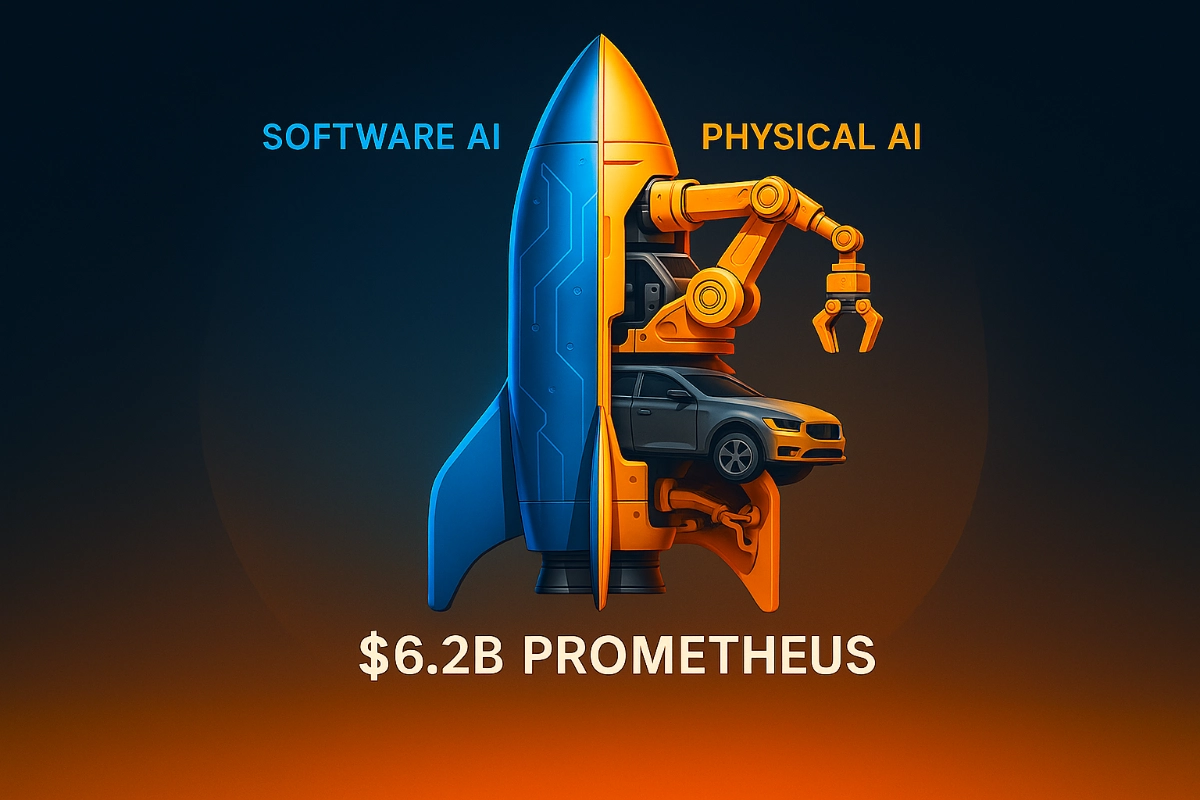
Six billion dollars sounds massive until you examine recent AI funding patterns. The sector raised over $100 billion in 2024 alone, up more than 80% from the previous year according to Crunchbase data. That represents nearly one-third of all global venture funding, making AI the most capital-intensive sector in tech investment history.
Prometheus sits in the middle of a funding spectrum that's become wildly polarized. OpenAI secured a $40 billion round at a $300 billion valuation from SoftBank. Databricks pulled in $10 billion in a single raise. Even companies without products are commanding billions: Thinking Machines Lab raised $2 billion at a $10 billion valuation in July 2025 without announcing any product, while Safe Superintelligence raised $2 billion at a $30 billion valuation earlier in the year also without revenues or products.
The concentration has intensified dramatically in 2025. Just 13 AI companies raised $47 billion, representing 44% of all AI funding that year. Six companies raised billion-dollar rounds in both 2024 and 2025: OpenAI, xAI, Scale AI, Anthropic, Anduril Industries, and Safe Superintelligence. These patterns reveal that investors are betting on proven teams and established players rather than distributing capital broadly across the ecosystem.
Prometheus enters this environment with enough runway to operate for years without revenue pressure, but not so much capital that it can simply outspend competitors. The real question isn't whether $6.2 billion is big it's whether the company's approach justifies that investment in a market where capital alone no longer guarantees success.
The fundamental distinction between Prometheus and companies like OpenAI or Anthropic lies in what they're teaching AI to do. Language models learn by analyzing enormous text datasets scraped from the internet. By identifying patterns in Wikipedia articles, academic papers, and online content, these systems learn to generate human-like text, write code, and solve math problems.
Physical AI requires an entirely different approach. These systems must perceive three-dimensional environments through sensors and cameras, reason about physics constraints like gravity and friction, understand spatial relationships in real-time, and execute precise physical actions. You can't train a robot to assemble spacecraft components by feeding it text from the internet it needs to learn from actual physical interactions, failed attempts, and successful manipulations.
According to the World Economic Forum's white paper on Physical AI, traditional industrial robots have operated on rule-based programming since the 1960s. They excel at fixed, repetitive tasks in controlled settings but require explicit programming for every movement. The new generation uses training-based approaches where AI systems learn from simulated or real-world experiences, allowing them to handle variation rather than just repetition.
This matters because language models have largely exhausted publicly available digital training data. Physical AI generates its own proprietary training data through real-world interaction, solving the data scarcity problem that's becoming a bottleneck for text-based models. When a robot runs 10,000 experiments in an autonomous lab, those results become unique training data that no competitor can replicate by scraping websites.
The market recognizes this shift. Physical AI was valued at $3.78 billion in 2024 and is projected to reach $67.91 billion by 2034 at a compound annual growth rate of 33.49%, according to market research from Cervicorn Consulting. Over 70% of global manufacturers plan to boost robotics and AI automation investments to address labor shortages and improve efficiency.
The co-CEO structure tells you something about Prometheus' ambitions. Bezos brings operational scaling expertise and direct access to manufacturing infrastructure through Blue Origin, his aerospace company. This marks his first formal operational role since stepping down as Amazon CEO in July 2021, signaling serious commitment rather than passive investment.
Vik Bajaj's background is particularly revealing. He holds a Ph.D. in physical chemistry from MIT and has spent his career bridging AI with physical sciences. As Chief Scientific Officer at GRAIL, he led cancer detection efforts using genomics and data science. He co-founded Verily (formerly Google Life Sciences) and served as Chief Scientific Officer there. At Google X, he worked directly with Sergey Brin on moonshot projects that eventually became Waymo (self-driving cars) and Wing (drone delivery) both requiring AI to interact successfully with the physical world.
That combination of chemistry expertise, life sciences commercialization, and autonomous systems experience is rare. Most AI founders come from pure computer science backgrounds. Bajaj has demonstrated he can take ambitious technology from research through regulatory hurdles to actual deployment across multiple domains. His experience with Waymo and Wing is directly relevant to Prometheus' challenge: building AI that works reliably in uncontrolled physical environments.
Through my evaluation of the leadership composition, the pairing suggests Prometheus plans to attack industrial applications requiring both AI breakthroughs and manufacturing execution not pure research projects. Bajaj handles the scientific and regulatory complexity while Bezos provides scaling infrastructure and capital access. That's fundamentally different from academic-minded founders who excel at publishing papers but struggle with commercialization.
The company has already recruited nearly 100 employees including researchers from OpenAI, DeepMind, and Meta. That headcount suggests they're building both foundational models and deployment capabilities simultaneously rather than focusing on one layer of the technology stack.
Prometheus doesn't exist in isolation. Several well-funded competitors are attacking different aspects of physical AI, and understanding their strategies reveals the market's complexity.
Physical Intelligence raised $400 million at a $2.4 billion valuation from Bezos, OpenAI, Thrive Capital, and others in November 2024. The San Francisco startup focuses on building foundation models for general-purpose robotics software that can control any robot to perform any task users request. They spent eight months developing π0 (pi-zero), their first general-purpose model, demonstrating capabilities like doing laundry, bussing tables, and assembling boxes. Their vision closely mirrors how language models work: users simply ask robots to perform tasks, and the AI figures out the execution.
Periodic Labs emerged from stealth with $300 million in seed funding from Andreessen Horowitz, DST, Nvidia, and Bezos in September 2025. Founded by Ekin Dogus Cubuk (who led materials and chemistry research at Google Brain and DeepMind) and Liam Fedus (former OpenAI VP of Research and ChatGPT co-creator), the company plans to build autonomous laboratories where robots conduct physical experiments at enormous scale. Their first goal involves inventing new superconductor materials. Cubuk's prior work on GNoME discovered over 2 million new crystals in 2023, proving AI can accelerate scientific discovery when given proper experimental infrastructure.
These companies represent different strategic bets. Physical Intelligence builds horizontal platforms foundation models that work across robot types. Periodic Labs creates vertical solutions AI specifically for scientific experimentation and materials discovery. Prometheus appears positioned somewhere between, targeting specific industries (aerospace, automotive, computing) but potentially building reusable capabilities across those domains.
The robotics sector overall raised $6.4 billion through November 2024, projected to reach approximately $7.5 billion for the full year according to Crunchbase analysis. That's below the 2021 peak of $14.7 billion but shows sustained investor interest. Bezos personally invested across this ecosystem: co-leading Skild AI's $300 million Series A, participating in Figure's $675 million round at roughly $2 billion pre-money valuation, and backing companies like Swiss-Mile and Rethink Robotics. This portfolio reveals a coordinated strategy rather than scattered angel investments.
While startups chase specific applications, established tech companies are providing enabling infrastructure that everyone needs. NVIDIA CEO Jensen Huang described physical AI as "transforming the world's factories into intelligent thinking machines the engines of a new industrial revolution." The company built a three-platform architecture specifically for physical AI development.
DGX AI supercomputers handle the training phase, allowing companies to develop models using massive computational power. Omniverse creates digital twins for simulation, enabling robots to practice millions of scenarios virtually before touching real hardware. Jetson AGX Thor modules provide on-robot inference, running trained models directly on physical devices with appropriate power and latency constraints.
Major manufacturers are already adopting these tools at scale. Foxconn is using Omniverse to design, simulate, and optimize its 242,287-square-foot Houston facility for manufacturing NVIDIA AI infrastructure. Figure AI leverages the Isaac platform for simulation and training to build humanoid robot fleets capable of handling tasks from household chores to industrial support. Amazon Robotics and Agility Robotics (with their Digit humanoid) are deploying AI-powered systems in logistics operations.
This infrastructure layer matters because it dramatically reduces the barrier to entry for physical AI development. Companies don't need to build simulation engines or custom chips they can focus on applications and algorithms while leveraging established platforms. However, it also means Prometheus won't enjoy proprietary infrastructure advantages that could create defensible moats. Everyone has access to the same foundational tools.
Massive funding helps, but physical AI faces constraints that software companies never encounter. Unlike software where iteration happens in hours and distribution is instant, physical AI requires expensive hardware, real-world testing facilities, and extended development cycles.
Manufacturing costs for humanoid robots dropped 40% between 2023 and 2024 due to cheaper sensors, actuators, and improved production methods, according to Deloitte's industry analysis. That cost reduction enables broader deployment, but robots still require capital expenditure that software doesn't. Periodic Labs is building autonomous laboratories where robots run experiments capital-intensive infrastructure that takes months to construct and validate.
Safety and regulatory compliance become critical when AI systems interact with the physical world rather than just generating text. Aerospace manufacturing, one of Prometheus' target sectors, demands extreme precision and rigorous certification. A language model that makes a mistake produces incorrect text. A robot that drops a spacecraft component or assembles something incorrectly can cause catastrophic failures. The World Economic Forum reports that 80% of manufacturing firms experienced cyber incidents in 2024, introducing security concerns absent from pure software applications.
From my assessment of the deployment timeline differences, physical AI companies face 3-5 year development cycles before meaningful revenue because they must validate safety, achieve regulatory approval, integrate with existing manufacturing systems, and demonstrate reliability across thousands of operational hours. Software AI companies can launch products in months and iterate weekly based on user feedback. That fundamental difference in speed affects everything from investor expectations to competitive dynamics.
The competitive moats differ entirely. Software models compete on benchmark performance, API response times, and cost per token. Physical AI competes on reliability in unstructured environments, safety certifications, integration complexity with legacy systems, and total cost of ownership including hardware maintenance. A brilliant algorithm that achieves 99% accuracy fails in production if that 1% error rate translates to damaged products or safety incidents.
Prometheus' focus on aerospace represents both opportunity and challenge. Success in aerospace would demonstrate capabilities under the most demanding conditions, potentially validating approaches for less-critical applications. But aerospace's regulatory environment and safety requirements mean longer paths to deployment and revenue than consumer robotics or warehouse automation.
The timing of Prometheus' announcement reveals strategic thinking about market maturity. Three forces are converging according to Deloitte's analysis: rapid AI model advances, falling hardware costs, and deepening labor shortages. That convergence creates conditions where physical AI becomes economically viable rather than just technically possible.
In 2025, $1.2 trillion in investments toward building U.S. production capacity was announced, led by electronics providers, pharmaceutical companies, and semiconductor manufacturers according to NVIDIA. That represents demand for automation solutions that can handle mid-volume production with variation exactly what traditional fixed-automation robots can't address but physical AI can.
The global robotics market is forecast to reach $392 billion by 2033, with the humanoid robot subset hitting $38 billion by 2035. Collaborative robots (cobots) designed to work alongside humans rather than replace them are projected to grow at over 20% annually through 2034. These figures suggest physical AI is transitioning from research curiosity to industrial necessity.
However, first-mover advantages matter less in physical AI than software because deployment requires partnerships with manufacturers who move cautiously. Validation cycles are measured in years, not months. Being too early means burning capital on technology before customers are ready to adopt. Being too late means competitors establish the integrations, certifications, and customer relationships that create switching costs.
Prometheus arrives with competitors like Physical Intelligence and Periodic Labs holding 1-2 year head starts. But those companies are still pre-revenue and pre-deployment at meaningful scale. The race is long enough that $6.2 billion in funding provides runway to catch up if the team executes effectively. The question isn't about timing advantage but rather execution quality over the next 3-5 years.
If you're evaluating whether Prometheus matters competitively: Focus on the physical AI differentiation rather than funding size alone. The company competes with Physical Intelligence, Periodic Labs, and manufacturing-focused startups not OpenAI or Anthropic because physical AI requires different architectures, training data, and deployment capabilities than language models. Success depends on execution over 3-5 years, not just capital availability.
If you're an investor assessing the AI landscape: Physical AI represents a parallel opportunity to software AI, with the global market projected to grow from $3.78 billion in 2024 to $67.91 billion by 2034 at a 33.49% compound annual growth rate. However, longer development cycles, capital-intensive infrastructure requirements, and regulatory complexity mean physical AI investments carry different risk profiles than software models with faster iteration and deployment.
If you're tracking Bezos' strategic positioning: His portfolio across Physical Intelligence ($400 million investment), Skild AI (co-led $300 million Series A), Figure ($675 million round participation), Periodic Labs ($300 million seed participation), and now Prometheus ($6.2 billion co-founding) reveals coordinated strategy rather than scattered bets. He's building ecosystem position in physical AI across scientific discovery, general-purpose robotics, and industrial manufacturing applications aligned with Blue Origin's aerospace needs.
If you're wondering about market timing: The convergence of AI model advances, 40% manufacturing cost reduction for humanoid robots between 2023-2024, and over 70% of manufacturers planning increased automation investments creates favorable conditions. But physical AI faces 3-5 year deployment cycles for safety validation and regulatory approval, meaning revenue realization lags software AI significantly regardless of funding levels.
If you're comparing funding rounds across AI startups: Context matters more than headline numbers. OpenAI's $40 billion at $300 billion valuation, Thinking Machines Lab's $2 billion seed with no announced product, and Prometheus' $6.2 billion all reflect different stages and strategies. AI funding in 2024-2025 concentrated heavily in proven teams: just 13 companies captured 44% of all AI funding in 2025, indicating investors bet on pedigree over novel approaches.
Share your expertise with our growing community. We accept in-depth articles on Tech, AI, Dev, Business, Crypto, Health, LifeStyle, and Sports.
Get Started